Learning English can be confusing because some words look plural but actually behave as singular words.
Everyone Is vs Everyone Are
This question appears simple, but it causes mistakes in speaking, writing, school exams, and even workplace communication.
Since everyone refers to many people, learners often think it should always be followed by are. However, English grammar follows a different rule.
If you understand this rule, you will avoid one of the most common grammar mistakes made by English learners around the world.
You will also sound more natural when speaking and writing.
The good news is that the rule is easy to learn. Once you know why everyone is treated as a singular pronoun, choosing the correct verb becomes much easier.
Throughout this guide, you will learn what “everyone” means, why “everyone is” is correct, why “everyone are” is usually incorrect, common mistakes to avoid, grammar rules, and plenty of real-life examples.
By the end, you will feel much more confident using this expression in everyday English.
What Does “Everyone” Mean?
Everyone is an indefinite pronoun that means every person in a group. It talks about all the people together, but English grammar treats it as one whole group, not as many separate people.
Although everyone refers to many individuals, it always takes a singular verb.
Simple Definition
Everyone means:
- Every person
- All people together
- Each individual in a group
For example:
- Everyone enjoyed the movie.
- Everyone needs water.
- Everyone has a chance.
- Everyone Is vs Everyone Are
- Everyone loves a holiday.
- Everyone knows the answer.
- Everyone Is vs Everyone Are
- Everyone deserves respect.
In every sentence above, everyone represents many people, but the verb remains singular.
When Do We Use “Everyone”?
Everyone Is vs Everyone Are
Examples:
- Everyone is waiting outside.
- Everyone likes chocolate.
- Everyone has finished the test.
- Everyone feels tired after work.
- Everyone wants good health.
- Everyone enjoys weekends.
- Everyone Is vs Everyone Are
- Everyone appreciates kindness.
These sentences show that the speaker is referring to all the people together.
Grammar Rule
The most important rule is simple:
Everyone Is vs Everyone Are
That means it takes:
- is
- has
- does
- was
Examples:
✔ Everyone is happy.
✔ Everyone has arrived.
Everyone Is vs Everyone Are
✔ Everyone was surprised.
Notice that the verb is always singular.
Why Does This Confuse Learners?
Many students think like this:
“There are many people, so I should use are.”
This sounds logical, but English grammar does not work that way.
Everyone Is vs Everyone Are
Think of it this way:
- Everyone = one complete group
- Therefore = singular verb
That is why English speakers naturally say:
- Everyone is here.
- Everyone has a ticket.
- Everyone wants to win.
Not:
- Everyone are here.
- Everyone have a ticket.
More Example Sentences
Here are more examples that show the correct use of everyone.
- Everyone is smiling today.
- Everyone has a backpack.
- Everyone knows the rules.
- Everyone enjoys music.
- Everyone needs practice.
- Everyone Is vs Everyone Are
- Everyone likes a good story.
- Everyone feels welcome here.
Notice how every verb stays singular.
What Does “Is” and “Are” Mean?
Both is and are are forms of the verb to be. They describe a person’s condition, identity, location, or situation.
Choosing between is and are depends on whether the subject is singular or plural.
What Does “Is” Mean?
Is is the singular form of the verb to be.
Use is with:
- he
- she
- it
- everyone
- somebody
- nobody
- each
- anyone
- one person or thing
Examples:
- She is a teacher.
- He is at home.
- It is raining.
- Everyone is ready.
- Somebody is calling.
- Nobody is perfect.
- Each student is present.
- Anyone is welcome.
Grammar Rule for “Is”
Use is when the subject is singular.
Sentence pattern:
Singular Subject + is + Complement
Examples:
- My brother is kind.
- The cat is sleeping.
- Everyone is laughing.
- The baby is hungry.
- The weather is nice.
- This book is interesting.
- Each child is smiling.
- The train is late.
What Does “Are” Mean?
Are is the plural form of the verb to be.
Use it with:
- we
- you
- they
- plural nouns
Examples:
- They are playing football.
- We are friends.
- You are welcome.
- The students are studying.
- My parents are visiting.
- The flowers are beautiful.
- The dogs are barking.
- The children are excited.
Grammar Rule for “Are”
Sentence pattern:
Plural Subject + are + Complement
Examples:
- The teachers are busy.
- The books are on the table.
- We are happy.
- They are ready.
- My friends are waiting.
- Cars are expensive.
- The players are warming up.
- The birds are singing.
Why “Everyone Are” Sounds Wrong
Many learners mix up meaning with grammar.
Meaning:
- Everyone Is vs Everyone Are
Grammar:
- Everyone = singular pronoun
Because grammar controls the verb, we say:
✔ Everyone is excited.
Everyone Is vs Everyone Are
✔ Everyone is waiting.
Not:
✘ Everyone are excited.
✘ Everyone are welcome.
✘ Everyone are waiting.
Everyone Is vs Everyone Are
Why Is “Everyone Is” Correct?
This is one of the easiest grammar rules once you understand the reason.
The pronoun everyone belongs to a group called indefinite pronouns. Many indefinite pronouns are singular, even though they refer to more than one person.
Some singular indefinite pronouns include:
- Everyone Is vs Everyone Are
- Everybody
- Someone
- Somebody
- Anyone
- Anybody
- No one
- Nobody
- Each
- Either
- Neither
All of these take singular verbs.
Examples:
- Everybody is excited.
- Somebody is waiting outside.
- Nobody is perfect.
- Everyone Is vs Everyone Are
- No one is missing.
- Each student is ready.
- Either answer is acceptable.
- Neither option is correct.
Once you remember that everyone belongs to this group, choosing is becomes easy.
Quick Summary
Before moving on, remember these key points:
- Everyone Is vs Everyone Are
- It is an indefinite pronoun.
- It is grammatically singular.
- Singular subjects take is, has, does, and was.
- Everyone is is the correct form in standard English.
- Everyone Is vs Everyone Are
In the next part, we’ll look at the **detailed difference between “everyone is” and “everyone are,” comparison tables, grammar rules, common mistakes, memory tricks, and many real-life examples.
Difference Between Everyone Is and Everyone Are
Many English learners wonder why everyone is is correct while everyone are sounds wrong. The answer is simple: English grammar follows the subject, not the meaning.
Although everyone refers to many people, it is treated as one singular subject. That is why it takes the singular verb is.
Think of everyone as one complete group. The group contains many people, but grammar sees it as one unit.
Comparison Table
| Feature | Everyone Is | Everyone Are |
|---|---|---|
| Grammar | ✅ Correct | ❌ Incorrect in standard English |
| Subject | Singular | Singular (but paired with the wrong verb) |
| Verb | Singular (is) | Plural (are) |
| Used by native speakers | Yes | Rarely, except in some non-standard dialects |
| Suitable for school and exams | Yes | No |
| Suitable for formal writing | Yes | No |
Meaning Difference
Everyone Is vs Everyone Are
Examples:
- Everyone Is vs Everyone Are
- Everyone is wearing blue today.
- Everyone is ready for dinner.
- Everyone is smiling.
- Everyone is welcome here.
The phrase everyone are usually appears because learners think about the number of people instead of the grammar.
For example:
❌ Everyone are happy.
This sentence is incorrect because everyone is singular.
The correct sentence is:
✔ Everyone is happy.
Sentence Structure Difference
The correct sentence pattern is:
Everyone Is vs Everyone Are
Examples:
- Everyone is busy.
- Everyone is hungry.
- Everyone Is vs Everyone Are
You can also use:
Everyone + is + noun
Examples:
- Everyone is a winner.
- Everyone Is vs Everyone Are
- Everyone is a guest.
Or:
Everyone + is + verb (-ing)
Examples:
- Everyone is working.
- Everyone is laughing.
- Everyone is dancing.
- Everyone Is vs Everyone Are
Why English Uses a Singular Verb
English groups some words into singular indefinite pronouns.
These words include:
- Everyone Is vs Everyone Are
- everybody
- someone
- somebody
- anyone
- anybody
- nobody
- no one
- each
Even though these words may refer to many people, they always take singular verbs.
Compare these examples:
✔ Everyone is waiting.
✔ Everybody is laughing.
✔ Somebody is calling.
✔ Nobody is sleeping.
Each sentence follows the same grammar rule.
Compare with Plural Subjects
Everyone Is vs Everyone Are
Singular
- Everyone Is vs Everyone Are
- Everybody is excited.
- Each student is prepared.
Plural
- The students are ready.
- My friends are excited.
- The players are prepared.
The verb changes because the subject changes.
Which One Should You Use?
Everyone Is vs Everyone Are
Use it in:
- School assignments
- English exams
- Business emails
- Academic writing
- Everyday conversations
- Job interviews
- Professional documents
Avoid everyone are unless you are quoting someone or discussing non-standard dialects.
Grammar Rules You Must Remember
Everyone Is vs Everyone Are
Rule #1: Everyone Always Takes a Singular Verb
This is the most important rule.
Correct:
- Everyone is here.
- Everyone has finished.
- Everyone wants to help.
Incorrect:
- Everyone are here.
- Everyone have finished.
- Everyone want to help.
Always check the verb after everyone.
Rule #2: Match Every Verb with a Singular Subject
The rule does not apply only to is.
It also applies to other verbs.
Correct:
- Everyone has a ticket.
- Everyone does their work.
- Everyone enjoys music.
- Everyone knows the answer.
Incorrect:
- Everyone have a ticket.
- Everyone do their work.
- Everyone enjoy music.
- Everyone Is vs Everyone Are
Rule #3: Do Not Be Confused by the Meaning
Many learners think:
“There are many people.”
That idea is true.
But grammar asks:
“What is the subject?”
The subject is everyone, and everyone is singular.
Examples:
✔ Everyone is laughing.
✔ Everyone has arrived.
✔ Everyone wants dessert.
Rule #4: Pronouns Can Be Plural Even When the Verb Is Singular
Everyone Is vs Everyone Are
Examples:
- Everyone is doing their best.
- Everyone should bring their ID.
- Everyone Is vs Everyone Are
- Everyone can choose their seat.
Notice that the verb remains singular.
This is completely normal in modern English.
Common Mistakes Students Make
Understanding these mistakes makes them easier to avoid.
Mistake 1: Using “Are” After Everyone
Wrong:
❌ Everyone are waiting.
Correct:
✔ Everyone is waiting.
Why?
Because everyone is singular.
Mistake 2: Using Plural Verbs
Wrong:
❌ Everyone have finished.
Correct:
✔ Everyone has finished.
Remember:
Singular subjects need singular verbs.
Mistake 3: Thinking About the People Instead of the Grammar
Students often imagine many people together.
That makes them choose are.
Instead, focus on the subject word.
Everyone Is vs Everyone Are
Example:
✔ Everyone is excited.
Not:
❌ Everyone are excited.
Mistake 4: Mixing Up “Everyone” and “All”
These words are similar, but they do not follow the same grammar.
Correct:
- Everyone is smiling.
- All the students are smiling.
Correct:
- Everyone is ready.
- All of us are ready.
The subject changes, so the verb changes too.
Mistake 5: Forgetting the Rule While Speaking
Some learners know the rule but speak too quickly.
Practice saying these sentences aloud:
- Everyone is welcome.
- Everyone is happy.
- Everyone is ready.
- Everyone Is vs Everyone Are
- Everyone is listening.
Repeating them helps build good habits.
Easy Trick to Remember the Difference
A simple memory trick can save you from making this mistake.
Memory Trick
Think of everyone as every single person.
The phrase every single person is singular.
Example:
Every single person is ready.
Now replace it with everyone.
Everyone is ready.
The answer stays the same.
Another Easy Trick
Look at the word:
Every + one
Everyone Is vs Everyone Are
Since one is singular, everyone also uses a singular verb.
Examples:
- Everyone is smiling.
- Everyone is learning.
- Everyone is welcome.
Whenever you see everyone, imagine the word one inside it.
That reminder makes choosing is much easier.
A Real-Life Way to Remember
Imagine a teacher walks into a classroom.
The teacher says:
“Everyone is quiet.”
The teacher speaks to the whole class as one group.
Even though there are many students, the sentence still uses is.
The same idea works in many places:
- Everyone is enjoying the party.
- Everyone Is vs Everyone Are
- Everyone is eating dinner.
- Everyone is waiting for the bus.
The group has many people, but English grammar treats it as one whole unit.
Daily Life Examples
Here are real-life examples you may hear every day.
- Everyone is ready for the meeting.
- Everyone is waiting outside.
- Everyone is enjoying the movie.
- Everyone is wearing a name tag.
- Everyone is excited about the holiday.
- Everyone is bringing food to the picnic.
- Everyone is talking about the match.
- Everyone is studying for the exam.
- Everyone is helping clean the room.
- Everyone is having a great time.
Short Conversations
Conversation 1
A: Is the team ready?
B: Yes, everyone is ready.
Conversation 2
A: Who is outside?
B: Everyone is waiting for you.
Conversation 3
A: Did people enjoy the show?
B: Yes, everyone is saying it was wonderful.
Conversation 4
A: Who cleaned the classroom?
B: Everyone is helping today.
Conversation 5
A: Is anybody missing?
B: No, everyone is here.
These examples show how naturally native speakers use everyone is in everyday conversations.
Practice Section
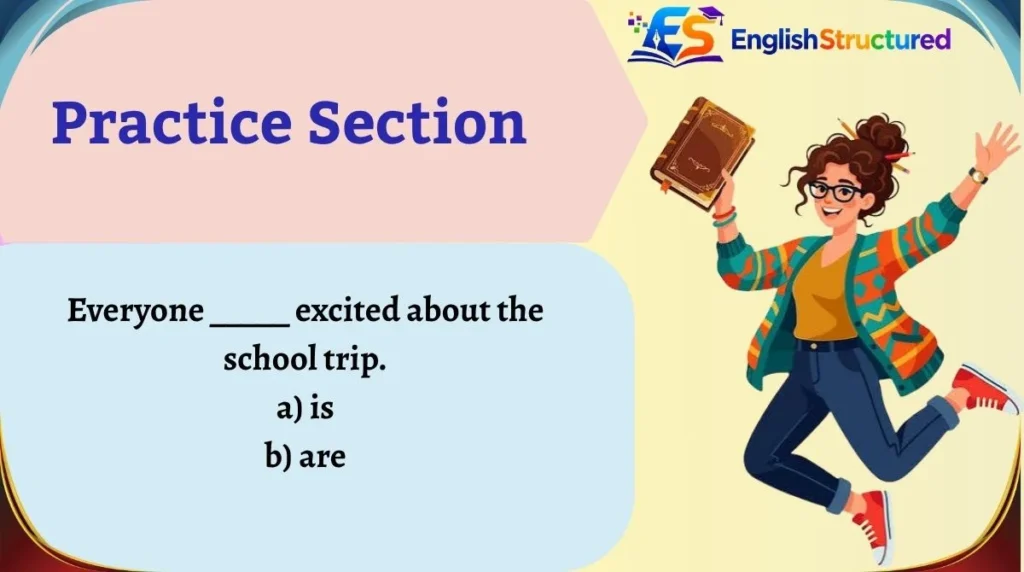
Now it’s time to test what you’ve learned. Read each sentence and choose the correct option.
Choose the Correct Answer
1. Everyone _____ excited about the school trip.
a) is
b) are
2. Everyone _____ finished the homework.
a) have
b) has
3. Everyone _____ waiting outside the classroom.
a) is
b) are
4. Everyone _____ their own opinion.
a) has
b) have
5. Everyone _____ welcome to join us.
a) is
b) are
Answers
1. a) is
Explanation: Everyone is a singular indefinite pronoun, so it takes the singular verb is.
2. b) has
Explanation: Use the singular verb has with everyone.
3. a) is
Explanation: The correct phrase is everyone is waiting.
4. a) has
Explanation: Even though their is used later in the sentence, the subject everyone is still singular.
5. a) is
Everyone Is vs Everyone Are
FAQs
What is the difference between everyone is and everyone are?
Everyone Is vs Everyone Are. Although it refers to many people, English grammar treats it as one group. Everyone are is considered incorrect in standard English.
Is everyone singular or plural?
Everyone is grammatically singular. It refers to every person in a group, but it always takes a singular verb such as is, has, or does.
Examples:
- Everyone is smiling.
- Everyone Is vs Everyone Are
Can I ever say everyone are?
In standard English, the answer is no. You should always write and say everyone is.
You might hear everyone are in some regional dialects or informal speech, but it is not correct for school, exams, professional writing, or formal conversations.
Why does everyone use a singular verb if it means many people?
English grammar focuses on the subject, not just the meaning.
Everyone Is vs Everyone Are
Think of it as meaning every single person, not many separate people.
Can I use their after everyone?
Yes.
Modern English commonly uses the singular they, them, and their after everyone.
Examples:
- Everyone should bring their notebook.
- Everyone Is vs Everyone Are
- Everyone is doing their best.
This is natural and widely accepted in modern English.
Is everyone is formal or informal?
Everyone is works in both formal and informal English.
You can use it in:
- School essays
- Exams
- Business emails
- Office meetings
- Academic writing
- Daily conversations
It is the standard form used by native English speakers.
Conclusion
English grammar sometimes feels confusing because meaning and grammar do not always match.
Everyone Is vs Everyone Are
That is why everyone is is the correct choice in standard English.
A simple way to remember this rule is to think of everyone as every single person. If every single person is correct, then everyone is must also be correct.
This small trick can help you avoid one of the most common grammar mistakes.
The best way to master this rule is through regular practice. Read English books, listen to native speakers, and pay attention to how everyone is used in real conversations.
The more examples you see, the more natural this grammar pattern will become.
With consistent practice, choosing everyone is instead of everyone are will soon become automatic, making your English sound clearer, more accurate, and more confident.