May Be vs Maybe
The only visible difference is a small space, but that space changes the grammar and meaning of the sentence.
For example, you might write, “She may be tired” or “Maybe she is tired.” Both sentences talk about something that is possible, but they are built differently.
This small difference matters because may be is a verb phrase, while maybe is an adverb. When you understand their grammar roles, the confusion becomes much easier to handle.
You will often see these words in text messages, emails, school work, conversations, and everyday speech. Native speakers use both forms all the time.
The problem usually starts when learners try to choose between them based only on meaning.
The good news is that there is a simple way to tell them apart. You do not need to memorize a long grammar rule.
You only need to look at what comes after the word and understand its job in the sentence.
By the end, you will know exactly when to write may be and when to write maybe.
You will also see common mistakes, easy memory tricks, real-life examples, and practice questions.
What Does “May Be” Mean?
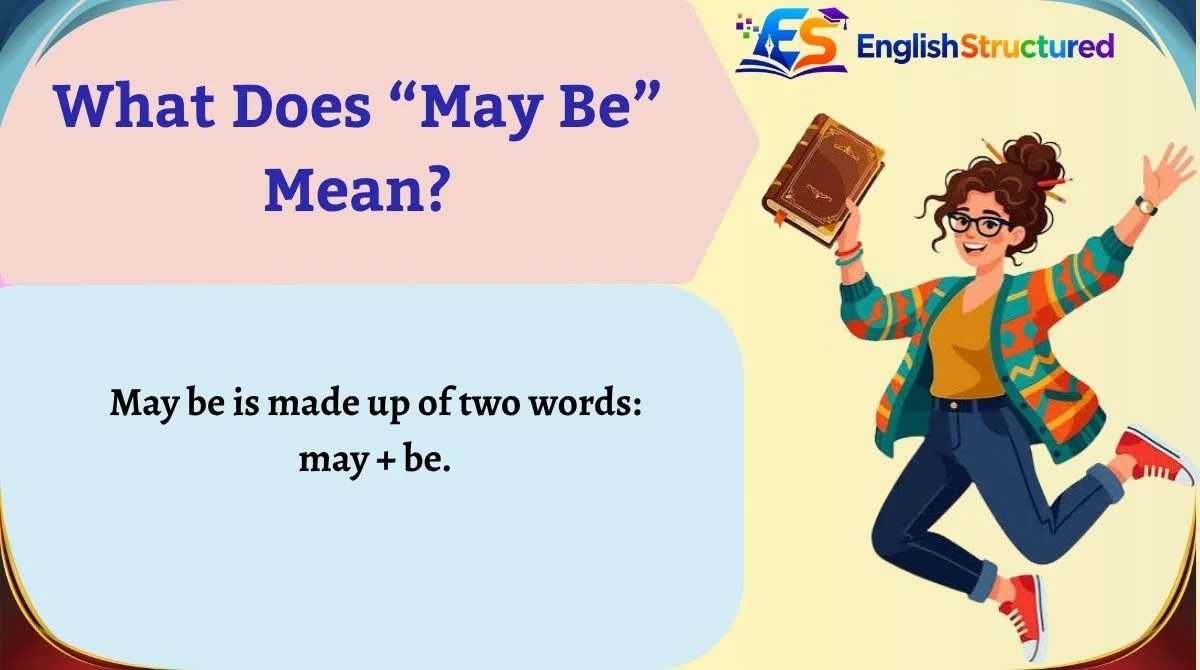
May be is made up of two words: may + be.
Here, may is a modal verb, and be is the base form of the verb “to be.” Together, they show that something is possible or may be true.
For example:
May Be vs Maybe
This means it is possible that she is busy. We do not know for sure.
The phrase can be used with different subjects:
- I may be
- May Be vs Maybe
- He may be
- She may be
- It may be
- We may be
- May Be vs Maybe
The word may does not change according to the subject. We do not say “she mays be.” We simply say “she may be.”
When Should You Use “May Be”?
Use may be when you need a modal verb followed by the verb be.
It is common when talking about a possible:
- condition
- feeling
- location
- identity
- situation
- description
For example:
May Be vs Maybe
We are saying that being at home is one possible situation.
You can also use may be before an adjective:
May Be vs Maybe
Here, “difficult” describes the test.
You can use it before a noun or noun phrase:
She may be the new manager.
You can also use it before a place:
May Be vs Maybe
Grammar Rule for “May Be”
The basic structure is:
Subject + may + be + complement
Examples:
May Be vs Maybe
Sarah may be a teacher.
They may be at school.
May Be vs Maybe
The important point is that may and be are separate words because they have separate grammatical jobs.
8 Examples of “May Be”
- He may be tired after the long trip.
- She may be at work right now.
- It may be difficult to finish today.
- They may be late for the meeting.
- May Be vs Maybe
- Your brother may be sleeping upstairs.
- The store may be closed on Sunday.
- I may be wrong about the time.
In every example, may be works as part of the verb phrase.
A Common Confusion With “May Be”
Many learners see a sentence such as:
May Be vs Maybe
Then they try to write:
May be he is tired.
That is normally incorrect in standard English.
The correct sentence is:
Maybe he is tired.
Why? Because maybe is one word when it is used as an adverb meaning “perhaps.”
However, this sentence is also correct:
May Be vs Maybe
The meaning is close, but the grammar is different.
That difference is the key to the whole topic.
What Does “Maybe” Mean?
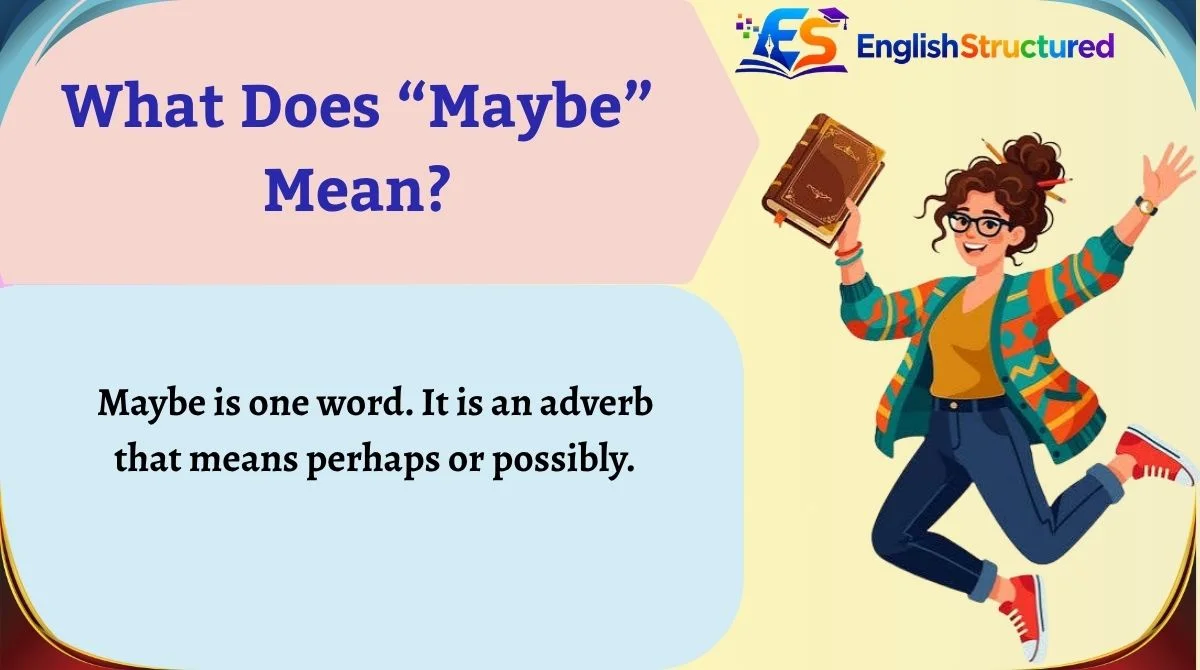
Maybe is one word. It is an adverb that means perhaps or possibly.
We use it when we are not certain about something.
For example:
May Be vs Maybe
This means:
Perhaps John will come.
The speaker does not know if John will come. It is only a possibility.
Unlike may be, the word maybe does not contain two separate words in modern English when it has this meaning.
When Should You Use “Maybe”?
Use maybe when you want to say that something is possible but not certain.
It is very common in everyday English.
You can use it at the beginning of a sentence:
May Be vs Maybe
You can also use it before a verb phrase:
Maybe she forgot.
It can appear in other positions too, depending on the sentence:
May Be vs Maybe
This use is common in informal speech, although placing maybe at the beginning is often clearer for learners.
Grammar Rule for “Maybe”
Maybe is an adverb.
A simple structure is:
Maybe + subject + verb
Examples:
Maybe she knows the answer.
May Be vs Maybe
Maybe he forgot my name.
Maybe we can help you.
It can also be used as a short answer:
“Are you going to the party?”
May Be vs Maybe
Here, “maybe” means “perhaps” or “I am not sure.”
8 Examples of “Maybe”
- Maybe she will call you tonight.
- Maybe we should wait a little longer.
- Maybe he forgot about the meeting.
- Maybe they are busy right now.
- May Be vs Maybe
- Maybe it will rain tomorrow.
- Maybe you are right about the problem.
- Maybe we can meet next week.
In each sentence, maybe expresses uncertainty or possibility.
“Maybe” in Questions and Answers
You can use maybe in answers when you are uncertain.
For example:
“Will you come with us?”
May Be vs Maybe
Or:
“Is Sarah coming?”
“Maybe. She has not told me yet.”
This is especially common in casual conversations.
Difference Between “May Be” and “Maybe” — Detailed Explanation
The biggest difference is simple:
May be = two words + verb phrase
Maybe = one word + adverb
They can have similar meanings, but they do not have the same grammatical function.
Comparison Table
| Feature | May Be | Maybe |
|---|---|---|
| Number of words | Two | One |
| Grammar | Modal verb + verb | Adverb |
| Main meaning | Could be / is possibly | Perhaps / possibly |
| Common position | After the subject | Often at the beginning |
| Example | She may be tired. | Maybe she is tired. |
| Can stand alone? | No | Yes |
| Followed by “be”? | Yes | Usually not directly |
| Style | Neutral | Very common in everyday English |
1. “May Be” Usually Comes After the Subject
Look at this sentence:
May Be vs Maybe
The subject is she. After the subject, we have may be.
The structure is:
She + may + be + sick
Now compare it with:
Maybe she is sick.
Here, maybe comes before the subject.
The structure is:
Maybe + she + is + sick
Both sentences express possibility.
2. “Maybe” Can Be Replaced With “Perhaps”
This is one of the easiest tests.
If you can replace the word with perhaps, you probably need maybe.
For example:
Maybe he is at home.
Replace “maybe” with “perhaps”:
Perhaps he is at home.
The sentence still works.
Now look at:
May Be vs Maybe
You cannot simply replace “may be” with “perhaps” while keeping the same structure:
He perhaps at home. ❌
You would need to change the sentence:
Perhaps he is at home. ✅
This tells you that may be is doing a different grammatical job.
3. “May Be” Can Be Followed by an Adjective
For example:
The movie may be interesting.
May Be vs Maybe
He may be tired.
The question may be difficult.
Here, be is a verb connecting the subject with a description.
You cannot normally use maybe in the same position:
The movie maybe interesting. ❌
The correct sentence is:
The movie may be interesting. ✅
Or:
Maybe the movie is interesting. ✅
4. “Maybe” Can Be Used Before a Complete Clause
For example:
Maybe he is sleeping.
The word “maybe” modifies the whole idea that follows it.
You can think of it as saying:
Perhaps he is sleeping.
The word maybe does not need another verb directly after it.
Grammar Rules You Must Remember
Rule #1: Use “may be” when “be” is the verb
If your sentence needs the verb be after may, keep the words separate.
Correct:
May Be vs Maybe
Correct:
They may be ready.
Correct:
He may be at home.
Incorrect:
She maybe busy. ❌
The simple question to ask is: Do I need the verb “be” here?
May Be vs Maybe
Rule #2: Use “maybe” when you mean “perhaps”
If you can replace the word with perhaps, use maybe.
For example:
Maybe I will call him.
You can say:
Perhaps I will call him.
May Be vs Maybe
Another example:
Maybe she knows the answer.
“Perhaps she knows the answer” also works.
Rule #3: “May be” usually follows a subject
A common pattern is:
Subject + may be + adjective/noun/place
Examples:
He may be tired.
She may be a doctor.
May Be vs Maybe
It may be true.
Rule #4: “Maybe” often comes before the subject
A common pattern is:
Maybe + subject + verb
Examples:
Maybe he is tired.
Maybe she is a doctor.
May Be vs Maybe
Maybe it is true.
Notice something important: after maybe, you normally have a complete clause.
That means you can see a subject and a verb after it.
Common Mistakes Students Make
The main reason learners make mistakes is that may be and maybe sound very similar when people speak.
When spoken quickly, the small space between the words is not easy to hear. This can make the spelling confusing.
Mistake 1: Writing “maybe” before an adjective
Incorrect:
May Be vs Maybe
Correct:
He may be tired.
Why? “Tired” needs the verb “be.” The structure is:
He + may + be + tired.
Mistake 2: Writing “may be” when you mean “perhaps”
Incorrect:
May be she will come later.
Correct:
Maybe she will come later.
You are using the word to mean “perhaps,” so it must be one word.
Mistake 3: Thinking “maybe” and “may be” are always interchangeable
They can sometimes communicate almost the same idea, but you cannot simply swap them without changing the sentence structure.
For example:
Maybe John is busy.
Correct.
John may be busy.
Also correct.
But:
John maybe busy. ❌
And:
May be John is busy. ❌
The words must fit the grammar of the sentence.
Mistake 4: Using “may be” as a complete answer
Someone asks:
“Will you come tomorrow?”
You answer:
“May be.”
This is incorrect when you mean “perhaps.”
The natural answer is:
“Maybe.”
Because maybe can stand alone.
Easy Correction Tip
When you are unsure, try these two tests:
Test 1: Can I replace it with “perhaps”?
If yes → use maybe.
Test 2: Is “be” acting as a verb after “may”?
If yes → use may be.
These two tests solve most problems.
Easy Trick to Remember the Difference
Here is a simple memory trick:
“Maybe” = “Perhaps”
Think of maybe as a replacement for perhaps.
Maybe = Perhaps
So:
Maybe she is home.
means:
Perhaps she is home.
Easy.
“May Be” = “May + Be”
For may be, imagine that you can see the two grammar parts:
may + be
For example:
She may be happy.
“May” shows possibility.
“Be” is the verb.
Together:
She may be happy.
A useful classroom trick is to ask yourself:
“Can I see the verb be?”
If the answer is yes, you may need may be.
Compare These Two
Maybe Tom is sick.
Tom may be sick.
The first starts with an adverb.
The second uses a modal verb followed by “be.”
The meaning is very close, but the sentence structure is different.
Daily Life Examples
These examples show how native speakers commonly use both forms in normal conversations.
Example 1
A: Where is Mike?
B: Maybe he is at the gym.
Here, “maybe” means “perhaps.”
Example 2
A: Why isn’t Anna answering?
B: She may be busy.
Here, “may be” comes after the subject “she.”
Example 3
A: Are you going to the restaurant tonight?
B: Maybe. I haven’t decided yet.
“Maybe” works as a short answer.
Example 4
A: Is this the right road?
B: It may be the right road, but I’m not sure.
“May be” is part of the verb phrase.
Example 5
A: Why is Daniel late?
B: Maybe he missed the bus.
The speaker is making a guess.
Example 6
A: Is your sister at home?
B: She may be at home. I haven’t checked.
“May be” follows the subject “she.”
Example 7
A: Should we order pizza?
B: Maybe we should wait until everyone arrives.
“Maybe” introduces the possible idea.
Example 8
A: Is the shop open?
B: It may be closed because it’s Sunday.
“May be” connects “it” with the adjective “closed.”
Example 9
A: Will you visit us next weekend?
B: Maybe. It depends on my plans.
Again, “maybe” can stand alone.
Example 10
A: Why does she look upset?
B: She may be worried about her exam.
This is a common everyday use of may be.
Practice Section: Choose the Correct Option
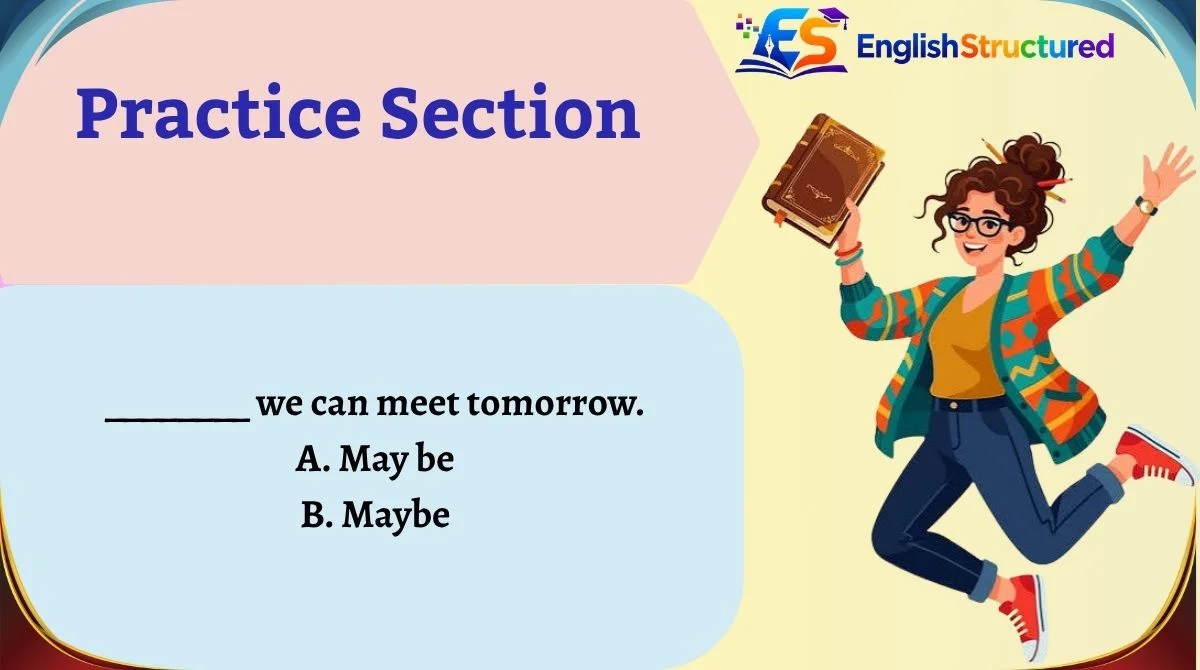
Choose may be or maybe in each sentence.
1. ________ we can meet tomorrow.
A. May be
B. Maybe
2. She ________ tired after work.
A. may be
B. maybe
3. ________ he forgot his phone.
A. May be
B. Maybe
4. They ________ at the airport now.
A. may be
B. maybe
5. ________ I will call you later.
A. May be
B. Maybe
Answers
1. B — Maybe
Maybe we can meet tomorrow.
“Maybe” means “perhaps.”
2. A — may be
She may be tired after work.
“Be” is needed as part of the verb phrase.
3. B — Maybe
Maybe he forgot his phone.
“Maybe” means “perhaps.”
4. A — may be
They may be at the airport now.
“May be” follows the subject “they.”
5. B — Maybe
Maybe I will call you later.
The word means “perhaps.”
FAQs
What is the difference between “may be” and “maybe”?
May be is two words and contains the modal verb “may” plus the verb “be.” Maybe is one word and is an adverb meaning “perhaps” or “possibly.” For example, “She may be tired” and “Maybe she is tired” have similar meanings but different grammar.
Can we use “maybe” in questions?
Yes. Maybe can be used in questions, especially when asking about a possible choice or situation. For example, “Maybe we should leave now?” can be used in casual speech. It can also appear in answers, such as “Maybe,” when you are not sure.
Is “maybe” formal or informal?
Maybe is a normal English word and is used in both everyday and standard written English. It is very common in conversation, emails, messages, and general writing. In more formal writing, perhaps can sometimes sound more formal, but “maybe” is not incorrect.
Can “may be” and “maybe” mean the same thing?
They can express a very similar idea of possibility, but their grammar is different. “Maybe she is busy” and “She may be busy” both suggest that she is possibly busy. You cannot always replace one with the other without changing the sentence structure.
Is “May be she is right” correct?
No, not when you mean “perhaps she is right.” The correct sentence is “Maybe she is right.” Another correct option is “She may be right.” Remember that “maybe” is one word when it means “perhaps.”
How can I quickly remember “may be” vs “maybe”?
Remember this simple rule: maybe = perhaps, while may be = may + the verb be. If you can replace the word with “perhaps,” choose “maybe.” If “be” is needed as a verb after “may,” write “may be.”
Conclusion
May Be vs Maybe
Use maybe as one word when you mean perhaps or possibly. It is an adverb and often appears at the beginning of a sentence.
Maybe she will come.
Use may be as two words when may is a modal verb followed by the verb be.
She may be late.
The easiest way to remember the difference is to use the “perhaps” test. If “perhaps” can replace the word, maybe is usually correct.
If you need “be” as part of the verb after “may,” use may be.
Do not worry if this mistake feels confusing at first. The two forms sound almost identical in normal speech, so many learners struggle with them.
After you notice their sentence patterns, the choice becomes much easier.
Read a few examples aloud, write your own sentences, and check whether you need maybe or may be.
With a little practice, this small grammar difference will become automatic.