
In the Past Few Years or Over the Past Few Years
At first, these two expressions seem to mean exactly the same thing. Many dictionaries and grammar books even use them in similar examples.
Still, native speakers often choose one over the other depending on the situation, which can make learners feel unsure.
This small grammar choice appears everywhere. You may hear it in conversations, read it in newspapers, see it in business reports, or find it in school essays.
Because both expressions talk about a period that started a few years ago and continues until now, learners sometimes think they are always interchangeable.
While that is true in many cases, there are also situations where one sounds more natural than the other.
Learning the difference is useful because it helps your English sound clear, fluent, and natural.
It also improves your writing for exams, work emails, academic assignments, and everyday conversations.
Native speakers pay attention to these small details, and using the right phrase can make your English feel more polished.
After reading this guide, you will understand what each expression means, when to use it, how native speakers choose between them, common grammar rules, and the mistakes learners often make.
You will also see plenty of easy examples that you can use in your own speaking and writing.
What Does “In the Past Few Years” Mean?
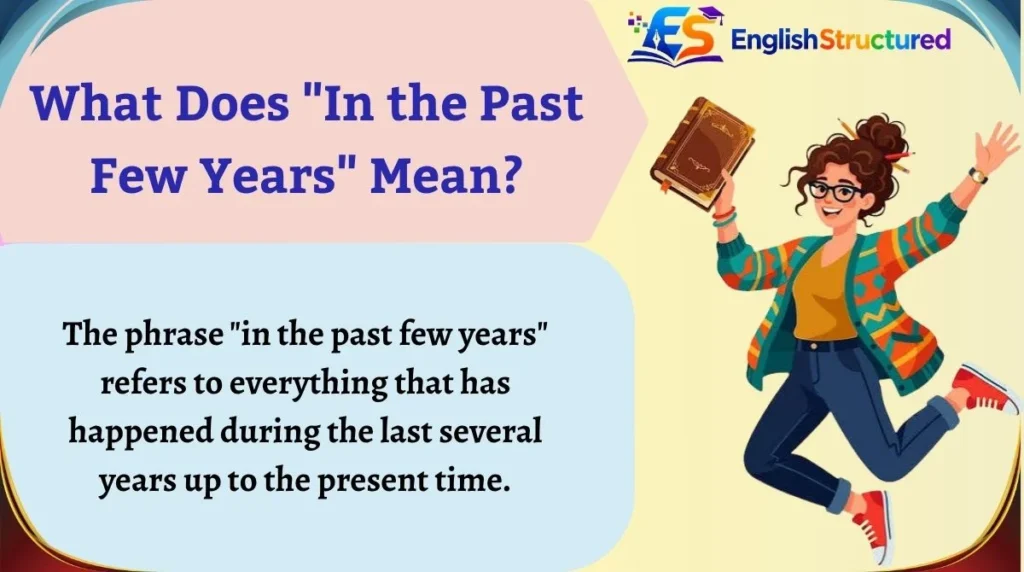
The phrase “in the past few years” refers to everything that has happened during the last several years up to the present time. It focuses on events, changes, experiences, or actions that occurred within this recent period.
The exact number of years is not fixed. Depending on the situation, it could mean two years, three years, five years, or even slightly longer.
The speaker does not need to give an exact number because the expression simply means recent years leading to now.
When Do We Use It?
In the Past Few Years or Over the Past Few Years
- Recent changes
- Personal experiences
- Trends
- Achievements
- Improvements
- Problems that have developed recently
- Events that happened several times recently
This phrase often appears with the present perfect tense because it connects the past with the present.
Examples:
- I have learned a lot in the past few years.
- Technology has changed quickly in the past few years.
- In the Past Few Years or Over the Past Few Years
- Our town has become much larger in the past few years.
- She has improved her English greatly in the past few years.
- In the Past Few Years or Over the Past Few Years
- Food prices have increased in the past few years.
- In the Past Few Years or Over the Past Few Years
Grammar Rule
The expression is most commonly used with:
- Present Perfect
- Present Perfect Continuous
Examples:
- Scientists have discovered many new medicines in the past few years.
- In the Past Few Years or Over the Past Few Years
- In the Past Few Years or Over the Past Few Years
Sometimes, it can also appear with other tenses if the meaning is clear from the context.
Example:
- In the Past Few Years or Over the Past Few Years
However, the present perfect is still the most natural choice in everyday English.
Why Native Speakers Like This Phrase
Native speakers often choose “in the past few years” when they simply want to mention a recent time period without emphasizing how something developed throughout that period.
For example:
I have met many interesting people in the past few years.
The sentence simply tells us when those meetings happened.
Another example:
In the Past Few Years or Over the Past Few Years
The speaker focuses on the fact that the change happened recently.
Common Learner Confusion
In the Past Few Years or Over the Past Few Years. That is not correct.
It often describes situations that started in the past and still affect the present.
For example:
In the Past Few Years or Over the Past Few Years
Your confidence increased during recent years and remains higher today.
Another misunderstanding is using the simple past tense unnecessarily.
Incorrect:
- In the Past Few Years or Over the Past Few Years
More natural:
- In the Past Few Years or Over the Past Few Years
Because the time period continues until now, the present perfect usually works better.
What Does “Over the Past Few Years” Mean?
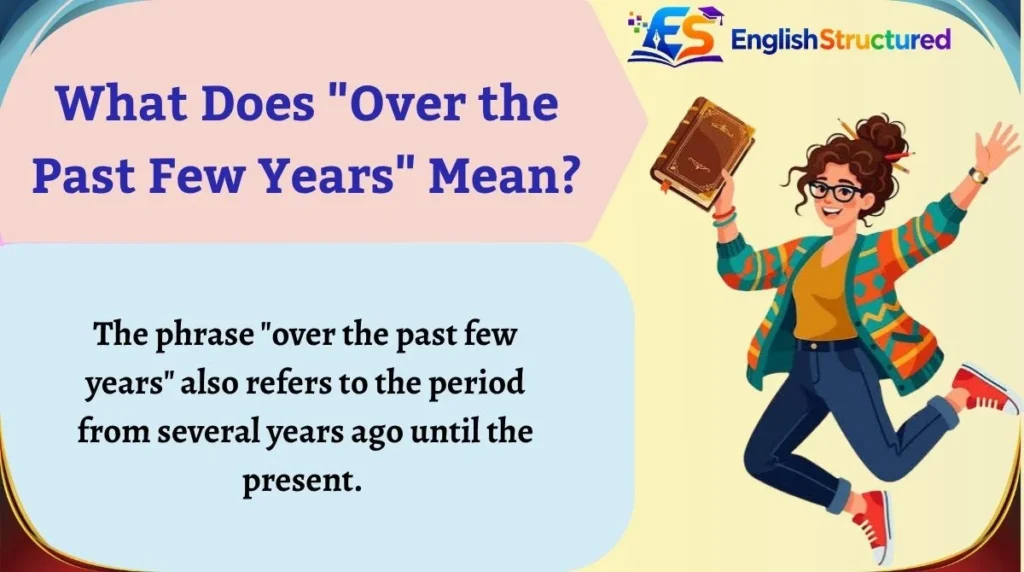
The phrase “over the past few years” also refers to the period from several years ago until the present.
However, it puts slightly more attention on what happened throughout that period rather than simply identifying the time.
Think of it as looking across the whole time span and describing how something developed little by little.
When Do We Use It?
In the Past Few Years or Over the Past Few Years
- Long-term progress
- Gradual improvement
- Ongoing changes
- Growth
- Development
- Research findings
- Business reports
- Statistics
- Trends over time
This phrase is especially common in formal English.
Examples
- Sales have increased over the past few years.
- In the Past Few Years or Over the Past Few Years
- Scientists have collected valuable data over the past few years.
- The climate has changed noticeably over the past few years.
- In the Past Few Years or Over the Past Few Years
- Healthcare has improved greatly over the past few years.
- In the Past Few Years or Over the Past Few Years
- In the Past Few Years or Over the Past Few Years
Grammar Rule
In the Past Few Years or Over the Past Few Years
- Present Perfect
- Present Perfect Continuous
Examples:
- Researchers have been studying this disease over the past few years.
- The economy has improved over the past few years.
- In the Past Few Years or Over the Past Few Years
Why Native Speakers Choose It
When someone says:
In the Past Few Years or Over the Past Few Years
they often want listeners to imagine the continuous progress from one year to the next.
Similarly:
The neighborhood has become much safer over the past few years.
This suggests a gradual improvement rather than one sudden change.
Because of this subtle meaning, “over the past few years” appears frequently in:
- Business presentations
- Academic writing
- News reports
- Government reports
- Research papers
In the Past Few Years or Over the Past Few Years
Common Learner Confusion
In the Past Few Years or Over the Past Few Years
For example:
- Over 100 people attended the event.
Here, over means more than.
However, in the expression “over the past few years,” the word over means during or throughout, not more than.
For example:
✅ She has gained valuable experience over the past few years.
The sentence describes what happened throughout the recent years.
Another mistake is believing this phrase can only be used in formal writing. In reality, native speakers also use it naturally in everyday conversation, especially when talking about gradual changes.
Difference Between “In the Past Few Years” and “Over the Past Few Years”
At first glance, these two expressions seem identical because both refer to a period that started several years ago and continues until now. In many everyday conversations, you can replace one with the other without changing the basic meaning.
However, there is a small difference in emphasis. Understanding this difference will help your English sound more natural.
- In the past few years mainly tells when something happened.
- Over the past few years highlights how something happened or developed throughout that period.
This is a matter of style and emphasis rather than a strict grammar rule.
Comparison Table
| Feature | In the Past Few Years | Over the Past Few Years |
|---|---|---|
| Basic meaning | During the recent few years | Throughout the recent few years |
| Main focus | Time period | Progress or development over time |
| Common tone | Neutral, everyday | Slightly more formal |
| Best used for | Experiences, events, recent changes | Trends, growth, gradual changes |
| Common tense | Present Perfect | Present Perfect |
| Spoken English | Very common | Common |
| Academic writing | Common | Very common |
| News reports | Common | Very common |
Meaning Comparison
Look at these two sentences.
In the Past Few Years or Over the Past Few Years
The speaker simply says the friendships happened during recent years.
Now compare it with:
I have made many new friends over the past few years.
This version gently suggests that the friendships were built little by little across those years.
Both are correct. The difference is very small.
Usage Difference
Choose in the past few years when your main goal is to mention the recent time period.
Examples:
- I have changed my daily routine in the past few years.
- In the Past Few Years or Over the Past Few Years
- We have traveled more in the past few years.
Choose over the past few years when talking about growth, progress, or continuing change.
Examples:
- The business has expanded over the past few years.
- Internet shopping has grown over the past few years.
- In the Past Few Years or Over the Past Few Years
Grammar Logic
Both expressions normally describe unfinished time. That is why they often appear with the present perfect tense.
Examples:
- Many schools have introduced online classes in the past few years.
- In the Past Few Years or Over the Past Few Years
Both sentences are natural.
The difference is only the speaker’s emphasis.
Sentence Structure
Both phrases usually appear at the end of a sentence.
Subject + have/has + past participle + phrase
Examples:
- She has become more confident in the past few years.
- In the Past Few Years or Over the Past Few Years
They may also appear at the beginning.
- In the past few years, many companies have hired remote workers.
- Over the past few years, many companies have hired remote workers.
Starting with the time expression gives it extra emphasis.
Which One Should You Choose?
There is no strict rule saying one is always better.
In the Past Few Years or Over the Past Few Years
In the Past Few Years or Over the Past Few Years
Native speakers often switch between them without thinking because both sound natural.
Grammar Rules You Must Remember
Understanding a few grammar rules makes these expressions much easier to use correctly.
Rule #1: Use the Present Perfect for Most Situations
Because these phrases connect the past with the present, they usually take the present perfect tense.
Correct:
- I have learned a lot in the past few years.
- In the Past Few Years or Over the Past Few Years
Incorrect:
- In the Past Few Years or Over the Past Few Years
The simple past sounds less natural because the time period still includes the present.
Rule #2: Use Them for Unfinished Time
Both expressions describe time that continues until now.
Correct:
- She has worked hard over the past few years.
Not suitable if the time period is completely finished.
Instead, say:
- She worked hard during her college years.
Rule #3: They Often Describe Gradual Change
These phrases are excellent when discussing progress.
Examples:
- My writing has improved in the past few years.
- Technology has advanced over the past few years.
- In the Past Few Years or Over the Past Few Years
Rule #4: Both Expressions Are Usually Interchangeable
In many everyday situations, either phrase sounds correct.
Example 1:
- Food prices have increased in the past few years.
- Food prices have increased over the past few years.
Example 2:
- I have become more patient in the past few years.
- In the Past Few Years or Over the Past Few Years
The meaning stays almost the same.
Common Mistakes Students Make
Even advanced learners sometimes misuse these expressions.
Here are the mistakes to avoid.
Mistake 1: Using the Simple Past Instead of the Present Perfect
❌ I visited many countries in the past few years.
✅ I have visited many countries in the past few years.
Why?
The period continues until today.
Mistake 2: Thinking “Over” Means “More Than”
Students sometimes read this sentence:
In the Past Few Years or Over the Past Few Years
They think over means more than.
Actually, it means throughout the recent years.
Mistake 3: Mixing Finished Time with Present Perfect
Incorrect:
❌ I have studied English last year.
Correct:
✅ I studied English last year.
But:
In the Past Few Years or Over the Past Few Years
Mistake 4: Believing Only One Expression Is Correct
Some learners think teachers prefer only one phrase.
That is not true.
Both are accepted by native speakers.
The difference is mainly one of style.
Mistake 5: Repeating the Phrase Too Often
Instead of writing:
In the Past Few Years or Over the Past Few Years
Use variations such as:
- recently
- lately
- during recent years
- over recent years
- throughout recent years
This makes your writing smoother and more natural.
Easy Trick to Remember the Difference
A simple memory trick can help.
Think of “in” as pointing to a time period.
Think of “over” as showing movement across time.
Imagine a bridge.
If you stand in the bridge area, you simply know where you are.
If you walk over the bridge, you move from one side to the other.
The same idea works here.
- In the past few years = during recent years.
- In the Past Few Years or Over the Past Few Years
Another easy trick is this:
If you’re talking about facts or experiences, in often sounds natural.
If you’re talking about growth, change, or progress, over often sounds a little smoother.
Remember that both expressions are correct in most situations, so don’t worry too much. Focus on communicating clearly.
Daily Life Examples
The best way to master these expressions is to see them in real conversations. Native speakers use “in the past few years” and “over the past few years” naturally when talking about work, family, school, travel, health, technology, and everyday life.
Below are examples you are likely to hear or use yourself.
Everyday Conversation Examples
- I have become much more confident in the past few years.
- In the Past Few Years or Over the Past Few Years
- I’ve read many interesting books in the past few years.
- The weather has become less predictable over the past few years.
- My sister has learned to cook really well in the past few years.
- Our company has hired many new employees over the past few years.
- I’ve spent more time with my family in the past few years.
- In the Past Few Years or Over the Past Few Years
- My English pronunciation has improved in the past few years.
- Public transportation has improved over the past few years.
Conversation Examples
Example 1
Ali: Your English sounds much better now.
Sara: Thanks! I’ve practiced every day in the past few years.
Example 2
Teacher: Why are more students studying online?
In the Past Few Years or Over the Past Few Years
Example 3
Friend: Your town looks different.
In the Past Few Years or Over the Past Few Years
Example 4
Mother: You seem much more organized now.
Son: I’ve changed my habits in the past few years.
Example 5
Manager: Sales look much stronger this year.
Employee: They have increased steadily over the past few years.
Formal Writing Examples
These expressions are also common in reports, research papers, and business documents.
- Customer satisfaction has improved over the past few years.
- Researchers have published several important studies in the past few years.
- In the Past Few Years or Over the Past Few Years
- Healthcare services have improved in the past few years.
- In the Past Few Years or Over the Past Few Years
Informal Writing Examples
You can also use these phrases in emails, text messages, or social media posts.
- I’ve learned so much in the past few years.
- Life has changed a lot over the past few years.
- We’ve made amazing memories in the past few years.
- In the Past Few Years or Over the Past Few Years
These examples show that both expressions fit naturally into everyday English. The choice usually depends on which one sounds better in the sentence.
Practice Section
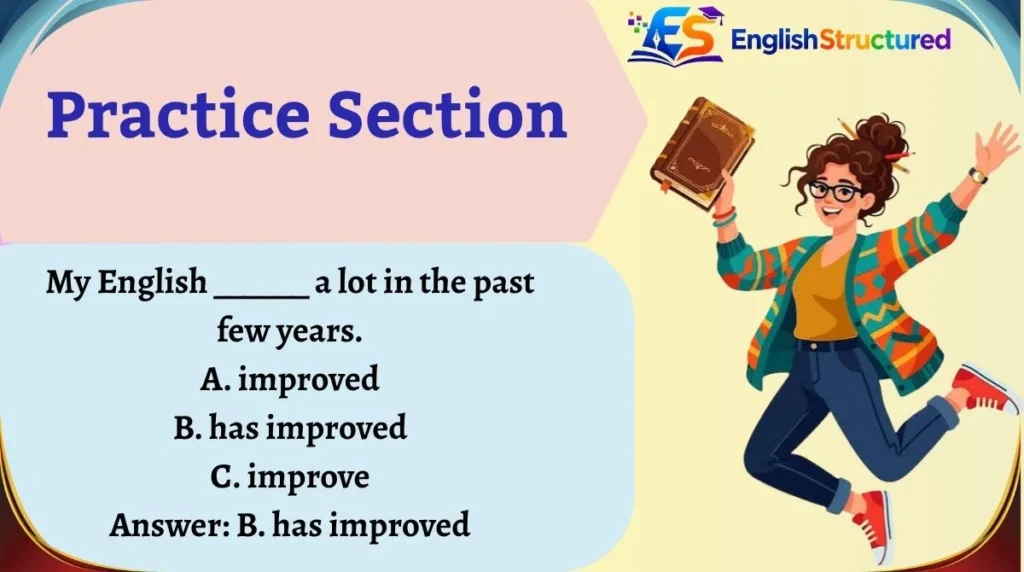
Test your understanding by choosing the best answer.
Choose the Correct Option
1. My English ______ a lot in the past few years.
A. improved
B. has improved
C. improve
Answer: B. has improved
2. The company has grown quickly ______ the past few years.
A. over
B. at
C. on
Answer: A. over
3. We ______ many new friends in the past few years.
A. make
B. made
C. have made
Answer: C. have made
4. Technology has changed greatly ______ the past few years.
A. over
B. beside
C. under
Answer: A. over
5. Which sentence is the most natural?
A. I learned a lot in the past few years.
B. I have learned a lot in the past few years.
C. I learning a lot in the past few years.
In the Past Few Years or Over the Past Few Years
Bonus Practice
Fill in the blanks with in or over.
- I’ve become healthier ______ the past few years.
- Our city has developed quickly ______ the past few years.
- Scientists have made many discoveries ______ the past few years.
- My confidence has grown ______ the past few years.
- We’ve created wonderful memories ______ the past few years.
Suggested Answers
- in
- over
- in (or over)
- over (or in)
- in (or over)
Teacher’s Tip: In several sentences, both “in” and “over” are correct. Choose “over” when you want to emphasize gradual progress or development. Choose “in” when you simply refer to the time period.
FAQs
1. What is the difference between “in the past few years” and “over the past few years”?
Both expressions refer to the time from several years ago until now. The main difference is emphasis. In the Past Few Years or Over the Past Few Years.
2. Can I use these expressions with the simple past tense?
Usually, no. Because these phrases refer to an unfinished period connected to the present, the present perfect tense is generally the best choice.
- ✅ I have improved my English in the past few years.
- ❌ I improved my English in the past few years.
3. Are these expressions formal or informal?
Both are suitable for formal and informal English. However, “over the past few years” appears a little more often in academic writing, business reports, news articles, and research papers because it naturally suggests gradual change.
4. Can I use “during the past few years” instead?
Yes. “During the past few years” has a similar meaning and is grammatically correct. However, native speakers more commonly use “in the past few years” or “over the past few years” in everyday conversation.
5. Which expression is more common in spoken English?
Both are common. “In the past few years” is slightly more frequent in casual conversations, while “over the past few years” is often chosen when discussing trends, growth, or long-term improvements.
6. Can I use these phrases at the beginning of a sentence?
Yes. Placing them at the beginning adds emphasis to the time period.
Examples:
- In the Past Few Years or Over the Past Few Years
- Over the past few years, our school has introduced several new programs.
Conclusion
Small grammar choices can make a big difference in how natural your English sounds.
In the Past Few Years or Over the Past Few Years
The first mainly points to a recent period of time, while the second often emphasizes continuous change or progress throughout that period.
The good news is that native speakers frequently use both expressions, and in many situations they are interchangeable.
Instead of worrying about memorizing complicated rules, pay attention to the message you want to express.
If you are simply talking about something that happened recently, “in the past few years” is an excellent choice.
If you want to highlight steady development, growth, or improvement, “over the past few years” may sound even more natural.
Keep practicing these expressions in your daily conversations, writing exercises, and reading.
The more authentic examples you see and use, the more confident you will become.
With regular practice, choosing between these two common English phrases will soon feel easy and natural.