Have Had or Has Had
At first, these two phrases look almost the same. The only difference is one small word—have or has. Even so, that small change can make a big difference in grammar.
You may hear someone say, “I have had this phone for three years,” and later hear another person say, “She has had the same phone for three years.”
Both sentences are correct, but they are used with different subjects. If you do not know this rule, it is easy to make mistakes in speaking and writing.
Understanding this grammar point is important because it appears in everyday English.
Native speakers use these phrases when talking about experiences, possessions, health, work, and actions that started in the past and still matter now.
You will also find them in school lessons, English tests, business emails, and daily conversations.
The good news is that this topic is much easier than it seems. Once you learn which subjects take have and which take has, everything becomes much clearer.
A few simple grammar rules and plenty of examples can help you remember the correct form every time.
By the end of this guide, you will understand when to use have had and has had, why they are different, how they fit into the present perfect tense, and how to avoid the mistakes that many English learners make.
What Does “Have Had” Mean?
Simple Definition
Have had is a form of the present perfect tense. It combines the helping verb have with the past participle had.
Have Had or Has Had
- I
- You
- We
- They
- Plural nouns
It usually talks about an action, experience, or situation that started in the past and has a connection to the present.
When to Use “Have Had”
Use have had when:
- Talking about experiences
- Showing possession over time
- Describing something that happened before now
- Talking about repeated actions
- Explaining situations that continue into the present
Grammar Rule
Have Had or Has Had
Examples:
- I have had this bicycle since 2022.
- We have had many happy memories together.
- They have had several meetings this week.
- You have had enough practice today.
- My parents have had this house for twenty years.
Notice that had is the past participle of have. Even though the phrase contains the word had, the sentence is not in the past tense. It is in the present perfect tense because the helping verb is have.
8 Example Sentences Using “Have Had”
- I have had a busy day at work.
- We have had many wonderful vacations together.
- Have Had or Has Had
- You have had enough coffee today.
- My friends have had the same coach for five seasons.
- The students have had several tests this month.
- I have had this watch since high school.
- We have had good weather all week.
Common Learner Confusion
Have Had or Has Had
For example:
- ✅ I have had this laptop for five years.
- Have Had or Has Had
Another common mistake is using have had with singular third-person subjects.
Incorrect:
- ❌ She have had a headache.
Correct:
- ✅ She has had a headache.
Have Had or Has Had
Why English Uses “Have Had”
The first word (have) works as the helping verb.
Have Had or Has Had
Example:
- I have had a cold since Monday.
The first have builds the present perfect tense.
Have Had or Has Had
This structure is common in English and sounds completely natural to native speakers.
What Does “Has Had” Mean?
Simple Definition
Has had is also part of the present perfect tense. It uses the helping verb has with the past participle had.
Have Had or Has Had
- He
- She
- It
- Singular nouns
Like have had, it describes an action, experience, or situation that began in the past and is connected to the present.
When to Use “Has Had”
Use has had when:
- A singular person has experienced something.
- Have Had or Has Had
- A situation started in the past and still matters.
- Someone completed an action before now.
- Talking about health, work, or daily life.
Grammar Rule
Have Had or Has Had
Examples:
- She has had a fever since yesterday.
- He has had this job for five years.
- Have Had or Has Had
- My brother has had several interviews.
- The dog has had its dinner.
8 Example Sentences Using “Has Had”
- She has had many exciting adventures.
- He has had the same teacher for two years.
- My sister has had a new phone since January.
- The baby has had a long nap.
- Have Had or Has Had
- Sarah has had several opportunities to travel.
- The cat has had its breakfast.
- John has had a difficult week.
Common Learner Confusion
Have Had or Has Had
Incorrect:
- ❌ He have had a busy morning.
Correct:
- Have Had or Has Had
Another mistake is using has had with plural subjects.
Incorrect:
- ❌ They has had enough practice.
Correct:
- Have Had or Has Had
Why English Uses “Has Had”
Just like have had, the first word is the helping verb.
- Has shows that the subject is singular.
- Had is the past participle of have.
Example:
- Have Had or Has Had
Here:
- Has agrees with the singular subject she.
- Have Had or Has Had
This pattern is one of the most common structures in spoken and written English.
Difference Between Have Had and Has Had (Detailed)
Have Had or Has Had
Both expressions belong to the present perfect tense. They both use the past participle had. The only thing that changes is the helping verb, which must agree with the subject of the sentence.
The easiest way to remember the difference is this:
- Have Had or Has Had
- Use has had with he, she, it, and singular nouns.
The meaning does not change. Only the subject changes.
Comparison Table
| Feature | Have Had | Has Had |
|---|---|---|
| Tense | Present Perfect | Present Perfect |
| Helping Verb | Have | Has |
| Past Participle | Had | Had |
| Used With | I, You, We, They, Plural Nouns | He, She, It, Singular Nouns |
| Talks About | Past actions connected to the present | Past actions connected to the present |
| Common in Speaking | Yes | Yes |
| Common in Writing | Yes | Yes |
Subject Comparison
| Subject | Correct Form | Example |
|---|---|---|
| I | have had | I have had enough sleep. |
| You | have had | You have had a busy day. |
| We | have had | We have had many visitors. |
| They | have had | They have had several meetings. |
| He | has had | He has had breakfast. |
| She | has had | She has had a headache. |
| It | has had | It has had a software update. |
| My brother | has had | My brother has had two interviews. |
| My friends | have had | My friends have had a great trip. |
Usage Difference
The meaning of both phrases is almost identical. The difference is only who or what you are talking about.
Use Have Had for Plural or Certain Pronouns
Have Had or Has Had
- I
- You
- We
- They
- Two or more people or things
Examples:
- I have had this computer for four years.
- You have had enough chances.
- We have had many wonderful experiences.
- Have Had or Has Had
- The students have had extra homework this week.
Use Has Had for Singular Subjects
Choose has had when the subject is:
- He
- She
- It
- One person
- One thing
Examples:
- Have Had or Has Had
- She has had a cold all week.
- It has had a small problem.
- The teacher has had a busy morning.
- My father has had the same job for twenty years.
Grammar Logic
Have Had or Has Had
The answer is the present perfect tense.
This tense is formed like this:
Subject + have/has + past participle
Since the verb is have, its past participle is had.
That is why we say:
- I have had
- She has had
The helping verb (have or has) tells us the tense.
Have Had or Has Had
Sentence Structure Difference
The sentence pattern changes only in the helping verb.
Structure with Have Had
Subject + have + had + object + extra information
Examples:
- I have had this watch for five years.
- We have had enough practice today.
- They have had many chances to improve.
- Have Had or Has Had
Structure with Has Had
Subject + has + had + object + extra information
Examples:
- Have Had or Has Had
- He has had a great career.
- The company has had excellent results.
- My sister has had many awards.
Meaning Comparison
Both expressions usually describe:
- Experiences
- Possession
- Health
- Feelings
- Events
- Repeated actions
- Situations that continue until now
Examples:
Experience
- I have had many interesting jobs.
- Have Had or Has Had
Possession
- We have had this house for ten years.
- Have Had or Has Had
Health
- They have had the flu.
- Have Had or Has Had
Education
- We have had excellent teachers.
- Have Had or Has Had
Notice that the meaning stays the same. Only the subject changes.
Have Had vs Has Had in Questions
Questions follow the same subject rule.
Questions with Have Had
Examples:
- Have you had lunch?
- Have they had enough time?
- Have Had or Has Had
- Have I had too much coffee?
Questions with Has Had
Examples:
- Has she had breakfast?
- Has he had any experience?
- Have Had or Has Had
- Has the dog had its food?
Have Had vs Has Had in Negative Sentences
Negative sentences are easy because you simply add not after have or has.
Negative Sentences with Have Had
Examples:
- I have not had enough sleep.
- We have not had any problems.
- They have not had dinner yet.
- Have Had or Has Had
Short forms:
- I haven’t had enough sleep.
- Have Had or Has Had
Negative Sentences with Has Had
Examples:
- She has not had breakfast.
- He has not had a holiday this year.
- Have Had or Has Had
- My sister has not had time to call.
Short forms:
- She hasn’t had breakfast.
- He hasn’t had a holiday.
Have Had and Has Had with Time Expressions
These phrases often appear with words that show time.
Common examples include:
- since
- for
- already
- yet
- recently
- lately
- today
- this week
- this month
- this year
Examples:
- I have had this bike for six years.
- She has had this bike since 2020.
- We have had three meetings today.
- He has had several visitors this week.
- Have Had or Has Had
- My brother has had a busy month.
Grammar Rules You Must Remember
Learning a few simple rules can help you avoid almost every mistake with have had and has had.
Rule #1: Match the Helping Verb with the Subject
Always choose the helping verb that agrees with the subject.
Use have had with:
- I
- You
- We
- They
- Plural nouns
Have Had or Has Had
- He
- She
- It
- Singular nouns
Examples
- I have had enough practice.
- Have Had or Has Had
- She has had a busy day.
- My uncle has had three jobs.
Rule #2: Use Them in the Present Perfect Tense
These expressions belong to the present perfect tense, not the simple past.
The action started in the past but still has a connection to the present.
Examples:
- I have had this laptop since 2022.
- She has had a headache all morning.
- Have Had or Has Had
- He has had many opportunities.
Rule #3: Do Not Replace Them with “Had”
Many learners think had can replace have had or has had.
That is not correct because had alone usually belongs to the past perfect or simple past, depending on the sentence.
Compare:
- ✅ I have had this car for five years. (I still have it.)
- ✅ I had this car five years ago. (I probably don’t have it now.)
Another example:
- ✅ She has had a cold since Monday. (She may still be sick.)
- ✅ She had a cold last month. (The illness is over.)
Rule #4: Use the Past Participle “Had”
Never change had to another form after have or has.
Correct:
- I have had breakfast.
- She has had lunch.
- They have had enough time.
- He has had many chances.
Incorrect:
- ❌ I have have breakfast.
- ❌ She has have lunch.
- ❌ They have has dinner.
- ❌ He has having breakfast.
Always remember:
have/has + had is the correct present perfect structure.
Common Mistakes Students Make
Many English learners understand the basic rule of have had and has had, but they still make small mistakes in speaking and writing. Most of these errors happen because learners mix up subject-verb agreement or confuse the present perfect tense with the simple past tense.
The good news is that these mistakes are easy to fix once you know why they happen.
Mistake #1: Using Have Had with Singular Subjects
This is one of the most common errors.
Incorrect:
- ❌ He have had a busy week.
- ❌ She have had enough practice.
- ❌ My brother have had two interviews.
Correct:
- ✅ He has had a busy week.
- ✅ She has had enough practice.
- ✅ My brother has had two interviews.
Why does this happen?
Many students memorize have had first and then use it with every subject. Remember that he, she, it, and singular nouns always take has.
Easy Tip:
If you can replace the subject with he or she, use has had.
Mistake #2: Using Has Had with Plural Subjects
This mistake is the opposite of the first one.
Incorrect:
- ❌ They has had enough food.
- ❌ We has had a wonderful vacation.
- ❌ My friends has had several meetings.
Correct:
- ✅ They have had enough food.
- ✅ We have had a wonderful vacation.
- ✅ My friends have had several meetings.
Easy Tip:
Plural subjects always use have had.
Mistake #3: Forgetting the Present Perfect Structure
Some learners leave out the helping verb.
Incorrect:
- ❌ I had this phone since 2022.
- ❌ She had a cold all week.
- ❌ They had many visitors this month.
Correct:
- ✅ I have had this phone since 2022.
- ✅ She has had a cold all week.
- ✅ They have had many visitors this month.
Why?
Words like since, for, this week, and all day often suggest the present perfect tense, not the simple past.
Mistake #4: Using the Wrong Verb Form
Some students write the verb incorrectly after have or has.
Incorrect:
- ❌ I have have breakfast.
- ❌ She has have lunch.
- ❌ They have having dinner.
- ❌ He has having a headache.
Correct:
- ✅ I have had breakfast.
- ✅ She has had lunch.
- ✅ They have had dinner.
- ✅ He has had a headache.
Always remember:
Have/Has + Had
Never use have, has, or having after the helping verb.
Mistake #5: Confusing Have Had with Had
Many learners think these expressions mean exactly the same thing.
They do not.
Compare these examples:
Simple Past
- I had a bike when I was a child.
(The action belongs completely to the past.)
Present Perfect
- I have had this bike for five years.
(I still own the bike today.)
Another example:
- She had a headache yesterday.
- She has had a headache since yesterday.
The second sentence suggests the headache continues until now.
Mistake #6: Choosing the Wrong Subject Verb in Questions
Questions follow the same rule as statements.
Incorrect:
- ❌ Have she had breakfast?
- ❌ Has they had dinner?
Correct:
- ✅ Has she had breakfast?
- ✅ Have they had dinner?
When making questions, move have or has to the beginning, but keep the same subject rule.
Quick Correction Tips
Whenever you write have had or has had, ask yourself these questions:
- Is my subject singular or plural?
- Am I talking about something connected to the present?
- Did I use had as the past participle?
- Does the sentence sound natural?
If the answer is yes, your sentence is probably correct.
Easy Trick to Remember the Difference
Grammar becomes much easier when you have a simple memory trick.
Memory Trick #1: Think About the Subject
Ask yourself:
Who is doing the action?
If the answer is:
- I
- You
- We
- They
- More than one person
Use:
Have Had
Examples:
- We have had fun today.
- They have had many lessons.
If the answer is:
- He
- She
- It
- One person
- One thing
Use:
Has Had
Examples:
- He has had breakfast.
- My teacher has had many students.
Memory Trick #2: Remember “HAS = HE”
A simple phrase can help:
HAS = HE
If he works, has works.
Examples:
- He has had
- She has had
- It has had
Everything else usually takes have had.
Memory Trick #3: Listen to Everyday English
Native speakers use these expressions naturally.
Examples you might hear:
- I’ve had a great day.
- We’ve had enough.
- She’s had a busy week.
- He’s had many chances.
The more you hear these patterns, the easier they become to remember.
Memory Trick #4: Picture a Traffic Signal
Imagine two traffic signs.
🟢 Green Sign
I
You
We
They
Plural nouns
➡ Have Had
🔴 Red Sign
He
She
It
Singular nouns
➡ Has Had
This simple picture helps many students remember the rule without thinking too much.
Daily Life Examples
These examples show how have had and has had are used in real conversations.
Conversation 1
A: How was your morning?
B: I have had a very busy morning.
Conversation 2
A: Is Sarah feeling better?
B: She has had a fever since yesterday.
Conversation 3
A: Why are you tired?
B: We have had many meetings today.
Conversation 4
A: Does Tom like his new job?
B: Yes, he has had a wonderful experience so far.
Conversation 5
A: Are your parents still living there?
B: Yes, they have had that house for nearly twenty years.
Conversation 6
A: Why isn’t Emma here?
B: She has had a doctor’s appointment.
Conversation 7
A: Have you enjoyed the holiday?
B: Yes, we have had an amazing time.
Conversation 8
A: Is your brother hungry?
B: No, he has had lunch already.
Conversation 9
A: How are the children doing at school?
B: They have had excellent teachers this year.
Conversation 10
A: Is your computer working now?
B: Yes, it has had a software update, and everything is fine.
Practice Section
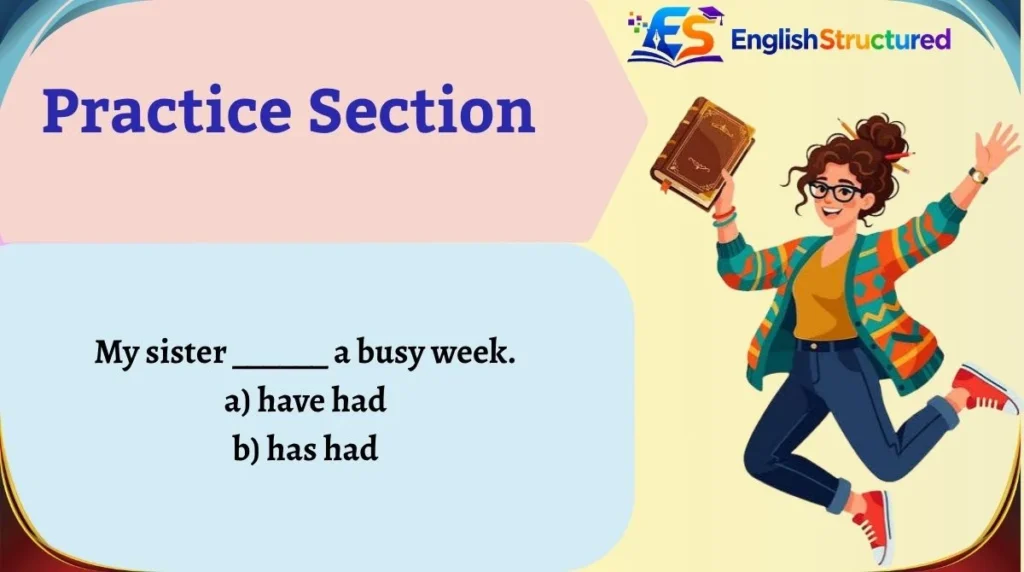
Choose the correct answer: have had or has had.
Question 1
My sister ______ a busy week.
a) have had
b) has had
Question 2
We ______ enough practice today.
a) have had
b) has had
Question 3
The students ______ three English tests this month.
a) have had
b) has had
Question 4
He ______ the same phone for five years.
a) have had
b) has had
Question 5
I ______ many chances to improve my English.
a) have had
b) has had
Answers
- b) has had ✅
- a) have had ✅
- a) have had ✅
- b) has had ✅
- a) have had ✅
Bonus Challenge
Fill in the blanks with have had or has had.
- My parents __________ this car since 2018.
- She __________ a wonderful career.
- I __________ enough water today.
- The baby __________ a long sleep.
- We __________ many happy memories together.
Answers:
- have had
- has had
- have had
- has had
- have had
Practicing with short exercises like these is one of the fastest ways to remember the correct form. Try creating your own sentences every day using different subjects. The more you use have had and has had in real conversations and writing, the more natural they will become.
FAQs
1. What is the difference between have had and has had?
The main difference is the subject. Use have had with I, you, we, they, and plural nouns. Use has had with he, she, it, and singular nouns. Both expressions are part of the present perfect tense and have the same basic meaning.
2. Can we use have had and has had in questions?
Yes. They are commonly used in questions by moving the helping verb to the beginning of the sentence.
Examples:
- Have you had breakfast?
- Have they had enough time?
- Has she had her lunch?
- Has he had any experience?
The same subject rules still apply.
3. Are have had and has had formal or informal?
They are both formal and informal. Native English speakers use them every day in conversations, emails, books, newspapers, business communication, and academic writing. Because they belong to standard English grammar, they are suitable for almost every situation.
Examples:
- I’ve had a great weekend. (Informal)
- The company has had strong financial growth this year. (Formal)
4. Why do English speakers say have had instead of just had?
The phrase have had is used in the present perfect tense, while had alone is usually used in the simple past or past perfect.
Compare these sentences:
- I had a bicycle when I was ten years old. (Finished past action.)
- I have had this bicycle for five years. (Started in the past and continues now.)
The helping verb have shows that the action is still connected to the present.
5. Can have had and has had be used with since and for?
Yes. In fact, they are very often used with since and for to talk about actions or situations that began in the past and continue to the present.
Examples:
- I have had this watch for six years.
- She has had a headache since Monday.
- Have Had or Has Had
- He has had this job since 2021.
Remember:
- Since + starting point
- For + length of time
6. What is the easiest way to remember have had and has had?
The easiest method is to remember the subject rule.
Use have had with:
- I
- You
- We
- They
- Plural nouns
Use has had with:
- He
- She
- It
- Singular nouns
A quick memory sentence is:
“He, She, It = Has Had. Everyone else = Have Had.”
With regular reading, listening, and speaking practice, this pattern soon becomes natural.
Conclusion
Have Had or Has Had
Both expressions belong to the present perfect tense, and both describe actions, experiences, or situations that began in the past and are still connected to the present. The only real difference is the subject you use.
Remember this easy rule: I, you, we, they, and plural nouns take have had, while he, she, it, and singular nouns take has had.
If you keep this pattern in mind, you will avoid many common grammar mistakes.
The best way to master this topic is through regular practice. Read English articles, listen to conversations, and create your own sentences using different subjects.
Over time, choosing the correct form will become automatic.
Every small grammar lesson you learn builds stronger English skills.
Keep practicing, stay curious, and don’t be afraid to make mistakes—they are an important part of becoming a confident English speaker.