Do You Have vs Have You Got vs Did You Get
At first, these questions may sound almost the same. After all, each one can be about getting or having something.
However, they are not always interchangeable. Each expression has its own meaning, grammar pattern, and common use.
This topic is especially important because these three forms appear in everyday conversations, school lessons, movies, emails, and English exams.
If you use the wrong one, native speakers will usually understand you, but your sentence may sound unusual or even change the meaning completely.
Many beginners become confused because American English and British English often prefer different expressions.
You might also hear people using have got in one country and do you have in another.
On top of that, did you get talks about something that happened in the past, while the other two usually ask about what someone has now.
By the end of this guide, you’ll clearly understand when to use “do you have,” “have you got,” and “did you get,” how they differ, which one sounds natural in different situations, and how to avoid common grammar mistakes.
With simple explanations and real-life examples, you’ll feel much more confident using these expressions in daily English.
What Does “Do You Have” Mean?
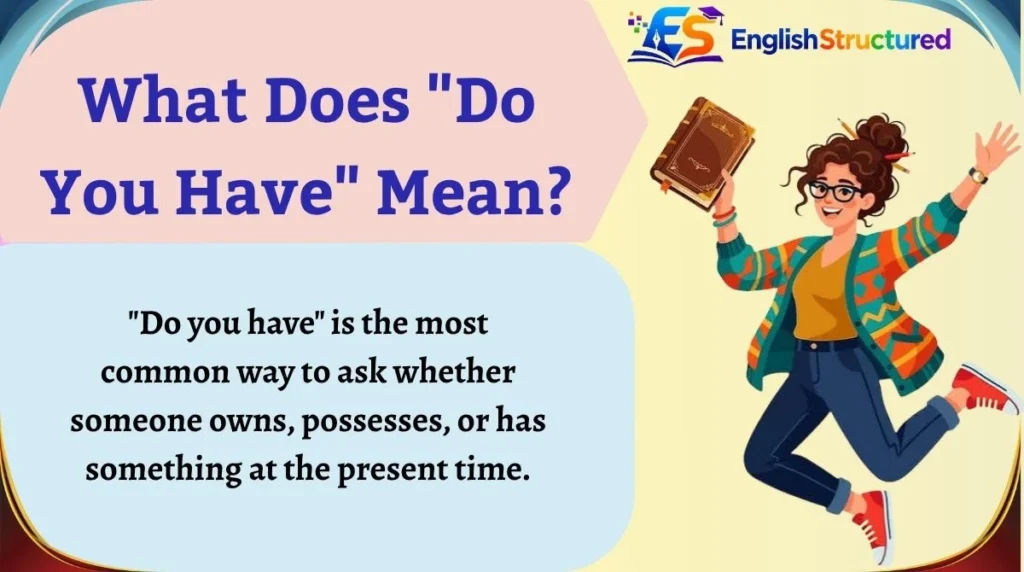
“Do you have” is the most common way to ask whether someone owns, possesses, or has something at the present time. It is widely used in American English, but people around the world understand and use it.
The sentence uses the present simple tense. The helping verb do forms the question, while have acts as the main verb.
When to Use “Do You Have”
Do You Have vs Have You Got vs Did You Get
- Something a person owns
- Something a person is carrying
- Something available now
- Habits or regular situations
- Things people experience
Grammar Rule
The basic structure is:
Do + subject + have + object?
Examples:
- Do you have a pencil?
- Do you have any brothers?
- Do You Have vs Have You Got vs Did You Get
- Do you have time today?
- Do you have a driving license?
- Do you have any questions?
- Do you have a pet?
- Do You Have vs Have You Got vs Did You Get
What Does It Mean?
In each example, the speaker wants to know whether the person has something now. The focus is on the present, not on the past.
For example:
Do You Have vs Have You Got vs Did You Get
This asks whether the person currently owns a passport.
It does not ask when or how they got it.
Everyday Situations
Do You Have vs Have You Got vs Did You Get
- Schools
- Shops
- Restaurants
- Hospitals
- Offices
- Airports
Examples:
Customer: Do you have this shirt in blue?
Do You Have vs Have You Got vs Did You Get
Friend: Do you have my phone charger?
Doctor: Do you have any allergies?
Common Learner Confusion
Many students think do you have and have you got always mean different things.
Actually, when talking about possession, they usually mean the same thing.
For example:
- Do you have a car?
- Have you got a car?
Both ask whether someone owns a car.
Do You Have vs Have You Got vs Did You Get
What Does “Have You Got” Mean?
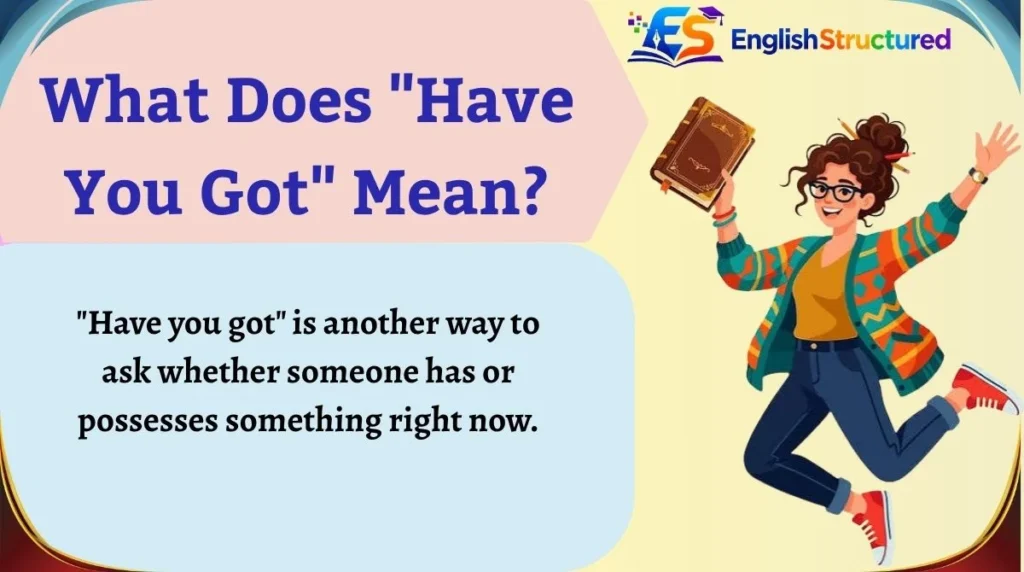
“Have you got” is another way to ask whether someone has or possesses something right now. It is extremely common in British English and sounds very natural in everyday conversations in the UK.
Although the word got appears in the sentence, it usually does not mean “received.” Instead, the whole phrase have got simply means have.
When to Use “Have You Got”
Use it to ask whether someone:
- Owns something
- Is carrying something
- Has something available
- Has a particular quality
- Has a family member, illness, or problem
Grammar Rule
The pattern is:
Have + subject + got + object?
Examples:
- Do You Have vs Have You Got vs Did You Get
- Have you got any milk?
- Have you got your ticket?
- Have you got enough time?
- Have you got a headache?
- Have you got children?
- Have you got any cash?
- Do You Have vs Have You Got vs Did You Get
What Does It Mean?
Do You Have vs Have You Got vs Did You Get
For example:
Have you got any coffee?
The speaker simply wants to know whether coffee is available now.
It does not ask whether someone bought the coffee today.
Where Is It Common?
Do You Have vs Have You Got vs Did You Get
- The United Kingdom
- Ireland
- Australia
- New Zealand
- Many British English classrooms
In American English, people usually prefer:
- Do you have any coffee?
instead of
- Have you got any coffee?
Both are correct, but one sounds more natural depending on the variety of English.
Common Learner Confusion
Many students believe have got is the same as the past tense of get.
It isn’t.
Compare these sentences:
- I have got a new laptop. (I own one now.)
- I got a new laptop yesterday. (I received one yesterday.)
The first sentence describes present possession.
The second sentence describes a past event.
That small difference changes the meaning completely.
Difference Between “Do You Have,” “Have You Got,” and “Did You Get”
Although these expressions sometimes talk about similar things, they answer different questions about time and meaning.
| Expression | Main Meaning | Tense | Common Use | Most Common In |
|---|---|---|---|---|
| Do you have | Ask about present possession | Present Simple | Everyday conversations | American English |
| Have you got | Ask about present possession | Present Perfect structure with present meaning | Casual conversations | British English |
| Did you get | Ask whether someone received or obtained something in the past | Past Simple | Past events | American & British English |
Meaning Comparison
Consider these three questions:
Do You Have vs Have You Got vs Did You Get
This means:
“Is the report with you now?”
Do You Have vs Have You Got vs Did You Get
This has almost the same meaning:
Do You Have vs Have You Got vs Did You Get
Did you get the report?
This asks something completely different:
Do You Have vs Have You Got vs Did You Get
The speaker wants to know whether the action of receiving happened.
Sentence Structure Comparison
| Expression | Structure |
|---|---|
| Do you have | Do + subject + have + object? |
| Have you got | Have + subject + got + object? |
| Did you get | Did + subject + get + object? |
Notice that did is followed by the base verb get, not got.
Correct:
- Do You Have vs Have You Got vs Did You Get
Incorrect:
- Did you got my email?
Quick Meaning Check
Imagine your friend was supposed to receive a package.
You can ask:
Did you get the package?
You are asking about yesterday or earlier today.
Later, after they have received it, you can ask:
Do You Have vs Have You Got vs Did You Get
or
Do You Have vs Have You Got vs Did You Get
Now the focus is on possession instead of receiving.
Grammar Rules You Must Remember
Learning a few simple grammar rules will help you choose the correct expression every time. Instead of memorizing long explanations, focus on how each phrase is used in real situations.
Rule #1: Use “Do you have” for present possession
Use do you have when you want to ask if someone has or owns something right now.
Structure:
Do + subject + have + object?
Examples:
- Do you have a notebook?
- Do you have enough money?
- Do You Have vs Have You Got vs Did You Get
- Do you have a bicycle?
These questions ask about the present situation, not the past.
Rule #2: Use “Have you got” for present possession in British English
Have you got has almost the same meaning as do you have. It is simply more common in British English.
Have + subject + got + object?
Examples:
- Have you got your phone?
- Do You Have vs Have You Got vs Did You Get
- Have you got a map?
- Have you got a ticket?
Do You Have vs Have You Got vs Did You Get
For example:
- I have got a new job.
- Do You Have vs Have You Got vs Did You Get
Both are correct.
Rule #3: Use “Did you get” to ask about receiving something
Do You Have vs Have You Got vs Did You Get
Structure:
Did + subject + get + object?
Examples:
- Did you get my email?
- Did you get your package?
- Did you get the tickets?
- Do You Have vs Have You Got vs Did You Get
The action happened before now.
Rule #4: Never use “got” after did
This is one of the most common grammar mistakes.
After did, always use the base verb.
✅ Correct:
- Did you get my text?
- Did she get the job?
- Do You Have vs Have You Got vs Did You Get
❌ Incorrect:
- Did you got my text?
- Did she got the job?
- Did they got home safely?
The helping verb did already shows that the sentence is in the past.
Common Mistakes Students Make
Many English learners mix these three expressions because they all use the words have or get. Here are the mistakes you should avoid.
Mistake 1: Using did with got
❌ Wrong:
- Did you got my letter?
✅ Correct:
- Did you get my letter?
Why?
After did, always use the base form of the verb.
Mistake 2: Using did you get when asking about present possession
Imagine your friend is holding a book.
❌ Wrong:
- Did you get the book?
This asks whether they received the book earlier.
✅ Better:
- Do you have the book?
- Do You Have vs Have You Got vs Did You Get
These questions ask whether they have it now.
Mistake 3: Thinking have got always means “received”
Look at these sentences.
- I have got a car.
- I got a car yesterday.
The first means:
“I own a car.”
The second means:
“I received or bought a car yesterday.”
The meanings are different.
Mistake 4: Mixing American and British patterns
American English usually prefers:
- Do you have a pen?
British English often prefers:
- Have you got a pen?
Both are correct.
Choose one style and stay consistent when speaking or writing.
Mistake 5: Forgetting the time difference
Ask yourself one question:
Am I asking about having something now or getting it earlier?
If the answer is having now, use:
- Do you have…
- Have you got…
If the answer is receiving earlier, use:
- Did you get…
This simple question prevents many mistakes.
Easy Trick to Remember the Difference
A small memory trick can make these expressions much easier.
Think about the word NOW
If you can replace your question with:
“Do you own it now?”
Use:
- Do you have…
- Have you got…
Example:
Do you have a passport?
You are asking if the passport exists now.
Think about the word BEFORE
If you can replace your question with:
“Did you receive it before now?”
Use:
- Did you get…
Example:
Did you get my email?
You are asking about something that happened earlier.
Another Simple Memory Tip
Remember this phrase:
Have = Own
Get = Receive
Examples:
I have a laptop.
I got a laptop for my birthday.
One shows possession.
The other shows an action.
Whenever you remember Own vs Receive, choosing the correct expression becomes much easier.
Daily Life Examples
These examples show how native speakers naturally use these expressions.
Conversation 1
A: Do you have a charger?
B: Yes, it’s in my bag.
Conversation 2
Do You Have vs Have You Got vs Did You Get
B: Yes, I’m ready to travel.
Conversation 3
A: Did you get my email yesterday?
B: Yes, I replied this morning.
Conversation 4
A: Do you have any homework tonight?
B: Just a little math.
Conversation 5
A: Have you got enough money for lunch?
B: Yes, thanks.
Conversation 6
A: Did you get the concert tickets?
B: Yes, I booked them online.
Conversation 7
A: Do you have a minute?
B: Sure. What’s up?
Conversation 8
A: Have you got a headache?
B: No, I feel fine.
Conversation 9
A: Did you get the package today?
B: Yes, the delivery arrived this afternoon.
Conversation 10
A: Do you have any questions?
B: Yes, I have one about today’s lesson.
These examples show that do you have and have you got ask about the present, while did you get asks about a past action.
Practice Section
Choose the correct option.
1.
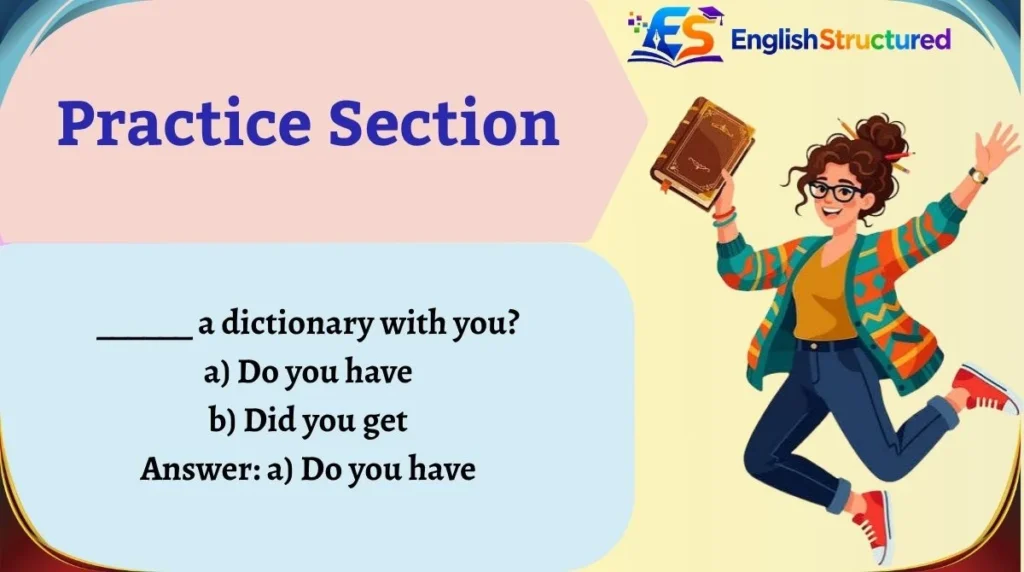
______ a dictionary with you?
a) Do you have
b) Did you get
Answer: a) Do you have
2.
______ my message yesterday?
a) Have you got
b) Did you get
Answer: b) Did you get
3.
______ enough food for everyone?
a) Have you got
b) Did you get
Answer: a) Have you got
4.
______ the tickets from the travel agent?
a) Did you get
b) Do you have
Answer: a) Did you get
5.
______ any brothers or sisters?
a) Do you have
b) Did you get
Answer: a) Do you have
FAQs
1. What is the difference between do you have and have you got?
Both expressions ask about present possession. The main difference is usage. Do you have is more common in American English, while have you got is preferred in British English. In most situations, they have the same meaning.
2. What does did you get mean?
Did you get asks whether someone received, obtained, or bought something in the past. It refers to a completed action, not to present possession.
3. Can I use do you have and have you got interchangeably?
Yes, in most everyday conversations about possession, they are interchangeable. However, your choice may depend on whether you are speaking American or British English.
4. Is have you got formal or informal?
Have you got is common in everyday British English and is generally informal to neutral. It is acceptable in most conversations, but do you have is often preferred in formal writing.
5. Why is Did you got incorrect?
After the helping verb did, English always uses the base form of the main verb. Do You Have vs Have You Got vs Did You Get
6. Which expression should beginners learn first?
If you are learning international or American English, start with do you have because it is widely used and easy to understand. Once you are comfortable with it, learn have you got so you can understand British English conversations more easily.
Conclusion
Do You Have vs Have You Got vs Did You Get
Although do you have and have you got usually ask about having something in the present, did you get asks about receiving or obtaining something in the past.
That small difference in meaning is important in everyday communication.
A simple way to remember this is to think about time. If you are asking whether someone has something now, choose do you have or have you got.
If you are asking whether someone received something earlier, use did you get.
Keep practicing with real conversations, read English every day, and try making your own examples.
The more you use these expressions, the more confident you will become.
Soon, choosing the right one will feel natural, whether you’re speaking with American or British English speakers.