
Couple of or Couple
Sometimes couple refers to two people in a romantic relationship, while a couple of means two or a small number of things.
Because both expressions contain the word couple, it is easy to mix them up.
This small grammar point appears everywhere. You will hear it in daily conversations, TV shows, books, classrooms, emails, and social media posts.
Native English speakers use these expressions naturally, so understanding them will make your English sound more fluent and confident.
Even advanced learners sometimes make mistakes by leaving out of or using the wrong sentence structure.
Knowing the difference also helps you avoid common writing errors.
For example, “I need a couple of minutes” is correct, but “I need couple minutes” is not considered standard English.
Likewise, “The couple is happy” talks about two people together, while “a couple of friends” talks about the number of friends.
The good news is that this topic is much easier than it seems.
Once you understand the meaning, grammar rules, and sentence patterns, choosing the correct expression becomes natural.
By the end of this guide, you’ll clearly understand when to use “couple,” when to use “a couple of,” the differences between them, common mistakes to avoid, and practical examples you can use in everyday English.
What Does “Couple” Mean?
The word couple is a countable noun. In its simplest sense, it means two people or two things that are connected or considered together.
In everyday English, it most commonly refers to two people who are in a romantic relationship, such as a husband and wife, boyfriend and girlfriend, or life partners.
Although couple originally means two, its meaning depends on the context. When people hear the word without extra information, they usually think of two people who are together romantically.
When to Use “Couple”
Use couple when you are talking about:
- Two people in a romantic relationship
- A married pair
- Two people acting together
- Two items that naturally belong together
- A pair that is treated as one unit
Grammar Rule
Couple is a noun, so it normally needs a determiner before it.
Common patterns include:
- a couple
- the couple
- this couple
- that couple
- every couple
Avoid using couple alone before another noun in standard English.
Examples of “Couple”
- The couple enjoyed a quiet dinner together.
- We met a friendly couple during our vacation.
- That couple has lived in this town for many years.
- Couple of or Couple
- Everyone applauded the happy couple after the wedding.
- A lovely couple sat beside us on the train.
- The couple celebrated their tenth anniversary.
- Couple of or Couple
“Couple” Can Also Mean a Pair
Couple of or Couple
Examples:
- The electrician connected a couple of wires into a secure couple. (Less common and technical.)
- The train cars were joined by a coupling to form a connected couple. (Technical use.)
In everyday English, however, most people use pair instead of couple for objects unless the context is about people.
Common Learner Confusion
Many students believe couple always means exactly two. That is true in many situations, but when referring to people, it specifically means two people who are together, not just any two individuals.
Compare these examples:
- Couple of or Couple
- The two students walked into the classroom. ✔ (Not a couple unless they are partners.)
- The couple students arrived late. ✘ (Incorrect English.)
Another common mistake is forgetting the article.
Incorrect:
- Couple is waiting outside.
Correct:
- Couple of or Couple
- A couple is waiting outside.
Tips for Remembering “Couple”
Remember these simple ideas:
- Couple of or Couple
- Usually refers to two people in a relationship
- Often needs “a” or “the” before it
- Can sometimes mean a pair of connected things
Whenever you hear the couple, picture two people standing together. That image will help you remember the correct meaning.
What Does “A Couple of” Mean?
The expression a couple of is one of the most common quantity phrases in English.
It usually means two, but in everyday conversation it can also mean a small number or a few, depending on the context.
Unlike couple, which is a noun, a couple of acts as a quantifier. It tells us how many people, animals, places, or things there are. This expression always comes before a plural countable noun.
Native speakers use a couple of every day because it sounds natural, friendly, and less exact than saying two. For example, if someone says, “I’ll be there in a couple of minutes,” they usually mean about two minutes, not necessarily exactly two.
When to Use “A Couple of”
Couple of or Couple
- Two people
- Two objects
- A small number of things
- A short amount of time
- A few ideas, questions, or examples
It is very common in both spoken and written English.
Grammar Rule
The basic sentence pattern is:
A couple of + plural countable noun
Examples:
- a couple of books
- a couple of chairs
- Couple of or Couple
- a couple of days
- Couple of or Couple
- a couple of cookies
Notice that the noun after of is always plural.
Examples of “A Couple of”
Here are some everyday examples:
- I bought a couple of apples at the market.
- She asked a couple of questions after class.
- We stayed there for a couple of days.
- Can you give me a couple of minutes?
- Couple of or Couple
- They planted a couple of trees in the backyard.
- I watched a couple of interesting movies last weekend.
- We still have a couple of tickets left.
These sentences sound natural because a couple of correctly introduces a plural noun.
Does “A Couple of” Always Mean Exactly Two?
Not always.
Originally, a couple of meant exactly two. However, in modern English, especially in casual conversation, native speakers often use it to mean around two or a few.
For example:
- I’ll call you in a couple of minutes.
- Couple of or Couple
- She has a couple of ideas for the project.
In these examples, the exact number is usually not important. The speaker simply means a small amount.
“A Couple of” vs. “Two”
Both expressions can refer to two things, but they are used differently.
Compare these examples:
- I bought two books. (Exactly two.)
- I bought a couple of books. (Usually two, but spoken English may allow a little flexibility.)
Another example:
- Wait two minutes. (Very exact.)
- Couple of or Couple
Because of this, a couple of often sounds more relaxed and conversational.
Common Learner Confusion
Many English learners make the same mistakes when using a couple of.
Mistake 1: Leaving Out “of”
❌ I need a couple minutes.
✅ I need a couple of minutes.
Although some informal American English drops of, a couple of is the standard form and is recommended for learners.
Mistake 2: Using a Singular Noun
Couple of or Couple
✅ A couple of books
The noun after of must always be plural.
Mistake 3: Using “Couple” Without “A”
❌ Couple of friends came yesterday.
✅ A couple of friends came yesterday.
The article a is part of the complete expression.
Tips for Remembering “A Couple of”
Keep these simple rules in mind:
- Couple of or Couple
- It always comes before a plural countable noun.
- It usually means two or a few.
- It is very common in everyday English.
- Don’t forget the words a and of.
A helpful memory trick is to think of a couple of as another way of saying “a small number of.” Whenever you want to mention a few things without sounding too exact, this expression is often the perfect choice.
Difference Between “Couple” and “A Couple of”
Although couple and a couple of look very similar, they serve different purposes in English grammar. The biggest difference is that couple is a noun, while a couple of is a quantity expression (also called a quantifier).
Understanding this difference will help you build correct sentences and avoid one of the most common grammar mistakes made by English learners.
Quick Comparison Table
| Feature | Couple | A Couple of |
|---|---|---|
| Part of speech | Noun | Quantifier (quantity phrase) |
| Main meaning | Two people together or a pair | Two or a small number of things |
| Function | Names people or a pair | Shows quantity |
| Followed by | A verb or description | A plural countable noun |
| Common use | Romantic partners or a pair | Counting people, objects, places, or time |
| Example | The couple is smiling. | I bought a couple of books. |
Meaning Difference
The easiest way to remember the difference is to focus on what each expression describes.
Couple of or Couple
Example:
- The couple arrived early.
- Everyone welcomed the happy couple.
- That couple loves hiking every weekend.
Here, couple refers to two people who are together.
Couple of or Couple
Example:
- I bought a couple of notebooks.
- She asked a couple of questions.
- Couple of or Couple
In these sentences, the phrase tells us the quantity, not the identity.
Grammar Difference
Another important difference is sentence structure.
Couple of or Couple
Determiner + couple + verb
Examples:
- The couple lives nearby.
- Couple of or Couple
- This couple enjoys cooking together.
Here, couple acts as the subject of the sentence.
Structure with “A Couple of”
Couple of or Couple
Examples:
- A couple of students stayed after class.
- A couple of birds landed on the roof.
- Couple of or Couple
The phrase modifies the plural noun by telling us how many.
Usage Difference
Use couple when talking about:
- A husband and wife
- Two romantic partners
- Two people acting together
- A pair considered as one unit
Examples:
- The young couple bought a new house.
- We met a friendly couple at the hotel.
- Couple of or Couple
Use a couple of when talking about:
- Time
- Objects
- People
- Places
- Animals
- Ideas
- Questions
Examples:
- I need a couple of minutes.
- She owns a couple of bicycles.
- We visited a couple of museums.
- He has a couple of cousins in Australia.
Sentence Structure Comparison
| Correct Sentence with Couple | Correct Sentence with A Couple of |
|---|---|
| The couple is dancing. | A couple of children are playing. |
| Couple of or Couple | I bought a couple of apples. |
| A young couple moved next door. | She has a couple of close friends. |
| That couple enjoys traveling. | We stayed for a couple of nights. |
Notice that couple is usually the subject, while a couple of introduces a plural noun.
Which One Sounds More Natural?
Both expressions are natural, but they are used in different situations.
If you’re introducing two people together, use couple.
- The couple looked happy.
- Everyone admired the couple.
Couple of or Couple
- I have a couple of ideas.
- We need a couple of volunteers.
Trying to replace one with the other usually creates incorrect English.
For example:
❌ The a couple of smiled.
✅ The couple smiled.
❌ I bought couple apples.
✅ I bought a couple of apples.
Meaning Comparison in Context
Look at how the meaning changes with just a few words.
Example 1
- The couple visited Paris.
- A couple of tourists visited Paris.
The first sentence talks about two partners.
The second sentence talks about two or a few tourists.
Example 2
- The couple ordered dinner.
- They ordered a couple of pizzas.
The first sentence tells us who ordered.
The second sentence tells us how many pizzas they ordered.
When Native Speakers Use Each Expression
In everyday English, native speakers naturally choose the expression based on their purpose.
They say:
- The couple is celebrating their anniversary.
- We spent a couple of hours at the beach.
- A couple of friends came over yesterday.
- The elderly couple lives across the street.
- Can I ask you a couple of questions?
Notice how couple introduces people, while a couple of introduces a quantity.
Summary of the Difference
To keep it simple:
- Couple of or Couple
- A couple of = a quantity phrase meaning two or a few, followed by a plural noun.
If you remember this one idea, you’ll choose the correct expression almost every time:
- Who? → Couple
- How many? → A couple of
Grammar Rules You Must Remember
Learning a few simple grammar rules will help you use couple and a couple of correctly every time. These rules are easy to remember and appear in everyday English, school writing, exams, and conversations.
Rule #1: Use “A Couple of” Before a Plural Countable Noun
The expression a couple of is always followed by a plural countable noun. It tells us the quantity of something.
Correct
- I bought a couple of books.
- She needs a couple of chairs.
- We have a couple of ideas.
- He asked a couple of questions.
- They planted a couple of trees.
Incorrect
- I bought a couple of book.
- Couple of or Couple
Why?
Because a couple of refers to more than one thing, the noun must be plural.
Rule #2: Don’t Forget the Words “A” and “Of”
Many learners leave out a or of, especially when translating directly from another language.
Correct
- I have a couple of friends.
- Wait a couple of minutes.
- We visited a couple of cities.
Incorrect
- I have couple friends.
- Wait couple minutes.
- We visited couple cities.
Couple of or Couple
Rule #3: “Couple” Is a Noun and Usually Needs a Determiner
When couple refers to two people together, it usually appears with words like a, the, this, or that.
Correct
- The couple looked happy.
- A couple entered the restaurant.
- Couple of or Couple
- That couple owns a small café.
Incorrect
- Couple looked happy.
- Couple entered the restaurant.
Using a determiner makes the sentence grammatically complete.
Rule #4: Know the Difference in Meaning
Although the words look similar, their meanings are different.
Couple of or Couple
- Refers to two people together.
- Acts as a noun.
Example:
- The couple is celebrating their anniversary.
A Couple of
- Refers to quantity.
- Means two or a small number.
Example:
- They bought a couple of gifts.
Remember this simple idea:
- Couple = People or a pair
- Couple of or Couple
Common Mistakes Students Make
Even advanced learners sometimes confuse these two expressions. Most mistakes happen because the phrases look similar or because students translate directly from their first language.
Learning these common errors will help you avoid them.
Mistake #1: Leaving Out “Of”
This is probably the most common mistake.
Wrong
- I need a couple minutes.
- She bought a couple apples.
Correct
- Couple of or Couple
- She bought a couple of apples.
Why does it happen?
Some learners hear native speakers speak quickly and do not notice the word of. In careful writing and standard English, a couple of is the preferred form.
Easy Tip
Whenever you write a couple, immediately ask yourself, “Did I add ‘of’?”
Mistake #2: Using a Singular Noun
Another common error is using a singular noun after a couple of.
Wrong
- A couple of student
- A couple of book
- Couple of or Couple
Correct
- A couple of students
- A couple of books
- A couple of chairs
Easy Tip
After a couple of, always check whether your noun ends in the plural form.
Mistake #3: Confusing “Couple” with “A Couple of”
Some learners use one expression when they actually need the other.
Wrong
- The couple of books are expensive.
- Couple of or Couple
Correct
- The books are expensive.
- A couple visited us yesterday.
- We bought a couple of books.
Think about what you want to say.
Are you talking about people together?
Couple of or Couple
Are you talking about how many things?
Use a couple of.
Mistake #4: Thinking “A Couple of” Always Means Exactly Two
Originally, a couple of meant exactly two.
Today, many native speakers use it more loosely to mean a small number.
Examples:
- I’ll be back in a couple of minutes.
- We visited a couple of stores.
- Couple of or Couple
In these examples, the speaker usually means around two, not necessarily exactly two.
Mistake #5: Using “Couple” Before Another Noun
Some students write:
❌ Couple friends came over.
The correct sentence is:
Couple of or Couple
Remember that couple alone is not used as a quantity word before another noun.
Mistake #6: Choosing the Wrong Verb
Couple of or Couple
American English
The couple is happy.
British English
The couple are happy.
Both are correct in their own style. However, if you’re learning American English, using is is the safest choice.
Quick Correction Tips
Whenever you write these expressions, ask yourself these questions:
- Am I talking about two people together?
- Am I talking about the number of things?
- Did I include a and of?
- Is the noun plural?
- Does the sentence sound natural?
These quick checks can help you avoid most mistakes before you finish writing.
Couple of or Couple
Easy Trick to Remember the Difference
Grammar becomes much easier when you have a simple memory trick. Instead of trying to memorize every rule, you can connect each expression with a clear picture in your mind.
Memory Trick #1: Think About “Who” or “How Many”
Ask yourself one simple question before you speak or write.
Am I talking about who someone is?
Couple of or Couple
Am I talking about how many things there are?
Use a couple of.
Examples:
- Couple of or Couple
- I need a couple of minutes. (How many minutes? Two or a few.)
This question works in almost every situation.
Memory Trick #2: Picture Two People Holding Hands
Imagine two people standing together and holding hands.
Couple of or Couple
Examples:
- The couple went shopping.
- The happy couple smiled for the photo.
- Everyone congratulated the couple.
Couple of or Couple
Memory Trick #3: Picture a Small Basket
Now imagine a small basket with two apples, two books, or two flowers inside.
Couple of or Couple
Examples:
- A couple of apples
- A couple of books
- Couple of or Couple
This image reminds you that a couple of tells you the quantity.
Memory Trick #4: Remember the Word “Of”
The tiny word of is easy to forget, but it is an important part of the phrase.
Think of this simple sentence:
No “of,” not enough.
If you’re using a couple of to count something, don’t leave out of.
Correct:
- A couple of friends
- A couple of questions
- A couple of weeks
Incorrect:
- Couple friends
- A couple questions (informal in some varieties, but “a couple of questions” is the standard form for learners)
Memory Trick #5: Use This Formula
Keep this formula in your notebook:
- Couple = People
- A couple of = Number
If you remember only this rule, you’ll avoid most grammar mistakes.
Real-Life Logic
Think about these everyday situations.
You see a man and a woman walking together.
You say:
- Couple of or Couple
Now imagine you go to a bookstore.
You buy two novels.
You say:
- I bought a couple of books.
Different situations need different expressions.
A Simple Story to Help You Remember
Imagine Sarah and David are married.
Couple of or Couple
One Saturday, they go shopping.
They buy a couple of books, a couple of plants, and a couple of cups for their new home.
In this short story:
- Couple refers to Sarah and David.
- A couple of tells us how many things they bought.
This is exactly how native speakers use these expressions.
Daily Life Examples
Here are some natural examples that you can hear in everyday conversations. Reading and repeating them aloud will help you remember the correct patterns.
- Can you wait a couple of minutes?
- I have a couple of questions about the homework.
- The young couple moved into the apartment next door.
- We spent a couple of hours at the beach yesterday.
- She invited a couple of friends to her birthday party.
- The happy couple thanked everyone for coming to the wedding.
- I only need a couple of dollars to buy lunch.
- A couple of students stayed after class to ask questions.
- The elderly couple enjoys taking evening walks together.
- Couple of or Couple
Short Conversation Examples
Conversation 1
Anna: Are you busy?
Ben: Just for a couple of minutes.
Conversation 2
Emma: Who lives in that blue house?
Tom: A lovely young couple.
Conversation 3
Teacher: Does anyone have questions?
Student: Yes, I have a couple of questions.
Conversation 4
Friend: How long will you stay?
You: Just a couple of days.
Conversation 5
Mother: Who rang the doorbell?
Son: A young couple asking for directions.
These conversations show how naturally both expressions appear in spoken English. The more you read and practice sentences like these, the easier it becomes to choose the correct form without thinking.
Practice Section
Choose the correct answer to complete each sentence.
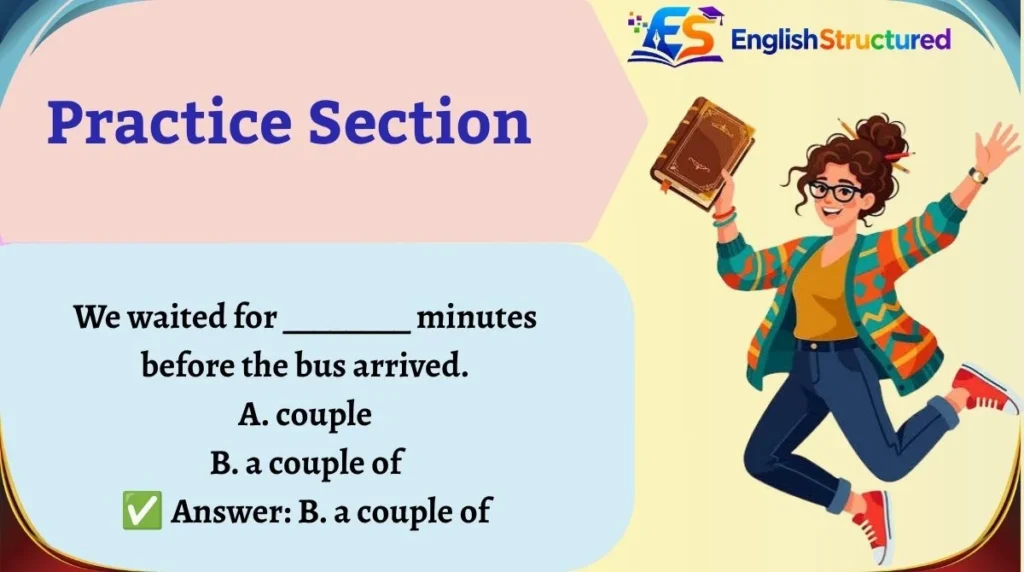
1. We waited for ________ minutes before the bus arrived.
A. couple
B. a couple of
✅ Answer: B. a couple of
2. The happy ________ celebrated their wedding anniversary.
A. couple
B. a couple of
✅ Answer: A. couple
3. She bought ________ notebooks for school.
A. couple
B. a couple of
✅ Answer: B. a couple of
4. A friendly ________ helped us find the hotel.
A. couple
B. a couple of
✅ Answer: A. couple
5. I have ________ ideas for our science project.
A. couple
B. a couple of
✅ Answer: B. a couple of
Bonus Practice
Fill in the blanks with couple or a couple of.
- We stayed there for __________ days.
- The young __________ adopted a puppy.
- I need __________ minutes to finish my work.
- Everyone congratulated the happy __________.
- She borrowed __________ books from the library.
Answers
- a couple of
- couple
- a couple of
- couple
- a couple of
FAQs
1. What is the difference between couple and a couple of?
The main difference is their purpose in a sentence. Couple of or Couple. A couple of is a quantity phrase that means two or a small number of something and is followed by a plural noun.
Examples:
- The couple is celebrating their anniversary.
- I bought a couple of books.
2. Can a couple of mean more than two?
Yes. Although a couple of originally meant exactly two, native speakers often use it to mean a few in informal conversation. The exact number depends on the situation.
For example:
- I’ll be back in a couple of minutes.
- We visited a couple of stores before lunch.
In these examples, the speaker usually means around two, not necessarily exactly two.
3. Can we use a couple of in questions?
Yes. It is very common in questions and sounds natural in both speaking and writing.
Examples:
- Can I ask you a couple of questions?
- Do you have a couple of minutes?
- Could you lend me a couple of dollars?
This expression is polite and commonly used in everyday English.
4. Is a couple of formal or informal?
A couple of can be used in both formal and informal English, but it is more common in everyday conversation because it sounds friendly and natural.
In very formal or academic writing, people sometimes prefer words like two, several, or a small number of, depending on the context.
For example:
- Informal: I have a couple of suggestions.
- Formal: I have two suggestions.
5. Can I say “couple books” or “couple minutes”?
Couple of or Couple
Examples:
✅ I read a couple of books during the holiday.
✅ Please wait a couple of minutes.
Although some native speakers, especially in informal American English, may omit of in speech, English learners should use a couple of because it is the standard and widely accepted form.
6. Is the couple singular or plural?
This depends on the variety of English.
In American English, couple is usually treated as a singular collective noun.
Example:
- The couple is planning a vacation.
In British English, couple may take either a singular or plural verb, depending on whether the speaker is thinking of the pair as one unit or as two individuals.
Examples:
- The couple is very happy.
- The couple are arguing about their plans.
Both forms are correct in British English.
Conclusion
Couple of or Couple
Although the two expressions look similar, they have different jobs in a sentence.
Couple is a noun that usually refers to two people in a romantic relationship or a pair, while a couple of is a quantity phrase that means two or a small number of something.
The easiest way to remember the difference is to ask yourself one simple question: Am I talking about people or about quantity?
If you’re talking about two people together, use couple. If you’re counting things, people, or time, use a couple of followed by a plural noun.
Don’t worry if you make mistakes at first. Every English learner needs practice with common grammar patterns.
Read English books, listen to conversations, and try creating your own sentences using both expressions. The more you practice, the more natural they will become.
Soon, you’ll be able to use couple and a couple of confidently in conversations, school assignments, emails, and everyday writing.