Amid vs Amidst
They have almost the same meaning, and many people wonder if one is more correct than the other.
Some students believe amid is American English and amidst is British English. Others think one is formal while the other is old-fashioned.
These ideas can make learning English confusing.
The good news is that the difference between these two words is very small. In most situations, they can replace each other without changing the meaning of a sentence.
However, knowing the small differences will help you sound more natural and choose the best word for different types of writing.
Both words are common in books, newspapers, stories, speeches, and everyday English.
They describe something happening in the middle of, surrounded by, or during something else. Once you understand how they work, using them becomes much easier.
By the end of this guide, you will clearly understand what amid and amidst mean, how they are used, when they can replace each other, and which one sounds more natural in different situations.
You’ll also see many simple examples, helpful grammar tips, and common mistakes that English learners often make.
What Does “Amid” Mean?
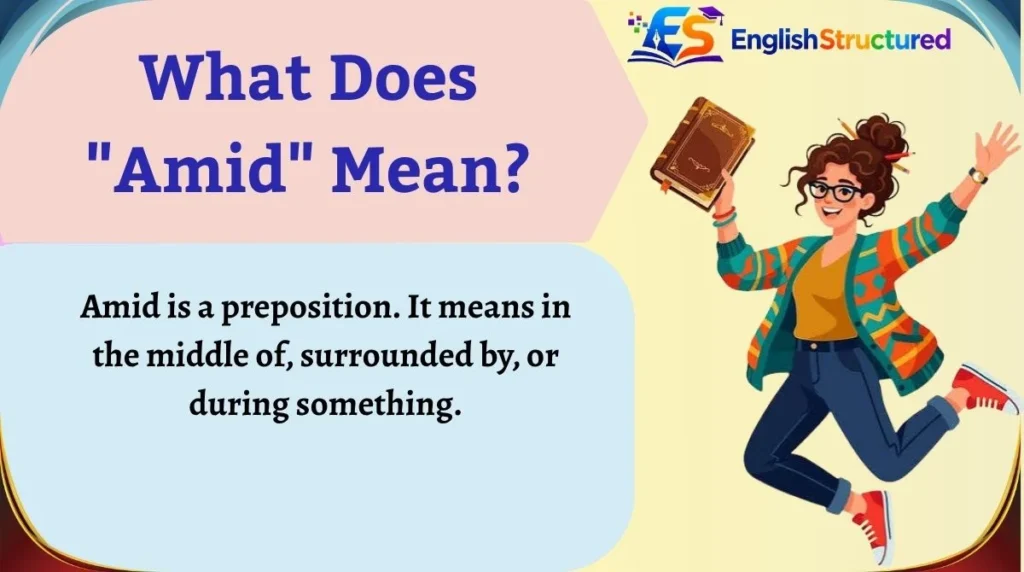
Amid is a preposition. It means in the middle of, surrounded by, or during something. It is used when someone or something is inside a place, situation, event, feeling, or group.
You can think of amid as another way of saying among, in the middle of, or during, depending on the sentence.
Simple Definition
Amid = in the middle of, surrounded by, or during.
When to Use “Amid”
Use amid when talking about:
- Being surrounded by people or objects
- Something happening during an event
- Emotional situations
- Difficult or busy circumstances
- News reports and formal writing
It often introduces a noun or noun phrase.
Grammar Rule
Amid + noun
or
Amid vs Amidst
It is not followed directly by a verb.
✔ Correct:
- Amid vs Amidst
- Amid growing concerns
- Amid loud applause
❌ Incorrect:
- Amid raining
- Amid people were talking
- Amid he walked
Amid vs Amidst
✔ Amid the heavy rain, we continued walking.
✔ Amid growing excitement, the team entered the stadium.
Examples of “Amid”
- The children played amid the tall trees.
- She remained calm amid the chaos.
- Amid vs Amidst
- We found a small house amid the mountains.
- He smiled amid loud applause.
- The flowers bloomed amid the green grass.
- They continued working amid heavy rain.
- The teacher stayed patient amid all the classroom noise.
Common Situations Where “Amid” Is Used
1. During Difficult Times
People often use amid when something happens during a challenging situation.
Examples:
- Amid vs Amidst
- Schools remained open amid severe weather.
2. Surrounded by Nature
You can describe locations surrounded by natural beauty.
Examples:
- Amid vs Amidst
- A lake appeared amid the forest.
3. Emotional Situations
It also describes emotions happening around someone.
Examples:
- She laughed amid everyone’s worries.
- Amid vs Amidst
4. Crowds and Gatherings
Examples:
- The singer walked amid cheering fans.
- Amid vs Amidst
Why Native Speakers Like “Amid”
Many native English speakers prefer amid because it is:
- Short
- Easy to read
- Modern sounding
- Common in newspapers
- Natural in everyday writing
Amid vs Amidst
Examples:
- Amid vs Amidst
- Schools Close Amid Heavy Snow
- Prices Rise Amid Economic Changes
Common Learner Confusion About “Amid”
Amid vs Amidst
That is not true.
It also describes situations, feelings, events, and conditions.
Compare these examples:
Physical place:
- Amid vs Amidst
Situation:
- The team stayed focused amid pressure.
Emotion:
- Amid vs Amidst
Event:
- The meeting ended amid laughter.
Amid vs Amidst
“Amid” Compared with Similar Words
Sometimes learners confuse amid with these words.
Amid vs Amidst
Among is used mainly for people or things in a group.
Example:
- She sat among her friends.
Amid focuses more on being surrounded by a situation, environment, or condition.
Example:
- She smiled amid the confusion.
Amid vs During
Both may describe time, but they are not always interchangeable.
During:
- During the meeting
Amid:
- Amid vs Amidst
During emphasizes time.
Amid emphasizes the surrounding situation or atmosphere.
Amid vs In the Middle of
These expressions often have similar meanings.
Formal:
- The castle stood amid green fields.
Less formal:
- The castle stood in the middle of green fields.
Both are correct, but amid sounds smoother in formal writing.
Tips for Using “Amid” Naturally
Here are a few easy tips.
- Use it before a noun.
- Think “surrounded by.”
- Use it in formal writing and news articles.
- It works well with emotions, events, and places.
- Don’t place a verb directly after it.
Mini Quiz
Choose the correct answer.
- The baby slept _____ the noise.
a) amid
b) amiding
Answer: amid
- The hikers rested _____ the mountains.
a) amid
b) amid of
Answer: amid
- The speech continued _____ loud applause.
a) amid
b) amid was
Answer: amid
Quick Summary of “Amid”
- It is a preposition.
- It means in the middle of, surrounded by, or during.
- It comes before a noun or noun phrase.
- It is very common in modern English.
- It appears frequently in newspapers, books, and formal writing.
- It can describe places, events, emotions, crowds, and difficult situations.
What Does “Amidst” Mean?
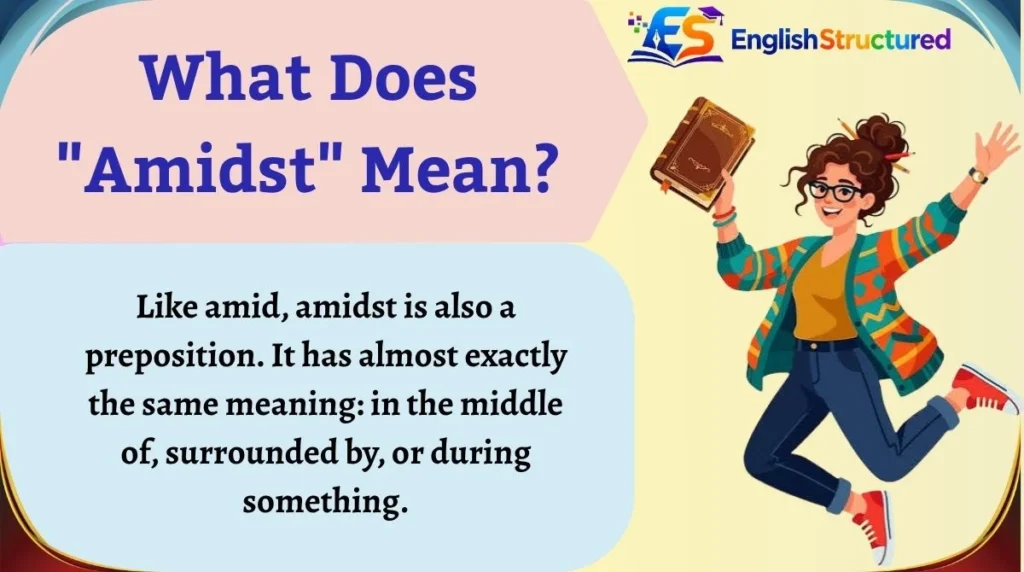
Like amid, amidst is also a preposition. It has almost exactly the same meaning: in the middle of, surrounded by, or during something. The main difference is not the meaning but the style. Amidst has a slightly more traditional, literary, or poetic feel, although it is still correct in modern English.
Amid vs Amidst. You will often see it in novels, speeches, historical writing, and creative storytelling.
Simple Definition
Amid vs Amidst
When to Use “Amidst”
Use amidst in the same kinds of situations as amid, especially when you want a slightly more formal or literary tone.
It is commonly used for:
- Describing scenes in stories
- Historical events
- Nature writing
- Formal speeches
- Creative and descriptive writing
Grammar Rule
Amid vs Amidst
Amid vs Amidst
Amidst + noun phrase
It should not be followed directly by a verb.
✔ Correct:
- Amidst the crowd
- Amidst growing excitement
- Amidst the silence
❌ Incorrect:
- Amidst singing
- Amid vs Amidst
- Amidst was raining
Continue with the same pattern by placing a noun or noun phrase after amidst.
Examples of “Amidst”
Here are some simple examples to show how amidst is used in everyday and formal English.
- The old castle stood amidst beautiful gardens.
- She remained confident amidst all the criticism.
- The hikers walked amidst thick fog.
- The child laughed amidst the falling snow.
- The speaker paused amidst loud applause.
- They found peace amidst the busy city.
- Amid vs Amidst
- The flowers grew amidst the rocks.
Notice that amidst always comes before a noun or noun phrase. It creates the idea of being surrounded by something.
Common Situations Where “Amidst” Is Used
Although amidst has the same meaning as amid, writers often choose it in certain situations because of its style.
1. Describing Nature
Nature writing often uses amidst because it sounds smooth and descriptive.
Examples:
- A waterfall flowed amidst the green hills.
- Birds sang amidst the tall trees.
- Amid vs Amidst
2. Storytelling
Many novels use amidst to paint a picture in the reader’s mind.
Examples:
- The knight stood amidst the smoke.
- She disappeared amidst the crowd.
- The treasure was hidden amidst ancient ruins.
3. Emotional Situations
You can also use amidst when describing feelings or difficult moments.
Examples:
- He smiled amidst uncertainty.
- They stayed hopeful amidst fear.
- Amid vs Amidst
4. Public Events
Examples:
- The actor arrived amidst cheering fans.
- The winner celebrated amidst loud applause.
- Amid vs Amidst
Why Some Writers Prefer “Amidst”
Many writers choose amidst because it sounds:
- More elegant
- Slightly more formal
- Literary
- Descriptive
- Traditional
This does not mean that amidst is old-fashioned or incorrect. It is still used in newspapers, books, magazines, and speeches. However, amid appears more often in modern news writing because it is shorter.
Common Learner Confusion About “Amidst”
Many students think amidst has a different meaning from amid.
It does not.
Compare these sentences:
- The children played amid the flowers.
- Amid vs Amidst
Both are correct.
Another example:
- She smiled amid the excitement.
- She smiled amidst the excitement.
Again, both sentences have the same meaning.
The only difference is the writing style. Amid sounds a little more modern and direct, while amidst feels slightly more literary.
“Amidst” Compared with Similar Words
Amidst vs Among
Among is usually used when talking about people or things in a group.
Example:
- She sat among her classmates.
Amid vs Amidst
Example:
- She remained calm amidst the confusion.
Amidst vs During
During tells us when something happens.
Example:
- During the concert, everyone stood.
Amidst describes the surrounding situation.
Example:
- Amidst loud music, everyone danced.
Amidst vs In the Middle of
Both expressions often mean the same thing.
Formal:
- Amid vs Amidst
Less formal:
- A cottage stood in the middle of the forest.
Both are correct, but amidst sounds more descriptive.
Tips for Using “Amidst” Naturally
Remember these easy tips.
- Use it before a noun.
- Think of “surrounded by.”
- It works well in stories and descriptive writing.
- It often appears in speeches and formal English.
- Never place a verb directly after it.
Mini Quiz
Choose the correct answer.
1. The children laughed _____ the celebration.
a) amidst
b) amidst was
Answer: amidst
2. The castle stood _____ green fields.
a) amidst
b) amidst walking
Amid vs Amidst
3. The team celebrated _____ cheering supporters.
a) amidst
b) amidst they
Answer: amidst
Quick Summary of “Amidst”
- It is a preposition.
- It means in the middle of, surrounded by, or during.
- It comes before a noun or noun phrase.
- It has the same meaning as amid.
- It often sounds slightly more formal or literary.
- It is common in stories, speeches, descriptive writing, and formal English.
Difference Between Amid and Amidst (Detailed)
Many English learners spend a lot of time trying to find a big difference between amid and amidst. The truth is that there is very little difference. Both words have the same meaning and follow the same grammar rules. The main difference is the style and tone they create.
If you replace amid with amidst in most sentences, the meaning stays exactly the same. Native speakers usually choose one over the other based on personal preference or the type of writing.
Comparison Table
| Feature | Amid | Amidst |
|---|---|---|
| Part of speech | Preposition | Preposition |
| Meaning | In the middle of, surrounded by, during | In the middle of, surrounded by, during |
| Grammar | Followed by a noun or noun phrase | Followed by a noun or noun phrase |
| Formality | Neutral to formal | Slightly more formal or literary |
| Common in modern English | Very common | Common but less frequent |
| Common in news headlines | Yes | Less common |
| Common in novels | Yes | Very common |
| Common in everyday writing | Yes | Sometimes |
| Changes the meaning? | No | No |
Usage Difference
Both words describe being surrounded by something.
Compare these examples.
Amid
- Amid vs Amidst
- She smiled amid the excitement.
- The meeting continued amid protests.
Amidst
- The school remained open amidst heavy rain.
- Amid vs Amidst
- The meeting continued amidst protests.
Every sentence means the same thing.
Style Difference
This is the biggest difference.
Amid sounds:
- Short
- Modern
- Direct
- Common in journalism
- Common in business writing
Amidst sounds:
- Literary
- Elegant
- Descriptive
- Traditional
- Common in novels and speeches
Neither word is more correct.
Grammar Logic
Both words follow exactly the same grammar pattern.
Structure:
Amid + noun
Amidst + noun
Examples:
- amid the storm
- amidst the storm
- amid growing concern
- amidst growing concern
- Amid vs Amidst
- amidst applause
You cannot use either word directly before a verb.
Incorrect:
- Amid running
- Amid vs Amidst
Better:
- Amid the running crowd
- Amidst the running crowd
Here, running crowd is a noun phrase.
Sentence Structure Difference
Both words fit into the same sentence structure.
Pattern:
Subject + verb + amid/amidst + noun phrase
Examples:
- The baby slept amid the noise.
- The baby slept amidst the noise.
- The team practiced amid heavy rain.
- The team practiced amidst heavy rain.
No grammar changes are needed.
Meaning Comparison
Both words express one or more of these ideas:
- Surrounded by something
- In the middle of something
- During a situation
- Inside an environment
- Within a condition
Examples:
Physical surroundings:
- A cabin stood amid the trees.
- A cabin stood amidst the trees.
Situation:
- He stayed calm amid the crisis.
- Amid vs Amidst
Emotion:
- She smiled amid the sadness.
- She smiled amidst the sadness.
Time or event:
- The speech ended amid applause.
- The speech ended amidst applause.
The meaning never changes.
Which Word Should You Choose?
If you are unsure, amid is usually the safer choice because it is more common in modern English.
Choose amid when you are writing:
- School assignments
- News articles
- Emails
- Reports
- Business documents
- Everyday English
Choose amidst when you want a slightly more descriptive or elegant style, such as in:
- Stories
- Novels
- Poems
- Speeches
- Historical writing
- Creative essays
Remember that many native speakers use both words naturally. Your choice depends more on style than grammar.
Can You Always Replace One with the Other?
In almost every situation, yes.
For example:
- The ship sailed amid rough seas.
- The ship sailed amidst rough seas.
- She stood amid friends.
- She stood amidst friends.
- The announcement came amid growing concern.
- The announcement came amidst growing concern.
All of these sentences are correct and natural.
Amid vs Amidst
Grammar Rules You Must Remember
Even though amid and amidst are easy to use, there are a few grammar rules that every English learner should remember. These simple rules will help you avoid common mistakes and make your writing sound more natural.
Rule #1: Always Use “Amid” and “Amidst” as Prepositions
Both amid and amidst are prepositions. This means they introduce a noun or noun phrase. They are not verbs, adjectives, or conjunctions.
Correct:
- The children played amid the flowers.
- Amid vs Amidst
- We walked amid the trees.
- The speaker continued amidst loud applause.
Incorrect:
- The children amid happily.
- She amidst everyone.
- They amid quickly.
Easy Tip: If a noun comes after amid or amidst, you are probably using it correctly.
Rule #2: Follow Them with a Noun or Noun Phrase
Amid vs Amidst
Correct:
- amid the crowd
- amidst the storm
- Amid vs Amidst
- amidst heavy traffic
Incorrect:
- amid people were talking
- amidst she arrived
- amid they celebrated
If you want to include an action, turn it into a noun phrase.
Correct:
- Amid vs Amidst
- Amidst the falling snow, the children built a snowman.
Rule #3: Don’t Add “Of” After Them
One of the most common learner mistakes is adding of after amid or amidst.
Correct:
- amid the trees
- amidst the noise
- amid growing excitement
Incorrect:
- amid of the trees
- amidst of the noise
- amid of the crowd
Unlike some other English expressions, these prepositions never need of.
Rule #4: Choose the Word That Matches Your Writing Style
Since both words have the same meaning, your choice depends mainly on the style of writing.
Use amid for:
- Everyday English
- News reports
- Business writing
- School assignments
- Formal documents
Amid vs Amidst
- Stories
- Poems
- Speeches
- Historical writing
- Descriptive passages
Example:
News style:
The company expanded amid rising demand.
Story style:
Amid vs Amidst
Both are correct. The tone is simply different.
Common Mistakes Students Make
Many English learners understand the meaning of amid and amidst, but they still make small grammar mistakes. Learning these common errors will help you avoid them.
Mistake #1: Adding “Of”
Many students write:
❌ We walked amid of the trees.
The correct sentence is:
✔ We walked amid the trees.
Amid vs Amidst
Mistake #2: Using Them Before a Complete Sentence
Some learners think these words can join two complete sentences.
Wrong:
❌ Amid she was tired, she finished her work.
Correct:
✔ Amid her tiredness, she finished her work.
✔ Despite being tired, she finished her work.
Remember, amid introduces a noun phrase, not an independent clause.
Mistake #3: Thinking They Have Different Meanings
Some learners believe amid means one thing and amidst means another.
That is incorrect.
Compare:
- The baby slept amid the noise.
- Amid vs Amidst
Both sentences mean exactly the same thing.
Mistake #4: Overusing “Amidst”
Because amidst sounds more formal, some learners use it everywhere.
For example:
❌ We ate lunch amidst our office.
This sounds unnatural.
A better sentence is:
✔ We ate lunch in our office.
Or, if describing surroundings:
✔ We ate lunch amidst the busy office atmosphere.
Choose these words only when they naturally express the idea of being surrounded by something.
Mistake #5: Confusing “Amid” with “Among”
These words are similar but not identical.
Among usually refers to people or things in a group.
Example:
- She sat among her classmates.
Amid focuses on the surrounding situation or environment.
Example:
- She stayed calm amid the confusion.
Easy Tip: Think among = group, amid = surroundings or situation.
Easy Trick to Remember the Difference
Many students ask if there is a quick way to remember when to use amid and amidst.
Here’s a simple memory trick.
Memory Trick
Think of amid as the short, modern version.
Think of amidst as the longer, more literary version.
Both mean exactly the same thing.
Only the style changes.
Real-Life Logic
Imagine two people describing the same beautiful park.
Person A says:
We had a picnic amid the flowers.
Person B says:
We had a picnic amidst the flowers.
Both pictures are identical.
The second sentence simply sounds a little more elegant.
Another Easy Way to Remember
Ask yourself one question:
Am I talking about being surrounded by something?
If the answer is yes, both amid and amidst are possible.
Examples:
- amid laughter
- amidst laughter
- amid the forest
- amidst the forest
- amid heavy rain
- amidst heavy rain
The meaning stays the same.
Student-Friendly Summary
Remember these three simple points:
- Same meaning
- Same grammar
- Different style
If you remember those three ideas, you’ll rarely make mistakes with these words.
Daily Life Examples
Here are some everyday sentences that show how native speakers use amid and amidst naturally.
- We found a quiet café amid the busy streets.
- She stayed calm amid all the excitement.
- The children laughed amidst the falling snow.
- He walked amidst cheering fans after the game.
- The meeting continued amid several interruptions.
- They built a small house amidst the mountains.
- She smiled amid the confusion.
- The singer appeared amidst loud applause.
- Amid vs Amidst
- The old church stood amidst beautiful gardens.
These examples show that both words fit naturally into everyday English, especially when describing surroundings, situations, or events.
Practice Section
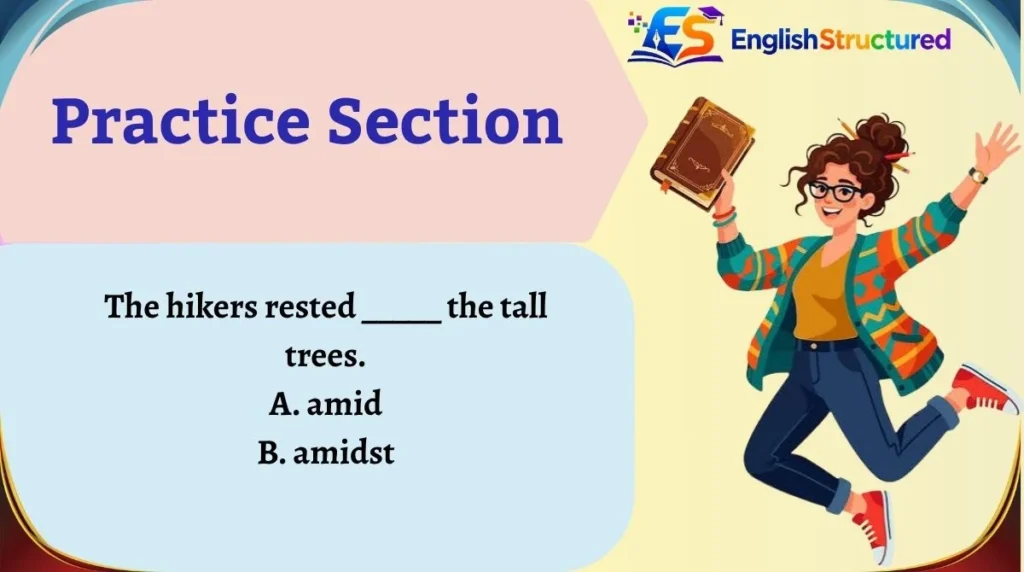
Choose the correct word: amid or amidst.
1.
The hikers rested _____ the tall trees.
A. amid
B. amidst
2.
The teacher remained calm _____ the noisy classroom.
A. amid
B. amidst
3.
The announcement came _____ growing concern.
A. amid
B. amidst
4.
The castle stood _____ beautiful hills.
A. amid
B. amidst
5.
The players celebrated _____ loud applause.
A. amid
B. amidst
Answers
- A or B (Both are correct.)
- A or B (Both are correct.)
- A or B (Both are correct.)
- A or B (Both are correct.)
- A or B (Both are correct.)
Why? Because amid and amidst have the same meaning and follow the same grammar rules. The only difference is the style. Amid sounds more modern and is more common in everyday writing, while amidst has a slightly more formal or literary tone.
FAQs
1. What is the difference between amid and amidst?
The difference between amid and amidst is mainly one of style, not meaning. Both words mean “in the middle of,” “surrounded by,” or “during.” They follow the same grammar rules and can usually replace each other. Amid is more common in modern English, while amidst has a slightly more literary or traditional feel.
2. Can amid and amidst be used interchangeably?
Yes. In almost every situation, you can use either amid or amidst without changing the meaning of the sentence.
Examples:
- The child laughed amid the celebration.
- The child laughed amidst the celebration.
Both sentences are correct. The only difference is the writing style.
3. Is amid more common than amidst?
Yes. Amid is used more often in today’s English, especially in:
- Newspapers
- News headlines
- Business writing
- School writing
- Everyday communication
Amid vs Amidst
4. Is amidst old-fashioned?
No. Amidst is not old-fashioned, but it does sound a little more traditional or literary than amid.
You will still find amidst in:
- Novels
- Speeches
- Historical writing
- Magazines
- Creative essays
It remains a correct and widely accepted English word.
5. Can amid and amidst be used in questions?
Yes. Both words can appear naturally in questions whenever you want to describe something surrounded by a place, situation, or event.
Examples:
- Did you stay calm amid the confusion?
- Was the village hidden amidst the mountains?
- How did she remain confident amid so much pressure?
As always, place a noun or noun phrase after the preposition.
6. Can I use amid or amidst in informal English?
Yes, especially amid. It sounds natural in everyday conversations, emails, and casual writing.
Examples:
- We found a quiet place amid the crowd.
- She smiled amid all the excitement.
Amidst is also correct, but it may sound a little more formal or descriptive in casual conversation.
Conclusion
Amid vs Amidst
Both words mean “in the middle of,” “surrounded by,” or “during,” and both are used as prepositions followed by a noun or noun phrase.
Their grammar is the same, and in most sentences you can replace one with the other without changing the meaning.
The biggest difference is style. Amid is shorter and more common in modern English, making it a great choice for everyday writing, school assignments, business communication, and news articles.
Amidst, on the other hand, adds a slightly more literary or descriptive tone, so it often appears in stories, speeches, and creative writing.
The best way to master these words is through regular reading and practice. Pay attention to how native speakers use them in books, newspapers, and conversations.
As you become more familiar with their style, choosing between amid and amidst will feel natural.
Remember, understanding the context is more important than memorizing rules.
With consistent practice, you’ll be able to use both words confidently and correctly in your own English.