Year Old or Years Old Hyphen Rule
Then you may have seen another sentence such as “She is five years old” and noticed that there are no hyphens at all.
This small difference causes a lot of confusion for English learners.
The words year and years are easy enough on their own. The tricky part is knowing when to write year old, years old, year-old, or years-old.
The answer depends on the job the phrase is doing in the sentence.
For example:
- My son is ten years old.
- Year Old or Years Old Hyphen Rule
Both sentences talk about the same age, but their grammar is different.
The good news is that the rule is much easier than it first appears. You do not need to memorize a long list of complicated grammar rules.
You only need to look at where the age phrase appears and what it describes.
By the end of this guide, you will know exactly when to use year old, years old, and year-old.
You will also learn why years-old is usually incorrect, how to use these forms in questions, and how to avoid common mistakes in school, work, and everyday English.
What Does “Year Old” Mean?
Year old is part of an expression that tells us someone’s or something’s age.
However, the exact form depends on how the phrase is used.
When an age comes after a linking verb, we normally use:
Year Old or Years Old Hyphen Rule
For example:
- She is six years old.
- My brother is twenty years old.
- The building is one hundred years old.
Here, years old works as a description of the subject’s age.
Notice that year changes to years when the number is more than one.
We say:
- one year old
- two years old
- five years old
- Year Old or Years Old Hyphen Rule
The plural form is used because we are talking about more than one year.
Examples of “year old” in sentences
- My daughter is one year old.
- My son is seven years old.
- The dog is three years old.
- Year Old or Years Old Hyphen Rule
- How old is your sister? She is sixteen years old.
- The house is almost fifty years old.
- Year Old or Years Old Hyphen Rule
- The school is more than one hundred years old.
In all these examples, the age comes after the verb.
The basic structure is:
Subject + be + number + year(s) old
For example:
Year Old or Years Old Hyphen Rule
Why do we use “years” here?
The answer is simple.
If the number is greater than one, the noun year normally becomes plural.
So:
He is one year old.
But:
Year Old or Years Old Hyphen Rule
We do not normally say:
He is five year old.
That form is incorrect when the phrase comes after the verb.
A common learner confusion
Many learners learn the expression five-year-old as a fixed phrase. Later, they may use that same form everywhere.
For example, they may write:
Year Old or Years Old Hyphen Rule
That can be grammatically possible when five-year-old is being used as a noun, but it is not the normal structure when simply stating a person’s age.
The usual sentence is:
Year Old or Years Old Hyphen Rule
But when the age directly describes a noun, we change the structure:
She is a five-year-old girl.
That small change is the key to understanding the hyphen rule.
What Does “Years Old” Mean?
Years old is normally used when we are directly stating or asking about age.
It is especially common after forms of the verb be.
Examples include:
- I am twenty years old.
- He is twelve years old.
- Year Old or Years Old Hyphen Rule
- How old are you?
- How many years old is the child?
The phrase years old tells us how long a person, animal, object, or place has existed.
Examples of “years old”
- My brother is eighteen years old.
- Year Old or Years Old Hyphen Rule
- That tree is forty years old.
- Our car is seven years old.
- The museum is two hundred years old.
- How many years old is your house?
- Their puppy is only six months old.
- My teacher is thirty-five years old.
The normal structure is:
Year Old or Years Old Hyphen Rule
For example:
Sarah is twenty years old.
There is no hyphen between the number, year, and old in this structure.
Why is there no hyphen?
Because twenty years old is functioning as a normal description after the verb is.
The phrase is not acting as one compound adjective directly before a noun.
Compare these two sentences:
Year Old or Years Old Hyphen Rule
Tom is a ten-year-old boy.
In the first sentence, ten years old tells us Tom’s age.
In the second sentence, ten-year-old works together as one adjective describing boy.
That is why the punctuation changes.
Another important point: “years-old” is usually wrong
A common mistake is:
Year Old or Years Old Hyphen Rule
This is incorrect in standard English.
The correct sentence is:
He is five years old.
The hyphens are not used when the phrase comes after the verb in this way.
Difference Between “Year Old” and “Years Old”
The easiest way to understand the difference is to ask:
Is the age phrase directly stating someone’s age, or is it describing a noun?
Look at these examples:
My daughter is six years old.
My daughter is a six-year-old student.
The meaning is almost the same, but the grammar is different.
Comparison Table
| Form | Use | Example |
|---|---|---|
| one year old | Stating age | The baby is one year old. |
| five years old | Stating age | The boy is five years old. |
| five-year-old | Describing a noun | A five-year-old boy smiled. |
| five-year-old | Compound adjective | She owns a five-year-old car. |
| five years-old | Normally incorrect | ❌ He is five years-old. |
| five year old | Usually incorrect before a noun | ❌ a five year old boy |
When to use “years old”
Use years old when the phrase comes after the verb and directly tells us the age.
Examples:
My sister is ten years old.
The house is fifty years old.
How old is the car?
The car is fifteen years old.
There are no hyphens.
When to use “year-old”
Use year-old when the entire age expression comes directly before a noun and works as a compound adjective.
Examples:
a ten-year-old boy
Year Old or Years Old Hyphen Rule
a twenty-year-old building
a five-year-old computer
Notice something important.
Even though the age is more than one year, we use the singular form year, not years, inside the compound adjective.
So we write:
a ten-year-old boy
Not:
a ten-years-old boy
Why does “year” become singular?
Because the complete phrase ten-year-old is acting like one adjective.
Think of it as one descriptive unit:
ten-year-old + boy
The word ten tells us the number of years, but year remains singular inside this compound expression.
This is one of the most important rules to remember.
Grammar Rules You Must Remember
Rule #1: Use “years old” after the verb
When you are simply stating someone’s age, use years old.
Examples:
- Emma is eight years old.
- Year Old or Years Old Hyphen Rule
- The building is sixty years old.
Do not add hyphens.
Correct:
He is fifteen years old.
Incorrect:
Year Old or Years Old Hyphen Rule
Rule #2: Use “year-old” before a noun
When the age directly describes a noun, use a hyphenated compound adjective.
Examples:
- a six-year-old child
- a twelve-year-old student
- a four-year-old car
- a ninety-year-old man
The hyphens join the words together because they work as one description.
For example:
We met a seven-year-old girl.
The phrase seven-year-old describes girl.
Rule #3: Keep “year” singular in a compound adjective
This rule catches many learners.
Even when the number is plural in meaning, use year, not years, inside the compound adjective.
Correct:
Year Old or Years Old Hyphen Rule
Incorrect:
a ten-years-old boy
Correct:
Year Old or Years Old Hyphen Rule
Incorrect:
a twenty-years-old student
Think of ten-year-old as one grammatical unit.
Rule #4: Do not hyphenate the normal age expression
When the phrase follows the verb, leave it open.
Correct:
She is seven years old.
Correct:
Year Old or Years Old Hyphen Rule
Incorrect:
She is seven-years-old.
Incorrect:
The house is twenty-years-old.
The hyphens return when the phrase moves before a noun:
Year Old or Years Old Hyphen Rule
It is a twenty-year-old house.
Common Mistakes Students Make
Age expressions look simple, but small punctuation mistakes are very common.
Mistake 1: Writing “years-old” after a verb
Many students write:
Year Old or Years Old Hyphen Rule
The correct version is:
✅ My daughter is six years old.
Why?
Because six years old is telling us her age. It is not directly acting as a compound adjective before another noun.
Mistake 2: Writing “years” before a noun
Another common error is:
❌ He is a ten-years-old boy.
The correct form is:
Year Old or Years Old Hyphen Rule
The phrase ten-year-old describes the noun boy, so it becomes a compound adjective.
Mistake 3: Forgetting the hyphens before a noun
Some learners write:
❌ She is a five year old girl.
The preferred standard form is:
Year Old or Years Old Hyphen Rule
The hyphens make it clear that the whole expression works together to describe girl.
Mistake 4: Using the plural “years” inside the compound adjective
This is another frequent error:
❌ a six-years-old child
Correct:
✅ a six-year-old child
Remember:
Compound adjective = singular year
Mistake 5: Adding unnecessary hyphens everywhere
Some learners learn the hyphen rule and then start hyphenating every age expression.
They may write:
❌ My father is sixty-five-years-old.
Correct:
Year Old or Years Old Hyphen Rule
But:
✅ My father is a sixty-five-year-old man.
The location of the phrase changes the punctuation.
Easy Trick to Remember the Difference
Here is a very simple trick:
Look at the word after the age.
If the age comes before a noun, use:
number + year-old + noun
For example:
a ten-year-old boy
a five-year-old car
a three-year-old tree
If the age comes after the verb, use:
number + years old
For example:
The boy is ten years old.
The car is five years old.
Year Old or Years Old Hyphen Rule
You can remember it like this:
Before a noun → hyphens
After the verb → no hyphens
There is one more small detail:
Before a noun → year
After the verb → year/years according to the number
So:
a seven-year-old child
but:
Year Old or Years Old Hyphen Rule
A quick classroom trick
Imagine that the age phrase is wearing a little “grammar belt.”
If it is standing directly in front of a noun, the words are tied together:
a 12-year-old student
If it is standing after the verb, the words are free:
The student is 12 years old.
This is not a formal grammar rule, of course. It is just an easy way to remember the difference.
Daily Life Examples
Age expressions appear everywhere in everyday English. Here are some natural examples you may hear or use.
1. Talking about a child
“How old is your daughter?”
“She is six years old.”
If you put the age before the noun:
“I have a six-year-old daughter.”
2. Talking about a pet
“How old is your dog?”
Year Old or Years Old Hyphen Rule
Before a noun:
“I have a three-year-old dog.”
3. Talking about a car
“How old is your car?”
“It is eight years old.”
Before a noun:
“I bought an eight-year-old car.”
4. Talking about a building
“This building is fifty years old.”
Before a noun:
“This is a fifty-year-old building.”
5. Talking about a student
“The student is fourteen years old.”
Before the noun:
“A fourteen-year-old student won the competition.”
6. Talking about a baby
“My baby is one year old.”
Before a noun:
“I have a one-year-old baby.”
Notice that one year remains singular in both cases.
7. Talking about a restaurant
“That restaurant is twenty years old.”
Before the noun:
“That is a twenty-year-old restaurant.”
8. Talking about a tree
“This tree is one hundred years old.”
Before the noun:
“This is a one-hundred-year-old tree.”
9. Talking about a person
“My uncle is sixty years old.”
Before the noun:
“My sixty-year-old uncle still plays tennis.”
10. Talking about a computer
“My computer is five years old.”
Before the noun:
“I need to replace my five-year-old computer.”
These examples show the pattern clearly. The meaning stays similar, but the grammar changes depending on the position of the age expression.
Practice Section
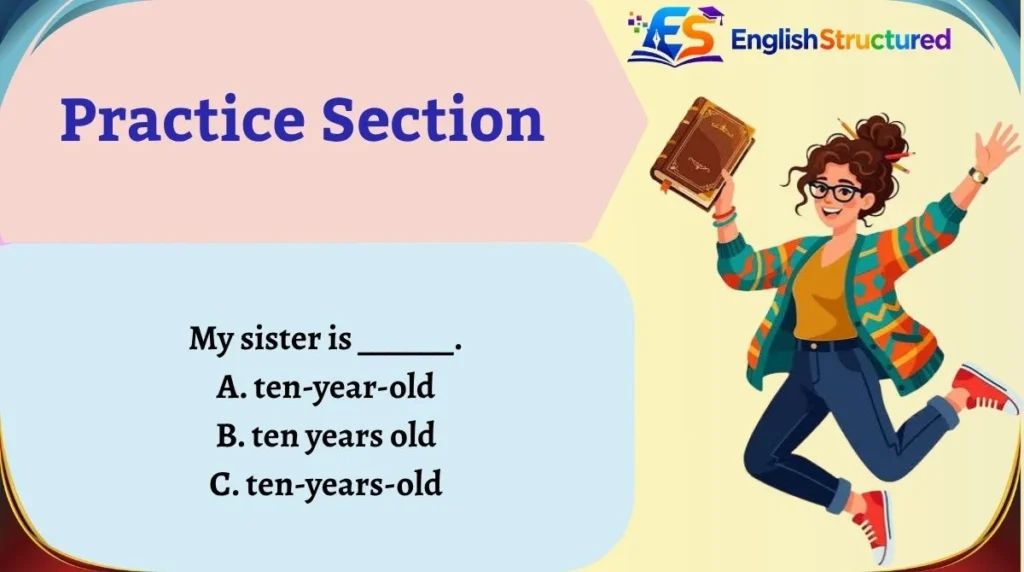
Choose the correct form in each sentence.
1. My sister is ______.
A. ten-year-old
B. ten years old
C. ten-years-old
2. We met a ______ boy at the park.
A. seven years old
B. seven-years-old
C. seven-year-old
3. This house is ______.
A. forty years old
B. forty-year-old
C. forty-years-old
4. She has a ______ car.
A. five years old
B. five-year-old
C. five-years-old
5. The dog is ______.
A. three-year-old
B. three-years-old
C. three years old
Answers
1. B — ten years old
My sister is ten years old.
The age comes after the verb is, so there are no hyphens.
Year Old or Years Old Hyphen Rule
We met a seven-year-old boy.
The age comes before the noun boy, so it becomes a hyphenated compound adjective.
3. A — forty years old
This house is forty years old.
The phrase follows the verb is.
4. B — five-year-old
She has a five-year-old car.
The age directly describes car.
5. C — three years old
The dog is three years old.
Again, the age comes after the verb.
FAQs
Is it “five year old” or “five years old”?
If you are directly stating someone’s age, use five years old.
Year Old or Years Old Hyphen Rule
If the phrase comes before a noun, use five-year-old.
He is a five-year-old boy.
Is “years-old” correct?
Usually, no.
When you state an age after a verb, do not use hyphens:
She is ten years old.
When the age directly describes a noun, use ten-year-old:
She is a ten-year-old girl.
So years-old is normally not the form you want.
Should I write “a 10-year-old” or “a 10 years old”?
Use a 10-year-old when the phrase describes a person or noun.
A 10-year-old boy answered the question.
If you are simply stating the person’s age, write:
The boy is 10 years old.
Why is “year” singular in “ten-year-old”?
Because ten-year-old is a compound adjective.
The whole expression works as one description before a noun:
Year Old or Years Old Hyphen Rule
Standard English uses the singular form year inside this compound.
Can “year-old” be used as a noun?
Yes, especially when the noun is understood from the context.
For example:
The two year-olds were playing together.
Here, year-olds is functioning as a noun, meaning children who are two years old.
You may also see:
The five-year-old won the race.
The word child is understood even though it is not written.
Do I need hyphens with ages in questions?
Usually, no, when you are simply asking about age.
For example:
How old is your son?
How many years old is she?
But if the age appears before a noun, use the compound form:
Is that a ten-year-old car?
The same basic rule still applies: before a noun, use the hyphenated compound adjective.
Is “one-year-old” or “one-year-old” correct?
The correct form is:
one-year-old
For example:
She has a one-year-old daughter.
When stating the age:
Her daughter is one year old.
Notice that one year stays singular because the number is one.
Is “20 years old” or “20-year-old” correct?
Both can be correct, but they are used differently.
He is 20 years old.
Here, you are stating his age.
He is a 20-year-old student.
Here, 20-year-old describes student.
The grammar determines the form.
Conclusion
Year Old or Years Old Hyphen Rule
When you are simply telling someone how old a person, animal, object, or place is, use years old without hyphens:
She is ten years old.
When the age comes directly before a noun and describes that noun, use a hyphenated compound adjective:
She is a ten-year-old girl.
There is one especially useful rule to keep in mind: use singular “year” inside a hyphenated age expression.
So write:
a five-year-old child
not:
a five-years-old child.
The easiest memory trick is simple: before a noun, use hyphens; after a verb, do not.
Once you notice this pattern in everyday English, the rule becomes much easier.
Try making a few sentences about your family, pets, car, school, or home. A little practice will make the correct form feel natural.