English learners often know the word motivate, but they are not always sure what should come after it.
Motivate To or -ing
These questions are common because English uses different patterns after different verbs.
The good news is that the basic rule is quite simple.
When motivate means “to give someone a reason, desire, or encouragement to do something,” it is normally followed by a person + to + base verb.
For example:
The teacher motivated the students to work harder.
We do not normally say:
The teacher motivated the students working harder.
The word motivate is especially common in school, work, sports, business, and everyday conversation.
You may hear people talk about motivating employees, motivating children, motivating a team, or motivating themselves.
There is also an important difference between using motivate and using an -ing form elsewhere in the sentence.
An -ing word can appear after motivate in some structures, but it usually does not replace the normal to + verb pattern.
By the end of this guide, you will know when to use “motivate someone to do something,” when an -ing form is possible, which mistakes to avoid, and how native speakers normally use these structures.
What Does “Motivate to” Mean?
Motivate to is the most important pattern to learn with the verb motivate.
The common structure is:
Motivate To or -ing
It means to encourage or inspire someone to take a particular action.
For example:
Motivate To or -ing
Here, my parents are the people giving encouragement, me is the person receiving that encouragement, and to study describes the action.
The pattern is easy to remember:
Someone motivates a person to do something.
The person after motivate is important. We normally need an object when we use motivate in this meaning.
The basic grammar rule
Use:
subject + motivate + person + to + verb
Examples:
- Motivate To or -ing
- Her teacher motivated her to read more books.
- The manager motivated the staff to improve their work.
- His success motivated him to try again.
- The speech motivated us to take action.
- My parents motivated me to become more confident.
- Motivate To or -ing
- Her friends motivated her to start exercising.
Notice that the verb after to stays in its basic form.
We say:
She motivated me to work harder.
Not:
Motivate To or -ing
And not:
She motivated me to working harder.
Why do we use “to + verb”?
The to-infinitive often shows an action that someone is encouraged or persuaded to perform.
Compare these examples:
Motivate To or -ing
John receives motivation, and study is the action he is encouraged to perform.
The coach motivated the team to train every morning.
The team is encouraged to perform the action train.
This is why to + base verb is the natural choice after an object with motivate.
More examples with “motivate someone to”
- The story motivated me to change my habits.
- Motivate To or -ing
- The coach motivated the players to believe in themselves.
- My teacher motivated me to speak English every day.
- The award motivated the young artist to continue painting.
- Motivate To or -ing
- The team’s victory motivated everyone to try harder.
- The manager motivated the employees to meet their goals.
These examples all follow the same pattern. Once you learn that pattern, you can use motivate with much more confidence.
A common learner confusion
Students sometimes think that because motivate is related to an action, an -ing form should follow it.
For example, they may write:
❌ The teacher motivated me studying harder.
The natural sentence is:
✅ The teacher motivated me to study harder.
The mistake happens because many English verbs can be followed by -ing, while others commonly take to + verb. You need to learn the pattern that belongs to each verb.
What Does “Motivate + -ing” Mean?
The -ing form is where things become a little more interesting.
English does allow an -ing form to appear in sentences containing motivate, but that does not mean that motivate + person + -ing is the normal pattern.
For example:
Motivate To or -ing
There is no -ing form here after motivate. But we could add an -ing phrase elsewhere:
The possibility of winning motivated him.
Here, winning is an -ing form, but it belongs to the phrase the possibility of winning.
This is very different from saying:
❌ The possibility motivated him winning.
The correct structure is:
Motivate To or -ing
When can an -ing form appear with “motivate”?
An -ing form may appear as a gerund or present participle in a larger sentence, depending on its grammatical role.
For example:
Motivate To or -ing
The word helping is a gerund because it is part of the noun phrase the idea of helping others.
Another example:
Motivate To or -ing
Here, losing follows the preposition of, not the verb motivate.
The important point is this:
Do not assume that an -ing word after “motivate” is automatically the object of “motivate.”
Look at the complete sentence.
Examples
- Motivate To or -ing
- Her desire for improving her English motivated her to practice.
- The fear of failing motivated him to study.
- The goal of becoming a doctor motivated her.
- The chance of getting a promotion motivated him to work harder.
- Seeing his friends succeed motivated him to try.
- Watching the athletes compete motivated the children to exercise.
- Motivate To or -ing
In many of these sentences, the -ing form is connected to another word such as of, while to + verb appears after the person being motivated.
A useful distinction
Compare these two sentences:
Motivate To or -ing
There are two different structures.
of + -ing
→ of failing
motivate + person + to + verb
→ motivated Ali to study
This distinction is extremely useful for learners.
Can we say “motivate doing something”?
Sometimes you may see motivate followed by an action expressed as an -ing noun phrase, especially in more formal or abstract writing.
For example:
The desire for success motivated working harder.
However, this sounds unnatural to many speakers. A clearer sentence would be:
The desire for success motivated the workers to work harder.
Or:
The desire for success motivated them to work harder.
For everyday English, it is safer and more natural to use the person + to + verb structure when motivate means encouraging a person to act.
Difference Between “Motivate Someone to” and “Motivate + -ing”
| Structure | Commonness | Meaning | Example |
|---|---|---|---|
| motivate + person + to + verb | Very common | Encourage someone to act | She motivated me to study. |
| motivate + person + -ing | Generally incorrect/unusual | Not the normal pattern | ❌ She motivated me studying. |
| motivate + noun phrase containing -ing | Possible | The -ing form belongs to another phrase | The fear of failing motivated him. |
| be motivated to + verb | Very common | Have a reason or desire to act | I am motivated to improve. |
| motivation for + -ing | Common | Reason for doing something | Her motivation for studying was clear. |
| motivation to + verb | Common | Reason or desire to do something | He has motivation to succeed. |
The biggest lesson is simple:
Motivate To or -ing
That is the structure you should choose in most normal sentences.
Usage difference
Consider:
The teacher motivated Sarah to read more.
The teacher encouraged Sarah, and Sarah was expected to perform the action read.
Now compare:
Motivate To or -ing
Here, reading is not controlled directly by motivated. It is part of the phrase love of reading.
The grammar is different even though both sentences contain an -ing word.
Grammar logic
The verb motivate commonly takes a causative or encouragement structure.
Someone causes or encourages another person to perform an action:
Motivate To or -ing
The players are the people receiving motivation.
The action is expressed with to + base verb:
to train
That is why this structure is so common.
Sentence structure
The most useful formula is:
Motivate To or -ing
For example:
The teacher + motivated + the students + to study.
You can change every part:
My father motivated me to work harder.
The coach motivated the team to practice.
Her success motivated us to continue.
Motivate To or -ing
The grammar stays the same.
Grammar Rules You Must Remember
Rule #1: Use “motivate + person + to + verb”
This is the main rule.
When you say that one person encourages another person to do something, use:
motivate + someone + to + base verb
Example:
Motivate To or -ing
Not:
❌ My teacher motivated me learning English.
The word to is followed by the base form learn.
Rule #2: Do not normally use “motivate someone + -ing”
This is one of the most common mistakes.
Incorrect:
❌ The coach motivated the players training harder.
Correct:
Motivate To or -ing
The object the players is followed by to train, not training.
Think of motivate as a verb that points someone toward an action.
motivate + person + to do
Rule #3: “Motivated to” can describe your own reason or desire
You do not always need another person as the subject.
You can say:
Motivate To or -ing
This means that I have a strong reason or desire to study.
Other examples include:
Motivate To or -ing
They are motivated to win.
He was motivated to change his lifestyle.
We are motivated to succeed.
The structure is:
be + motivated + to + verb
This is very common in everyday English.
Rule #4: “-ing” can follow words such as “of” and “for”
This is where learners sometimes mix two grammar patterns.
We can say:
His fear of failing motivated him to study.
We can also say:
Her motivation for learning English is strong.
In these examples, failing and learning are connected to of and for.
We are not using the pattern:
Motivate To or -ing
Instead, we are using:
of + -ing
or
for + -ing
This small difference can prevent many mistakes.
Common Mistakes Students Make
English learners often make mistakes with motivate because they remember the meaning but not the grammar pattern.
Mistake 1: Using “-ing” after a person
Incorrect:
❌ My parents motivated me studying harder.
Correct:
✅ My parents motivated me to study harder.
Motivate To or -ing
Mistake 2: Adding “to” before an -ing form
Incorrect:
❌ She motivated me to studying English.
Correct:
✅ She motivated me to study English.
After to in this structure, use the base verb.
So:
- to study ✅
- to work ✅
- to learn ✅
- to improve ✅
Not:
- Motivate To or -ing
- to working ❌
- to learning ❌
- to improving ❌
Mistake 3: Forgetting the person
A learner may write:
❌ The teacher motivated to study.
This sentence is incomplete in standard everyday usage.
Who was motivated?
A better sentence is:
✅ The teacher motivated the students to study.
Or:
Motivate To or -ing
The person receiving the motivation is normally placed between motivate and to.
Mistake 4: Confusing “motivate” with “motivation”
These words are related but have different grammar.
Motivate is a verb:
The coach motivated me to practice.
Motivation is a noun:
My motivation for practicing was to improve.
Notice the different patterns.
With the verb:
motivate + someone + to + verb
With the noun:
motivation + for + -ing
For example:
She motivated me to exercise.
My motivation for exercising was better health.
The meaning is related, but the grammar is not the same.
Mistake 5: Using “motivate” when “motivation” is needed
Incorrect:
❌ I don’t have enough motivate to study.
Correct:
✅ I don’t have enough motivation to study.
Motivate is a verb.
Motivation is a noun.
You can say:
I need something to motivate me.
But:
I need more motivation.
Easy Trick to Remember the Difference
Here is a simple classroom trick:
Person → TO → Action
Whenever motivate is followed by a person, think:
PERSON → TO → ACTION
For example:
The teacher motivated me → to study.
The coach motivated us → to practice.
My parents motivated her → to work.
The speech motivated them → to act.
This makes the grammar much easier.
Now remember a second trick:
OF/FOR → ING
When you see a phrase such as of or for, an -ing form is often possible:
fear of failing
interest in learning
reason for studying
motivation for improving
So compare:
motivated me to study
but
Motivate To or -ing
These two patterns look similar in meaning, but they are grammatically different.
A quick mental check can help:
Who is being motivated?
If you can answer with a person, use:
motivate + person + to + verb
For example:
The coach motivated the players to train.
If you are talking about a reason, idea, fear, desire, or purpose, you may see an -ing form in a different phrase.
Daily Life Examples
The following examples sound natural in school, work, family, and everyday conversation.
1. At school
Teacher: You look tired today.
Student: I am.
Teacher: Don’t give up. Your progress should motivate you to keep studying.
2. At work
Manager: How can we improve the team’s performance?
Employee: Maybe we can give them clear goals. That might motivate them to work harder.
3. Talking about parents
My parents always motivated me to follow my dreams.
This means the parents encouraged the speaker to follow those dreams.
4. Talking about sports
The coach’s speech motivated the players to give their best.
The players received encouragement from the coach.
5. Talking about yourself
I feel motivated to learn English when I see my progress.
Here, motivated to learn describes the speaker’s own desire.
6. Talking about a friend
My best friend motivated me to apply for the job.
The friend encouraged the speaker to apply.
7. Talking about success
Her success motivated me to start my own business.
Her success gave the speaker a reason or desire to take action.
8. Talking about exercise
My friends motivated me to go to the gym.
The friends encouraged the speaker to exercise.
9. Talking about studying
The good grade motivated him to study even harder.
The good grade gave him extra encouragement.
10. Talking about a team
The captain’s words motivated everyone to keep trying.
The captain encouraged everyone not to stop.
Practice Section
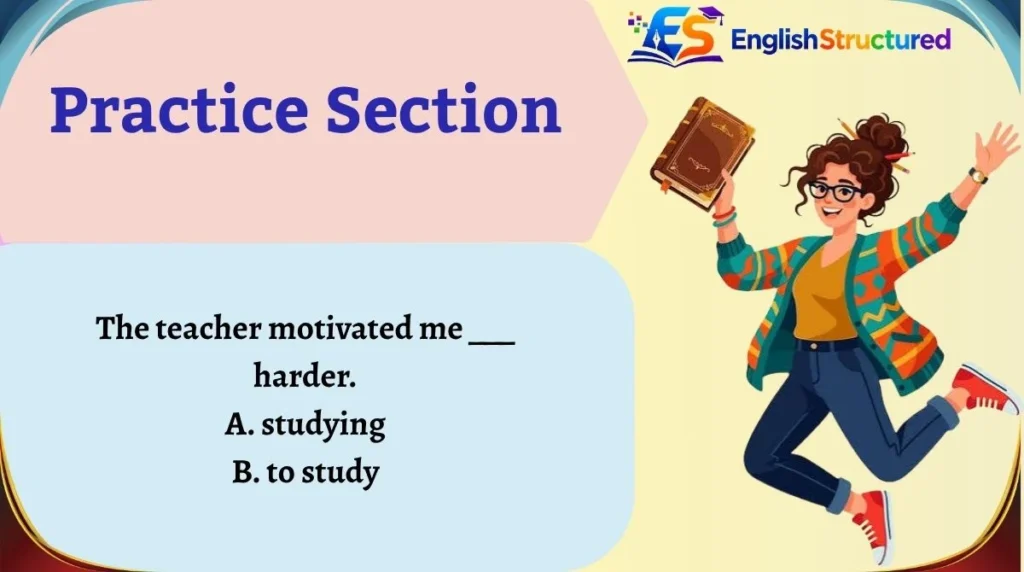
Choose the correct option in each sentence.
1. The teacher motivated me ___ harder.
A. studying
B. to study
2. Her success motivated him ___ again.
A. to try
B. trying
3. My coach motivated the team ___ together.
A. to work
B. working
4. His fear of ___ motivated him to prepare carefully.
A. failing
B. fail
5. I am motivated ___ my English.
A. to improve
B. improving
Answers
1. B — to study
The teacher motivated me to study harder.
2. A — to try
Her success motivated him to try again.
3. A — to work
My coach motivated the team to work together.
4. A — failing
His fear of failing motivated him to prepare carefully.
Here, failing follows the preposition of.
5. A — to improve
I am motivated to improve my English.
This uses the common pattern be motivated to + verb.
FAQs
1. Is it “motivate to” or “motivate -ing”?
The most common structure is motivate someone to do something.
For example:
Motivate To or -ing
Do not normally use motivate someone + -ing. The -ing form may appear elsewhere in the sentence as part of another grammatical structure.
2. Is “motivate me to” correct?
Yes. Motivate me to + base verb is completely natural.
For example:
My parents motivated me to work harder.
This book motivated me to learn more.
Her advice motivated me to apply for the position.
3. Can we say “motivated to”?
Yes. Be motivated to + verb is very common.
For example:
I am motivated to succeed.
She is motivated to learn.
They are motivated to improve.
It describes having a strong reason, desire, or willingness to do something.
4. Can “motivate” be followed by an -ing word?
An -ing form can appear in a sentence containing motivate, but it does not normally follow a person as the direct complement.
For example:
The fear of failing motivated him to study.
Here, failing follows of.
The normal pattern is still:
motivate + person + to + verb
5. Is “motivation for doing” correct?
Yes. Motivation for + -ing is a common noun structure.
For example:
What is your motivation for learning English?
Her motivation for studying was to pass the exam.
This is different from the verb structure:
Her teacher motivated her to study.
6. Is “motivate me studying” correct?
No, not in normal standard English.
Instead, say:
Motivate me to study.
You can also say:
Give me motivation to study.
Or:
I need something to motivate me to study.
These structures are natural and clear.
Conclusion
The main rule for motivate to or -ing is easier than it first seems. When motivate means encouraging a person to do something, the normal structure is:
Motivate To or -ing
For example:
The teacher motivated me to study.
The coach motivated the players to practice.
Her success motivated him to try again.
The -ing form can also appear in sentences with motivate, but it usually belongs to another structure. For example, we can say fear of failing or motivation for studying.
In these phrases, failing and studying are connected to of or for, not used as the normal complement of motivate.
If you remember just one formula, remember this:
Motivate a person TO do something.
With a little practice, this pattern will quickly become natural. The next time you are unsure, look for the person receiving the encouragement.
If there is a person after motivate, to + base verb is usually the form you need.