Similar to or Similarly to
They look almost the same, but they do not work in the same way.
One is normally used to describe how two people or things are alike, while the other is used to show that something happens in a similar way.
The small difference between these expressions can change the grammar of a sentence. For example, we say, “This phone is similar to mine.”
But we may say, “Similarly to her brother, she enjoys playing tennis.” The structures are different, even though the two expressions share the word similar.
This matters because these phrases appear often in spoken English, academic writing, emails, essays, and everyday conversations.
Using the wrong one can make a sentence sound unnatural or grammatically weak.
The good news is that the difference is easier than it first appears.
“Similar to” describes similarity, while “similarly to” usually introduces a person, thing, or action that behaves in a similar manner.
Once you understand what comes after each expression, choosing the right phrase becomes much easier.
You will also learn when “similarly” can stand alone, why “similarly to” is less common in everyday speech, and which alternatives sound more natural.
What Does “Similar To” Mean?
“Similar to” means alike in some way or having qualities that are almost the same.
It is one of the most common ways to compare two people, things, ideas, places, or situations. It does not mean that the two things are exactly the same. Instead, they share one or more features.
For example:
Similar to or Similarly to
The two laptops are not necessarily identical. They may have a similar size, design, speed, or function.
Grammar Rule for “Similar To”
The basic structure is:
Subject + be + similar to + noun/pronoun
Examples:
- This dress is similar to the one I bought last year.
- Your idea is similar to mine.
- Similar to or Similarly to
You can also use similar to after other verbs:
- Similar to or Similarly to
- The new system seems similar to the old system.
- Her voice sounds similar to her mother’s.
The important point is simple: similar is an adjective, and it is normally followed by to when you are making a comparison.
Examples of “Similar To”
- Similar to or Similarly to
- Your jacket looks similar to mine.
- The two houses are very similar to each other.
- His teaching style is similar to his father’s.
- This recipe is similar to a traditional Italian recipe.
- My new job is similar to my previous job.
- The two questions are similar to each other.
- Similar to or Similarly to
These sentences all compare two things and show that they have something in common.
“Similar To” Does Not Mean “Exactly the Same”
This is an important point for beginners.
If you say:
Similar to or Similarly to
You are saying that the bags have some features in common.
You are not saying they are exactly identical.
Compare:
- The two phones are the same. = They are identical or considered equal.
- The two phones are similar. = They have some common features.
So, similar to is useful when the things being compared are alike but not necessarily equal.
Common Learner Confusion
A common mistake is to replace to with with:
❌ This car is similar with mine.
✅ This car is similar to mine.
Similar to or Similarly to
Another common mistake is using an adjective where a noun or noun phrase is expected:
❌ This phone is similar to expensive.
✅ This phone is similar to an expensive model.
After to, you normally need a noun, pronoun, or noun phrase.
What Does “Similarly To” Mean?
“Similarly to” means in a way that is similar to something or someone else.
The word similarly is an adverb. It comes from the adjective similar.
While similar to commonly describes a person or thing, similarly often describes an action, situation, result, or manner.
For example:
Similar to or Similarly to
This means Maria made a choice in a way that resembles her sister’s choice.
The expression can be grammatically correct, but it is less common in everyday English than “similar to” or other natural alternatives.
Grammar Rule for “Similarly To”
A common structure is:
Similar to or Similarly to
Examples:
- Similarly to her mother, she became a teacher.
- Similarly to other students, he struggled with the test.
- Similarly to last year, sales increased in June.
Here, similarly to connects the first idea with the action or situation in the main clause.
It tells us that the second action or situation resembles the first one.
Examples of “Similarly To”
- Similarly to his brother, James decided to study engineering.
- Similar to or Similarly to
- Similarly to last month, sales increased during the final week.
- Similarly to her classmates, Emma found the exam difficult.
- Similarly to the previous model, this car uses less fuel.
- Similarly to many young people, he prefers working online.
- Similarly to the first experiment, the second test produced positive results.
- Similar to or Similarly to
These examples show that similarly to can introduce a comparison between one situation and another.
Is “Similarly To” Common?
This is where learners need to be careful.
Although “similarly to” is grammatically possible, it is not always the most natural choice.
In everyday conversation, native speakers often choose:
- like
- just like
- similar to
- in the same way as
- as with
- similarly
For example:
Similar to or Similarly to
This is understandable, but:
Like her mother, Anna is a doctor.
sounds more natural in ordinary conversation.
In formal writing, however, similarly to can sometimes be useful, especially when comparing studies, results, methods, or situations.
Difference Between “Similar To” and “Similarly To”
The biggest difference is their grammatical role.
Similar to or Similarly to
Similarly is an adverb.
That one point explains much of the difference.
| Expression | Word Type | Main Use | Common Structure | Example |
|---|---|---|---|---|
| similar to | Adjective phrase | Shows that things or people are alike | be + similar to + noun | The two cars are similar to each other. |
| similarly to | Adverbial phrase | Shows that an action or situation is alike | similarly to + noun, + clause | Similarly to her sister, she became a doctor. |
| similarly | Adverb | Shows a similar action, result, or situation | Sentence + similarly + clause | The first test failed. Similarly, the second test failed. |
1. “Similar To” Describes Similarity
When you want to say that A and B have similar qualities, use similar to.
Similar to or Similarly to
You are comparing two restaurants.
Another example:
Your answer is similar to mine.
You are comparing two answers.
The expression focuses on the people or things themselves.
2. “Similarly To” Connects a Comparison to an Action or Situation
With similarly to, the comparison often leads into a larger statement.
Similar to or Similarly to
The phrase connects John’s situation with his father’s situation.
It is not simply saying that John and his father are similar people. It is saying that John’s situation or action resembles his father’s.
3. The Word After the Expression Matters
After similar to, you normally identify the thing being compared:
My car is similar to yours.
After similarly to, you often introduce a person, group, event, or situation that provides a model for comparison:
Similar to or Similarly to
The second structure usually needs a complete clause after the opening phrase.
4. “Similarly” Can Stand Alone
You do not always need to after similarly.
For example:
Tom enjoys hiking. Similarly, his wife loves outdoor activities.
Similar to or Similarly to
This structure is extremely common in formal writing.
Another example:
The first plan was expensive. Similarly, the second plan required a large budget.
Similar to or Similarly to
Grammar Rules You Must Remember
Rule #1: Use “Similar To” After the Adjective “Similar”
The normal pattern is:
similar + to
Examples:
- My answer is similar to yours.
- This design is similar to the original.
- Her dress is similar to mine.
Do not normally say:
❌ similar with
Use:
✅ similar Similar to or Similarly toto
This is one of the easiest rules to remember.
Rule #2: “Similar” Is an Adjective, but “Similarly” Is an Adverb
Look at these two sentences:
The two plans are similar.
Here, similar describes the plans.
Similar to or Similarly to
Here, similarly describes how the second situation relates to the first.
Think of it this way:
Similar to or Similarly to
similarly = describes an action, result, or relationship
This distinction will help you choose the right form.
Rule #3: Use “Similarly” to Connect Related Ideas
You can use similarly at the beginning of a sentence when the second sentence has a related idea.
For example:
The first student answered all the questions correctly. Similarly, the second student got a high score.
The second result is like the first result.
You can also write:
The company reduced its prices. Similarly, its main competitor offered discounts.
This is especially useful in essays and reports.
Rule #4: “Similarly To” Is Correct, but Often Less Natural
Do not assume that because similarly to is grammatical, it is always the best choice.
Compare:
Similar to or Similarly to
and:
Like her father, she became a lawyer.
The second sentence sounds more natural in everyday English.
In a formal comparison, however, similarly to may fit:
Similar to or Similarly to
So, always think about context and style, not grammar alone.
Common Mistakes Students Make
Learners often make mistakes with these expressions because similar, similarly, and same look related. They are related, but their grammar is different.
Mistake 1: Using “Similar With”
❌ My phone is similar with yours.
Similar to or Similarly to
Why?
The standard preposition used after similar is to.
A simple correction tip is to memorize the pair:
similar + to
Mistake 2: Using “Similarly” as an Adjective
❌ The two houses are similarly.
✅ The two houses are similar.
Why?
You need an adjective after are to describe the houses.
Similar to or Similarly to
Similarly is an adverb.
You could say:
The two houses are similarly designed.
Here, similarly describes designed, so the adverb works.
Mistake 3: Adding “To” After Every Use of “Similarly”
❌ Similarly to, the second company reduced its prices.
✅ Similarly, the second company reduced its prices.
Similar to or Similarly to
Use:
The first company reduced its prices. Similarly, the second company did the same.
Mistake 4: Using “Similarly To” When “Like” Sounds Better
A sentence can be grammatically possible but still sound stiff.
For example:
Similarly to my mother, I love gardening.
This is understandable.
But in everyday speech, most speakers would probably say:
Like my mother, I love gardening.
Use similarly to when the context calls for a more formal comparison. In casual conversation, like is often smoother.
Mistake 5: Confusing “Similar” With “Same”
These words do not have exactly the same meaning.
My shoes are the same as yours.
This suggests they match or are identical.
Similar to or Similarly to
This means they look alike or share features, but they may not be identical.
The difference can be small, but it matters.
Easy Trick to Remember the Difference
Here is a simple classroom trick:
Think: “Similar = Thing, Similarly = Action”
When similar describes a thing, person, or idea, use:
similar to
Your bag is similar to mine.
When similarly connects an action, result, or situation, use:
similarly
Similar to or Similarly to
And when you want to say that one person’s action or situation resembles another person’s, you can use:
similarly to + noun
Similarly to her sister, she chose a career in medicine.
Another useful trick is to look at the ending:
-ly often creates an adverb.
For example:
- quick → quickly
- careful → carefully
- similar → similarly
So when you see similarly, think about how something happens or how one situation relates to another.
Daily Life Examples
These expressions become much easier when you see them in normal conversations.
Example 1: Talking About Clothes
A: I like your jacket.
B: Thanks! It looks similar to yours.
Similar to or Similarly to
Example 2: Talking About Phones
A: Is your new phone different from your old one?
B: Not much. It is quite similar to my old phone.
The speaker is comparing two phones.
Example 3: Talking About Family
A: Your son loves football, doesn’t he?
B: Yes. Similarly to his father, he watches every match.
The speaker compares the son’s interest with his father’s interest.
Example 4: Talking About Students
Teacher: Did Sarah find the test difficult?
Student: Yes. Similarly, I found several questions difficult.
Similar to or Similarly to
Example 5: Talking About Food
A: Does this soup taste like the one we had yesterday?
B: Yes. It is very similar to it.
The phrase compares the taste of two soups.
Example 6: Talking About Work
A: Is your new job very different?
B: Not really. It is similar to my old job.
This is a natural everyday use of similar to.
Example 7: Talking About Results
A: The first test showed a big improvement.
B: Similarly, the second test showed better results.
Here, similarly connects two results.
Example 8: Talking About Habits
A: Your daughter wakes up early.
B: Yes. Similarly to her mother, she likes starting the day early.
The phrase compares a habit.
Example 9: Talking About Businesses
A: Company A lowered its prices.
B: Similarly, Company B introduced cheaper plans.
Here, similarly is a natural way to connect two business actions.
Example 10: Talking About Ideas
A: Your suggestion is close to mine.
B: Yes, our ideas are quite similar.
You could also say:
Your suggestion is similar to mine.
This is a very common sentence pattern.
Practice Section
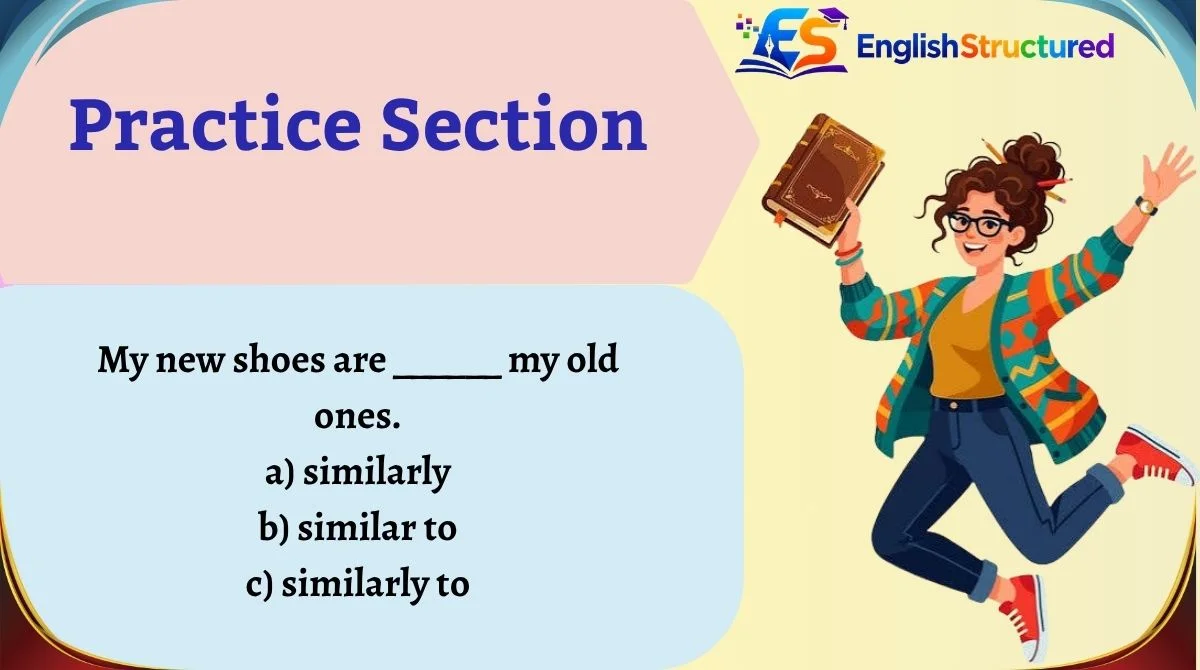
Choose the correct option in each sentence: similar to, similarly to, or similarly.
1. My new shoes are ______ my old ones.
a) similarly
b) similar to
c) similarly to
2. The first team played well. ______, the second team performed strongly.
a) Similar to
b) Similarly
c) Similarly to
3. ______ her mother, Anna decided to become a teacher.
a) Similar to
b) Similarly
c) Similarly to
4. Your answer is very ______ mine.
a) similarly
b) similar to
c) similarly to
5. The first experiment produced good results. ______, the second experiment was successful.
a) Similarly
b) Similar to
c) Similarly to
Answers
1. b) similar to
My new shoes are similar to my old ones.
The phrase compares two things.
2. b) Similarly
Similar to or Similarly to
Here, similarly connects two complete ideas.
3. c) Similarly to
Similarly to her mother, Anna decided to become a teacher.
The opening phrase compares Anna’s situation with her mother’s.
4. b) similar to
Your answer is very similar to mine.
The adjective similar needs to here.
5. a) Similarly
The first experiment produced good results. Similarly, the second experiment was successful.
Similarly connects the two related results.
FAQs
What is the difference between “similar to” and “similarly to”?
Similar to is an adjective phrase used to show that two things, people, or ideas are alike.
Similarly to is an adverbial expression used to compare an action or situation with another person, thing, or situation.
For example, “This car is similar to mine” describes two cars, while “Similarly to his father, he became a doctor” compares two situations.
Is “similarly to” grammatically correct?
Similar to or Similarly to
However, it is less common in casual conversation than expressions such as like, similar to, or in the same way as.
It is more likely to appear in formal or academic comparisons.
Is “similar to” or “similar with” correct?
Similar to is the standard expression.
For example:
Similar to or Similarly to
Avoid:
❌ Her idea is similar with mine.
Remember the simple pair: similar + to.
Can “similarly” be used at the beginning of a sentence?
Yes. This is actually a very common use.
For example:
Similarly, the second group achieved good results.
Here, similarly connects the new statement to an earlier idea.
It is especially useful in essays, reports, explanations, and formal writing.
Is “similarly to” formal or informal?
Similarly to generally sounds more formal than like.
For example:
Similarly to her brother, she chose to study law.
In everyday conversation, you might more naturally say:
Like her brother, she chose to study law.
Both can communicate a similar idea, but the second sounds more relaxed.
Can I use “similar to” for people?
Yes. You can use similar to when people share qualities, habits, interests, appearances, or other features.
For example:
John is similar to his father.
You can also be more specific:
John’s personality is similar to his father’s.
The expression is common and natural.
Can “similar to” and “similarly” be used in the same sentence?
Yes, but they have different jobs.
For example:
The two plans are similar to each other. Similarly, both require a large budget.
The first phrase compares the plans. The second connects the next idea with the previous one.
Is “similarly to” the same as “like”?
They can have a similar meaning in some sentences, but they are not always interchangeable.
Like is very common in everyday English:
Like her father, she loves music.
Similarly to can sound more formal:
Similarly to her father, she loves music.
When speaking casually, like is often the more natural choice.
Conclusion
Similar to or Similarly to
Use similar to when you want to say that two people, things, ideas, or situations are alike. For example, “This phone is similar to mine.” Here, similar is an adjective.
Use similarly when you want to connect two related actions, results, or ideas. For example, “The first test was difficult. Similarly, the second test was challenging.”
Similarly to can be used to introduce a comparison, especially in formal writing, but it may sound less natural in everyday speech. In casual English, like is often a better choice.
The easiest memory trick is: similar = describes; similarly = connects.
Once you start noticing these expressions in conversations, books, and essays, the difference will feel much more natural.
Try writing a few sentences of your own. A little practice is enough to make this grammar point stick.