Have You Seen vs Did You See
At first, they may seem almost the same. In many conversations, native speakers even talk about the same event using one of these questions.
This makes the difference even more confusing.
The good news is that there is a simple grammar rule behind each one.
Once you understand when the time matters and when it does not, choosing the correct phrase becomes much easier.
Have You Seen vs Did You See
Each tense has its own purpose, and using the wrong one can make your English sound unnatural or incorrect.
Understanding this difference is important because people use these questions every day.
You will hear them when talking about movies, news, friends, homework, shopping, travel, and many other daily situations.
By the end of this guide, you will clearly know:
- Have You Seen vs Did You See
- when to use did you see
- the grammar rules behind each phrase
- common mistakes to avoid
- simple memory tricks
- real-life conversation examples
Once you master these two expressions, your spoken and written English will sound much more natural.
What Does “Have You Seen” Mean?
Have you seen is a question in the present perfect tense.
It asks whether something has happened at any time before now. The exact time is not important or is unknown.
When to Use “Have You Seen”
Use have you seen when:
- the exact time is not mentioned
- the experience still connects to the present
- you want to know if something has happened up to now
- the result is important now
Grammar Rule
Have You Seen vs Did You See
Structure:
Have + you + seen + object?
The past participle of see is seen.
Examples
- Have you seen my phone?
- Have you seen this new movie?
- Have you seen Sarah today?
- Have you seen the latest news?
- Have You Seen vs Did You See
- Have you seen that restaurant before?
- Have you seen this email?
- Have You Seen vs Did You See
Common Learner Confusion
Have You Seen vs Did You See
It does not.
Instead, it asks if something has happened before now, without focusing on exactly when it happened.
For example:
✔ Have you seen my keys?
The speaker only wants to know if you know where the keys are now.
What Does “Did You See” Mean?
Did you see is a question in the simple past tense.
It asks about a finished action that happened at a specific time in the past.
When to Use “Did You See”
Have You Seen vs Did You See
- the time is known
- the action is finished
- yesterday, last week, this morning, or another past time is mentioned
- everyone knows which event you mean
Grammar Rule
Did + subject + base verb?
Notice that after did, we use the base form see, not seen.
Structure:
Have You Seen vs Did You See
Examples
- Have You Seen vs Did You See
- Did you see Anna at school?
- Did you see the accident?
- Did you see my message last night?
- Have You Seen vs Did You See
- Have You Seen vs Did You See
- Did you see the fireworks?
- Did you see what happened?
Common Learner Confusion
Many students accidentally say:
Have You Seen vs Did You See
This is incorrect.
After did, always use the base verb.
Have You Seen vs Did You See
Difference Between Have You Seen and Did You See
Although both questions talk about the past, they focus on different ideas.
| Feature | Have You Seen | Did You See |
|---|---|---|
| Tense | Present Perfect | Simple Past |
| Time | Not specific | Specific |
| Connection to now | Yes | No |
| Time words | Usually none | Yesterday, last night, in 2024, etc. |
| Main focus | Experience or result | Finished past event |
Usage Difference
Have You Seen vs Did You See
Example:
Have you seen my wallet?
The wallet is still missing.
Use did you see when asking about one completed event.
Example:
Did you see my wallet on the kitchen table this morning?
The time is clear.
Grammar Logic
Present perfect connects the past and present.
Simple past talks about a completed moment in history.
Compare:
- Have you seen Emma today?
- Did you see Emma yesterday?
Today is still continuing.
Yesterday is completely finished.
Sentence Structure Difference
Present Perfect
Have + subject + seen
Example:
Have you seen my bag?
Simple Past
Did + subject + see
Example:
Did you see my bag yesterday?
Meaning Comparison
Imagine your friend lost a watch.
You ask:
Have You Seen vs Did You See
You are asking if they know where it is now.
Now imagine yesterday’s football game.
You ask:
Did you see the match yesterday?
You are talking about one finished event.
Grammar Rules You Must Remember
Rule #1: Use Present Perfect Without a Finished Time
Correct:
- Have you seen my notebook?
- Have you seen this film?
Wrong:
- Have you seen him yesterday?
Rule #2: Use Simple Past With Finished Time Expressions
Correct:
- Did you see him yesterday?
- Did you see the show last night?
Wrong:
- Have you seen him yesterday?
Rule #3: After “Did,” Always Use the Base Verb
Correct:
- Did you see the dog?
Wrong:
- Did you seen the dog?
Rule #4: Present Perfect Often Focuses on the Present Result
Example:
Have You Seen vs Did You See
The passport is still missing now.
Common Mistakes Students Make
Mistake 1: Mixing Time Expressions
❌ Have you seen him yesterday?
✔ Did you see him yesterday?
Why?
Yesterday is a finished time.
Mistake 2: Using “Seen” After Did
❌ Did you seen it?
Have You Seen vs Did You See
Remember:
Did + base verb.
Mistake 3: Using Simple Past When the Result Matters
Imagine your phone is missing.
Natural:
✔ Have you seen my phone?
Less natural:
Have You Seen vs Did You See
The first question connects to the present problem.
Mistake 4: Forgetting the Present Connection
If today is not finished:
✔ Have you seen Tom today?
If the day is finished:
✔ Did you see Tom yesterday?
Easy Correction Tips
- Look for time words.
- If there is yesterday, last week, or last year, use did you see.
- If no time is mentioned, have you seen is often the better choice.
- Remember: did + see, never did + seen.
Easy Trick to Remember the Difference
Here is a simple memory trick.
Have You Seen vs Did You See
Up to now?
Think of did you see as asking:
At that time?
Examples:
Up to now:
- Have You Seen vs Did You See
At that time:
- Have You Seen vs Did You See
Another easy reminder:
Present perfect = no finished time.
Simple past = finished time.
This one rule solves most problems.
Daily Life Examples
These examples sound natural in everyday conversations.
- Have you seen my keys?
- Did you see my keys on the table this morning?
- Have you seen the new café?
- Have You Seen vs Did You See
- Have you seen today’s newspaper?
- Did you see yesterday’s newspaper?
- Have you seen Emma today?
- Have You Seen vs Did You See
- Have you seen my email?
- Did you see the email I sent yesterday?
Conversation Example 1
A: Have you seen my wallet?
B: Yes, it’s on your desk.
Conversation Example 2
A: Did you see the concert last weekend?
B: Yes, it was amazing.
Conversation Example 3
A: Have you seen this TV series?
B: Not yet.
Conversation Example 4
A: Did you see John after school yesterday?
B: Yes, we walked home together.
Practice Section
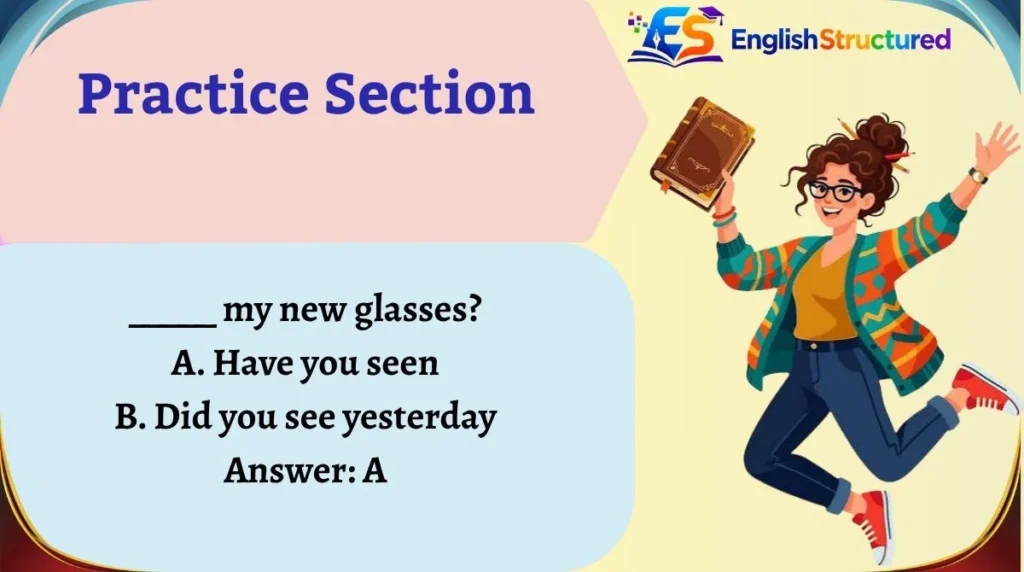
Choose the correct answer.
1.
_____ my new glasses?
A. Have you seen
B. Did you see yesterday
Answer: A
2.
_____ the game last night?
A. Have you seen
B. Did you see
Answer: B
3.
_____ this movie before?
A. Have you seen
B. Did you see
Answer: A
4.
_____ the teacher yesterday?
A. Have you seen
B. Did you see
Answer: B
5.
_____ my notebook anywhere?
A. Have you seen
B. Did you see
Answer: A
FAQs
What is the difference between have you seen and did you see?
Have You Seen vs Did You See. Did you see uses the simple past tense and asks about an action that happened at a definite time in the past.
Can we use have you seen in questions?
Yes. It is one of the most common present perfect questions. Native speakers often use it when asking about experiences, missing objects, or events that still matter now.
Can did you see be used without a time expression?
Yes. Even if no time word is spoken, the context may make the past event clear. For example, after watching a match, someone may ask, “Did you see that goal?” because both speakers know which moment they mean.
Is have you seen formal or informal?
It is suitable for both formal and informal English. You can use it in conversations, emails, classrooms, and professional settings whenever the present perfect is appropriate.
Why can’t I say Did you seen?
Because did already shows the past tense. The main verb must stay in its base form. The correct sentence is Did you see, not Did you seen.
How can I remember which one to use?
Think about time. If you mention a finished time such as yesterday, use did you see. If the time is unknown or unimportant and the situation connects to the present, use have you seen.
Conclusion
Have You Seen vs Did You See
Although both questions refer to the past, they are not interchangeable.
Have you seen connects the past with the present and is used when the exact time does not matter or when the result is still important.
Did you see, on the other hand, focuses on a completed event at a specific time.
A helpful habit is to listen for time expressions. Words like yesterday, last week, or this morning (when that time has finished) usually point to the simple past.
When there is no finished time and you are asking about an experience or a current situation, the present perfect is often the right choice.
The more you read, listen, and practise these patterns in everyday conversations, the more natural they will become.
Before long, choosing between these two questions will feel easy and automatic.