Anyplace vs Any Place
This small difference can make writing and speaking more confusing than it needs to be.
The good news is that the difference is not difficult once you understand how English grammar works.
Both forms can refer to a location, but they are not always used in the same way.
Knowing which one fits your sentence will make your English sound more natural and more accurate.
You may see anyplace in books, websites, conversations, and American English. You may also see any place written as two separate words.
Because both forms exist, learners often wonder which one is correct.
Understanding this topic is important because words about places, locations, and directions appear in everyday conversations.
Whether you are asking for directions, talking about travel, or describing where something happened, choosing the right form helps your message become clear.
By the end of this guide, you will understand what anyplace means, what any place means, when to use each one, the grammar behind them, common mistakes, memory tricks, and plenty of real-life examples that you can use every day.
What Does “Anyplace” Mean?
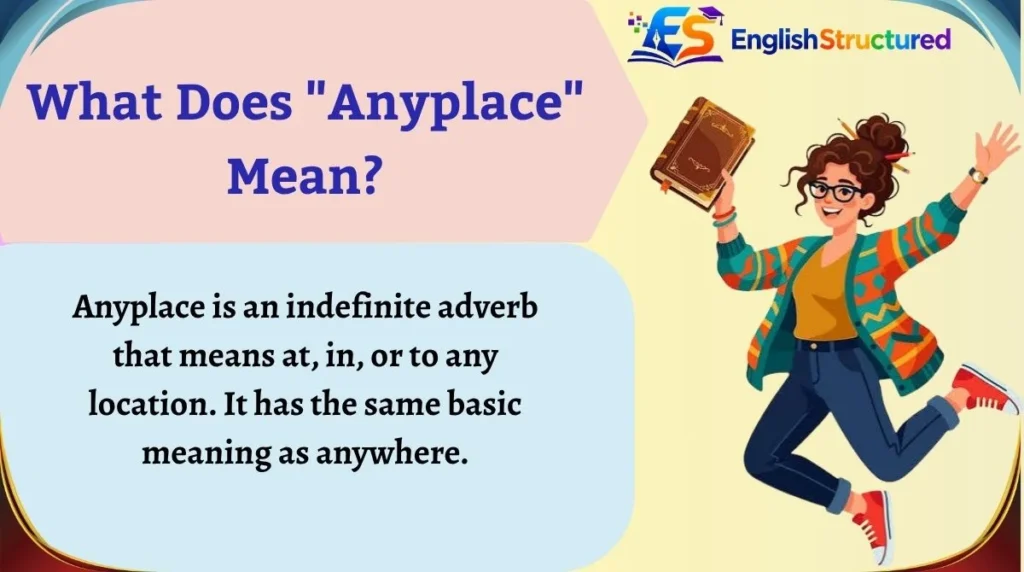
Anyplace is an indefinite adverb that means at, in, or to any location. It has the same basic meaning as anywhere. It does not refer to one specific place. Instead, it means no matter where.
Anyplace vs Any Place
When to Use “Anyplace”
Use anyplace when talking about an unspecified location.
Examples include:
- I can’t find my keys anyplace.
- You can sit anyplace you like.
- Anyplace vs Any Place
- We didn’t go anyplace yesterday.
- She couldn’t find her phone anyplace.
- Anyplace vs Any Place
- They searched anyplace they could think of.
- Is there anyplace quiet to study?
Grammar Rule
Anyplace usually works as an adverb because it tells where something happens.
Sentence pattern:
Anyplace vs Any Place
Example:
- Anyplace vs Any Place
Common Learner Confusion
Many learners think anyplace is incorrect because it is only one word. It is actually a correct English word, although anywhere is more common, especially in British English.
What Does “Any Place” Mean?
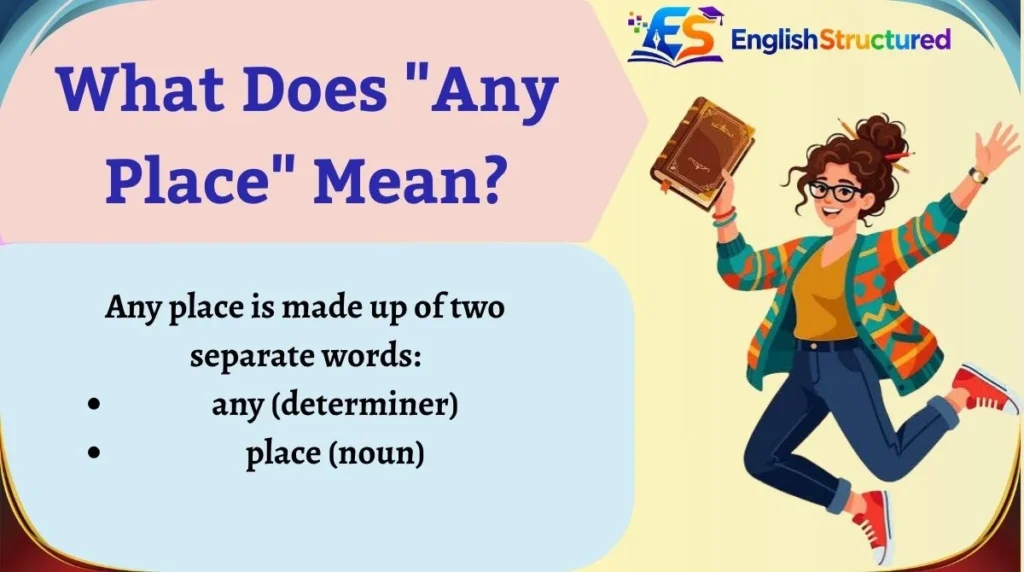
Any place is made up of two separate words:
- any (determiner)
- place (noun)
Together, they mean any location or any specific place without naming which one.
When to Use “Any Place”
Use any place when place is acting as a noun.
Examples:
- You may choose any place on the map.
- Pick any place you want for dinner.
- We can meet at any place nearby.
- Is there any place open right now?
- She didn’t have any place to sleep.
- Anyplace vs Any Place
- You can park in any place marked with a green sign.
- I don’t have any place to keep these boxes.
Grammar Rule
In any place, the word place is a noun, and any describes it.
Sentence pattern:
Any + noun
Example:
- Any place will work.
Common Learner Confusion
Anyplace vs Any Place. That is not true. If place is clearly functioning as a noun, writing the two words separately is perfectly correct.
Difference Between Anyplace and Any Place
Although they look very similar, they are not always used in the same way.
| Feature | Anyplace | Any Place |
|---|---|---|
| Word type | One word | Two words |
| Grammar | Usually an adverb | Determiner + noun |
| Meaning | Anywhere | Any location |
| Common in | Mostly American English | All varieties of English |
| Can replace “anywhere”? | Usually yes | Not always |
| Formal writing | Less common | More common |
Usage Difference
Use anyplace when talking generally about location.
Example:
- Anyplace vs Any Place
Use any place when referring to a noun.
Example:
- Anyplace vs Any Place
Grammar Logic
Think about the job each word is doing.
Anyplace vs Any Place
If the sentence needs a word that answers where, use anyplace.
Sentence Structure Difference
Anyplace
- Subject + verb + anyplace
Example:
- We couldn’t go anyplace.
Any Place
- Subject + verb + any place + noun phrase
Example:
- We couldn’t find any place to stay.
Meaning Comparison
Sometimes both forms sound natural.
- Is there anyplace to eat?
- Anyplace vs Any Place
Both are acceptable in everyday English, although any place is often preferred in careful writing.
Grammar Rules You Must Remember
Rule #1: Use “Anyplace” as an Adverb
Example:
- We didn’t go anyplace during the holiday.
Rule #2: Use “Any Place” When “Place” Is a Noun
Example:
- Do you know any place that sells fresh bread?
Rule #3: “Anywhere” Often Replaces “Anyplace”
Examples:
- I can’t find it anyplace.
- Anyplace vs Any Place
Both are correct.
Rule #4: Formal Writing Often Prefers “Any Place”
Example:
- Anyplace vs Any Place
Common Mistakes Students Make
Many mistakes happen because both forms have nearly the same meaning.
Mistake 1
❌ I don’t have anyplace to live.
Anyplace vs Any Place
Mistake 2
❌ We searched any place.
✅ We searched anyplace.
Mistake 3
❌ Pick anyplace on this map.
✅ Pick any place on this map.
Mistake 4
❌ Is there anyplace seat available?
✅ Is there any place available to sit?
Easy Correction Tips
- Ask yourself whether place is a noun.
- If yes, use any place.
- If the sentence simply means anywhere, anyplace usually works.
Easy Trick to Remember the Difference
Here is a simple trick.
Think about the word place.
Anyplace vs Any Place
Example:
- Choose any place on the map.
If you simply mean anywhere, use anyplace.
Example:
- You can sit anyplace.
A quick memory tip is:
- Anyplace = Anywhere
- Any place = Any location
This small trick helps many students choose the correct form within seconds.
Daily Life Examples
Here are some examples you may hear every day.
- We can eat any place you choose.
- I can’t find my wallet anyplace.
- Is there any place to charge my phone?
- Anyplace vs Any Place
- Do you know any place nearby for coffee?
- They couldn’t find the dog anyplace.
- Anyplace vs Any Place
- We didn’t travel anyplace during the weekend.
- Pick any place on the list.
- Anyplace vs Any Place
Practice Section
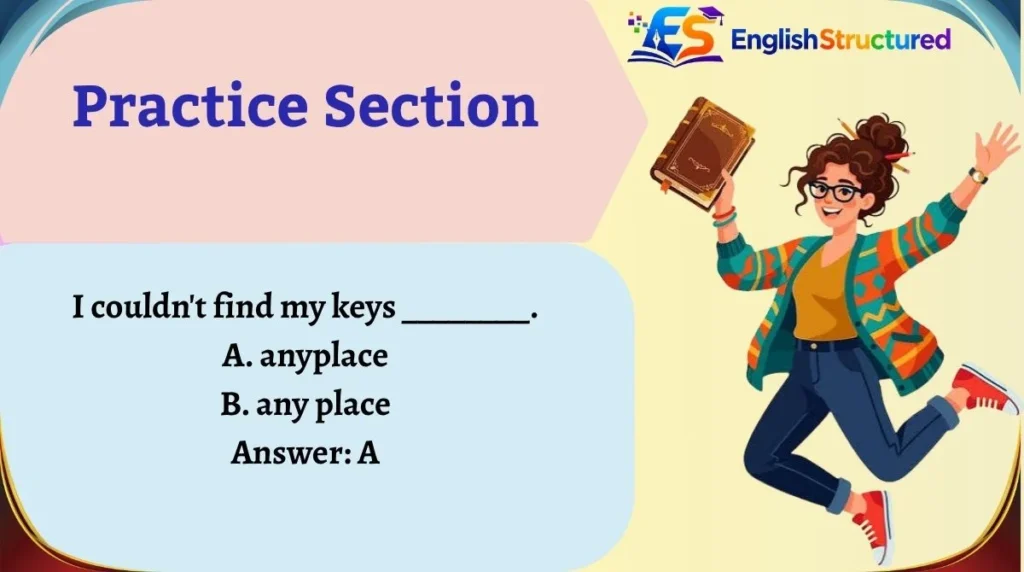
Choose the correct answer.
1. I couldn’t find my keys ________.
A. anyplace
B. any place
Answer: A
2. Do you know ________ to buy flowers?
A. anyplace
B. any place
Answer: B
3. We didn’t go ________ because it rained.
A. anyplace
B. any place
Answer: A
4. Choose ________ on the seating chart.
A. anyplace
B. any place
Answer: B
5. I looked ________ but couldn’t find it.
A. anyplace
B. any place
Answer: A
FAQs
What is the difference between anyplace and any place?
Anyplace vs Any Place. The correct choice depends on the grammar of your sentence.
Can we use anyplace in questions?
Yes. It is common in questions.
Example:
- Anyplace vs Any Place
Is anyplace formal or informal?
Anyplace is acceptable in everyday English, especially in American English. In formal writing, many writers prefer any place or anywhere.
Is any place grammatically correct?
Yes. It is completely correct when place is used as a noun.
Example:
- Anyplace vs Any Place
Is anyplace the same as anywhere?
In many situations, yes. Both usually mean at any location. However, anywhere is generally more common, especially in British English.
Which form should English learners use?
If you are unsure, any place is always a safe choice when referring to a location, while anywhere is often the easiest alternative to anyplace.
Conclusion
Anyplace vs Any Place
Although both relate to location, they do not always play the same role in a sentence.
Use anyplace when you simply mean anywhere or at any location. It usually works as an adverb and is especially common in American English.
Use any place when place is a noun and you are talking about a location that someone can choose, visit, or describe.
The best way to remember the difference is to ask yourself one question: Am I talking about anywhere, or am I talking about a place?
That simple check will help you choose the correct form most of the time.
Keep reading, listening, and practising with real conversations. The more examples you see, the more natural these expressions will become.
Small grammar details like this may seem unimportant at first, but they make your English clearer, more confident, and more natural every day