
Plaintiff vs Defendant
These two words are common in legal English, but they can be confusing for English learners because both describe people involved in a court case.
The easiest way to remember them is to think about who starts a civil case and who has to respond to it.
The plaintiff is generally the person or party who brings a civil lawsuit. The defendant is the person or party who is being sued.
For example, imagine that Sara believes John damaged her car and refuses to pay for the repairs.
Sara takes the matter to civil court. Sara is the plaintiff, while John is the defendant.
These words are important not only in law but also in news reports, contracts, legal documents, court discussions, and everyday conversations about lawsuits.
There is one important detail, though: the terms can vary depending on the type of legal case and the legal system. In criminal cases, for example, the person accused of a crime is usually called the defendant, while the government brings the prosecution.
By the end of this guide, you will know what each word means, how to use them correctly, how they differ, and how to remember them without getting confused.
What Does “Plaintiff” Mean?
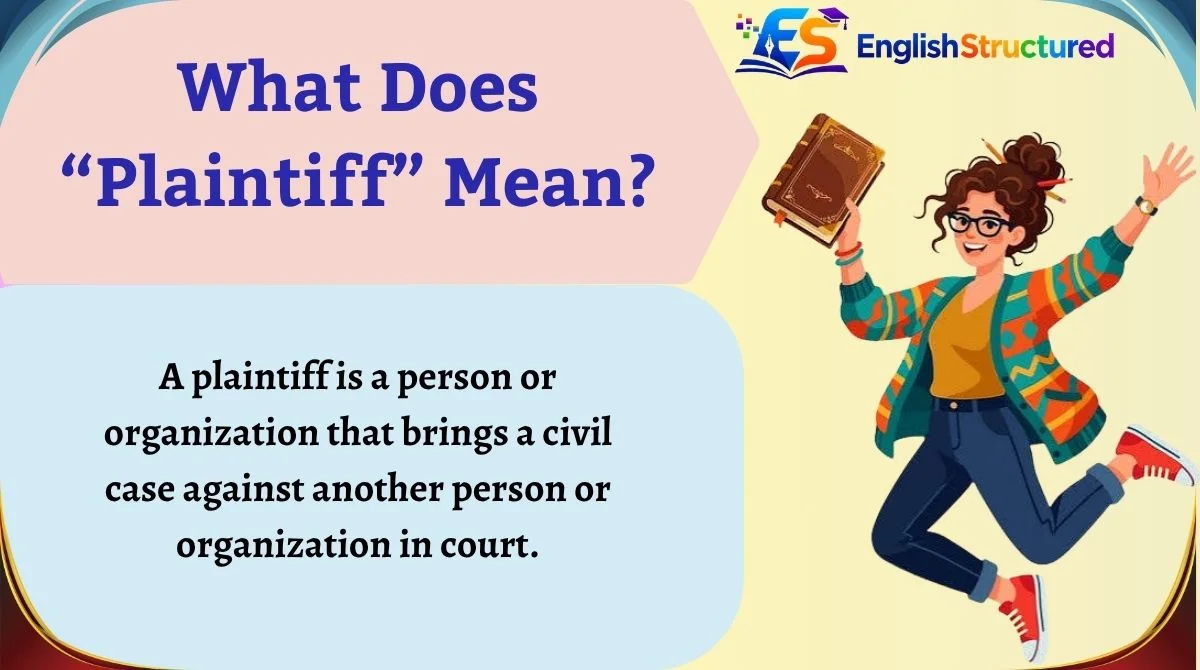
A plaintiff is a person or organization that brings a civil case against another person or organization in court.
In simple English, the plaintiff is usually the person who starts the lawsuit.
Suppose Emma hires a company to repair her roof. The company does poor work, and Emma believes the company caused serious damage to her home. If Emma files a civil lawsuit against the company, Emma is the plaintiff.
The company is the party responding to the lawsuit.
When Do We Use “Plaintiff”?
Plaintiff vs Defendant
Civil cases can involve many kinds of disagreements, such as:
- Personal injury claims
- Property disputes
- Contract disagreements
- Employment disputes
- Business disputes
- Debt claims
- Damage to property
- Some family-law matters
The plaintiff does not necessarily have to be one individual. A company, organization, or other legal entity can also be a plaintiff.
For instance:
The company filed a lawsuit against its former supplier.
Plaintiff vs Defendant
Grammar Rule for “Plaintiff”
Plaintiff vs Defendant
You can use:
- Plaintiff vs Defendant
- the plaintiff
- one plaintiff
- two plaintiffs
- several plaintiffs
Plaintiff vs Defendant
Notice the spelling:
plaintiff → plaintiffs
We do not normally write plaintiffes.
Example Sentences
- Plaintiff vs Defendant
- The plaintiff says the defendant broke the contract.
- The judge asked the plaintiff to provide more evidence.
- The plaintiff is seeking compensation for the damage.
- The court heard testimony from the plaintiff.
- Plaintiff vs Defendant
- Three plaintiffs joined the same lawsuit.
- The plaintiff claims that the company failed to provide the promised service.
A Common Learner Confusion
Some learners think plaintiff means a person who is simply complaining.
That is not quite right.
A person can complain about something without being a plaintiff. The legal term plaintiff normally refers to the person or party that has brought a civil lawsuit before a court.
For example:
Maria complained to the manager.
Plaintiff vs Defendant
But:
Maria filed a civil lawsuit against the company.
Plaintiff vs Defendant
So, remember:
A complaint is not automatically a lawsuit.
What Does “Defendant” Mean?
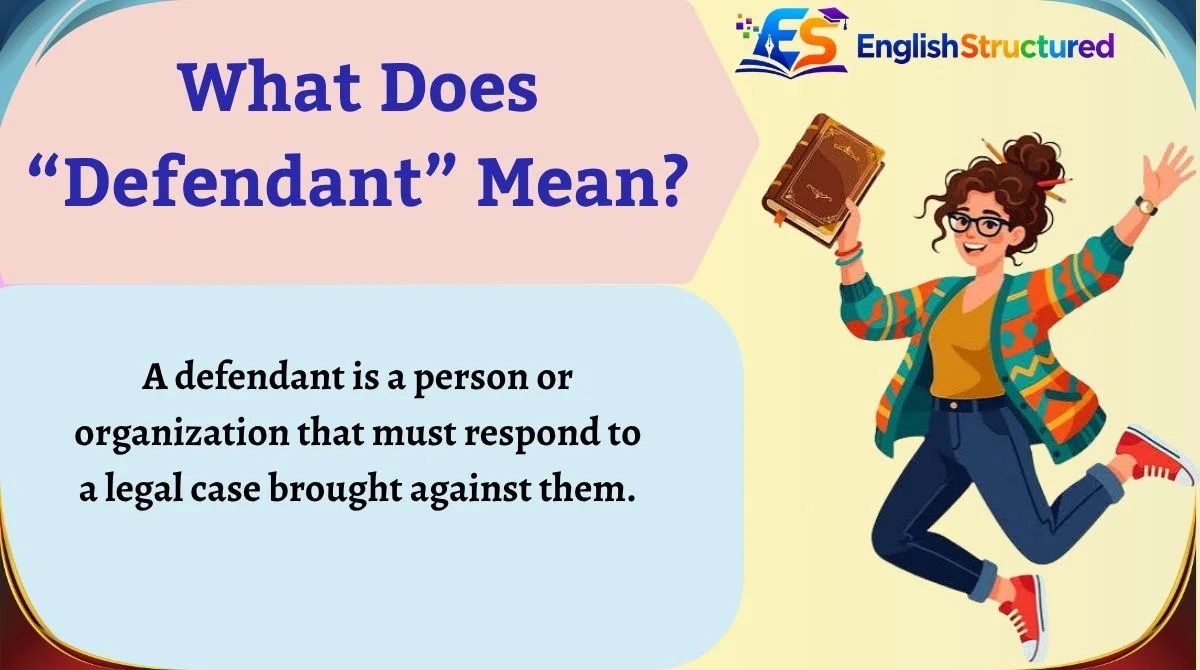
A defendant is a person or organization that must respond to a legal case brought against them.
In simple English, the defendant is generally the person or party being sued in a civil case.
For example, David files a lawsuit against a landlord because he believes the landlord failed to return his security deposit. David is the plaintiff, and the landlord is the defendant.
Plaintiff vs Defendant
If someone is formally accused of committing a crime and the case goes to court, that person is generally called the defendant.
When Do We Use “Defendant”?
We use defendant in both civil and criminal legal contexts, although the details depend on the legal system.
In a civil lawsuit:
The plaintiff sues the defendant.
In a criminal case:
Plaintiff vs Defendant
This is an important difference from plaintiff, which is mainly associated with civil lawsuits.
Grammar Rule for “Defendant”
Defendant is a countable noun.
You can say:
- Plaintiff vs Defendant
- the defendant
- one defendant
- Plaintiff vs Defendant
- several defendants
The plural is:
defendant → defendants
For example:
The two defendants appeared in court.
Example Sentences
- Plaintiff vs Defendant
- The defendant’s lawyer asked the judge for more time.
- The judge ordered the defendant to pay damages.
- The defendant appeared in court on Monday.
- The defendant filed a response to the lawsuit.
- Plaintiff vs Defendant
- The defendant argued that the contract was valid.
- Several defendants were named in the civil case.
A Common Learner Confusion
A common mistake is to think that defendant means guilty person.
It does not.
A defendant is a person or party facing a legal case or accusation. Being called a defendant does not mean that the person has been found guilty.
Plaintiff vs Defendant
- guilty,
- not guilty, or
- otherwise have the case resolved according to the applicable legal process.
In a civil case, the court may decide whether the defendant has legal responsibility for the plaintiff’s claim.
So, never use defendant as a direct synonym for criminal or guilty person.
Difference Between Plaintiff and Defendant
The basic difference is easy:
The plaintiff brings a civil lawsuit. The defendant responds to the lawsuit.
Here is a quick comparison:
| Word | Basic meaning | Typical role | Common context |
|---|---|---|---|
| Plaintiff | Party bringing a civil lawsuit | Starts the case | Civil law |
| Defendant | Party facing the lawsuit or criminal accusation | Responds to the case | Civil and criminal law |
| Plaintiffs | More than one plaintiff | Brings a case together | Civil law |
| Defendants | More than one defendant | Faces a case | Civil or criminal law |
Think About Direction
A useful way to understand the relationship is:
Plaintiff → brings the civil case → Defendant
Imagine a disagreement between two people.
John says that Lisa owes him money. John files a civil lawsuit.
Plaintiff vs Defendant
Lisa = defendant
The two words describe their roles in the case, not their personalities.
John is not called a plaintiff because he is a good person. Lisa is not called a defendant because she is a bad person.
They receive these labels because of their positions in the legal proceeding.
Sentence Structure
You will often see structures such as:
Plaintiff vs Defendant
Here, plaintiff is the person bringing the case.
You may also see:
The defendant responded to the plaintiff’s claim.
Here, defendant is the party responding to the case.
Another common structure is:
The plaintiff claims that the defendant caused financial damage.
This sentence clearly shows the relationship between the two terms.
Possessive Forms
Both words can be possessive.
For one plaintiff:
Plaintiff vs Defendant
For one defendant:
the defendant’s lawyer
For several plaintiffs:
Plaintiff vs Defendant
For several defendants:
the defendants’ lawyers
Be careful with the apostrophe.
One plaintiff: plaintiff’s
Several plaintiffs: plaintiffs’
Plaintiff vs Defendant
Several defendants: defendants’
Grammar Rules You Must Remember
Rule #1: “Plaintiff” Usually Refers to the Party Bringing a Civil Lawsuit
When someone brings a civil lawsuit against another party, the person or organization bringing the case is generally the plaintiff.
Example:
Plaintiff vs Defendant
The plaintiff is the party who started the civil case.
Rule #2: “Defendant” Refers to the Party Facing the Case
The person or organization responding to a lawsuit is generally the defendant.
Example:
The defendant denied the plaintiff’s claims.
The defendant is responding to the case brought against them.
Rule #3: A Defendant Is Not Automatically Guilty
This rule is especially important for English learners.
Plaintiff vs Defendant
Correct:
The defendant was accused of theft.
This tells us about the accusation.
Incorrect idea:
Plaintiff vs Defendant
That is not what the word means.
Rule #4: “Plaintiff” Is Mainly Used in Civil Cases
The term plaintiff is strongly associated with civil lawsuits.
Criminal cases usually use different terminology for the party bringing the prosecution. In many English-speaking legal systems, the government or state brings the criminal case, rather than calling that party a plaintiff.
Example:
Plaintiff vs Defendant
Here, defendant is appropriate because the sentence concerns a criminal proceeding.
Common Mistakes Students Make
Legal English can feel difficult because many words have meanings that are narrower than their everyday equivalents.
Mistake 1: Thinking the Plaintiff Is Always the “Good Person”
This is a misunderstanding.
Being the plaintiff does not mean that the court has decided the person is right.
The plaintiff is simply the party bringing the civil claim.
Wrong idea:
The plaintiff is the person who is right.
Better understanding:
Plaintiff vs Defendant
The court still has to consider the claims and evidence.
Mistake 2: Using “Defendant” to Mean “Criminal”
A defendant may be accused of a crime, but that does not automatically make the person a criminal.
Wrong:
The defendant is a criminal.
Better:
Plaintiff vs Defendant
The second sentence correctly separates the person’s legal status from the accusation.
Mistake 3: Calling Every Complainant a Plaintiff
Someone who complains is not automatically a plaintiff.
For example:
I complained to the store about a broken phone.
You are not necessarily a plaintiff.
But if you bring a civil lawsuit against the store, you may become the plaintiff in that case.
Mistake 4: Forgetting the Plural Forms
The plural of plaintiff is:
Plaintiff vs Defendant
The plural of defendant is:
defendants
Examples:
The plaintiffs filed a joint claim.
The defendants denied the allegations.
Mistake 5: Confusing the Plaintiff With the Plaintiff’s Lawyer
Plaintiff vs Defendant
The lawyer represents that party.
For example:
The plaintiff’s lawyer presented the evidence.
This means the lawyer represents the plaintiff.
The lawyer and plaintiff are not the same person.
Easy Trick to Remember the Difference
Here is a simple classroom trick:
Plaintiff = Starts the civil lawsuit
Think:
Plaintiff vs Defendant
The plaintiff is generally the party who brings the civil claim to court.
Defendant = Defends against the case
Think:
D = Defendant = Defends
The defendant is the party facing the claim or accusation.
So you can remember:
Plaintiff presents the claim. Defendant defends against it.
This is only a memory trick, not a complete description of every legal procedure, but it works well for beginners.
A Simple Story
Imagine two neighbors.
Ali says:
“Bilal damaged my fence, and he will not pay for the repairs.”
Ali files a civil lawsuit.
Plaintiff vs Defendant
Bilal = defendant
The court then considers the legal claims, evidence, and arguments.
Notice something important: we do not know who is right just from these labels.
The labels simply tell us who is bringing the case and who is responding to it.
Daily Life Examples
These examples show how plaintiff and defendant can appear in natural English.
Example 1: Property Damage
A: Who filed the lawsuit?
B: The homeowner did.
A: So the homeowner is the plaintiff?
Plaintiff vs Defendant
Example 2: Contract Dispute
A: Why are they going to court?
B: The plaintiff says the company broke the contract.
A: And what does the defendant say?
B: The company denies the claim.
Example 3: Personal Injury Case
Plaintiff vs Defendant
B: The person who says they were injured.
A: And the driver?
B: The driver is the defendant.
Example 4: Business Lawsuit
A: The company filed a lawsuit against its supplier.
B: Then the company is the plaintiff?
A: Correct. The supplier is the defendant.
Example 5: Court News
The plaintiff told the court that the agreement had been broken.
This means the person or organization bringing the civil claim made that statement.
Example 6: Defendant’s Response
Plaintiff vs Defendant
The defendant disagreed with the claims made against them.
Example 7: Several Parties
Two plaintiffs filed a lawsuit against three defendants.
This means two parties brought the case, while three parties were named as defendants.
Example 8: Lawyer Representation
Plaintiff vs Defendant
The attorney represents the plaintiff.
Example 9: Settlement
The plaintiff and defendant reached a settlement.
This means the parties resolved the dispute through an agreement rather than continuing the case to a final judgment.
Example 10: Court Decision
Plaintiff vs Defendant
This means the court decided the case in the plaintiff’s favor.
You could also say:
The court ruled in favor of the defendant.
That means the decision favored the defendant.
Plaintiff vs Defendant: A Simple Side-by-Side Example
Let’s use one complete situation.
Imagine that Ahmed pays a company $5,000 to build a small office. The company does not complete the work. Ahmed believes the company failed to meet its agreement.
Ahmed files a civil lawsuit.
Ahmed = Plaintiff
Plaintiff vs Defendant
Now imagine that the company says Ahmed changed the original agreement and refuses to pay the remaining amount.
The company can present its own evidence and arguments.
The important point is that both sides can present their position.
Calling Ahmed the plaintiff does not automatically mean Ahmed will win.
Calling the company the defendant does not automatically mean the company will lose.
The words describe their roles in the legal case.
Practice Section
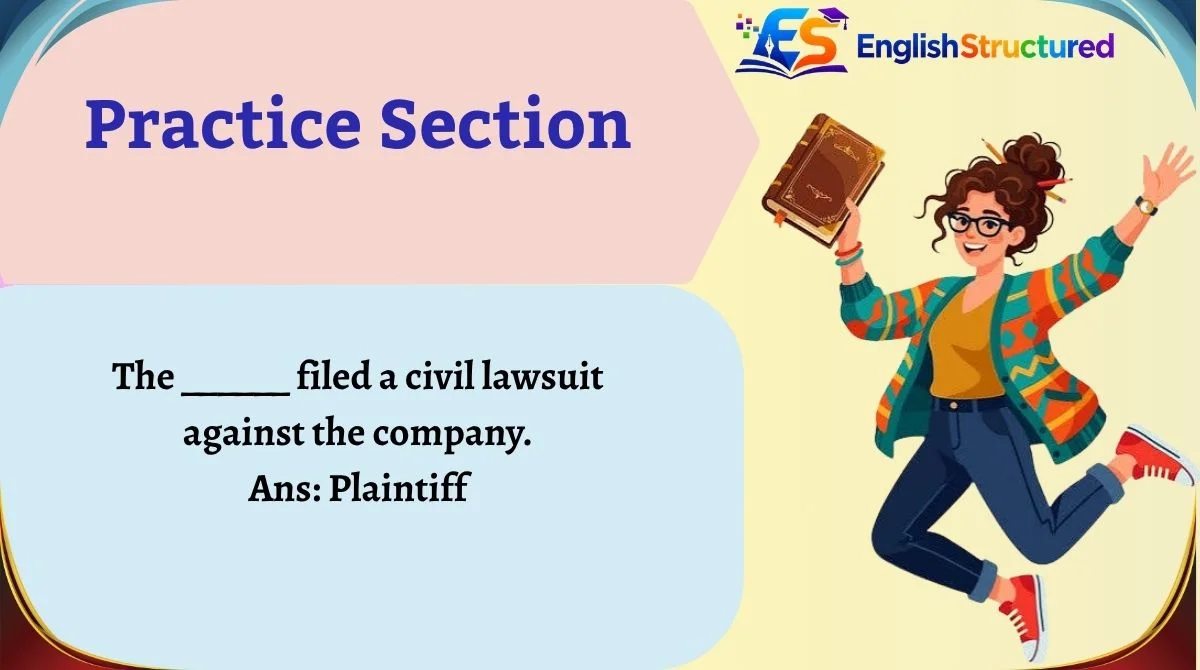
Choose plaintiff or defendant to complete each sentence.
1.
The ______ filed a civil lawsuit against the company.
2.
The ______ denied the allegations.
3.
The court asked the ______ to provide evidence supporting the claim.
4.
The plaintiff’s lawyer argued that the ______ had broken the contract.
5.
The two ______ reached an agreement before the trial ended.
Answers
1. Plaintiff
The plaintiff is generally the party bringing the civil lawsuit.
2. Defendant
The defendant is the party facing the case or accusation.
3. Plaintiff
The plaintiff is the party making the civil claim.
4. Defendant
The defendant is the party accused of breaking the contract in this example.
5. Parties / plaintiff and defendant
Both the plaintiff and defendant can reach a settlement.
FAQs About Plaintiff vs Defendant
1. What is the difference between a plaintiff and a defendant?
A plaintiff is generally the person or party that brings a civil lawsuit. A defendant is the person or party responding to that lawsuit.
The defendant can also be a person accused in a criminal case.
2. Is the plaintiff always the person who is right?
No. Plaintiff describes a legal role, not the final result of the case.
The plaintiff brings the claim, but the court still has to consider the evidence and arguments before making a decision.
3. Is a defendant always guilty?
No. Being a defendant does not mean a person is guilty.
In a criminal case, a defendant is someone facing a criminal accusation. The court must determine the outcome according to the applicable legal process.
4. Can a company be a plaintiff or defendant?
Yes. A company can be either one.
If a company brings a civil lawsuit, it may be the plaintiff. If another party sues the company, the company may be the defendant.
5. What is the plural of plaintiff?
The plural of plaintiff is plaintiffs.
For example:
Several plaintiffs filed claims against the company.
The plural of defendant is defendants.
6. Is plaintiff used in criminal cases?
Generally, plaintiff is associated with civil lawsuits.
Criminal cases use different terms for the government or state that brings the prosecution, depending on the legal system. The person accused is generally called the defendant.
7. Can the same person be a plaintiff and a defendant?
Yes, depending on the legal proceedings.
A person can be a plaintiff in one case and a defendant in another. In some legal situations, one party may also bring a claim against another party involved in the same broader dispute.
The exact terminology can vary by jurisdiction.
8. What is an easy way to remember plaintiff and defendant?
Think:
Plaintiff = brings the civil claim
Defendant = faces the claim
You can also remember the simple classroom trick:
P = Plaintiff presents the claim.
D = Defendant defends against it.
Conclusion
The words plaintiff and defendant become much easier once you focus on their roles rather than trying to memorize complicated legal definitions.
A plaintiff is generally the person or party that brings a civil lawsuit. A defendant is the person or party responding to that lawsuit.
The word defendant is also commonly used for someone facing a criminal accusation.
Remember that these words do not tell you who is right or wrong. A plaintiff is not automatically the winner, and a defendant is not automatically guilty.
They simply identify the parties’ positions in a legal proceeding.
A useful memory trick is P for Plaintiff presents the claim and D for Defendant defends against it.
Once you see these words in news stories, court documents, or English lessons, look for the simple question: Who brought the case, and who is responding?
That will usually help you identify the correct word quickly.