Polite vs Courteous
Both words describe good behavior, respectful language, and the way we treat other people.
Because they are so similar, English learners often wonder if they can always use one word instead of the other.
The good news is that the difference is not very difficult. In many sentences, polite and courteous can be used almost interchangeably.
However, they can have slightly different feelings depending on the situation.
Polite is the more common word in everyday English.
We use it when talking about good manners, respectful speech, and behavior that is not rude. For example, we can say, “Please be polite to your teacher.”
Courteous also means polite, but it often gives a stronger idea of showing respect and consideration for other people.
It is especially common in formal, professional, or public situations.
Cambridge Dictionary defines courteous as being polite and showing respect, while polite refers to behavior that is socially correct and shows care for other people’s feelings.
By the end of this guide, you will understand the meaning of both words, their grammar, their main differences, common mistakes, and how to use them naturally in daily English.
What Does “Polite” Mean?
Polite is an adjective that describes someone who behaves in a respectful and socially acceptable way. A polite person usually uses good manners and thinks about other people’s feelings.
In simple words, polite means “having good manners and not being rude.”
For example:
- Polite vs Courteous
- Sarah is always polite to her teachers.
- It is polite to say “thank you.”
- He gave me a polite smile.
- She asked a polite question.
- The children were very polite at dinner.
- Polite vs Courteous
- He was too polite to complain.
The word can describe a person, action, question, request, reply, tone, behavior, or manner.
When Do We Use “Polite”?
Polite vs Courteous. It is especially common when talking about social behavior.
You might use it when:
- asking someone to behave well,
- talking about children,
- making requests,
- describing someone’s manners,
- talking about respectful speech,
- describing a friendly or respectful reply,
- discussing social rules.
For example, a parent may say:
“Please be polite to your grandmother.”
A teacher may say:
Polite vs Courteous
A friend may say:
“You should be polite when you ask for help.”
These sentences sound natural because polite is a very common everyday word.
Grammar Rule for “Polite”
Polite is an adjective.
It usually comes:
- Before a noun:
- She is a polite student.
- He gave a polite answer.
- After a linking verb such as be, seem, look, or become:
- She is polite.
- He seems polite.
- Polite vs Courteous
We can also make comparative and superlative forms:
- polite
- more polite
- most polite
Examples:
- Maria is more polite than John.
- He was the most polite person in the room.
We also have related words:
- politely — adverb
- politeness — noun
Examples:
- She politely asked him to leave.
- Polite vs Courteous
A Common Confusion About “Polite”
Some learners think that being polite always means being friendly. That is not necessarily true.
Someone can be polite without being warm or friendly.
For example:
“Thank you for your message. Unfortunately, we cannot accept your request.”
Polite vs Courteous
A person can also be polite while disagreeing:
“I understand your point, but I see it differently.”
So, polite does not mean that you agree with someone. It means that you communicate in a respectful and acceptable way.
What Does “Courteous” Mean?
Courteous is also an adjective. It means polite and respectful, especially in the way you treat other people.
In simple English, courteous means showing good manners and respect toward others.
Examples:
- Polite vs Courteous
- Please be courteous to other passengers.
- He gave a courteous reply.
- The driver was courteous to the pedestrians.
- Polite vs Courteous
- The customer service agent was helpful and courteous.
- He was courteous even when the customer became angry.
- We should be courteous to our neighbors.
Cambridge Dictionary describes courteous as “polite and showing respect.” This extra idea of respect is one useful way to understand the word.
When Do We Use “Courteous”?
Courteous is common when we are talking about respectful behavior toward other people.
It often appears in situations such as:
- workplaces,
- customer service,
- public places,
- formal conversations,
- meetings,
- professional communication,
- dealing with strangers,
- situations where patience and respect matter.
For example:
Polite vs Courteous
This sounds natural because the sentence describes professional behavior toward guests.
Another example:
Polite vs Courteous
Here, courteous suggests that passengers should think about other people’s comfort and rights.
Grammar Rule for “Courteous”
Polite vs Courteous
It can come before a noun:
- a courteous driver
- a courteous reply
- Polite vs Courteous
- a courteous gesture
It can also come after a linking verb:
- She was courteous.
- He remained courteous.
- The staff seemed courteous.
The adverb is courteously.
Example:
She answered the question courteously.
Polite vs Courteous
Example:
He treated everyone with courtesy.
Be careful here. Courtesy and courteous are not the same part of speech.
- courteous = adjective
- Polite vs Courteous
For example:
The waiter was courteous.
But:
The waiter showed courtesy.
Difference Between Polite and Courteous
The easiest answer is this:
Polite and courteous both describe respectful and well-mannered behavior. However, polite is more common and general, while courteous often emphasizes respect, consideration, and good manners toward other people.
They overlap a lot.
Comparison Table
| Polite | Courteous |
|---|---|
| Means having good manners | Means being polite and showing respect |
| Very common in everyday English | More common in formal or professional situations |
| Can describe speech and behavior | Often focuses on respectful treatment of others |
| Sounds natural in casual conversation | Can sound more formal |
| Used with children, friends, family, strangers, etc. | Often used with customers, guests, coworkers, passengers, and the public |
| Example: Be polite to your brother. | Example: Please be courteous to other passengers. |
1. “Polite” Is More General
Polite is a broad word.
You can use it for almost any situation involving good manners.
For example:
Polite vs Courteous
Please give me a polite answer.
That was not a polite thing to say.
These sentences are normal everyday English.
2. “Courteous” Often Stresses Respect
Courteous can give more attention to the way one person treats another.
For example:
Polite vs Courteous
The word suggests that the receptionist treated the visitors with respect and consideration.
Another example:
Drivers should be courteous to pedestrians.
This means drivers should think about other people and behave respectfully.
3. Polite Is More Common in Everyday Speech
If you are speaking with friends or family, polite will usually sound more natural.
For example:
Polite vs Courteous
This is much more common than:
“Be courteous to your sister.”
The second sentence is grammatically correct, but it sounds more formal than necessary.
4. Courteous Can Sound More Professional
In a workplace, hotel, office, or customer service setting, courteous is often a good choice.
For example:
“Our staff are trained to provide courteous service.”
This sounds professional.
You could say:
Polite vs Courteous
That is understandable, but courteous service sounds more natural in this formal context.
Grammar Logic: How Are They Different?
There is no major grammar difference between the two words because both are adjectives.
You can use both after be:
- She is polite.
- She is courteous.
You can use both before nouns:
- a polite student
- Polite vs Courteous
You can also use both with very:
- He is very polite.
- He is very courteous.
The main difference is therefore not grammar. It is mostly meaning, tone, and common usage.
Sentence Structure Difference
Both words can fit the same basic structures.
Adjective + noun
a polite request
a courteous request
Be + adjective
Polite vs Courteous
He is courteous.
Very + adjective
She is very polite.
Polite vs Courteous
However, some expressions sound more natural with one than the other.
For example:
polite society
is a familiar expression.
But:
courteous society
is not normally used in the same way.
Likewise:
Polite vs Courteous
is common.
But:
Polite vs Courteous
is much less common.
This shows why learning words as complete expressions can be helpful.
Grammar Rules You Must Remember
Rule #1: Both “Polite” and “Courteous” Are Adjectives
Both words describe a person, thing, action, or quality.
Examples:
She is polite.
Polite vs Courteous
Polite vs Courteous
He gave a courteous response.
Do not use them as nouns.
Incorrect:
His polite was impressive.
Correct:
His politeness was impressive.
For courteous, use courtesy:
His courtesy was impressive.
Rule #2: Use “Polite” for General Good Manners
When you simply mean “not rude” or “having good manners,” polite is usually the easiest choice.
Examples:
Please be polite to your classmates.
It is polite to say thank you.
She was polite to everyone.
He asked a polite question.
This is especially useful for beginners because polite is common in daily English.
Rule #3: Use “Courteous” When Respectful Treatment Is Important
Choose courteous when the sentence focuses on respect, consideration, or professional behavior.
Examples:
The staff were courteous to every customer.
Please be courteous to other guests.
He remained courteous during the difficult meeting.
The driver was courteous to the elderly passenger.
Here, the idea is not only “not rude.” It is also about treating others with respect.
Rule #4: Do Not Confuse “Courteous” With “Courtesy”
These words are related but have different jobs.
Courteous is an adjective:
She is courteous.
Courtesy is a noun:
She showed courtesy.
Remember:
courteous = describes
courtesy = the behavior or quality
This small difference can prevent many grammar mistakes.
Common Mistakes Students Make
English learners often make mistakes with these words because their meanings are very close.
Mistake 1: Thinking They Are Completely Different
Some learners believe that polite and courteous describe completely different behaviors.
They do not.
There is a large area of overlap between them.
Incorrect idea:
Polite means friendly, while courteous means respectful.
The difference is not that simple.
A polite person can be respectful, and a courteous person is normally polite.
A better way to remember it is:
Polite = general good manners
Courteous = polite + strong idea of respect and consideration
Mistake 2: Using “Courteous” in Every Situation
Because courteous sounds formal and respectful, some learners use it everywhere.
For example:
“My little brother was courteous to me.”
This is grammatically possible, but in normal family conversation, polite sounds more natural:
“My little brother was polite to me.”
Use the simpler word when the situation is simple.
Mistake 3: Confusing “Courteous” and “Courtesy”
Wrong:
The receptionist showed courteous.
Correct:
The receptionist showed courtesy.
Or:
The receptionist was courteous.
Remember that courtesy is the noun.
Mistake 4: Thinking Polite Means Agreeing
Being polite does not mean saying yes.
You can politely disagree.
For example:
“I’m sorry, but I don’t agree with that idea.”
This can be polite even though the speaker disagrees.
You can also give a polite refusal:
“Thank you for asking, but I’m afraid I can’t come.”
Good manners are about how you communicate, not whether you always agree.
Mistake 5: Using “Polite” and “Courteous” as Adverbs
Incorrect:
He spoke courteous.
Correct:
He spoke courteously.
For polite, the adverb is:
politely
Example:
She answered politely.
So remember:
- polite → politely
- courteous → courteously
- politeness → noun
- courtesy → noun
Easy Trick to Remember the Difference
Here is a simple memory trick:
Polite = Good Manners
Courteous = Good Manners + Respect
Think about a child at the dinner table.
The child says:
“Please pass the water.”
That is polite.
Now think about a person on a crowded bus who notices an elderly passenger standing. The person offers a seat.
That action is courteous because it shows consideration for another person’s comfort.
Of course, the two ideas can overlap. Offering the seat is also polite.
The trick is not meant to create a strict grammar rule. It is simply a quick way to remember the usual difference in feeling.
Another easy trick is to think about everyday vs. formal:
Everyday → polite
Professional/public → courteous
For example:
Polite vs Courteous
But:
Please be courteous to other passengers.
Both sentences are correct. The second one sounds more formal and public.
Daily Life Examples
Here are some natural examples that show how native speakers may use these words.
Example 1: At Home
Mother: Please be polite to your sister.
Son: Okay, Mom. I’m sorry.
Here, polite is natural because this is an everyday family situation.
Example 2: At School
Teacher: Remember to be polite when another student is speaking.
This means students should use good manners and not interrupt rudely.
Example 3: At a Hotel
Guest: The hotel staff were very courteous.
Friend: That’s good. Did they help you with your bags?
Here, courteous fits the professional setting.
Example 4: At Work
Manager: Please remain courteous when speaking with customers.
This sounds professional and focuses on respectful customer service.
Example 5: Asking for Help
“Excuse me, could you please help me?”
This is a polite way to ask for help.
Example 6: On a Bus
“Please be courteous and leave the priority seat available for passengers who need it.”
Here, courteous highlights consideration for other passengers.
Example 7: Disagreeing
“I understand your opinion, but I politely disagree.”
Polite vs Courteous
Example 8: Customer Service
“The employee was courteous even though the customer was angry.”
The sentence emphasizes the employee’s respectful behavior during a difficult situation.
Example 9: A Simple Thank You
“It is polite to say thank you when someone helps you.”
This is a general rule about good manners.
Example 10: Public Behavior
“Please be courteous to the people around you.”
This asks people to consider others and behave respectfully.
Practice: Choose the Correct Option
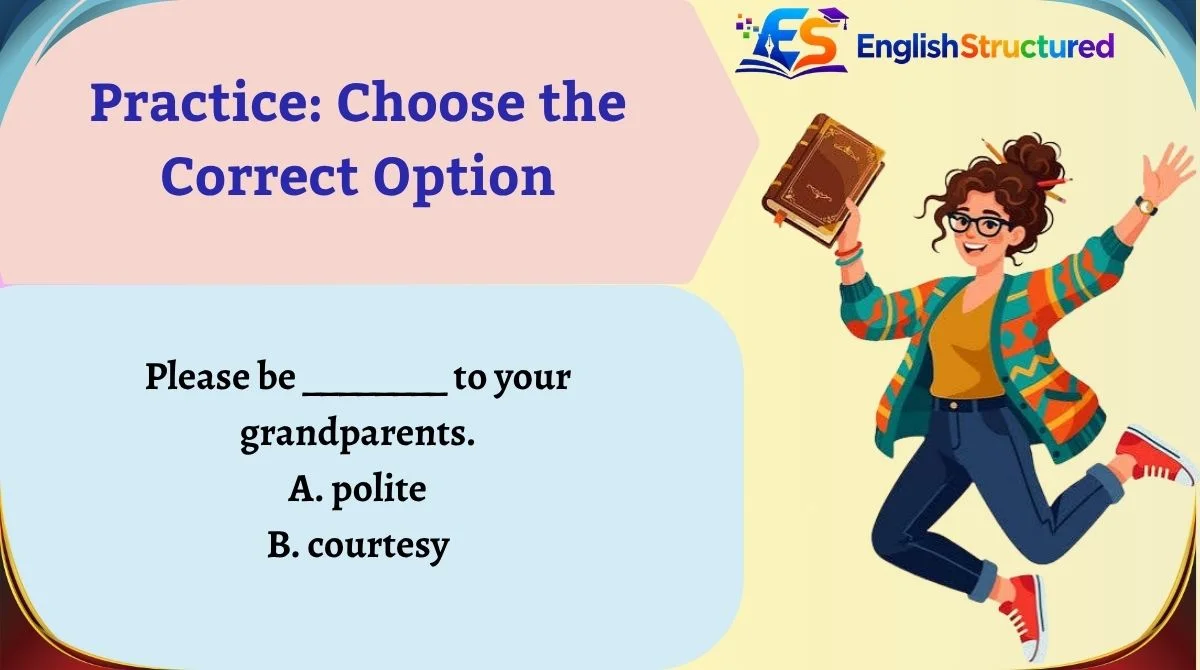
Choose polite or courteous to complete each sentence.
1. Please be ________ to your grandparents.
A. polite
B. courtesy
2. The customer service agent was very ________.
A. courteous
B. courtesy
3. It is ________ to say “thank you” after receiving help.
A. polite
B. courteously
4. The driver was ________ to the pedestrians.
A. courteous
B. courtesy
5. She ________ asked him to lower his voice.
A. polite
B. politely
Answers
- polite
- courteous
- polite
- courteous
- politely
Notice that the last sentence uses politely, not polite, because the word describes the verb asked.
FAQs
What is the difference between polite and courteous?
Both words mean having good manners and treating people respectfully. Polite is more common and general, while courteous often carries a stronger feeling of respect and consideration. Courteous can also sound more formal, especially in professional or public situations.
Can polite and courteous be used interchangeably?
Often, yes. For example, both “She was polite” and “She was courteous” are grammatically correct. However, polite is usually more natural in casual everyday English, while courteous may fit better when talking about professional or public behavior.
Is courteous more formal than polite?
Generally, yes. Courteous often sounds more formal or professional than polite. For example, “Be polite to your brother” sounds natural at home, while “Please be courteous to other passengers” sounds natural in a public setting.
Can we use polite in questions?
Yes. Polite is often used when talking about polite questions or requests. For example, “Is it polite to ask someone about their age?” and “Could you make a polite request?” are both correct.
What is the noun form of polite?
The noun form of polite is politeness. For example: “Her politeness impressed the guests.” The adverb form is politely, as in “He politely refused the offer.”
What is the noun form of courteous?
The related noun is courtesy. For example, “The hotel staff treated us with courtesy.” The adjective is courteous, as in “The hotel staff were courteous.” The adverb is courteously.
Conclusion
Polite vs Courteous
Polite is the common, everyday word for good manners and respectful behavior. You can use it with friends, family, children, teachers, coworkers, and strangers.
Courteous has a very similar meaning, but it often puts more focus on respect, consideration, and thoughtful treatment of other people. It is also more common in formal, professional, and public situations.
Remember the simple trick:
Polite = good manners.
Courteous = good manners with a strong sense of respect.
Do not worry about choosing perfectly every time. In many situations, either word can work. Start by using polite in everyday conversations.
As you read and listen to more English, you will become more comfortable with courteous and the situations where it sounds most natural.
The best way to learn the difference is to notice these words in real sentences and then use them yourself. A few small examples each day can make a big difference.