Rational vs Rationale
They also come from the same word family and are both connected with reason, logic, and sensible thinking. That is why many English learners mix them up.
However, they do not play the same role in a sentence.
Rational is usually an adjective. It describes a person, idea, choice, argument, decision, or action that is based on reason rather than strong emotion or poor thinking. For example, you can make a rational decision.
Rationale, on the other hand, is a noun.
It means the reason or group of reasons behind a decision, action, belief, or plan. For example, you can ask for the rationale behind a decision.
This small grammar difference makes a big difference in everyday English.
Compare these two sentences:
- She made a rational decision.
- She explained the rationale for her decision.
The first sentence describes the decision. The second tells us about the reason behind it.
The difference becomes especially useful in school, business, academic writing, meetings, reports, and professional conversations.
Once you understand the word class and sentence pattern, the confusion becomes much easier to avoid.
What Does “Rational” Mean?
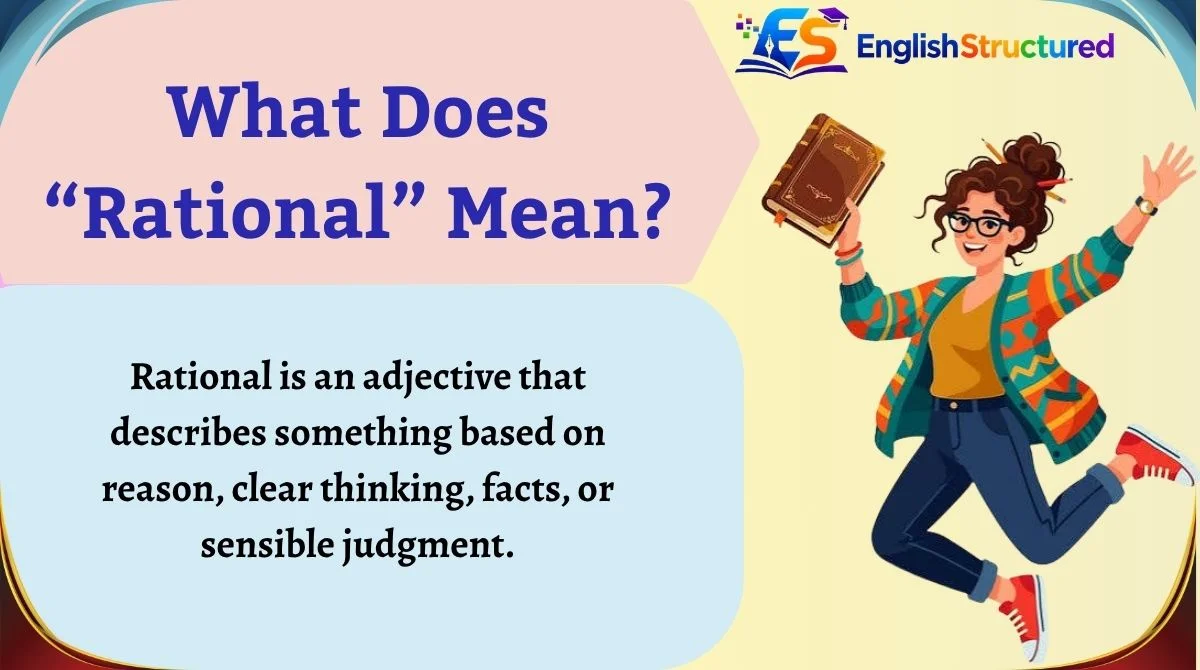
Rational is an adjective that describes something based on reason, clear thinking, facts, or sensible judgment.
Cambridge Dictionary defines rational as being based on clear thought and reason. It can also describe a person who makes decisions using facts rather than being controlled by emotions.
In simple English:
Rational vs Rationale
For example:
Buying a cheaper phone was a rational choice.
Here, rational describes the choice. The speaker thinks the choice made sense because there was a good reason for it.
When Should You Use “Rational”?
Use rational when you want to describe a person, decision, argument, explanation, action, or idea as reasonable or logical.
It often appears before a noun:
- Rational vs Rationale
- a rational choice
- a rational argument
- a rational explanation
- a rational approach
- Rational vs Rationale
- a rational response
- a rational solution
You can also use it after linking verbs such as be, seem, become, or remain.
For example:
His decision was rational.
Here, rational comes after the verb was and describes his decision.
8 Examples of “Rational”
- Rational vs Rationale
- It is rational to save money when you know you will need it later.
- He stayed calm and tried to give a rational answer.
- There must be a rational explanation for the problem.
- Buying the cheaper model was a rational choice.
- Try to be rational instead of making a decision when you are angry.
- Rational vs Rationale
- It would be rational to check the weather before planning the trip.
Notice that rational does not mean that something is automatically correct.
A person can make a rational decision and still get a bad result. The important point is that the decision was based on a reasonable process or available information.
Rational Does Not Mean “Without Feelings”
This is another useful point for learners.
Being rational does not mean that a person has no emotions. It means that the person tries to use reason and clear thinking when making a decision.
For example:
Rational vs Rationale
The speaker still had feelings. They simply did not allow those feelings to control the decision completely.
A Common Learner Confusion
Some learners use rational as if it were a noun.
For example:
❌ We need a rational for this decision.
This is incorrect if you mean “a reason for the decision.”
The correct word is rationale:
Rational vs Rationale
But this sentence is correct:
✅ We need a rational explanation for this decision.
Here, rational is an adjective describing explanation.
What Does “Rationale” Mean?
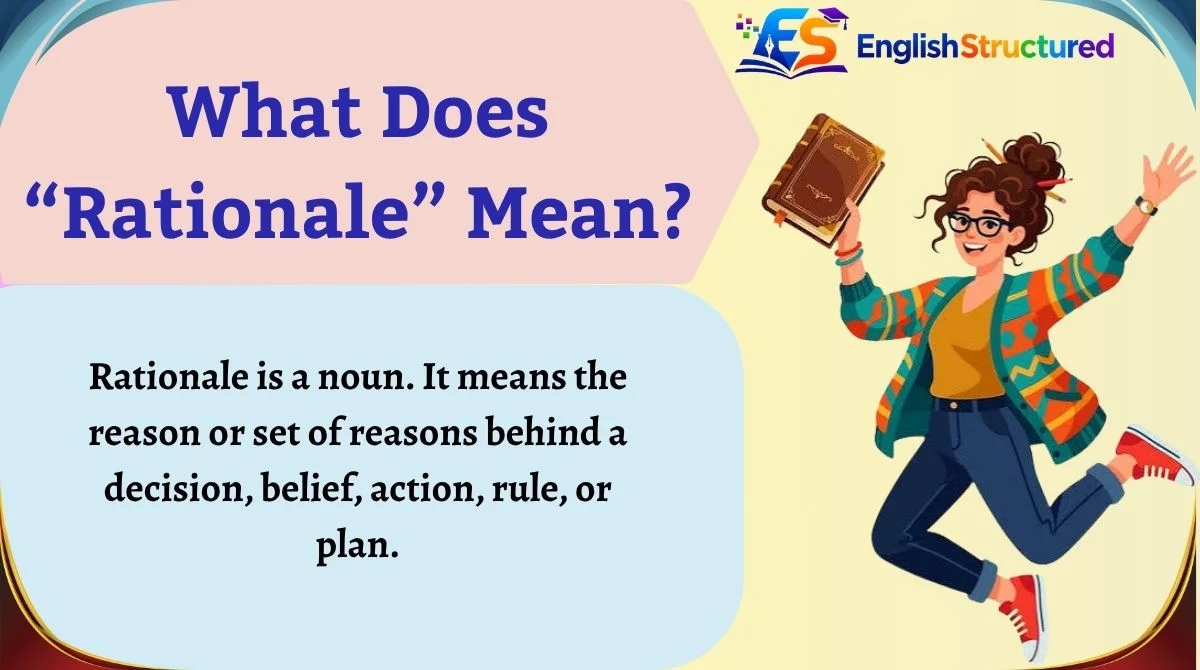
Rationale is a noun. It means the reason or set of reasons behind a decision, belief, action, rule, or plan.
Cambridge describes rationale as the reasons or intentions behind particular thoughts or actions. It is commonly used in formal, academic, professional, and business English.
In very simple English:
Rationale = the reason or reasons behind something.
Think of it as answering the question:
“Why was this done?”
For example:
Rational vs Rationale
The rationale is the reason for creating the rule.
When Should You Use “Rationale”?
Use rationale when you are talking about the reasoning behind something.
Common patterns include:
- the rationale for a decision
- Rational vs Rationale
- the rationale for the change
- the rationale behind the policy
- explain the rationale
- Rational vs Rationale
- understand the rationale
The word is especially common in professional and academic writing.
8 Examples of “Rationale”
- The teacher explained the rationale behind the new homework policy.
- Can you explain the rationale for this decision?
- The report provides a clear rationale for the proposed changes.
- I understand the rationale behind your suggestion.
- Rational vs Rationale
- There was a strong rationale for delaying the project.
- The committee discussed the rationale behind the new rules.
- We need to provide a clear rationale for our recommendation.
In each example, rationale refers to the reasoning behind something.
“Rationale” Is Usually a Noun
This is the grammar point you should remember most.
You can say:
The rationale is clear.
You can also say:
Rational vs Rationale
And:
I don’t understand the rationale for the change.
Because rationale is a noun, it can be used with articles and determiners:
- Rational vs Rationale
- the rationale
- this rationale
- their rationale
- your rationale
- Rational vs Rationale
Rationale vs Reason
The two words are closely related, but they are not always interchangeable in style.
Reason is much more common in everyday English.
Rationale sounds more formal and often refers to the reasoning or set of reasons behind a decision, policy, method, or belief.
Compare:
What is the reason for the change?
This sounds completely natural in everyday conversation.
Rational vs Rationale
This sounds more formal and may be common in a meeting, report, research paper, or workplace discussion.
So, if you are chatting with a friend, reason is often the easier choice. In formal writing, rationale can be useful when you want to emphasize the reasoning behind a decision.
Difference Between Rational and Rationale
The easiest way to understand rational vs rationale is to focus on their grammatical jobs.
Rational describes. Rationale names the reasoning.
| Feature | Rational | Rationale |
|---|---|---|
| Part of speech | Adjective | Noun |
| Basic meaning | Based on reason | Reasoning behind something |
| Main question | What is it like? | Why was it done? |
| Describes a noun? | Yes | No |
| Common use | Rational decision | Rationale for a decision |
| Style | Everyday and formal | Mostly formal |
| Example | a rational choice | the rationale for the choice |
Compare These Sentences
Rational vs Rationale
Here, rational describes the decision.
She explained the rationale for her decision.
Here, rationale means the reason or reasoning behind the decision.
The two words are related, but they do different jobs.
Another Example
Rational vs Rationale
The word rational describes the approach.
The company explained the rationale behind its approach.
The word rationale identifies the reasoning behind the approach.
This is a very useful pattern:
rational + noun
but:
Rational vs Rationale
Sentence Structure
A common structure with rational is:
rational + noun
Examples:
- rational decision
- rational choice
- rational argument
- Rational vs Rationale
- rational explanation
Another common structure is:
Rational vs Rationale
Example:
His response was rational.
With rationale, common structures include:
the rationale for + noun
Example:
The rationale for the change was unclear.
And:
the rationale behind + noun
Example:
The rationale behind the decision was explained later.
You can also use:
explain the rationale
Example:
The director explained the rationale for the new policy.
Meaning Comparison
Consider this short situation:
A student wants to buy a new laptop.
The student compares prices, checks the features, considers their budget, and chooses a reasonably priced model.
You could say:
The student made a rational choice.
That describes the choice.
Now imagine someone asks:
Why did the student choose that laptop?
The student’s reasons—such as price, battery life, and performance—form the rationale for the choice.
So:
Rational vs Rationale
Rationale = explains the reason behind the thinking or decision.
Grammar Rules You Must Remember
Rule #1: “Rational” Is an Adjective
Use rational to describe a noun or a person.
Examples:
That was a rational decision.
She gave a rational explanation.
He remained rational during the argument.
A simple test is to ask:
“Am I describing something?”
If yes, rational may be the correct choice.
Rule #2: “Rationale” Is a Noun
Use rationale when you mean the reasoning or reasons behind something.
Examples:
Rational vs Rationale
What is the rationale for this rule?
The manager explained the rationale behind the change.
A useful test is:
“Am I naming the reason or reasoning?”
If yes, rationale is probably the word you need.
Rule #3: Use “Rationale for” and “Rationale behind”
Two very common structures are:
the rationale for something
and
the rationale behind something
Examples:
We need to understand the rationale for the decision.
The teacher explained the rationale behind the exercise.
Both structures are natural.
You may also see:
Rational vs Rationale
For example:
She explained the rationale for changing the schedule.
Rule #4: Do Not Replace “Reason” With “Rational”
This mistake is common because the words look similar.
❌ What is the rational for this decision?
If you mean “What is the reason?”, use rationale or reason.
✅ What is the rationale for this decision?
✅ What is the reason for this decision?
But if you are describing something as sensible, use rational:
✅ It was a rational decision.
Remember:
rational = adjective
Rational vs Rationale
Common Mistakes Students Make
The main reason learners make mistakes with these words is their spelling.
They look almost identical:
rational
rationale
The ending is different, but that small difference changes the grammar.
Mistake 1: Using “rational” as a noun
❌ What is the rational behind this rule?
Correct:
✅ What is the rationale behind this rule?
Or simply:
✅ What is the reason behind this rule?
The problem is that rational describes something, while rationale names the reasoning.
Mistake 2: Using “rationale” as an adjective
❌ She made a rationale decision.
Correct:
Rational vs Rationale
Why?
Because decision needs an adjective here. You are describing the decision as sensible.
Mistake 3: Confusing “rationale” with “rationality”
These words are related, but they are not the same.
Rationality means the quality or condition of being rational.
Rationale means the reasoning behind something.
Compare:
His rationality helped him remain calm.
His rationale for leaving was easy to understand.
One refers to a quality of thinking. The other refers to the reasons behind a particular action or decision.
Mistake 4: Using “rationale” in every situation
Although rationale is correct in many formal situations, it can sound too formal in casual conversation.
For example:
What is your rationale for buying that sandwich?
This is grammatically fine, but it may sound unnecessarily formal.
In normal conversation, you would probably say:
Why did you buy that sandwich?
Or:
What’s your reason for buying it?
Use rationale when the context calls for a formal explanation, especially in business, education, research, government, or professional writing.
Mistake 5: Thinking “rational” means “right”
A rational decision is not necessarily the perfect decision.
Imagine you have only $20 and need shoes for work. You compare several pairs and choose a reasonably priced pair that fits your needs.
Rational vs Rationale
But the shoes might still break after two weeks.
So rational describes the reasoning behind the choice. It does not promise a perfect result.
Easy Trick to Remember the Difference
Here is a simple classroom trick:
Rational describes. Rationale explains.
Think about the two questions:
What kind?
→ Rational
Why?
→ Rationale
For example:
What kind of decision was it?
Rational vs Rationale
Why was the decision made?
→ The rationale was that the old system was too expensive.
Another memory trick is to connect rationale with reason.
Both are nouns.
You can say:
- the reason
- the rationale
But you cannot normally say:
- a rational
when you mean “a reason.”
You can also remember the adjective pattern:
rational decision
rational choice
Rational vs Rationale
If a word comes directly before a noun and describes it as sensible or logical, rational is often the right choice.
Daily Life Examples
These examples show how the two words work in natural English.
Example 1: Buying a Car
A: Why did you choose that car?
B: It was the most rational choice for my budget.
Here, rational describes the choice.
Example 2: Workplace Meeting
Manager: Why are we changing the schedule?
Employee: Could you explain the rationale behind the change?
Here, rationale means the reasoning behind the change.
Example 3: Studying
Teacher: Why did you choose to study in the morning?
Student: I made a rational decision because I concentrate better before lunch.
The decision is described as rational.
Example 4: Company Policy
Employee: I don’t understand the rationale for this new rule.
The employee wants to know why the rule exists.
Example 5: Family Decision
Dad: We should compare the prices before buying anything.
Mom: That’s rational. We don’t need to spend extra money.
Here, rational describes the idea as sensible.
Example 6: School Project
Teacher: Why did your group choose this topic?
Student: We explained our rationale in the introduction.
The students have given their reasons for choosing the topic.
Example 7: Argument
Friend 1: He was very emotional during the discussion.
Friend 2: Yes. It was difficult for him to give a rational response.
Here, rational means calm and based on reason rather than emotion.
Example 8: Business Report
The report provides a clear rationale for expanding the company.
This is formal English. The report gives the reasons for the expansion.
Example 9: Travel
Taking the train was a rational choice because the roads were crowded.
The choice is described as sensible.
Example 10: Everyday Conversation
I understand your rationale, but I still disagree with your decision.
This sentence is useful because it shows an important point: you can understand someone’s reasoning without agreeing with their conclusion.
Practice Section

Choose rational or rationale in each sentence.
1. She made a ______ decision after checking the facts.
2. What is the ______ behind this new policy?
3. The manager explained the ______ for changing the working hours.
4. It would be ______ to save some money before buying a new phone.
5. I don’t understand the ______ for rejecting the proposal.
Answers
1. rational
She made a rational decision after checking the facts.
2. rationale
The rationale behind something means the reasoning behind it.
3. rationale
The manager explained the rationale for changing the working hours.
4. rational
Here, rational describes the action as sensible.
5. rationale
The speaker wants to know the reason or reasoning behind the rejection.
Quick Test
Before choosing the word, ask yourself:
Am I describing something as sensible?
Use rational.
Am I talking about the reason behind something?
Use rationale.
That one question can prevent most mistakes.
FAQs
What is the difference between rational and rationale?
Rational is an adjective meaning based on reason, facts, or sensible thinking. Rationale is a noun meaning the reason or reasoning behind a decision, action, belief, or plan.
For example, “a rational decision” describes the decision, while “the rationale for the decision” explains why it was made.
Can “rationale” be used in a question?
Yes. Rationale is commonly used in questions, especially formal ones.
For example:
Rational vs Rationale
You can also ask:
What is the rationale behind the new policy?
In casual conversation, Why did you make this decision? may sound more natural.
Is “rationale” formal or informal?
Rationale is generally more formal. It is common in business, academic writing, reports, research, professional discussions, and official documents.
In everyday conversation, people often use reason instead.
For example, “What’s the reason?” is more casual than “What’s the rationale?”
Is “rational” an adjective?
Yes. Rational is an adjective.
It describes someone or something that is based on reason or clear thinking.
Examples include:
- a rational decision
- a rational person
- a rational argument
- a rational explanation
You can also say, “Her decision was rational.”
Can “rational” and “rationale” be used interchangeably?
No. They have related meanings, but they have different grammatical roles.
Rational describes something as reasonable or logical.
Rationale refers to the reason or reasoning behind something.
So “a rational decision” and “the rationale for the decision” are both correct, but they do not mean exactly the same thing.
Is “rationale” the same as “reason”?
They are very similar, but rationale is usually more formal.
A reason can be any explanation for something:
My reason for leaving was simple.
A rationale often refers to the reasoning or set of reasons supporting a decision, plan, method, or belief:
The committee explained the rationale for the new policy.
In casual English, reason is usually the easier choice.
Conclusion
The difference between rational and rationale becomes much easier once you focus on grammar.
Rational is an adjective. It describes someone or something as sensible, reasonable, or based on clear thinking.
Rationale is a noun. It means the reason or reasoning behind a decision, action, belief, or plan.
The simplest rule is:
Rational vs Rationale
So you can have a rational decision, a rational argument, or a rational response.
But you can explain the rationale for a decision, the rationale behind a policy, or the rationale for a change.
Also remember that rationale is more formal than reason. It is especially useful in professional and academic English, while reason is often better for everyday conversation.
Once you start noticing the difference between adjectives and nouns, these two words will stop looking confusing.
Practice them in short sentences, and choosing the right one will soon feel natural.