Thus vs Hence
They often appear in books, news articles, business writing, and academic papers.
At first, they seem to have the same meaning, so many students use them in the wrong place.
The confusion becomes even greater because both words can often be translated as “therefore,” “so,” or “as a result.”
However, they are not always interchangeable. Their tone, grammar, and common usage are different.
Knowing these differences can make your English sound more natural and accurate.
Learning when to use thus and hence is important if you want to improve your writing.
These words help connect ideas clearly and show the relationship between a cause and its result.
Whether you are writing an essay, sending a business email, or preparing for an English exam, using the correct word will make your sentences stronger.
Many native speakers also prefer one word over the other depending on the situation.
That is why understanding their meanings instead of memorizing simple rules is the best way to learn them.
After reading this guide, you will clearly understand what thus means, what hence means, when each word should be used, their grammar rules, common mistakes, and easy ways to remember the difference.
You’ll also see plenty of real-life examples that make these words much easier to use with confidence.
What Does “Thus” Mean?
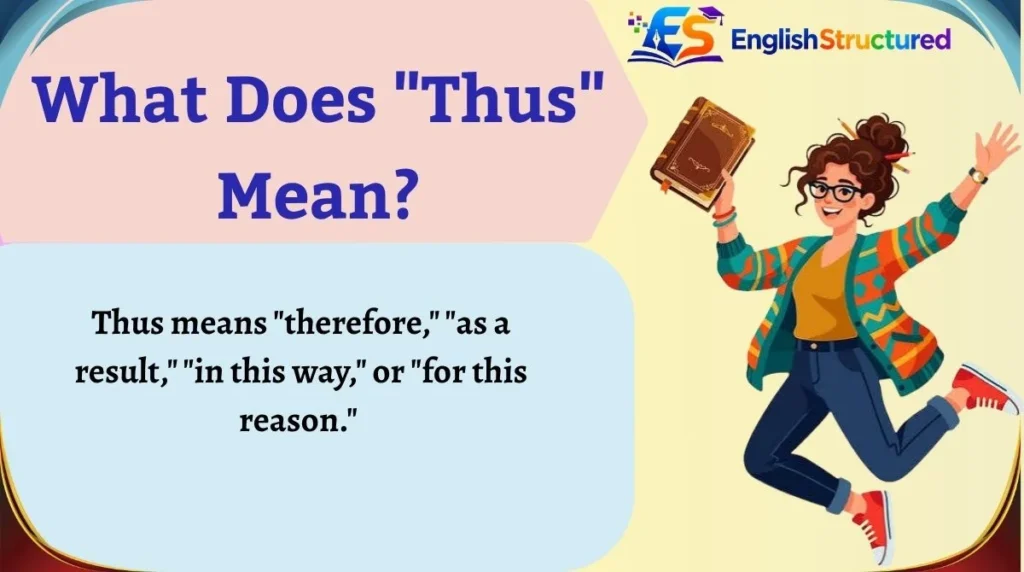
Thus means “therefore,” “as a result,” “in this way,” or “for this reason.” It connects one idea with another by showing that the second idea happens because of the first.
In modern English, thus is mainly used in formal writing. You will often find it in academic papers, reports, research articles, newspapers, and professional documents. It is less common in everyday conversations, where people usually say so or therefore instead.
When to Use “Thus”
Thus vs Hence
- You want to show a logical result.
- You are explaining why something happened.
- You are writing in a formal or academic style.
- You want to describe the way something is done.
Grammar Rule for “Thus”
The most common pattern is:
Cause + thus + result
or
Cause. Thus, + result.
Examples:
- The roads were covered with ice. Thus, many schools closed for the day.
- Thus vs Hence
- The company reduced unnecessary costs, thus increasing its yearly profit.
- Water froze overnight, thus making the roads slippery.
Thus vs Hence
Example Sentences with “Thus”
Here are several examples to help you understand its meaning.
- The team worked hard; thus, they finished the project early.
- The power went out. Thus, the meeting was canceled.
- He studied every weekend, thus improving his grades.
- The bridge was damaged, thus preventing traffic from crossing.
- Thus vs Hence
- The company invested in new technology, thus saving both time and money.
- The students completed all the assignments. Thus, they passed the course with excellent marks.
- Thus vs Hence
Common Learner Confusion About “Thus”
Many learners think thus is simply another word for so. Although the meanings are close, thus sounds much more formal.
Compare these examples:
- I was tired, so I went to bed. ✅ (Natural conversation)
- Thus vs Hence
In daily conversations, native speakers usually choose so.
Thus vs Hence
Correct:
- Thus vs Hence
Incorrect:
- Thus the experiment failed because of the weather. ❌
Here, thus does not clearly introduce the result, so the sentence sounds awkward.
“Thus” Can Also Mean “In This Way”
Besides showing results, thus sometimes means “in this way” or “like this.”
Examples:
- Fold the paper thus to make a perfect triangle.
- The machine works thus, producing less waste.
- Thus vs Hence
This meaning is less common today but still appears in instructions and older writing.
Formality of “Thus”
Thus is considered formal but still common in modern English writing.
You may see it in:
- Academic essays
- Scientific reports
- Legal documents
- Business reports
- News articles
- Research papers
In casual speech, people usually replace it with:
- so
- therefore
- because of that
- as a result
Synonyms of “Thus”
Thus vs Hence
- Therefore
- So
- Consequently
- As a result
- Accordingly
- Hence (sometimes)
- For this reason
Even though these words have similar meanings, they are not always perfect substitutes because each has a slightly different tone and level of formality.
Quick Summary of “Thus”
- Means therefore, as a result, or in this way.
- Mostly used in formal writing.
- Connects a cause with its result.
- Can also introduce an -ing phrase showing the result.
- Less common in everyday conversation than so or therefore.
What Does “Hence” Mean?
The next section will explain hence in detail, including its meaning, grammar rules, common learner mistakes, and plenty of example sentences before comparing thus vs hence side by side.
What Does “Hence” Mean?
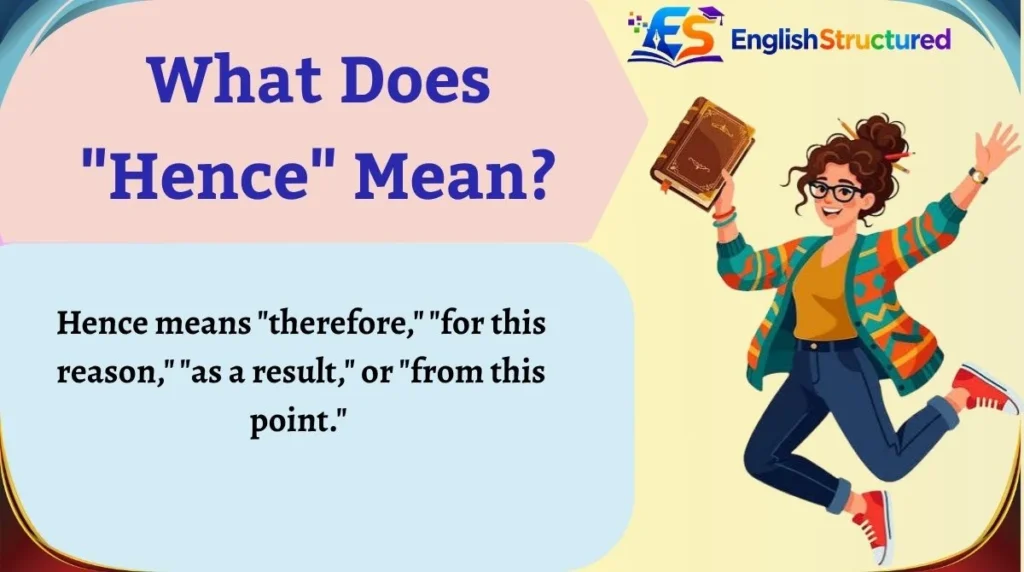
Hence means “therefore,” “for this reason,” “as a result,” or “from this point.” Like thus, it shows that one event happens because of another. However, hence has an additional meaning related to time or place, which makes it a little more flexible than thus.
You will often see hence in formal writing, academic papers, legal documents, business reports, and news articles. In everyday conversations, native speakers usually choose so, therefore, or that’s why instead.
When to Use “Hence”
Thus vs Hence
- Show the result of something.
- Explain the reason for a conclusion.
- Express a future time (for example, two years hence).
- Write in a formal or professional style.
Grammar Rule for “Hence”
The most common sentence patterns are:
Thus vs Hence
or
Cause; hence, + result.
Examples:
- The roads were flooded. Hence, the school remained closed.
- The company made a large profit; hence, it expanded its offices.
- Thus vs Hence
Unlike thus, hence is less commonly followed by an -ing phrase. It usually introduces a complete result clause.
Example Sentences with “Hence”
These examples show how hence works in different situations.
- The weather became worse. Hence, the match was canceled.
- She forgot her passport; hence, she could not board the plane.
- Thus vs Hence
- The product was popular; hence, sales increased rapidly.
- He had no previous experience. Hence, he needed extra training.
- The report contained several mistakes; hence, it was revised.
- Fuel prices increased sharply. Hence, transportation costs also rose.
- Thus vs Hence
“Hence” Can Show Time
One feature that makes hence different from thus is its use with time.
Thus vs Hence
Examples:
- The conference will take place three months hence.
- Our new office will open a year hence.
- Five years hence, this neighborhood may look completely different.
- Thus vs Hence
This usage is quite formal and is more common in books, contracts, and official writing than in everyday speech.
In normal conversation, people usually say:
- in three months
- a year from now
- five years from now
“Hence” Can Also Mean “From Here”
In older English, hence sometimes means “away from here” or “from this place.”
Examples:
- Go hence immediately.
- Thus vs Hence
Today, this meaning mostly appears in literature, historical writing, or dramatic language.
Common Learner Confusion About “Hence”
Many students believe hence and thus always mean exactly the same thing. While they often overlap, hence has additional meanings that thus does not.
Compare these sentences:
- The factory closed. Hence, many workers lost their jobs. ✅
- Thus vs Hence
Both are correct because they express a result.
Now compare these:
- The building will be completed two years hence. ✅
- The building will be completed two years thus. ❌
Only hence works when referring to future time.
Thus vs Hence
Incorrect:
- Hence because it rained, we stayed home. ❌
Correct:
- Thus vs Hence
- It rained, so we stayed home. ✅
Formality of “Hence”
Like thus, hence sounds formal.
You will commonly find it in:
- Academic writing
- Government documents
- Business reports
- Legal contracts
- Research papers
- Professional emails
- News reports
In casual conversation, speakers usually choose:
- so
- therefore
- that’s why
- because of that
- as a result
Synonyms of “Hence”
Thus vs Hence
- Therefore
- Consequently
- As a result
- For this reason
- Accordingly
- Thus
- From now (time meaning)
- From here (older meaning)
Always check the sentence because the meaning changes with context.
Quick Summary of “Hence”
- Usually means therefore or for this reason.
- Can also mean from now when talking about time.
- May mean from here in older English.
- Common in formal writing.
- Less common in everyday conversation.
Difference Between Thus and Hence
Although thus and hence often express the same basic idea—a result—they are not completely identical. Their grammar, sentence patterns, and common usage are slightly different.
Understanding these differences will help you choose the most natural word in every situation.
Comparison Table
| Feature | Thus | Hence |
|---|---|---|
| Basic meaning | Therefore; as a result; in this way | Therefore; for this reason; from now |
| Shows result | ✔ Yes | ✔ Yes |
| Means “in this way” | ✔ Yes | ✘ No |
| Means “from now” | ✘ No | ✔ Yes |
| Used with time expressions | Rarely | Very common in formal English |
| Common in academic writing | ✔ Yes | ✔ Yes |
| Common in conversation | Rare | Rare |
| Often followed by an -ing phrase | ✔ Yes | Less common |
Meaning Difference
Both words can introduce a logical conclusion.
Examples:
- The team trained every day. Thus, they became stronger.
- Thus vs Hence
Both sentences are correct because they express a result.
However, only thus naturally means “in this way.”
Example:
- Thus vs Hence
Only hence naturally expresses future time.
Example:
- The project will finish six months hence.
Grammar Difference
Thus vs Hence
Examples:
- She exercised regularly, thus improving her health.
- The company invested wisely, thus increasing profits.
- Thus vs Hence
Hence normally introduces a complete clause instead.
Examples:
- She exercised regularly; hence, her health improved.
- The company invested wisely; hence, profits increased.
- Thus vs Hence
Sentence Structure Difference
Thus
- Cause + thus + result
- Cause + thus + verb-ing phrase
Examples:
- Thus vs Hence
- He saved money, thus buying his first house.
Hence
- Cause + hence + complete clause
- Time expression + hence
Examples:
- The weather changed suddenly; hence, the event was canceled.
- Thus vs Hence
Usage Difference
Although dictionaries often list these words as synonyms, writers tend to use them slightly differently.
Choose thus when:
- Explaining how something happened.
- Showing the direct result of an action.
- Writing academic or technical explanations.
- Using an -ing phrase after the connector.
Choose hence when:
- Explaining a conclusion.
- Referring to future time.
- Writing formal reports or legal documents.
- Giving a logical consequence in professional writing.
Which Word Is More Common?
In modern everyday English, neither word is especially common in conversation. Native speakers usually prefer:
- so
- therefore
- that’s why
- because of that
- as a result
Thus vs Hence
Grammar Rules You Must Remember
Learning a few simple grammar rules will help you use thus and hence correctly. These rules are easy to remember and will make your writing sound more natural.
Rule #1: Use Both Words to Show a Result
Both thus and hence connect a cause with its result.
Examples:
- The train arrived late. Thus, we missed the meeting.
- The train arrived late. Hence, we missed the meeting.
- Thus vs Hence
- She practiced every day. Hence, she became more confident.
In these examples, the second idea happens because of the first one.
Rule #2: Use “Thus” with an -ing Phrase
One of the biggest grammar differences is that thus often comes before a verb ending in -ing to explain the result of an action.
Examples:
- Thus vs Hence
- The company reduced waste, thus saving thousands of dollars.
- She reviewed her notes, thus remembering the answers during the exam.
- They upgraded the software, thus increasing system security.
This pattern is common in academic and business writing.
Rule #3: Use “Hence” with Time Expressions
Only hence naturally means “from now” or “from this point in time.”
Examples:
- The new library will open three months hence.
- Our contract expires one year hence.
- The bridge will be completed six months hence.
- Five years hence, this city may look very different.
Thus vs Hence
❌ Two years thus
✅ Two years hence
Rule #4: Keep the Tone Formal
Both words are formal connectors. In everyday conversation, simpler alternatives are usually better.
Formal:
- The evidence was incomplete; thus, the case remained open.
- Sales increased; hence, the company hired more workers.
Informal:
- The evidence wasn’t enough, so the case stayed open.
- Sales went up, so the company hired more workers.
If you’re chatting with friends, so is usually the most natural choice.
Common Mistakes Students Make
Even advanced learners sometimes confuse thus and hence. Most mistakes happen because both words have similar meanings.
Understanding these errors will help you avoid them.
Mistake #1: Thinking They Always Mean Exactly the Same Thing
Although both words often mean therefore, hence has extra meanings related to time and place.
Wrong:
- The event will happen two weeks thus.
Correct:
- Thus vs Hence
Tip: Use hence when talking about future time.
Mistake #2: Using Them Too Often
Some learners replace every so with thus or hence.
Unnatural:
- I was hungry; thus, I made a sandwich.
More natural in conversation:
- I was hungry, so I made a sandwich.
Save thus and hence for formal writing unless you intentionally want a formal tone.
Mistake #3: Using “Hence Because”
Both words already express a reason or result.
Wrong:
- Hence because it rained, the game was canceled.
Correct:
- It rained; hence, the game was canceled.
- It rained, so the game was canceled.
Thus vs Hence
Mistake #4: Forgetting Punctuation
These transition words are often separated with commas when they introduce a new clause.
Correct:
- The machine stopped working. Thus, production ended.
- The machine stopped working. Hence, production ended.
Proper punctuation makes your writing easier to read.
Mistake #5: Using “Hence” Before an -ing Phrase
Many learners copy the grammar pattern of thus.
Less natural:
- She practiced daily, hence improving her skills.
Better:
- She practiced daily, thus improving her skills.
- She practiced daily; hence, her skills improved.
Easy Correction Tips
Remember these quick ideas:
- Use thus when explaining how something happened.
- Use hence when giving a logical conclusion or talking about future time.
- Choose so in everyday conversations.
- Read the whole sentence aloud. If it sounds too formal for the situation, use a simpler connector.
Easy Trick to Remember the Difference
Simple memory tricks make grammar much easier to remember.
Trick for “Thus”
Think of thus as “this way.”
Both words begin with “th.”
If you can replace thus with “in this way,” it is probably the right choice.
Example:
- She organized her schedule, thus finishing everything on time.
Here, the action happened in this way.
Trick for “Hence”
Think of hence as “from now.”
When you see a number of days, weeks, months, or years before it, hence is almost always correct.
Examples:
- One week hence
- Two months hence
- Five years hence
This trick immediately separates hence from thus.
A Classroom Memory Tip
Imagine your teacher drawing two boxes.
Box 1: Thus
- Result
- In this way
- Often with -ing
Box 2: Hence
- Result
- From now
- Future time
Visualizing these two boxes helps many students remember the difference during exams.
Daily Life Examples
The best way to learn grammar is by seeing it in everyday situations.
Here are some natural examples.
- My phone battery died, so I couldn’t call anyone. In a formal report, you could write: Thus, communication was interrupted.
- The weather forecast predicted heavy rain; hence, we packed umbrellas.
- Thus vs Hence
- The shop was closed; hence, we visited another store.
- The project finished ahead of schedule, thus saving valuable time.
- Our vacation begins two weeks hence.
- He forgot to set an alarm. Thus, he arrived late for work.
- The road was under construction; hence, traffic moved slowly.
- The company trained its employees regularly, thus increasing customer satisfaction.
- The contract will end one year hence, unless both sides renew it.
Notice that these sentences sound natural because each word is used in the right context.
Practice Section
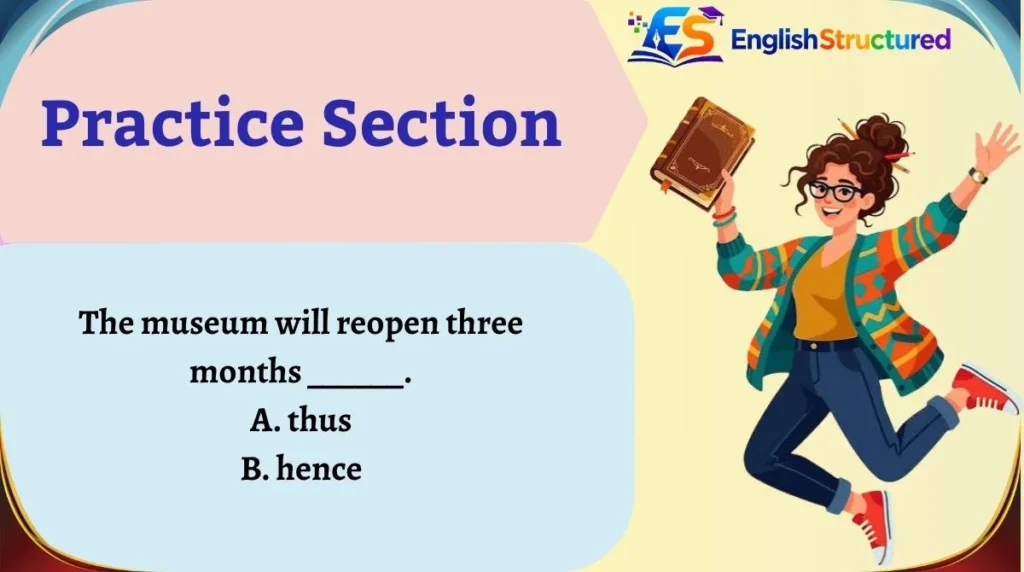
Choose the correct word: thus or hence.
Question 1
The team practiced every day, ______ improving its performance.
A. thus
B. hence
Question 2
The museum will reopen three months ______.
A. thus
B. hence
Question 3
The computer crashed. ______, we lost the unsaved files.
A. Thus
B. Hence
Question 4
She followed every instruction, ______ completing the task successfully.
A. thus
B. hence
Question 5
The bridge was unsafe; ______, it was closed immediately.
A. thus
B. hence
Answers
- A. thus ✅
- B. hence ✅
- A. Thus or B. Hence ✅ (Both are correct because they express a result.)
- A. thus ✅
- A. Thus or B. Hence ✅ (Both are acceptable in formal English.)
FAQs
What is the difference between thus and hence?
Both words mean “therefore” or “as a result.” However, thus can also mean “in this way,” while hence can mean “from now.” That is the biggest difference between them.
Can thus and hence be used interchangeably?
Sometimes, yes. When both introduce a logical result, they often have the same meaning. However, they are not interchangeable when hence refers to future time.
Is thus formal or informal?
Thus is considered a formal transition word. It is common in academic writing, reports, and professional documents. In everyday speech, people usually say so instead.
Is hence formal or informal?
Hence is also formal. It appears frequently in business writing, legal documents, research papers, and official reports. It is less common in casual conversation.
Can hence be used with future time?
Yes. This is one of its special meanings.
Examples:
- Three months hence
- One year hence
- Five days hence
This usage is correct and widely accepted in formal English.
Which word is more common in modern English?
In everyday conversation, neither word is very common. Native speakers usually prefer so, therefore, or that’s why. Thus vs Hence
Conclusion
Thus vs Hence
Both words help connect ideas by showing a result or conclusion, but each has its own strengths.
Thus is often used to explain how something happened or to introduce an -ing phrase, while hence is especially useful when expressing a logical conclusion or talking about future time, such as two weeks hence.
Instead of trying to memorize long grammar rules, focus on reading and practicing real examples.
Pay attention to how these words are used in books, articles, and formal writing. Over time, choosing the correct one will become natural.
Don’t worry if you make mistakes at first. Every new grammar point takes practice.
The more you write and read, the more confident you’ll become.
Keep using short exercises, compare your own sentences, and soon you’ll know exactly when thus or hence is the better choice.