
Someday vs Some Day
You are not alone. These two forms look almost identical, and both are correct English. The confusing part is that they do not always mean exactly the same thing.
The good news is that the difference is easier than it first appears. The main idea is about time and meaning.
Someday is usually used when you mean an unknown or unspecified time in the future. You have a future idea in your mind, but you do not say exactly when it will happen.
For example:
I hope to travel around Europe someday.
Here, the speaker does not have a particular day in mind.
Some day, written as two words, normally refers to one particular day, although the exact day may not be named.
It can also be used when “some” directly describes the noun “day.”
For example:
We should meet some day next week.
The meaning is closer to one day within a certain period.
This small difference can make your writing clearer. It is especially useful in emails, school assignments, conversations, and everyday English.
Once you understand whether you are talking about an unspecified future time or one particular day, choosing the correct form becomes much easier.
What Does “Someday” Mean?

Someday is an adverb that means at an unknown or unspecified time in the future.
You use it when you believe or hope that something will happen, but you do not know exactly when.
Think of it as:
Someday vs Some Day
The exact date is not important, or the speaker does not know it.
For example:
Someday vs Some Day
The person wants to learn Spanish in the future. However, they do not say when they will start.
Another example is:
Someday, I will visit Japan.
The speaker has a future goal. There is no particular day, month, or year attached to the idea.
When Should You Use “Someday”?
Use someday when the word describes when an action will happen and the time is uncertain.
It is very common with dreams, wishes, hopes, plans, and predictions.
You may hear it in sentences such as:
Someday vs Some Day
We will own our own house someday.
Someday, you will understand why I said that.
I would love to see the Northern Lights someday.
She wants to open a restaurant someday.
Someday vs Some Day
Someday, I will look back on this experience and smile.
Notice that none of these sentences gives a specific day.
The speaker is talking about an unknown future time.
Grammar Rule for “Someday”
“Someday” works as an adverb of time.
It can appear at the beginning or end of a sentence.
At the beginning:
Someday, I will write a book.
At the end:
Someday vs Some Day
Both are grammatically correct.
The comma after “Someday” is commonly used when it comes at the beginning of a sentence because it creates a natural pause.
More Examples of “Someday”
- I hope to meet my favorite author someday.
- Someday, I want to live near the ocean.
- You will understand this lesson someday.
- We should go hiking together someday.
- She dreams of becoming a doctor someday.
- Maybe I will learn how to play the piano someday.
- Someday, people may look back at this period in history differently.
- I would like to visit that beautiful city someday.
All eight examples refer to a future time without identifying one particular day.
A Common Confusion About “Someday”
Many learners think someday must mean a specific day that the speaker has secretly chosen.
Usually, that is not the case.
If you say:
Someday vs Some Day
You are not pointing to Tuesday, Friday, or another particular day. You simply mean at some point in the future.
This is why “someday” is especially common with long-term dreams.
You might say:
Someday, I will start my own business.
The speaker may have no idea when that will happen.
What Does “Some Day” Mean?

Some day is written as two separate words when some directly describes the noun day.
It usually means one particular day, but that day is not identified.
Think of it as:
Someday vs Some Day
The focus is on the day itself.
For example:
We need to choose some day for the meeting.
Here, the speaker is thinking about a day that will be selected.
Another example:
I met him some day last summer.
The speaker is referring to one day during last summer, even though the exact date is not given.
When Should You Use “Some Day”?
Use some day when “day” is functioning as a noun and some is modifying it.
It is especially natural when there is another phrase that helps identify the general period.
For example:
We can meet some day next week.
Here, “some day” means one day during next week.
Compare that with:
We can meet someday.
This second sentence is much more general. It simply means at an unspecified future time.
Grammar Rule for “Some Day”
In some day, the word some works as a determiner describing the noun day.
You can often replace the phrase with something like:
- one day
- Someday vs Some Day
- one particular day
- an unspecified day
For example:
We should go there some day.
This can mean:
We should go there on one day.
The exact day is not identified.
More Examples of “Some Day”
- Someday vs Some Day
- Let’s meet some day next week.
- I remember seeing her some day in May.
- Some day during the holiday, we should visit the museum.
- He called me some day last month, but I cannot remember when.
- Someday vs Some Day
- On some day in the future, this building may become a museum.
- She said she would return some day in June.
The exact grammar and naturalness can vary depending on context. In everyday English, someday is often preferred when the intended meaning is simply “at some unknown time in the future.”
A Common Confusion About “Some Day”
Learners sometimes use some day every time they mean “someday.”
That is understandable because the meanings overlap.
However, the two-word version can sound more deliberate because it treats day as a specific noun.
Consider:
Someday vs Some Day
This sounds completely natural.
But:
I want to travel the world some day.
This is possible in some contexts, but many readers will expect the single-word form because the meaning is simply at an unspecified time in the future.
Difference Between “Someday” and “Some Day”
The easiest way to understand the difference is to focus on what you mean by time.
| Expression | Main Meaning | Grammar | Typical Use | Example |
|---|---|---|---|---|
| someday | At an unknown future time | Adverb | Future hopes, dreams, plans | I will travel there someday. |
| some day | One particular but unnamed day | Determiner + noun | A day within a period or context | We can meet some day next week. |
1. “Someday” Is Usually About the Future
When you use someday, you normally have a future time in mind, but the time is not specified.
Someday vs Some Day
The speaker means:
I will learn to drive at some point in the future.
There is no particular day involved.
2. “Some Day” Focuses on One Day
With some day, the word “day” remains a noun.
We need to select some day for the event.
The speaker is talking about one day that will be selected.
The difference becomes even clearer when you add a time period:
Someday vs Some Day
This means one day during next week.
3. The Forms Can Sometimes Overlap
English is not always divided into perfectly separate boxes.
There are situations where some day and someday may seem close in meaning.
For example:
Someday vs Some Day
and
Maybe we will meet some day.
The first is much more natural for the general meaning “at some point in the future.”
The second can place more focus on one day.
Because modern English strongly favors someday for the general future meaning, it is usually the safer choice when there is no special reason to emphasize “day.”
4. Ask Yourself One Simple Question
When you are unsure, ask:
Am I talking about an unknown future time, or one particular day?
If you mean an unknown future time, choose someday.
Someday vs Some Day
If you mean one day, especially within a known period, some day may be appropriate.
We should meet some day next week.
That simple question solves most cases.
Grammar Rules You Must Remember
Rule #1: Use “someday” for an unspecified future time.
When you mean “at some point in the future,” write someday as one word.
Someday vs Some Day
The exact time is unknown.
Another example:
Someday, I will understand how this machine works.
The speaker is talking about the future in general.
Rule #2: Use “some day” when “some” directly describes “day.”
When the phrase means one particular day, use two words.
Someday vs Some Day
Here, “some” describes the noun “day.”
You can imagine the sentence as:
We need to choose one day for the celebration.
That makes the two-word form easier to understand.
Rule #3: “Someday” is common with dreams and hopes.
When talking about something you want to do in the future, someday is usually the natural choice.
Someday vs Some Day
She hopes to become a teacher someday.
We would like to travel together someday.
These sentences describe future goals without a fixed date.
Rule #4: A specific time expression can make “some day” clearer.
When you identify a general period, the two-word form can refer to one day within that period.
We will meet some day next month.
Someday vs Some Day
Choose some day in December for the event.
The phrase is connected to a particular day inside a larger time period.
Common Mistakes Students Make
The biggest problem is that both forms look reasonable.
Students often remember that “some” and “day” are two separate words and automatically write some day. But English has many compounds that have developed into single words, and someday is one of them when it functions as an adverb.
Mistake 1: Using “some day” for every future dream
Less natural:
Someday vs Some Day
More natural:
I want to become famous someday.
The second sentence clearly means at some point in the future.
Mistake 2: Thinking “someday” means a particular day
Incorrect idea:
Someday means one exact day.
Usually, it does not.
Someday vs Some Day
This does not tell us which day.
The speaker may not know either.
Mistake 3: Avoiding “some day” completely
The opposite mistake also happens.
A learner may think someday is always correct.
But two-word some day can be useful when you are talking about one day in a particular situation.
We need to choose some day next week.
Here, the phrase naturally points to one day next week.
Mistake 4: Thinking the pronunciation solves everything
In normal speech, someday and some day may sound very similar.
That means listening alone may not tell you which spelling is intended.
Instead, look at the meaning and grammatical role.
Ask whether “day” is being treated as a noun or whether the whole word is functioning as an adverb.
A Quick Correction Tip
When editing your writing, replace someday mentally with:
at some point in the future
If the sentence still makes sense, someday is probably the right choice.
For example:
Someday vs Some Day
→ I want to visit Italy at some point in the future.
Perfect.
For some day, try replacing it with:
one day
For example:
We need to choose some day next week.
→ We need to choose one day next week.
That also works.
Easy Trick to Remember the Difference
Here is a simple classroom trick:
One word = one general future idea
Think:
Someday vs Some Day
If you could use sometime in the sentence, someday is often the better choice.
I will call you someday.
I will call you sometime.
Both express a general, unknown future time.
Two words = one day
Think:
some day = one day
If you are thinking about one day from a group of days, the two-word form may fit.
We can meet some day next week.
Imagine seven days on a calendar. You are not choosing the exact day yet, but you mean one of those days.
This is the key difference:
Someday vs Some Day
Some day → one particular or selected day
It is not a perfect rule for every sentence, but it is an excellent guide for everyday English.
Daily Life Examples
Here are some natural examples that show how native speakers use these forms.
1. Talking about a dream
A: What do you want to do after graduation?
Someday vs Some Day
The speaker has a future dream but no fixed date.
2. Talking about meeting a friend
A: We haven’t had coffee together in months.
B: I know! We should meet someday.
This means at some point in the future.
3. Choosing a day next week
A: When can we discuss the project?
B: We can meet some day next week.
Here, the conversation is about choosing one day during next week.
4. Talking about a future goal
Someday, I want to write my own book.
The speaker has a long-term ambition.
5. Talking about a holiday
Someday vs Some Day
The speaker has a trip period in mind and means one day during that trip.
6. Talking about a future home
I hope to have a garden someday.
There is no fixed date.
7. Talking about an event
Let’s choose some day in July for the party.
The group needs to select one day in July.
8. Giving encouragement
Someday vs Some Day
This refers to an unknown point in the future.
9. Making a casual invitation
We should go hiking someday.
This is a general future suggestion.
10. Selecting a date
We need to pick some day that everyone can attend.
The focus is on choosing one suitable day.
Practice Section
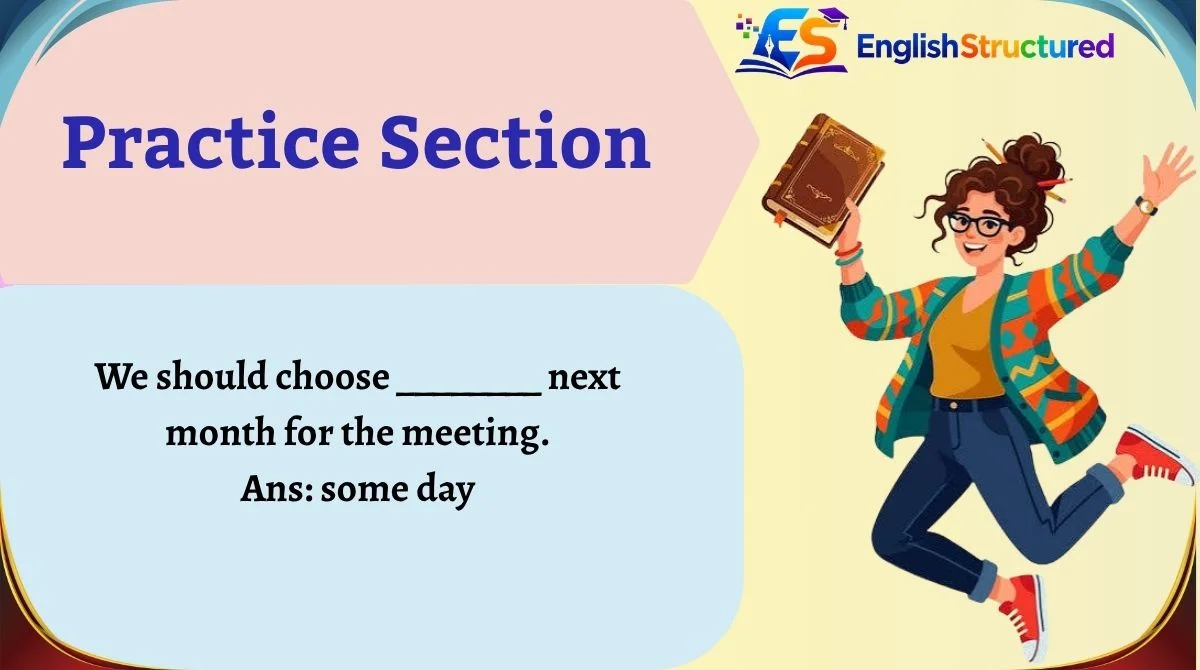
Choose someday or some day to complete each sentence.
1. I hope to visit Canada ________.
2. We should choose ________ next month for the meeting.
3. She wants to learn to swim ________.
4. Let’s go there ________ during the holiday.
5. ________, I will achieve my biggest goal.
Answers
1. someday
I hope to visit Canada someday.
This means at an unknown time in the future.
2. some day
We should choose some day next month for the meeting.
This means one day during next month.
3. someday
Someday vs Some Day
This is a future goal with no fixed time.
4. some day
Let’s go there some day during the holiday.
The phrase refers to one day during the holiday period.
5. Someday
Someday, I will achieve my biggest goal.
The speaker is talking about an unspecified future time.
Try This Extra Test
Consider this sentence:
I want to meet you ________.
The most natural choice is:
Someday vs Some Day
Why? Because there is no particular day or time period being discussed. It is simply a future wish.
Now consider:
I want to meet you some day next week.
Here, some day works because the speaker means one day within next week.
FAQs
What is the difference between “someday” and “some day”?
Someday usually means at some unspecified time in the future. It is one word and commonly works as an adverb.
Some day means one particular or selected day, especially when “day” is being treated as a noun.
For general future hopes and dreams, someday is normally the natural choice.
Can “someday” be used in questions?
Yes. It can appear in questions when you are asking about an unspecified future time.
For example:
Someday vs Some Day
It can also be used in casual suggestions:
Could we go there someday?
The meaning is usually “at some point in the future.”
Is “someday” formal or informal?
Someday is normal English and works in both everyday and reasonably formal writing.
It is especially common in conversations, personal writing, stories, and sentences about future hopes.
The choice is based more on meaning than on formality.
Is “some day” grammatically correct?
Yes. Some day is grammatically correct when the meaning calls for two words.
For example:
We can choose some day next week.
Here, “some” describes the noun “day.”
However, if you simply mean “at some point in the future,” someday is generally the more natural spelling.
Can “someday” mean “one day”?
Sometimes someday can be close in meaning to “one day,” especially when “one day” means an unknown future time.
For example:
Someday, I will become a successful writer.
This is similar to:
One day, I will become a successful writer.
However, “one day” has other uses too. It can refer to a particular day in the past or future, so context matters.
Which is correct: “I will see you someday” or “I will see you some day”?
For the usual meaning “at some point in the future,” the preferred form is:
I will see you someday.
The one-word form is standard for this meaning.
The two-word form can be used when you specifically mean one day, especially within a particular period or situation.
Can I use “someday” at the beginning of a sentence?
Yes.
For example:
Someday, I will travel the world.
You can also put it at the end:
I will travel the world someday.
Both are correct. The beginning position can give the future idea a little more emphasis.
Is “some day” always followed by a time period?
No. It does not have to be.
You can say:
We will choose some day for the ceremony.
However, adding a phrase such as next week, in July, or during the holiday often makes the two-word meaning clearer.
Conclusion
Someday vs Some Day
Use someday when you mean at an unspecified time in the future. It is common when talking about dreams, hopes, plans, wishes, and future possibilities.
I hope to travel the world someday.
Use some day when some describes the noun day, usually meaning one particular or selected day.
We can meet some day next week.
A useful memory trick is to connect someday with sometime. If you mean “at some point in the future,” the one-word form is usually the right choice.
When you mean one day from a group of days, think about some day as two words.
Do not worry if the distinction feels confusing at first. Native speakers also rely heavily on context.
With a little practice, you will quickly recognize whether you are talking about a general future time or one particular day.
That small difference will make your English writing sound more natural and precise.