Former vs Latter
You may see them in books, articles, emails, school lessons, and even everyday conversations.
The problem is that their meanings are connected, so learners sometimes mix them up.
The good news is that the basic idea is quite easy.
When we mention two people, things, places, or ideas, we can use former to talk about the first one and latter to talk about the second one.
Once you understand this simple order, these words become much easier.
For example:
I like tea and coffee, but I prefer the latter.
Here, tea is mentioned first, while coffee is mentioned second. So latter means coffee.
You may also see former used in another way. It can mean someone or something that had a position or condition in the past.
For example:
Former vs Latter
This means she was a teacher before, but she is not a teacher now.
Understanding these two meanings is important because the words are common in formal English.
They can also make your writing shorter and clearer when you are comparing two choices.
By the end, you will know exactly when to use former and latter, how their meanings differ, what grammar rules they follow, and how to avoid the most common mistakes.
What Does “Former” Mean?
The word former has two main uses in English.
The first meaning is the first of two people or things that have just been mentioned.
The second meaning is someone or something that had a particular role, job, position, or condition in the past.
These two meanings are related to the idea of being earlier.
Former Meaning 1: The First of Two
When two things are mentioned, former refers to the first one.
Look at this sentence:
I enjoy reading novels and watching movies, but I prefer the former.
Two activities are mentioned:
- reading novels
- watching movies
Former vs Latter
Here are more examples:
- Former vs Latter
- Sara studied English and French; she found the former easier.
- We can travel by bus or train. The former is cheaper.
- Tom likes football and basketball, but the former is his favorite.
- The company sells phones and laptops. The former are more popular.
- I enjoy summer and winter, but I prefer the former.
- She considered joining the club or the team. She chose the former.
- Former vs Latter
In every example, former points back to the first item.
Former Meaning 2: Something From the Past
Former can also mean previous or past.
For example:
Former vs Latter
This means he worked for the company in the past, but he does not work there now.
More examples include:
Former vs Latter
She studied at the school before.
He is a former president.
He held the position of president in the past.
Former vs Latter
That person was the speaker’s boss before.
Former vs Latter
The home was theirs previously.
This use is very common when talking about jobs, positions, relationships, places, or conditions.
Grammar Rule for “Former”
When former means the first of two things, it is usually used with the:
Former vs Latter
For example:
Former vs Latter
When former means something from the past, it normally comes before a noun:
Former vs Latterformer president
former employee
former manager
former home
You would not normally say:
Former vs Latter
That sounds incomplete when you mean a past role. You need to identify what she used to be:
Former vs Latter
A Common Confusion
Many learners think former always means past. That is not correct.
Consider:
I chose between pizza and pasta. I chose the former.
Here, former does not mean that pizza is from the past. It means pizza was mentioned first.
So always look at the context.
If two things are being compared, former usually means first.
If it comes directly before a noun such as teacher, president, or employee, it often means previous or past.
What Does “Latter” Mean?
Latter has one main meaning in modern English: it refers to the second of two people or things that have just been mentioned.
Former vs Latter
If former means first, latter means second.
For example:
I like tea and coffee, but I prefer the latter.
Tea comes first. Coffee comes second.
Therefore:
- the former = tea
- Former vs Latter
Examples of “Latter”
Here are several simple examples:
- Former vs Latter
- She likes cats and dogs, but she prefers the latter.
- We can take a taxi or a bus. The latter is cheaper.
- Jack enjoys science and history. The latter is his favorite subject.
- You can call me or send me a message. The latter may be easier.
- He considered buying a car or a motorcycle. He chose the latter.
- We discussed two restaurants, and the latter had better reviews.
- Former vs Latter
Former vs Latter
Grammar Rule for “Latter”
Like former, latter is often used with the:
the latter
It normally refers back to something already mentioned.
For example:
John and Mark joined the meeting. The latter arrived late.
Former vs Latter
The word is especially useful when you do not want to repeat a name or noun.
Instead of saying:
John and Mark joined the meeting. Mark arrived late.
You can write:
John and Mark joined the meeting. The latter arrived late.
This can sound more formal.
Latter Does Not Usually Mean “Past”
This is an important difference.
Former vs Latter
But they are different.
Former vs Latter
Later = at a time after now or after another time.
For example:
I will call you later.
Here, later refers to time.
But:
I can call you or text you. I prefer the latter.
Here, latter refers to the second choice, text you.
That small spelling difference changes the meaning completely.
Difference Between Former and Latter
The easiest way to understand the difference is to remember one simple order:
Former = first
Former vs Latter
Suppose you mention two things:
A and B
Then:
Former vs Latter
This is the basic rule.
Comparison Table
| Word | Main meaning | What does it point to? | Example |
|---|---|---|---|
| Former | First of two | First item mentioned | I chose the former. |
| Latter | Second of two | Second item mentioned | I chose the latter. |
| Former | Previous/past | A past role or condition | He is a former teacher. |
| Latter | Second of two | The second item | The latter option is better. |
Example With Both Words
Consider:
Anna and Maria applied for the job. The former had more experience, while the latter had better qualifications.
Who is the former?
Anna.
Former vs Latter
Maria.
The order is:
- Anna → former
- Maria → latter
Another example:
I enjoy reading and writing. The former helps me relax, while the latter helps me express my ideas.
Here:
- Former vs Latter
- writing = latter
Grammar Logic
These words work because English often avoids repeating the same nouns.
Compare:
I like tea and coffee. I drink tea every morning, and I drink coffee in the afternoon.
There is nothing grammatically wrong with this, but it sounds repetitive.
You can say:
I like tea and coffee. I drink the former every morning and the latter in the afternoon.
Former vs Latter
However, there is one important point: the reader must clearly know which two things you mean.
If you mention several things, using former and latter can become confusing.
For example:
I bought apples, bananas, oranges, and grapes. The latter was expensive.
Former vs Latter
A reader may not be sure because more than two items were mentioned.
For clear English, it is best to use these words when you are dealing with two clearly identified choices or subjects.
Sentence Structure
The most common pattern is:
Former vs Latter
or:
A and B. The latter…
Examples:
Former vs Latter
Tea and coffee are popular drinks. The latter contains more caffeine.
You can also use them after longer descriptions:
Working from home and working in an office have different benefits. The former can save travel time, while the latter may offer more social interaction.
The words do not have to follow two single nouns. They can refer to two ideas, actions, choices, or situations.
Grammar Rules You Must Remember
Rule #1: Former Means the First
When two things are mentioned, former points to the first.
I like football and cricket. I prefer the former.
Former vs Latter
A quick way to check is to number the items:
- football → former
- cricket → latter
Rule #2: Latter Means the Second
When two things are mentioned, latter points to the second.
I like football and cricket. I prefer the latter.
Former vs Latter
Remember:
First = former
Second = latter
Rule #3: Former Can Mean “Previous”
When former comes before a noun, it can mean previous or past.
Former vs Latter
This means she worked there before.
Other examples:
a former president
a former student
a former manager
a former friend
Former vs Latter
The person or thing had that role in the past.
Rule #4: Latter and Later Are Different
Do not confuse latter with later.
Latter refers to the second of two things.
I chose the latter.
Former vs Latter
I will see you later.
This is one of the most common spelling and vocabulary mistakes involving these words.
Common Mistakes Students Make
These words cause mistakes mainly because their meanings are easy to reverse.
Mistake 1: Thinking Former Means Second
Some learners remember that former means something old or past, so they become unsure when it refers to the first item.
Wrong thinking:
“Former means old, so it must mean the second one.”
That is not how the comparison works.
Correct:
I like tea and coffee. I prefer the former.
The former is tea, because tea came first.
Mistake 2: Thinking Latter Means “Later”
The words look almost the same, but they do different jobs.
Incorrect:
I will call you latter.
Correct:
I will call you later.
But:
I chose between the red shirt and the blue shirt. I chose the latter.
Here, latter means the blue shirt.
Mistake 3: Using These Words for Many Items
Using former and latter after a long list can make your writing unclear.
For example:
I bought bread, milk, eggs, cheese, and fruit. The latter was fresh.
The reader may wonder what latter refers to.
A better sentence is:
I bought bread, milk, eggs, cheese, and fruit. The fruit was fresh.
Use former and latter most safely when there are two clear items.
Mistake 4: Forgetting “The”
In the usual comparison structure, learners often leave out the.
Less natural:
I like tea and coffee. Former is cheaper.
Better:
I like tea and coffee. The former is cheaper.
Similarly:
The latter is stronger.
Mistake 5: Using “Former” When You Mean “Ex”
Sometimes former and ex- have similar meanings, but they are not always interchangeable.
He is my former manager.
This means he was my manager before.
He is my ex-manager.
This can also mean he was my manager before, but former is usually more neutral and formal.
The exact choice depends on context and style.
Easy Trick to Remember the Difference
Here is a simple memory trick that works well for students:
F = First
L = Last
The first letters give you a helpful clue:
Former → F → First
Latter → L → Last
This is not a perfect dictionary definition of the words, but it is an excellent memory aid.
Imagine two boxes:
Box 1: Apple
Box 2: Orange
If you say:
The former is red.
You mean the apple, because it came first.
If you say:
The latter is orange.
You mean the orange, because it came second.
Another useful trick is to think:
Former vs Latter
Be careful, though: latter does not mean later in time. It means the second item in the pair.
For a classroom test, simply write:
F = First
L = Last
That small reminder can prevent a very common mistake.
Daily Life Examples
These words are more common in formal writing than casual conversation, but you may still hear them in discussions, classes, interviews, and presentations.
Example 1
A: Do you prefer tea or coffee?
B: I prefer the latter.
Former vs Latter
Example 2
We can go by car or train. The former is faster.
Former means car because car was mentioned first.
Example 3
My brother and sister both work in education. The former is a teacher.
Former means brother.
Example 4
You can study at home or at the library. The latter is usually quieter.
Latter means the library.
Example 5
I tried both restaurants. The latter had better service.
Latter means the second restaurant mentioned.
Example 6
She worked as a nurse for ten years. She is now a former nurse.
Here, former means previous, not “first of two.”
Example 7
The company offers online and classroom courses. The former is more flexible.
Former means online courses.
Example 8
We discussed two solutions. The latter was easier to use.
Latter means the second solution.
Example 9
He is a former university student.
This means he was a university student before.
Example 10
Between honesty and popularity, I would choose the former.
Former means honesty because it was mentioned first.
These examples show why context matters. The same word, former, can mean either first or previous, depending on how it is used.
Practice Section
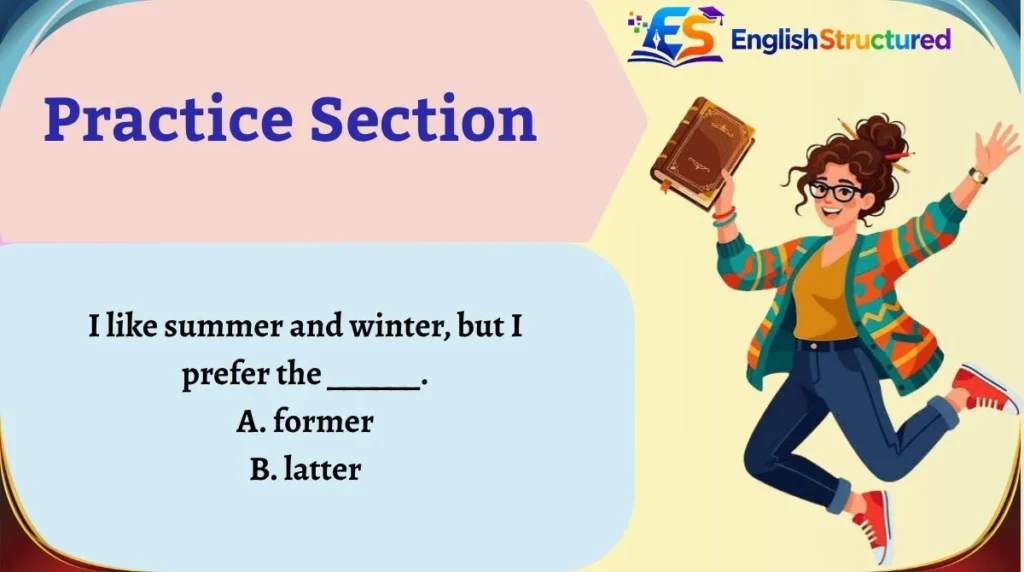
Choose the correct word: former or latter.
1. I like summer and winter, but I prefer the ______.
A. former
B. latter
2. Sarah and Emma joined the class. The ______ arrived early.
A. former
B. latter
3. He is a ______ employee of the company.
A. former
B. latter
4. We can take the bus or the train. The ______ is more comfortable.
A. former
B. latter
5. I studied English and Spanish. The ______ was easier for me.
A. former
B. latter
Answers
1. former — Summer was mentioned first.
2. former — Sarah was mentioned first.
3. former — He worked for the company in the past.
4. latter — The train was mentioned second.
5. latter — Spanish was mentioned second.
A good habit is to identify the two items first. Then ask yourself:
Which one came first?
That is the former.
Which one came second?
That is the latter.
FAQs
What is the difference between former and latter?
When two people or things are mentioned, former means the first one and latter means the second one.
For example, in “tea and coffee,” tea is the former and coffee is the latter.
Former can also mean “previous” or “past,” while latter normally refers to the second of two things.
Can former mean “previous”?
Yes. Former often means previous when it comes before a noun.
For example:
She is a former teacher.
This means she was a teacher in the past but is not one now.
You can also say former president, former employee, or former manager.
Can latter be used for more than two things?
It is best to use latter when there are two clearly mentioned things.
If you have a long list of three or more items, latter can become unclear.
For clear writing, name the item again instead of making the reader guess.
Is former formal English?
Yes, former is common in both general and formal English, but its use as “the first of two” can sound somewhat formal.
In casual speech, people often simply repeat the noun or say “the first one.”
For example:
I like tea and coffee. I prefer the first one.
This is more conversational than:
I prefer the former.
Is latter formal or informal?
Latter is mainly formal or written English.
You may see it often in essays, reports, books, academic writing, business writing, and formal explanations.
In everyday conversation, speakers often say the second one instead.
What is the difference between latter and later?
Latter refers to the second of two things.
I chose the latter.
Later refers to a future or following time.
I will call you later.
The spelling is similar, but the meanings are completely different.
Can I use former and latter in the same sentence?
Yes, and this is a common way to make a comparison clear.
For example:
John and David applied for the job. The former had more experience, while the latter had better qualifications.
John is the former because he was mentioned first. David is the latter because he was mentioned second.
Conclusion
The difference between former and latter is much easier once you connect each word with its position.
When two things are mentioned, former means the first and latter means the second. For example, if you mention tea first and coffee second, tea is the former and coffee is the latter.
There is one extra meaning to remember. Former can also mean previous or past, as in “former teacher” or “former president.”
The easiest memory trick is:
She is a former teacher.Latter = Last
Also, do not confuse latter with later. Latter is about the second item in a pair, while later is about time.
These words can make your English more concise, especially in formal writing.
However, clarity should always come first. If your reader may not know which two things you mean, simply repeat the noun.
With a little practice, choosing between these two words becomes almost automatic.