Lighted vs Lit
You are not alone. Many English learners find lighted vs lit confusing because both words come from the verb light.
The confusion becomes even bigger because English has two forms of the past participle: lit and lighted.
In many everyday sentences, they can both be grammatically correct. However, they do not always sound equally natural.
For example, you can say:
- She lit the candle.
- She lighted the candle.
Both are possible, but lit is much more common in modern everyday English.
The word lit is usually the natural choice when talking about turning on a light, starting a fire, or setting something on fire. Lighted, on the other hand, still has some useful roles.
It can be used as a past-tense or past-participle form, and it is especially common when light describes something that has been provided with lights or is decorated with lights.
Understanding this small difference can make your English sound much more natural.
By the end of this guide, you will know when to use lit, when to use lighted, how their grammar works, which one native speakers usually prefer, and how to avoid common mistakes.
What Does “Lighted” Mean?
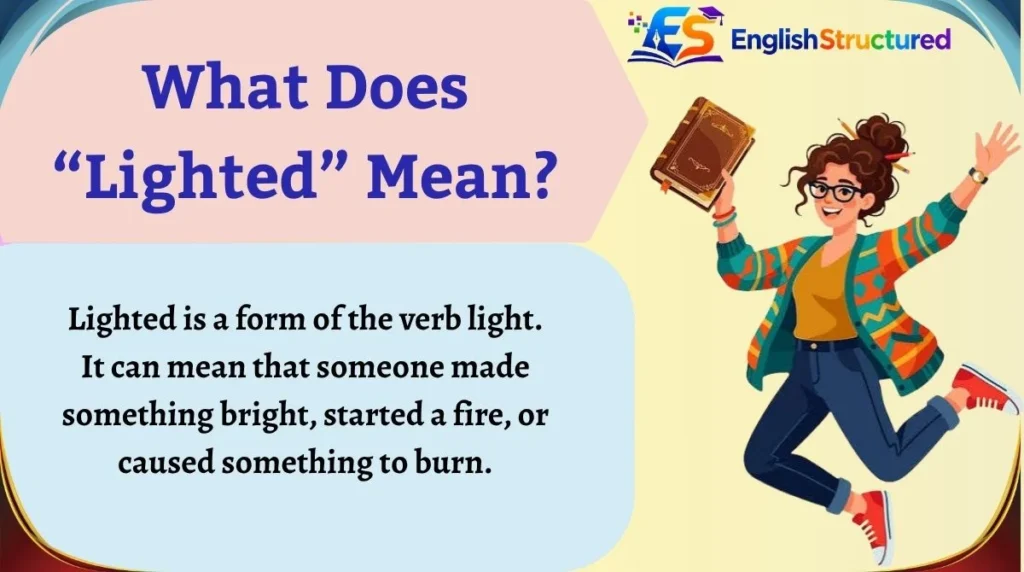
Lighted is a form of the verb light. It can mean that someone made something bright, started a fire, or caused something to burn.
For example:
Lighted vs Lit
This means that she caused the candle to start burning.
However, there is an important point to remember: although lighted is grammatically correct in many situations, it is often less common than lit in everyday English.
The verb light is an irregular verb. That means it can have different forms that do not simply follow the normal “add -ed” pattern.
Its common forms are:
| Verb form | Word |
|---|---|
| Base form | light |
| Past tense | lit / lighted |
| Past participle | lit / lighted |
| -ing form | lighting |
Lighted vs Lit
When Do We Use “Lighted”?
One useful situation is when lighted works as an adjective.
Consider this sentence:
We walked along a lighted street.
Here, lighted describes the street. It tells us that the street had lights on it.
Lighted vs Lit
- a lighted sign
- a lighted window
- Lighted vs Lit
- a lighted building
- a lighted tower
In these examples, lighted focuses on something being supplied with or surrounded by light.
Examples of “Lighted”
Here are several examples:
- Lighted vs Lit
- We walked down a lighted path.
- The old building had a beautifully lighted entrance.
- A lighted sign stood above the shop.
- The garden looked beautiful when it was lighted at night.
- The room was softly lighted by small lamps.
- Lighted vs Lit
- A lighted window could be seen from the road.
Notice that several of these examples use lighted to describe something that has been illuminated.
Is “Lighted” Grammatically Correct?
Yes.
There is nothing grammatically wrong with lighted.
The important issue is usage and naturalness. In many everyday situations, modern speakers are more likely to choose lit.
For example:
He lit the match.
sounds more natural to most speakers than:
He lighted the match.
The second sentence is possible, but it may sound formal, old-fashioned, or less natural depending on the context.
So, do not think of lighted as “wrong.” Think of it as a form that has more limited or specific use in modern English.
What Does “Lit” Mean?
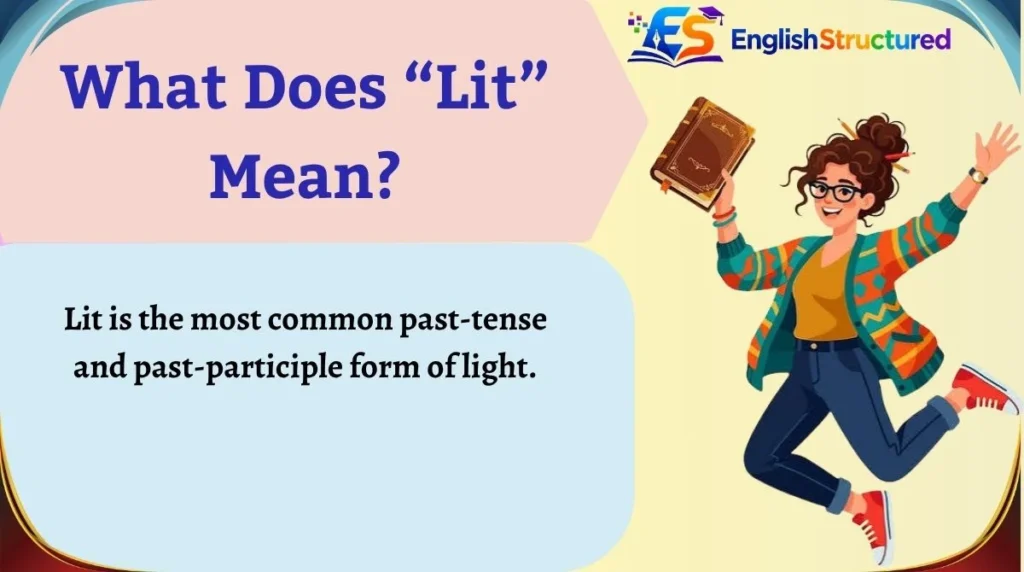
Lit is the most common past-tense and past-participle form of light.
It usually means that someone made something burn or become bright.
For example:
She lit the candle.
The action happened in the past. She used a flame or another method to make the candle burn.
You can also say:
The candle was lit.
Here, lit is the past participle used in a passive construction.
When Do We Use “Lit”?
Use lit in many ordinary situations involving:
- candles
- matches
- fires
- lamps
- cigarettes
- fireplaces
- Lighted vs Lit
- lanterns
It is especially common in spoken English.
For example:
Lighted vs Lit
Maria lit a candle.
I lit the lamp.
Lighted vs Lit
These sentences sound natural and normal.
Examples of “Lit”
Here are some everyday examples:
- Lighted vs Lit
- He lit the fire because the room was cold.
- I lit the lamp and started reading.
- They lit the candles on the birthday cake.
- Dad lit the barbecue in the backyard.
- The guide lit a small lantern.
- Lighted vs Lit
- The candles were already lit when we arrived.
The word lit is especially useful because it works naturally in both active and passive sentences.
Lit as a Past-Tense Verb
When the person performs the action, use lit as the past tense:
Sarah lit the candle.
The structure is:
Subject + lit + object
For example:
Lighted vs Lit
The boy lit a match.
We lit the fireplace.
Lit as a Past Participle
Lighted vs Lit
The candle was lit.
The room was lit by candles.
The street was lit by lamps.
Lighted vs Lit
This is one reason learners may find the word confusing.
Difference Between Lighted and Lit
The biggest difference is not that one is correct and the other is incorrect.
Both can be correct.
The real difference is mainly about usage, frequency, style, and context.
| Feature | Lit | Lighted |
|---|---|---|
| Base verb | light | light |
| Past form | Yes | Yes |
| Past participle | Yes | Yes |
| Common in everyday English | Very common | Less common |
| Used with candles | Very natural | Possible |
| Used with fires | Very natural | Possible |
| Used with matches | Very natural | Possible |
| Used as a descriptive adjective | Common in some contexts | Very common |
| Can describe something supplied with lights | Possible | Often natural |
| Overall modern usage | Preferred in many situations | More specific/formal in many situations |
“Lit” Is Usually the Natural Choice for Actions
When you are describing someone actually performing the action of making something burn or become illuminated, lit is normally the better choice.
Compare:
Lighted vs Lit
and:
Emma lighted the candle.
Both can be understood, but the first sounds much more natural in everyday English.
Another example:
Lighted vs Lit
This is the normal choice for most speakers.
“Lighted” Can Work Well as a Description
Now compare:
We walked along a lighted path.
Here, lighted sounds quite natural.
It describes the path. The focus is not really on the action of someone turning on the lights. The focus is on the path’s condition: it had lights.
Other examples include:
a lighted sign
Lighted vs Lit
a lighted street
a lighted display
This is an important pattern for learners.
The Meaning Can Be Almost the Same
Sometimes the difference is very small.
For example:
Lighted vs Lit
The room was lighted by candles.
Both can mean that candles provided the light.
However, lit by candles is generally more natural in ordinary modern English.
The choice often depends on what sounds natural in the particular sentence.
Grammar Rules You Must Remember
Rule #1: Use “Lit” for Most Everyday Past Actions
When someone made something burn or become bright in the past, lit is usually the safest choice.
Examples:
Lighted vs Lit
She lit the fire.
He lit a match.
They lit the lantern.
Lighted vs Lit
Rule #2: “Lighted” Is Not Wrong
Do not mark every use of lighted as an error.
It is a legitimate form of light.
For example:
The path was lighted with small lamps.
This sentence is grammatically possible.
Lighted vs Lit
So the better question is not:
“Is lighted correct?”
Instead, ask:
“Which form sounds more natural in this sentence?”
That is a much better way to learn the difference.
Rule #3: “Lit” Is Common in Passive Sentences Too
Lighted vs Lit
For example:
The candle was lit.
The fire was lit before sunset.
The lamps were lit at six o’clock.
The structure is:
Lighted vs Lit
This is very common in English.
Do not change lit to lighted just because the sentence is passive.
Rule #4: “Lighted” Is Common as a Descriptive Word
When you describe something as having lights, lighted can be a natural choice.
For example:
We entered through the lighted doorway.
Lighted vs Lit
They decorated the lighted stage.
In these cases, lighted functions much like an adjective.
This does not mean lit can never be used in similar descriptions. English allows variation.
For example:
Lighted vs Lit
This is also completely natural.
The sentence structure and the writer’s preferred style help determine the choice.
Common Mistakes Students Make
Many learners make the same few mistakes with these words.
Mistake #1: Thinking “Lighted” Is Always Wrong
Some students learn that lit is the past tense of light and then assume lighted must be incorrect.
That is not true.
For example:
The room was lighted by candles.
This can be grammatically correct.
A better rule is:
Lit is usually more common for the past action, while lighted can be useful in descriptive contexts and certain styles.
Mistake #2: Using “Light” in a Past Sentence
Lighted vs Lit
Incorrect:
Yesterday, I light the candle.
Correct:
Yesterday, I lit the candle.
You need a past form when the action happened in the past.
Mistake #3: Saying “Lighted” When “Lit” Sounds Much More Natural
Consider:
Lighted vs Lit
It is understandable, but most everyday speakers would say:
She lit the candle for dinner.
The correction is simple: use lit for ordinary past actions unless you have a particular reason to choose lighted.
Mistake #4: Confusing “Lit” With “Light”
Remember that light has several meanings.
It can mean:
- to make something bright
- to start a fire
- to set something burning
- something that makes it possible to see
- something that is not heavy
Lighted vs Lit
For example:
She lit the candle.
But you would not use lit when you mean that something has little weight.
You cannot say:
This bag is lit.
if you mean:
This bag is light.
The adjective light meaning “not heavy” has a different grammatical use.
Easy Trick to Remember the Difference
Here is a simple memory trick:
Lit = the action
Lighted = often the description
Think about a candle.
If you are talking about someone lighting it, use lit:
She lit the candle.
If you are describing something that has been provided with light, lighted may work:
We walked through the lighted hallway.
This trick will not cover every possible sentence, but it is a helpful starting point.
Another easy trick is:
When in doubt about an ordinary past action, choose “lit.”
For most everyday conversations, these are the forms you will naturally hear:
lit a candle
lit a fire
lit a match
lit the lamp
lit the fireplace
You do not need to force lighted into these sentences.
Daily Life Examples
The easiest way to understand the difference is to see the words in normal conversations.
Example 1: At Home
Mom: Why is the room so dark?
Sam: I haven’t turned on the lamp yet.
Mom: Please light it.
Later:
Sam lit the lamp and started reading.
Example 2: Birthday Party
Anna: Are we ready to cut the cake?
Ben: Almost. We need to light the candles.
Ben lit the candles on the cake.
Here, lit is the natural past form.
Example 3: Camping
Ali: Are you going to start the fire?
Dan: Yes.
Dan lit the fire while everyone gathered around.
Again, lit sounds natural.
Example 4: Walking at Night
We walked along a lighted road after dinner.
Here, lighted describes the road. The road had lights, making it easier to see.
Example 5: A Shop
The lighted sign outside the store could be seen from far away.
The word lighted describes the sign.
Example 6: A Romantic Dinner
Mia: Why are there candles everywhere?
Leo: I lit them before you arrived.
This is a very natural use of lit.
Example 7: A Fireplace
Tom: Is the fireplace ready?
Jane: Yes. I lit it a few minutes ago.
The person performed the action, so lit is the normal choice.
Example 8: A Festival
The bridge was beautifully lit during the festival.
This sentence uses lit as part of a passive structure.
You could also encounter lighted, but lit is very natural here.
Example 9: A Building
The entrance was brightly lighted.
This is possible, especially when the writer wants to describe the entrance as illuminated.
You could also say:
The entrance was brightly lit.
Both are understandable, with lit often sounding more natural in modern everyday English.
Example 10: A Lantern
Dad: Did you bring a lantern?
Sara: Yes.
Dad: Good. Can you light it?
Sara lit the lantern.
Short, simple, and natural.
Practice Section
Lighted vs Lit
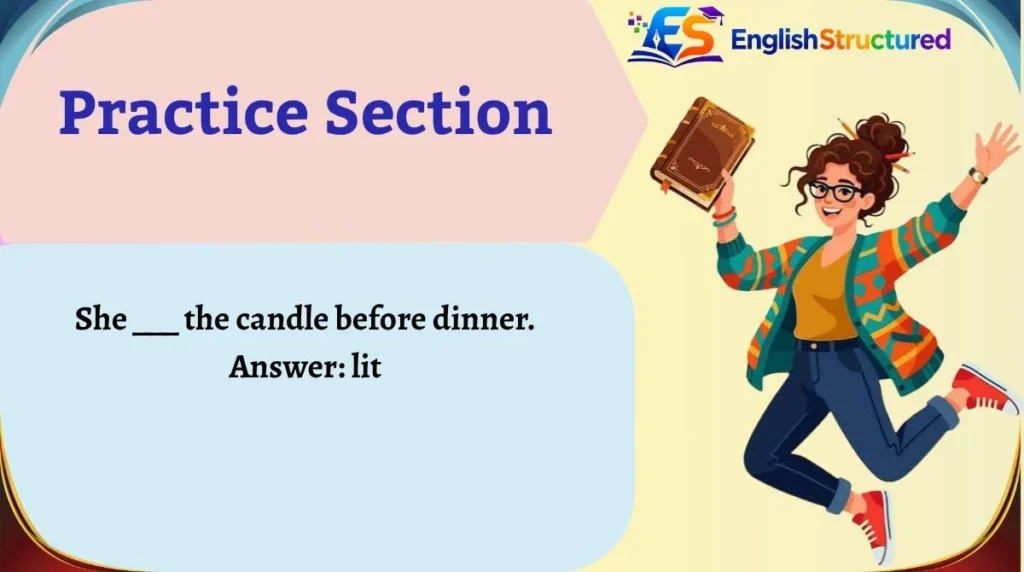
1. She ___ the candle before dinner.
Answer: lit
She lit the candle before dinner.
2. We walked along a ___ pathway.
Answer: lighted
We walked along a lighted pathway.
Here, the word describes the pathway.
3. He ___ the fire at sunset.
Answer: lit
Lighted vs Lit
4. The building was beautifully ___ at night.
Answer: lit
The building was beautifully lit at night.
Lighted can also be possible, but lit is very natural here.
5. A ___ sign stood above the entrance.
Answer: lighted
A lighted sign stood above the entrance.
Here, lighted works as a descriptive adjective.
FAQs
What is the difference between lighted and lit?
Both lit and lighted are forms of the verb light. They can both refer to making something burn or become bright.
However, lit is much more common in everyday modern English, especially for past actions. Lighted is also correct in certain contexts and is often useful as a descriptive adjective.
Is “lit” the past tense of “light”?
Yes.
Lit is a common past-tense form of light.
For example:
I light the candle every evening.
becomes:
Lighted vs Lit
You can also use lit as a past participle:
The candle was lit.
Is “lighted” grammatically correct?
Yes. Lighted is grammatically correct.
It is another past and past-participle form of light. However, it is generally less common than lit for ordinary past actions.
For example, “She lit the candle” is usually more natural than “She lighted the candle.”
Which is more common: lit or lighted?
Lit is generally more common in modern everyday English.
Native speakers commonly say:
He lit the fire.
She lit a candle.
They lit the lamps.
Lighted still appears in English, particularly in descriptions such as lighted sign, lighted path, or lighted building.
Can I say “lighted candle”?
Yes, but context matters.
You can use lighted as a descriptive word:
A lighted candle stood on the table.
However, in many situations, speakers may naturally say:
A lit candle stood on the table.
Both can be understood. The choice depends on style and context.
Should I use “lit” in formal English?
Yes.
There is no problem with using lit in formal English.
For example:
The candles were lit before the ceremony began.
This sentence is perfectly suitable for formal writing.
Do not assume that lighted is automatically more formal or more correct. In many cases, lit is the normal choice.
Conclusion
Lighted vs Lit
Both forms belong to the verb light, and both can be grammatically correct.
The main point is usage.
For most ordinary past actions, lit is the natural choice. We say lit a candle, lit a fire, lit a match, and lit a lamp.
It is also very common in passive sentences, such as “The room was lit by candles.”
Lighted is still useful. It often works well when describing something that has been supplied with light, such as a lighted sign, lighted path, or lighted doorway.
It can also appear as a past-tense or past-participle form in contexts where the writer prefers it.
If you are unsure, remember the simple rule: use lit for most everyday past actions. Then pay attention to how native speakers use lighted in descriptive phrases.
With a little practice, the choice will soon feel natural.