When you fill out a passport form, open a bank account, apply for a job, or register for school, you may see different labels for your name.
Surname vs Last Name vs Family Name
This often makes English learners stop and wonder, “Are these words the same, or do they mean different things?”
The confusion is normal. These three terms are closely related, but they are not always used in exactly the same way.
Their meaning can change depending on the country, culture, or official document. A person in the
United States may say last name, while someone in the United Kingdom may prefer surname.
International forms often use family name because it is easy for people from different cultures to understand.
Knowing the correct term is important in everyday life.
It helps you complete forms correctly, avoid mistakes in official documents, and communicate more confidently in English.
It also helps you understand how names are organized in different parts of the world.
By the end of this guide, you will clearly understand what surname, last name, and family name mean, when to use each one, and how to choose the correct word in both spoken and written English.
The explanations are simple, practical, and filled with real-life examples to make learning easy.
What Does “Surname” Mean?
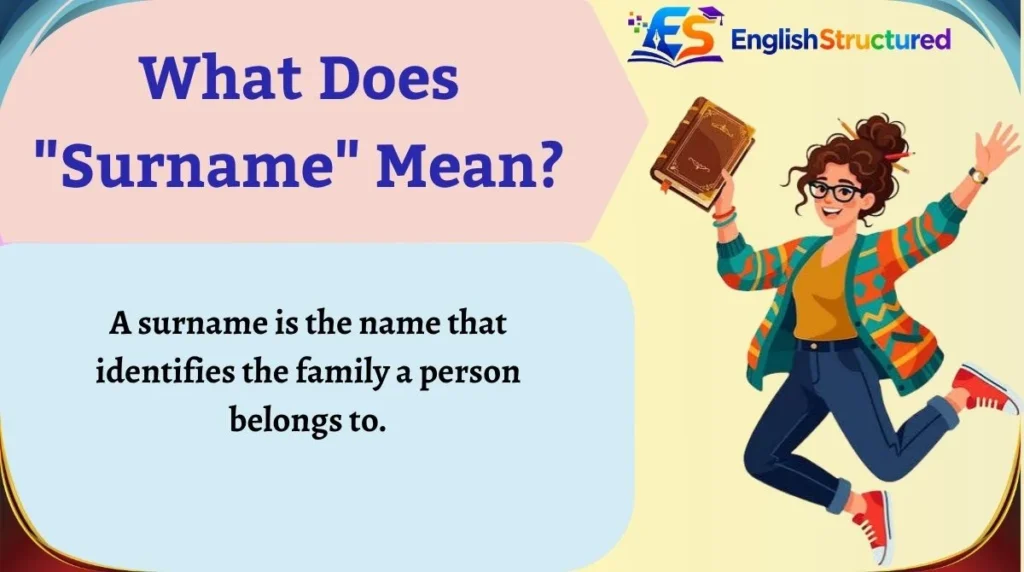
A surname is the name that identifies the family a person belongs to. It is usually shared by parents, children, brothers, sisters, and other close relatives.
In many English-speaking countries, the surname appears after the first name. However, in some countries, such as China, Japan, and Korea, the surname is often written before the given name.
Simple Definition
Surname vs Last Name vs Family Name
Example:
- Emma Johnson
- David Brown
- Sophia Wilson
In these examples, Johnson, Brown, and Wilson are the surnames.
When to Use “Surname”
Surname vs Last Name vs Family Name
- Official documents
- Government forms
- Passports
- Visa applications
- School admission forms
- Legal paperwork
- British English
Surname vs Last Name vs Family Name
Grammar Rule
Surname is a countable noun.
Examples:
- My surname is Khan.
- Her surname is Williams.
- Please write your surname clearly.
- Surname vs Last Name vs Family Name
You can use articles and possessive words with it.
Examples:
- a surname
- the surname
- my surname
- Surname vs Last Name vs Family Name
- their surname
Example Sentences
- My surname is Ahmed.
- Her surname is Smith.
- Please enter your surname first.
- Surname vs Last Name vs Family Name
- His surname is difficult to pronounce.
- Everyone in the family shares the same surname.
- The passport shows both the given name and the surname.
- She changed her surname after getting married.
Common Learner Confusion
Surname vs Last Name vs Family Name
For example:
English naming style
- John Smith
- Surname: Smith
Chinese naming style
- Li Wei
- Surname vs Last Name vs Family Name
Here, the surname comes before the given name.
This is why many international organizations use the term family name instead of last name. It works better for people whose family name is written first.
Quick Tip
Remember this simple idea:
Surname vs Last Name vs Family Name
Its position may change depending on the country’s naming system.
What Does “Last Name” Mean?
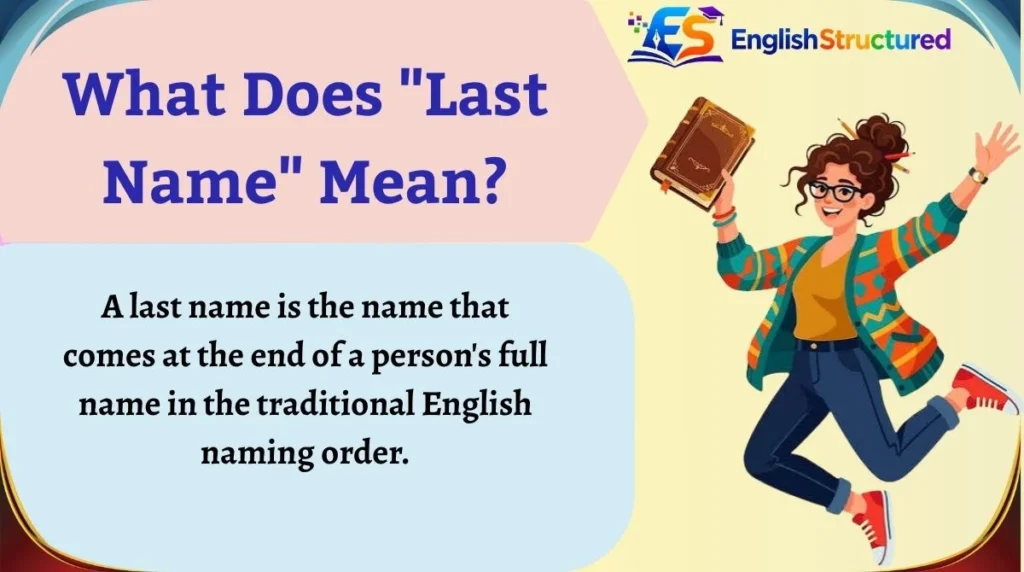
A last name is the name that comes at the end of a person’s full name in the traditional English naming order.
For many people in countries such as the United States, Canada, Australia, and the United Kingdom, the last name is also the family name.
Simple Definition
A last name is the name written at the end of a person’s full name.
Example:
- Michael Taylor
- Olivia White
- Daniel Clark
Here, Taylor, White, and Clark are the last names.
When to Use “Last Name”
The expression last name is very common in everyday American English.
People use it when:
- Introducing themselves
- Filling out simple forms
- Talking in daily conversations
- Registering online
- Speaking with customer service
Surname vs Last Name vs Family Name
Grammar Rule
Surname vs Last Name vs Family Name
Examples:
- My last name is Ali.
- What is your last name?
- Please spell your last name.
- Surname vs Last Name vs Family Name
Example Sentences
- My last name is Wilson.
- Can you tell me your last name?
- Surname vs Last Name vs Family Name
- She wrote her last name on the application.
- I forgot your last name.
- Their last names are the same.
- Please print your last name in capital letters.
- Surname vs Last Name vs Family Name
Common Learner Confusion
Surname vs Last Name vs Family Name
They are often the same in English-speaking countries, but last name focuses on the position of the name, while surname focuses on the family identity.
For example:
American style
- Sarah Johnson
- Last name: Johnson
- Surname: Johnson
Chinese style
- Wang Lei
Here, Wang is the surname because it is the family name.
However, it is not the last name because it comes first.
Surname vs Last Name vs Family Name
Quick Tip
Think of it this way:
Last name = the name at the end of your full name.
In English-speaking countries, it is usually the same as your surname, but that is not true for every culture.
Difference Between Surname and Last Name
Although surname and last name are often used interchangeably, they are not identical in every situation. Understanding the small difference helps you complete forms correctly and communicate more naturally.
| Feature | Surname | Last Name |
|---|---|---|
| Main meaning | Family name | Name at the end of the full name |
| Focus | Family relationship | Position in the name |
| Common in | British English, official documents | American English, everyday conversation |
| Always at the end? | No | Yes |
| Used internationally? | Yes | Less often |
| Formality | More formal | Less formal |
Usage Difference
A surname tells you which family a person belongs to. It is about family identity rather than the order of the name.
A last name simply describes the final part of a person’s full name.
In many Western countries, these two ideas match because the family name is written last. In other cultures, they may not.
Grammar Logic
Use surname when discussing official records, legal documents, passports, visas, or international forms.
Use last name in everyday conversations, casual writing, and situations where people follow the Western naming order.
Examples:
- Surname vs Last Name vs Family Name
- What’s your last name?
Both sentences are correct, but they fit different situations.
Sentence Structure Difference
Both expressions follow the same grammar pattern.
Examples:
- My surname is Brown.
- Surname vs Last Name vs Family Name
- His surname begins with K.
- His last name begins with K.
The grammar is the same. The difference is mainly in meaning, style, and context.
Meaning Comparison
Imagine your name is Emma Johnson.
- Surname vs Last Name vs Family Name
- Johnson is also your last name because it appears at the end of your full name.
Now imagine a person named Li Ming.
- Surname vs Last Name vs Family Name
- Ming is the given name.
- Li is not the last name because it comes first.
This example shows why surname is a broader and more accurate term for people from different cultures.
Which One Should You Use?
Choose surname when:
- Completing official forms
- Talking about legal documents
- Writing formal English
- Communicating internationally
Choose last name when:
- Speaking casually
- Living or working in the United States
- Filling out everyday online forms
- Having normal conversations
Understanding this small difference will help you avoid confusion and use the correct term with confidence.
What Does “Family Name” Mean?
A family name is the name that people in the same family usually share. It is passed from one generation to the next. In many countries, a family name is the same as a surname.
The term family name is common on international forms because it works well for different naming systems around the world. It does not matter whether the family name comes first or last. The important point is that it identifies the person’s family.
Simple Definition
A family name is the name shared by members of the same family.
Examples:
- James Anderson
- Lily Anderson
Both James and Lily have the same family name, Anderson.
When to Use “Family Name”
You will often see family name on:
- Passports
- Visa applications
- Airline tickets
- International registration forms
- University admission forms
- Immigration documents
- Medical records
Many global organizations prefer family name because people from different cultures write their names in different orders.
Grammar Rule
Family name is a countable noun phrase.
Examples:
- My family name is Khan.
- Her family name is Garcia.
- Please write your family name exactly as it appears on your passport.
- Their family names are different.
Like surname, it can be used with articles and possessive words.
Examples:
- a family name
- the family name
- my family name
- your family name
Example Sentences
- My family name is Ali.
- Please enter your family name first.
- Surname vs Last Name vs Family Name
- His family name is difficult to spell.
- The teacher asked students to write their family names.
- My family name appears on every official document.
- Her family name is Lee.
- The airline ticket must match your family name exactly.
Common Learner Confusion
Surname vs Last Name vs Family Name
For example:
- Emma Wilson
- Surname: Wilson
- Family name: Wilson
Both answers are correct.
Surname vs Last Name vs Family Name
For example:
Japanese name
- Suzuki Haruto
Here, Suzuki is the family name even though it comes first.
Quick Tip
Remember this simple idea:
Family name = the name shared by your family, no matter where it appears in your full name.
Grammar Rules You Must Remember
Knowing the meanings of these words is helpful, but using them correctly is even more important. These simple grammar rules will help you avoid common mistakes.
Rule #1: Use “Surname” in Formal and Official Situations
The word surname is common in formal English and official documents.
Correct:
- Please write your surname.
- Your surname must match your passport.
Incorrect:
- Please write your surname name.
Why?
The word surname already includes the idea of a family name. Adding name again is unnecessary.
Rule #2: Use “Last Name” Mainly in Everyday American English
When talking to friends, teachers, or customer service in the United States, last name sounds natural.
Correct:
- What’s your last name?
- My last name is Patel.
Correct but More Formal:
- What is your surname?
Surname vs Last Name vs Family Name
Rule #3: “Family Name” Is Best for International Forms
If a form may be completed by people from different countries, family name is often the safest term.
Correct:
- Enter your family name.
- Please write your family name exactly as shown on your passport.
This wording works for people whose family name comes first or last.
Rule #4: Do Not Mix These Terms in One Sentence Without a Reason
Choose one term that fits the situation.
Natural:
- My surname is Brown.
- Surname vs Last Name vs Family Name
- My last name is Brown.
Less Natural:
- Surname vs Last Name vs Family Name
If all three mean the same thing for your name, using one of them is enough.
Common Mistakes Students Make
Many learners understand these words separately but become confused when using them in real situations. Here are some common mistakes and easy ways to fix them.
Mistake 1: Thinking All Three Words Always Mean Exactly the Same Thing
Wrong idea:
Surname vs Last Name vs Family Name
Correct idea:
They often have the same meaning, but last name depends on where the name appears.
Example:
- English: John Smith
- Surname: Smith
- Last name: Smith
- Surname vs Last Name vs Family Name
- Chinese: Wang Wei
- Surname: Wang
- Family name: Wang
- Last name: Wei (because it is the last word)
This is why international forms usually avoid the term last name.
Mistake 2: Writing the Given Name Instead of the Family Name
Some students accidentally enter their first name when a form asks for their surname.
Wrong:
Surname: David
Full name: David Miller
Correct:
Surname: Miller
Tip:
Read the form carefully before writing your name.
Mistake 3: Using “Surname Name”
Wrong:
- My surname name is Khan.
Correct:
- Surname vs Last Name vs Family Name
- My family name is Khan.
The word surname already means family name.
Mistake 4: Believing Everyone Has the Same Name Order
Not every country places the family name last.
For example:
- Korea
- China
- Japan
- Hungary
These countries may write the family name first.
Always check the country’s naming style before completing official forms.
Mistake 5: Forgetting Passport Spelling
Even a small spelling mistake can cause problems.
Wrong:
Passport: Mohammad
Form: Mohamed
Surname vs Last Name vs Family Name
Easy Correction Tips
- Learn the difference between position and meaning.
- Read forms carefully before writing.
- Copy your passport spelling exactly.
- Surname vs Last Name vs Family Name
- Practice writing your full name correctly.
Easy Trick to Remember the Difference
Sometimes a simple memory trick makes grammar much easier.
Trick 1: Think About the Meaning
- Surname → Your family’s name.
- Surname vs Last Name vs Family Name
- Last name → The name written last.
Notice that last tells you where the name is, while surname and family name tell you what the name is.
Trick 2: Imagine a School Attendance List
A teacher calls:
- Emily Brown
- Daniel Brown
- Sophie Brown
The word Brown connects all three students.
Surname vs Last Name vs Family Name
If their names follow the English order, Brown is also their last name.
Trick 3: Remember This Short Formula
Surname = Family Name
Last Name = Last Part of the Name
This simple formula solves most confusion.
Real-Life Logic
Imagine you travel to another country.
Surname vs Last Name vs Family Name
They do not care whether your family name comes first or last in your culture. They simply need the name that identifies your family.
That is why international forms usually choose family name instead of last name.
Daily Life Examples
These examples show how native English speakers use these terms in everyday situations.
- Could you spell your last name, please?
- My surname is Ahmed, and my first name is Hassan.
- Please enter your family name exactly as shown on your passport.
- The hotel receptionist asked for my last name.
- Everyone in our family shares the same family name.
- His surname is difficult for foreigners to pronounce.
- Your airline ticket must match your family name on your passport.
- The nurse checked my family name before giving me my appointment card.
- What’s your last name? I want to add you to my contact list.
- The school printed every student’s surname on the report card.
These are the kinds of sentences you are likely to hear at schools, airports, hospitals, offices, banks, and government departments. Learning them will help you understand and use these terms naturally in everyday English.
Practice Section
Test your understanding by choosing the correct answer. Don’t worry if you make mistakes. Practice is the best way to improve your English.
Choose the Correct Option
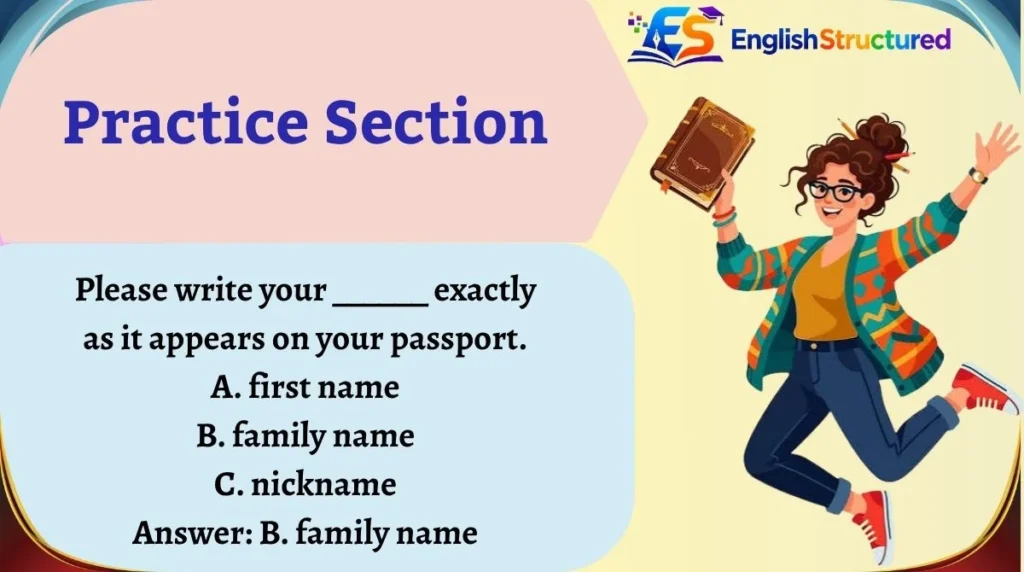
1. Please write your ______ exactly as it appears on your passport.
A. first name
B. family name
C. nickname
Answer: B. family name
2. In everyday American English, people usually ask:
A. What’s your last name?
B. What’s your middle word?
C. What’s your family word?
Answer: A. What’s your last name?
3. Which sentence is correct?
A. My surname name is Brown.
B. My surname is Brown.
C. My surname family is Brown.
Answer: B. My surname is Brown.
4. Which term is most common on international forms?
A. Family name
B. Pet name
C. Short name
Answer: A. Family name
5. Which statement is true?
A. Every surname is always the last word in every language.
B. A surname always comes before the first name.
C. A surname is the family name, but its position depends on the country’s naming system.
Answer: C. A surname is the family name, but its position depends on the country’s naming system.
FAQs
1. What is the difference between surname, last name, and family name?
A surname is your family’s inherited name. A family name has the same meaning and is often used on international forms. A last name is the name written at the end of a person’s full name in the Western naming order. In many English-speaking countries, all three refer to the same name.
2. Are surname and family name the same?
Yes. Surname vs Last Name vs Family Name. The only difference is that family name is more common on international forms.
3. Is “last name” formal or informal?
Last name is common in everyday American English and is suitable for both casual and many professional situations. However, surname is usually considered more formal and often appears in legal or government documents.
4. Why do some forms use “family name” instead of “last name”?
International forms are completed by people from many countries. Since the family name is not always written last, family name is a clearer and more accurate term. It helps avoid confusion across different naming traditions.
5. Can my surname come before my first name?
Yes. In several countries, including China, Japan, and Korea, the family name is traditionally written before the given name. This is why the position of a surname depends on the local naming system.
6. Which word should I use in everyday conversation?
If you are speaking with Americans, last name sounds the most natural. In formal writing or official situations, surname is a good choice. When completing international documents, family name is usually the safest option.
Conclusion
Surname vs Last Name vs Family Name
Although these words often refer to the same part of a person’s name, they are not always used in the same way.
A surname is your family’s inherited name. A family name has the same meaning and is commonly used on international forms because it works with different naming systems.
A last name refers to the final part of a person’s full name in the traditional Western name order.
Remember one simple idea: surname and family name describe what the name is, while last name describes where the name appears.
This small difference will help you complete forms correctly, avoid mistakes on official documents, and communicate more confidently in English.
Keep practicing with real-life conversations, online forms, and writing exercises.
The more you see these terms in everyday situations, the more natural they will become. Soon, choosing the correct word will feel easy and automatic.