Thus Far vs So Far
At first glance, they seem to mean the same thing. You may even hear both in conversations, books, news reports, and business emails.
This makes it difficult to know which one is the better choice.
The good news is that both expressions often have the same basic meaning. However, they are not always used in the same situations.
The biggest difference is style and tone. One sounds more formal, while the other feels more natural and conversational.
Understanding this small difference can make your English sound much more fluent.
If you use the right phrase in the right situation, your speaking and writing will feel more natural.
Whether you are writing an essay, sending an email, chatting with friends, or taking an English exam, knowing when to use these expressions is helpful.
Many students also wonder if they can replace one with the other in every sentence. The answer is sometimes yes, but not always. The context and the level of formality matter.
By the end of this guide, you will clearly understand the meaning of thus far and so far, learn the grammar behind each expression, see plenty of real-life examples, and know exactly when to use each one with confidence.
What Does “Thus Far” Mean?
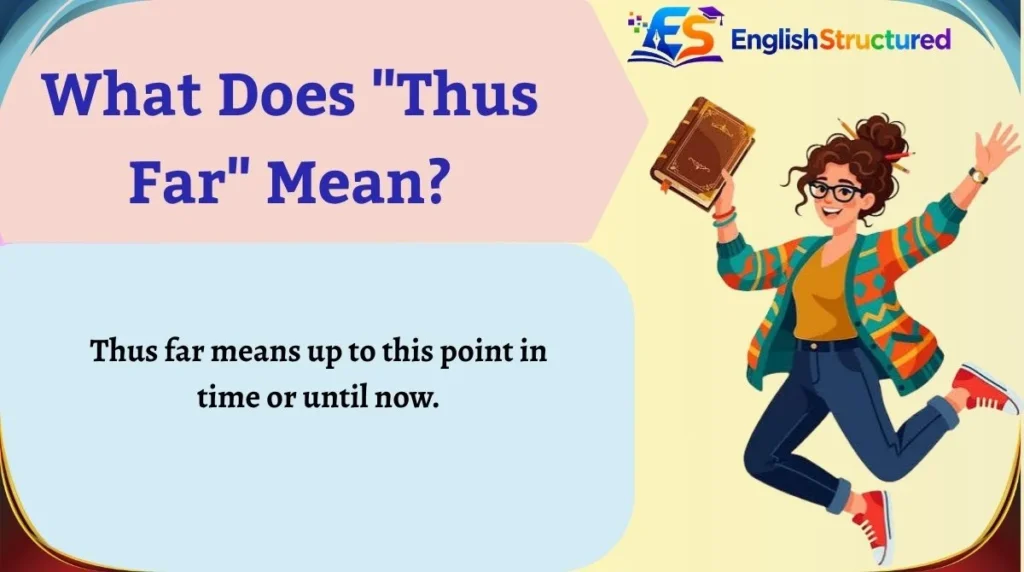
Thus far means up to this point in time or until now. It refers to everything that has happened from the beginning of a period until the present moment.
It has almost the same meaning as so far, but it sounds more formal. You will often find thus far in academic writing, research papers, business reports, official speeches, legal documents, and news articles.
Simple Definition
Thus Far vs So Far
When to Use “Thus Far”
Use thus far when you want your writing or speech to sound more formal or professional.
It is common in:
- Academic essays
- Research papers
- Business reports
- Official announcements
- Professional presentations
- News articles
- Legal writing
Thus Far vs So Far
Grammar Rule
Thus far is an adverbial expression of time. It usually appears:
- At the beginning of a sentence
- At the end of a sentence
- Occasionally in the middle for emphasis
It often works with:
- Present perfect tense
- Present perfect continuous tense
- Present tense (in formal writing)
- Past tense when discussing a period leading up to a specific point
Sentence Patterns
Subject + have/has + past participle + thus far
Example:
- Thus Far vs So Far
Thus far + subject + has/have + past participle
Example:
- Thus Far vs So Far
Examples of “Thus Far”
Here are some easy examples.
- Thus far, the experiment has been successful.
- The company has earned strong profits thus far.
- Thus Far vs So Far
- Thus Far vs So Far
- Thus far, everyone has followed the safety rules.
- The government has completed three stages of the plan thus far.
- Thus Far vs So Far
- The report is accurate thus far.
Notice that these examples sound more suitable for formal writing than everyday conversation.
Common Learner Confusion
Thus Far vs So Far
Actually, it is still correct and widely used. The reason you hear it less often is that it belongs mainly to formal English.
For example:
✔ Thus far, the results have been positive. (Formal)
✔ So far, the results have been positive. (Natural and everyday)
Both sentences are correct. The only real difference is the level of formality.
Another common mistake is believing that thus always means therefore. While thus often means therefore, the expression thus far is different. Together, the two words form a fixed phrase meaning until now or up to this point.
For example:
- Thus, we decided to leave early. (Therefore)
- Thus far, everything has gone well. (Up to now)
The meanings are completely different even though both use the word thus.
What Does “So Far” Mean?
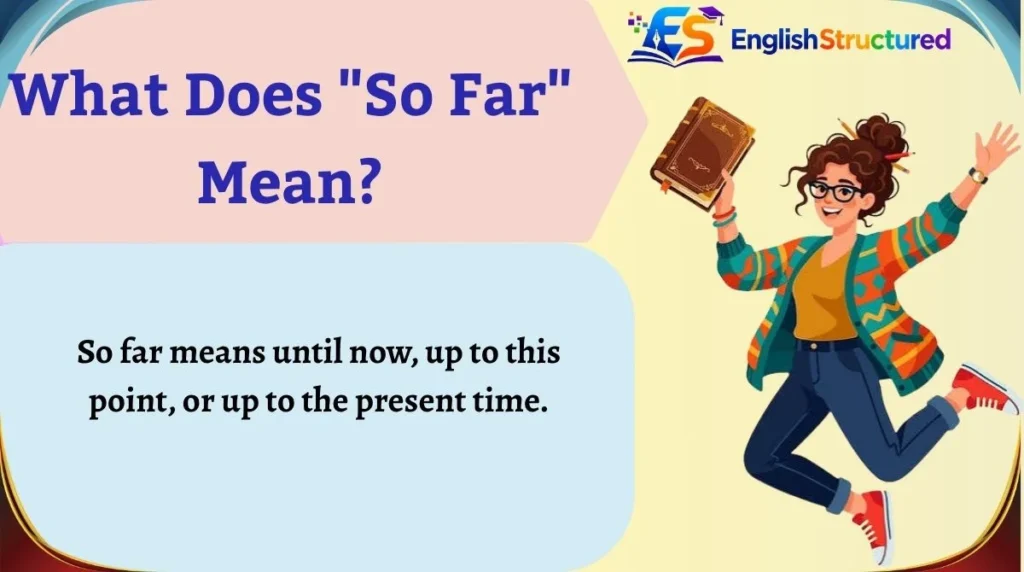
So far means until now, up to this point, or up to the present time. It describes something that has happened from the beginning of a period until the moment of speaking or writing.
Unlike thus far, so far is the expression that native speakers use most often in everyday English. You will hear it in conversations, television shows, classrooms, social media, emails, and casual writing.
Simple Definition
So far = until now = up to this point
When to Use “So Far”
Thus Far vs So Far
It is common in:
- Daily conversations
- Text messages
- Emails
- School discussions
- Blogs
- Interviews
- Casual writing
It also appears in formal writing, although many professional writers choose thus far when they want a more polished tone.
Grammar Rule
Thus Far vs So Far
It commonly appears with:
- Present perfect tense
- Present perfect continuous tense
- Present tense in certain contexts
The present perfect is the most common because the action started in the past and continues until now.
Sentence Patterns
Subject + have/has + past participle + so far
Example:
- Thus Far vs So Far
So far + subject + have/has + past participle
Example:
- So far, everything has gone well.
Examples of “So Far”
These examples sound natural in everyday English.
- So far, I like my new job.
- We have visited three museums so far.
- So far, the weather has been wonderful.
- I haven’t made any mistakes so far.
- So far, everyone is enjoying the party.
- My English has improved a lot so far.
- So far, the teacher has explained everything clearly.
- The movie has been exciting so far.
These are the kinds of sentences you are likely to hear every day.
Common Learner Confusion
Thus Far vs So Far
That is not true.
Both positions are correct.
At the beginning:
- So far, we haven’t found any errors.
At the end:
- We haven’t found any errors so far.
Another common mistake is using so far with a finished past time.
❌ So far, I visited London last year.
✔ So far, I have visited five countries.
The first sentence is incorrect because last year refers to a completed time in the past. So far connects the past with the present, so it usually works best with the present perfect tense.
Students also worry that so far sounds too informal. In reality, it is acceptable in almost every situation except very formal or highly academic writing.
Difference Between Thus Far and So Far
Although thus far and so far both mean up to this point in time, they are not always the best choice in the same situations. The biggest difference is tone, not meaning.
Many native speakers can replace one with the other without changing the basic idea. However, choosing the right expression helps your English sound more natural and appropriate for the situation.
Quick Comparison Table
| Feature | Thus Far | So Far |
|---|---|---|
| Basic meaning | Up to this point | Up to this point |
| Level of formality | Formal | Neutral to informal |
| Common in conversation | Rare | Very common |
| Common in academic writing | Yes | Sometimes |
| Common in business reports | Yes | Yes, but less formal |
| Common in everyday speech | Rare | Very common |
| Sounds natural with friends | Less natural | Very natural |
| Works with present perfect | Yes | Yes |
Usage Difference
The meaning is almost identical, but the feeling is different.
Thus Far vs So Far
- Professional
- Academic
- Official
- Formal
Thus Far vs So Far
- Friendly
- Natural
- Conversational
- Relaxed
Compare these examples:
Formal
- Thus far, the committee has approved five proposals.
- Thus Far vs So Far
- Thus far, the investigation has found no evidence of fraud.
Everyday English
- So far, everything is going well.
- So far, I love this restaurant.
- So far, the trip has been amazing.
Even though the meanings are almost the same, native speakers would normally choose so far in everyday conversation because it feels smoother and more natural.
Grammar Logic
Both expressions describe a period that started in the past and continues until the present.
That is why they commonly appear with the present perfect tense.
For example:
- Thus Far vs So Far
- She has completed five lessons thus far.
Both are grammatically correct. The second sentence simply sounds more formal.
Sentence Structure Difference
The sentence structure does not change when you replace one with the other.
Both expressions can appear at the beginning or end of a sentence.
Beginning:
- Thus Far vs So Far
- So far, the plan has worked well.
End:
- The plan has worked well thus far.
- Thus Far vs So Far
The grammar stays the same. Only the style changes.
Meaning Comparison
In most situations, thus far and so far communicate the same idea:
- Until now
- Up to the present moment
- Up to this point
The difference lies in the tone.
Imagine these situations:
A scientist presenting research
Thus Far vs So Far
This sounds professional and fits the formal setting.
A friend talking about a holiday
Thus Far vs So Far
This sounds natural and friendly.
Choosing the expression that matches the situation makes your English sound more fluent and confident.
Grammar Rules You Must Remember
Understanding a few simple grammar rules will help you use thus far and so far correctly in both speaking and writing. These expressions are easy to learn once you know how they work with English tenses and sentence structure.
Rule #1: Use Them Mostly with the Present Perfect Tense
Both thus far and so far usually describe an action or situation that started in the past and continues until now. Because of this, they are most often used with the present perfect tense.
Structure:
Subject + has/have + past participle + thus far/so far
Examples:
- I have read five chapters so far.
- Thus Far vs So Far
- We have completed the first stage so far.
- The team has achieved excellent results thus far.
The present perfect connects the past with the present, which matches the meaning of both expressions.
Rule #2: They Can Go at the Beginning or the End of a Sentence
You do not have to place these expressions in only one position.
They work naturally at either the beginning or the end of a sentence.
Beginning
- So far, everything has gone well.
- Thus far, the results have been encouraging.
End
- Everything has gone well so far.
- Thus Far vs So Far
Beginning placement often adds a little more emphasis, while end placement sounds slightly more conversational.
Rule #3: Do Not Use Them with Finished Time Expressions
A common mistake is combining these expressions with a time that has already finished, such as yesterday, last week, or in 2022.
Incorrect
- ❌ So far, I visited Paris last year.
- ❌ Thus far, she finished the project yesterday.
Correct
- ✔ So far, I have visited five countries.
- ✔ Thus far, she has completed most of the project.
If the time period has completely ended, these expressions usually do not fit.
Rule #4: Choose the Right Level of Formality
The grammar is the same, but the tone is different.
Choose thus far for:
- Academic papers
- Research reports
- Business documents
- Official speeches
- Professional writing
Choose so far for:
- Everyday conversations
- Emails to friends
- Classroom discussions
- Social media
- Casual writing
Examples
Formal:
- Thus far, no major issues have been reported.
Casual:
- So far, everything looks great.
Using the right tone makes your English sound more natural.
Common Mistakes Students Make
Thus Far vs So Far. Most mistakes happen because both expressions share almost the same meaning.
Here are the most common errors and simple ways to fix them.
Mistake 1: Using the Simple Past Instead of the Present Perfect
Many learners choose the simple past because they are talking about something that happened earlier.
Wrong
- I finished three lessons so far.
Correct
- I have finished three lessons so far.
Why?
The action started in the past but connects to the present.
Easy Tip
If you can replace the phrase with until now, the present perfect is usually the better choice.
Mistake 2: Using “Thus Far” in Everyday Conversation Too Often
Some students think formal words always sound better.
That is not true.
Imagine talking with a friend.
Less Natural
- Thus far, I like this café.
Natural
- So far, I like this café.
Thus Far vs So Far
Mistake 3: Thinking the Meanings Are Completely Different
Some learners believe these phrases have different meanings.
Actually, the meaning is almost the same.
Thus far = up to this point
Thus Far vs So Far
The real difference is the style.
Mistake 4: Mixing Them with Finished Time Words
These combinations are usually incorrect.
❌ So far yesterday
❌ Thus far last month
Instead, choose one or the other.
✔ Yesterday, we finished the meeting.
Thus Far vs So Far
Mistake 5: Forgetting the Context
Both expressions should match the situation.
Imagine writing a university research paper.
Better:
- Thus far, the evidence supports the hypothesis.
Now imagine talking with your brother.
Better:
- So far, the game is fun.
The same meaning, but different situations.
Quick Correction Table
| Wrong Sentence | Correct Sentence |
|---|---|
| I finished my homework so far. | I have finished my homework so far. |
| Thus far, this pizza is delicious. | So far, this pizza is delicious. |
| So far, I visited Japan last year. | I have visited Japan once so far. |
| Thus far yesterday we found nothing. | Thus far, we have found nothing. |
| So far last week we completed everything. | We completed everything last week. |
Easy Trick to Remember the Difference
Many students want a quick way to remember which phrase to use.
Here is an easy memory trick.
Think About Your Clothes
Imagine you own two outfits.
One is a business suit.
The other is a T-shirt and jeans.
Both outfits cover your body.
Both do the same basic job.
But you wear them in different places.
Thus far is like the business suit.
You wear it when the situation is formal.
Examples:
- Business reports
- Academic writing
- Official speeches
- Research papers
Thus Far vs So Far
You wear it almost everywhere.
Examples:
- Talking with friends
- Family conversations
- School discussions
- Everyday English
This simple picture helps many students remember the difference.
Another Memory Trick
Notice the word thus.
It sounds a little old-fashioned and formal.
Thus Far vs So Far
Now think about so.
Children learn the word so very early.
People use it every day.
That is why so far sounds friendly and natural.
Real-Life Logic
Imagine watching a football match.
Talking to your friend:
“So far, our team is playing really well.”
Reading tomorrow’s newspaper:
“Thus far, the team’s performance has exceeded expectations.”
The meaning stays almost the same.
Only the style changes.
Daily Life Examples
The best way to learn these expressions is to see how people actually use them.
Here are some everyday conversations.
At School
Student A: How is your science project?
Student B: So far, everything is going well.
At Work
Manager: Thus far, the sales figures have exceeded our expectations.
Talking About a Holiday
Friend: How’s your trip?
Thus Far vs So Far
Watching a Movie
Friend: Do you like the film?
You: So far, yes. The story is interesting.
Studying English
I’ve learned over fifty new words so far.
Visiting a New City
So far, we’ve visited the museum, the park, and the old town.
Business Meeting
Thus far, all departments have completed their assigned tasks.
Cooking Dinner
So far, nothing has burned!
Reading a Book
So far, I can’t stop reading this novel.
Research Presentation
Thus far, our findings suggest that the new method is more effective.
Thus Far vs So Far
Practice Section
Choose the correct answer in each sentence.
1.
__________, I have answered all the questions correctly.
A. Thus far
B. So far
Answer: B (best for everyday English, though A is possible in a formal setting)
2.
The research has produced encouraging results __________.
A. so far
B. thus far
Answer: B (best choice for formal writing)
3.
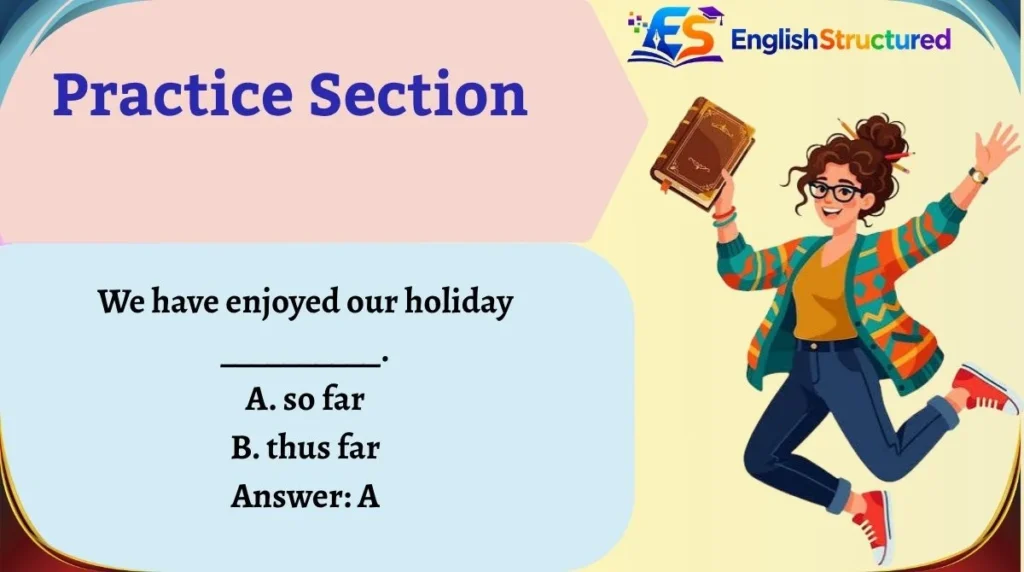
We have enjoyed our holiday __________.
A. so far
B. thus far
Answer: A
4.
__________, no serious safety problems have been discovered.
A. Thus far
B. So far
Answer: A (formal report)
5.
My English has improved a lot __________.
A. thus far
B. so far
Answer: B
Practice Challenge
Choose the better expression.
- My new job has been great ________.
- ________, the investigation has uncovered no evidence.
- We’ve finished half the game ________.
- ________, customer satisfaction has increased by 15%.
- I haven’t made any spelling mistakes ________.
Answers
- so far
- Thus Far vs So Far
- so far
- Thus far
- so far
A simple rule to remember is this:
- If you are speaking with friends, classmates, or family, so far is almost always the best choice.
- If you are writing a report, research paper, business document, or official statement, thus far often sounds more polished and professional.
FAQs
What is the difference between thus far and so far?
The main difference is formality. Both expressions mean up to this point in time or until now. Thus Far vs So Far.
Can we use thus far and so far in questions?
Yes, both can be used in questions. However, so far is much more common in spoken English.
Examples:
- How is your project going so far?
- Have you enjoyed the course so far?
- Thus far, have any problems been reported? (Formal)
Thus Far vs So Far
Is thus far formal or informal?
Thus far is considered a formal expression. It often appears in:
- Academic essays
- Business reports
- Research papers
- Official announcements
- News articles
It is correct in conversation, but it may sound more formal than necessary.
Is so far formal or informal?
So far is neutral. It works well in both spoken and written English.
You can use it when talking to friends, classmates, teachers, or colleagues. It also appears in newspapers, blogs, emails, and many professional settings, although very formal documents may prefer thus far.
Can thus far and so far always replace each other?
Not always.
Their meanings are almost the same, but the style is different.
For example:
- Thus Far vs So Far
- So far, I’ve watched three episodes. (Casual)
Replacing one with the other may make the sentence sound too formal or too informal for the situation.
Which tense is usually used with thus far and so far?
The present perfect tense is the most common because both expressions describe something that started in the past and continues until the present.
Examples:
- I have finished my homework so far.
- Thus far, the project has met every deadline.
Other tenses are possible in certain contexts, but the present perfect is the standard choice.
Conclusion
Thus Far vs So Far
Both expressions mean up to now or until this point, so the basic meaning is almost identical. The real difference is the tone.
If you are writing a report, research paper, business document, or another formal piece of writing, thus far often sounds more polished and professional.
If you are talking with friends, chatting online, writing everyday emails, or having a normal conversation, so far is the expression that native speakers use most naturally.
A good habit is to pay attention to how these phrases appear in books, news articles, podcasts, and conversations.
The more examples you see and hear, the easier it becomes to choose the right one without thinking.
Don’t worry if you occasionally use one instead of the other.
Both expressions are correct in many situations, and practice will help you develop a natural feel for when each one fits best.
Keep reading, keep listening, and keep speaking English. Before long, using thus far and so far correctly will become second nature.