Has Been Changed vs Has Changed
This small difference can cause a lot of trouble for English learners, especially when talking about plans, rules, schedules, names, prices, or other things that are different now.
Compare these two sentences:
- The meeting time has changed.
- The meeting time has been changed.
Both sentences are grammatically correct, but the focus is different. In the first sentence, we simply say that the meeting time is different now.
In the second, we suggest that someone changed it.
The difference comes from active and passive voice. “Has changed” normally uses an active structure, while “has been changed” uses a passive structure.
However, the verb change can behave in slightly different ways, which makes the topic more confusing.
This distinction is useful in everyday English.
You may need it when discussing work schedules, school rules, appointments, prices, documents, plans, settings, or personal situations.
By the end of this guide, you will know exactly when to use has changed and when to use has been changed.
You will also learn simple grammar rules, common mistakes, natural conversation examples, and an easy trick that can help you choose the right form quickly.
What Does “Has Changed” Mean?
“Has changed” means that something is different now from how it was before.
The important point is that the sentence focuses on the change itself or the new condition. We are not necessarily saying who caused the change.
The structure is:
Has Been Changed vs Has Changed
For the verb change:
has + changed = has changed
This is the present perfect tense.
We use it when a change happened in the past but has a connection with the present.
Simple meaning
If you say:
Has Been Changed vs Has Changed
You mean the weather is different now. Perhaps it was sunny earlier, but now it is raining.
You do not need to say who changed the weather. In fact, nobody may have caused it intentionally.
Examples of “Has Changed”
- Has Been Changed vs Has Changed
- My schedule has changed.My schedule is different from before.
- The price has changed.The price is different now.
- The situation has changed.The situation is no longer the same.
- Her attitude has changed.Her attitude is different now.
- The plan has changed.The plan is different from the original plan.
- The company has changed a lot.The company is different compared with the past.
- Has Been Changed vs Has Changed
Notice something important in these examples: the subject is the thing that is different now.
“The plan has changed” means the plan itself is now different.
When Should You Use “Has Changed”?
Use has changed when you want to describe a difference between the past and the present.
It is especially natural when the change happened naturally, gradually, or when the person who caused it is not important.
For example:
Has Been Changed vs Has Changed
The weather is different now. There is no need to identify a person who caused the change.
Another example:
Technology has changed a lot in recent years.
The focus is on how technology is different today.
A Useful Question to Ask
When you are unsure, ask yourself:
“Am I simply saying that something is different now?”
Has Been Changed vs Has Changed
What Does “Has Been Changed” Mean?

“Has been changed” is the passive form of the present perfect tense.
It usually means that someone or something has changed the subject.
The structure is:
Subject + has + been + past participle
With change:
Has Been Changed vs Has Changed
Here, changed is a past participle, and been helps create the passive structure.
Simple Meaning
Consider this sentence:
The meeting time has been changed.
The sentence tells us that the meeting time is different now because someone changed it.
We may not know who changed it, or we may simply not care who did it.
The focus is on the result of an action performed on the subject.
Examples of “Has Been Changed”
- Has Been Changed vs Has Changed
- The school rule has been changed.Someone changed the rule.
- The password has been changed.Someone changed the password.
- The date has been changed.Someone moved the date to another time.
- The name of the company has been changed.Someone officially changed the company name.
- The document has been changed.Someone edited or altered the document.
- The room has been changed for the event.Someone assigned a different room.
- Has Been Changed vs Has Changed
Why Do We Use the Passive Voice?
Sometimes the person who performed the action is unknown.
For example:
Has Been Changed vs Has Changed
You may not know who changed it.
Sometimes the person is known but not important.
The meeting time has been changed.
Maybe your manager changed it. But the important information is simply that the time is different.
Sometimes we use the passive voice because the result matters more than the person.
Has Been Changed vs Has Changed
The main news is that the rules are now different.
Adding the Person Who Made the Change
You can mention the person or organization responsible by using by.
For example:
The schedule has been changed by the manager.
The school policy has been changed by the administration.
The document has been changed by Sarah.
However, in everyday English, we often leave the person out when that information is obvious or unimportant.
Difference Between “Has Changed” and “Has Been Changed”
The easiest way to understand the difference is to look at who or what performs the action.
| Expression | Voice | Basic Meaning | Main Focus |
|---|---|---|---|
| has changed | Active | Something is different now | The change |
| has been changed | Passive | Someone/something changed it | The action and result |
Compare:
The schedule has changed.
This simply tells us that the schedule is different now.
Now compare:
Has Been Changed vs Has Changed
This suggests that someone changed the schedule.
The Grammar Logic
Look at the two structures:
Active:
The manager has changed the schedule.
Here, the manager performs the action.
Passive:
Has Been Changed vs Has Changed
Here, the schedule receives the action.
When we remove “by the manager,” we get:
Has Been Changed vs Has Changed
This is why the two expressions can describe the same event from different viewpoints.
Compare These Examples
The price has changed.
The price is different now. The reason may not matter.
The price has been changed.
Someone has deliberately changed the price.
Has Been Changed vs Has Changed
The plan is different now.
The plan has been changed.
Someone has modified the plan.
Has Been Changed vs Has Changed
The rules are different now.
The rules have been changed.
Someone has modified the rules.
The second version often sounds more deliberate because it presents the change as an action done to something.
An Important Point About the Verb “Change”
There is a small detail that makes this topic interesting.
The verb change can be used both transitively and intransitively.
A transitive verb takes an object:
The manager changed the schedule.
“Schedule” receives the action.
An intransitive use does not need an object:
The schedule changed.
Here, we simply describe the schedule becoming different.
This gives us two useful patterns:
Pattern 1: Something changes
Has Been Changed vs Has Changed
The weather has changed.
His attitude has changed.
Pattern 2: Someone changes something
Has Been Changed vs Has Changed
The teacher has changed the lesson plan.
The company has changed the policy.
The passive form of Pattern 2 is:
The schedule has been changed.
Has Been Changed vs Has Changed
The policy has been changed.
This is the key grammar idea behind the entire difference.
Grammar Rules You Must Remember
Rule #1: Use “has changed” when the subject is simply different now
If your main idea is that something is no longer the same, use has changed.
Example:
Has Been Changed vs Has Changed
The weather is different now.
Another example:
My life has changed since I moved here.
The speaker is describing a difference in the present.
Rule #2: Use “has been changed” when something has received an action
Use has been changed when someone or something has deliberately modified the subject.
Example:
Has Been Changed vs Has Changed
Someone changed the appointment.
The person could be the doctor, receptionist, customer, or another person. The sentence does not tell us who.
Rule #3: “Has been changed” is a passive structure
Remember this formula:
has + been + past participle
Examples:
- has been changed
- Has Been Changed vs Has Changed
- has been updated
- has been moved
- has been canceled
For example:
The website has been updated.
Someone updated it.
The meeting has been moved.
Someone moved it to another time or place.
Has Been Changed vs Has Changed
Someone modified it.
Rule #4: Do not assume every change needs “been”
Many learners think that because something is different now, they should use has been changed.
That is not correct.
If you are simply describing a new condition, has changed is enough.
Correct:
The weather has changed.
Not automatically necessary:
The weather has been changed.
The second sentence sounds unusual in normal situations because we do not usually think of someone deliberately changing the weather.
But with something that people control, the passive form is very natural:
The schedule has been changed.
The rules have been changed.
Has Been Changed vs Has Changed
Common Mistakes Students Make
Mistake 1: Using “has been changed” every time something is different
A learner may say:
My opinion has been changed.
This can be grammatical in a special context, but it suggests that someone or something caused the speaker to change their opinion.
If you simply mean that your opinion is different now, say:
Has Been Changed vs Has Changed
Compare:
My opinion has changed.
I now think differently.
Has Been Changed vs Has Changed
The new evidence caused me to think differently.
The second sentence emphasizes the cause.
Mistake 2: Thinking “has changed” always means the subject caused itself to change
English does not always require us to identify the exact cause.
For example:
The schedule has changed.
This does not mean the schedule magically changed itself.
It simply means the schedule is different now.
Maybe the manager changed it. Maybe the office changed it. The speaker is focusing on the result rather than the person responsible.
Mistake 3: Confusing active and passive word order
Look at these sentences:
The manager has changed the date.
Active.
The date has been changed by the manager.
Passive.
The object in the active sentence, the date, becomes the subject in the passive sentence.
This is a basic active-to-passive transformation.
Mistake 4: Forgetting “been” in the passive form
Some learners say:
The schedule has changed by the manager.
That is not the intended passive structure.
Say:
The schedule has been changed by the manager.
The word been is essential in this present perfect passive structure.
Mistake 5: Using “has” with plural subjects
Remember that has is used with singular subjects.
The plan has changed.
The rule has changed.
But with plural subjects, use have:
The plans have changed.
The rules have changed.
And:
Has Been Changed vs Has Changed
The rules have been changed.
This small point is important when writing correctly.
Easy Trick to Remember the Difference
Here is a simple trick:
Ask: “Different” or “Done to it?”
If you mean different, think:
has changed
If you mean done to it, think:
has been changed
For example:
Has Been Changed vs Has Changed
Think: It is different.
The situation has been changed.
Think: Someone changed it.
Another easy trick is to try adding “by someone.”
If the sentence naturally accepts “by someone,” the passive form may be appropriate.
The schedule has been changed by the manager.
That works.
Now try:
The weather has been changed by the manager.
That does not make normal sense.
So:
Has Been Changed vs Has Changed
is the natural choice.
Think About a Whiteboard
Imagine a teacher writes something on a classroom whiteboard.
You come back after lunch and see different words.
You could say:
The information on the board has changed.
You are simply noticing the difference.
But you could also say:
The information on the board has been changed by the teacher.
Now you are focusing on the teacher’s action.
That is the whole idea in a very simple picture.
Daily Life Examples
These examples show how native and fluent speakers naturally use the two forms.
1. Talking About a Schedule
A: What time is the meeting?
B: It was at 10, but the schedule has changed.
Here, the speaker is simply saying that the schedule is different now.
2. Talking About an Appointment
A: Is my appointment still at 3 p.m.?
B: No. Your appointment has been changed to 4 p.m.
The passive form works well because someone changed the appointment.
3. Talking About the Weather
A: Should we go outside?
B: Maybe not. The weather has changed.
The weather is different now.
4. Talking About a Company Rule
A: Can employees work from home on Fridays?
B: No. The company rule has been changed.
The company or its management made the change.
5. Talking About a Personal Opinion
A: Do you still dislike that restaurant?
B: Not really. My opinion has changed.
The speaker now has a different opinion.
6. Talking About a Document
A: Is this the final version?
B: No. The document has been changed since yesterday.
Someone edited it.
7. Talking About Prices
A: How much is this laptop?
B: I think the price has changed. Let me check.
The speaker only knows that the current price is different.
8. Talking About a Plan
A: Are we still going to the beach tomorrow?
B: No, the plan has changed.
The plan is different now.
9. Talking About a Website
A: Why does the website look different?
B: The website has been changed recently.
Someone redesigned or modified it.
10. Talking About Life
A: You seem happier these days.
B: A lot has changed since I started my new job.
The speaker is talking about changes in life, not an action performed on one specific object.
Practice Section
Has Been Changed vs Has Changed
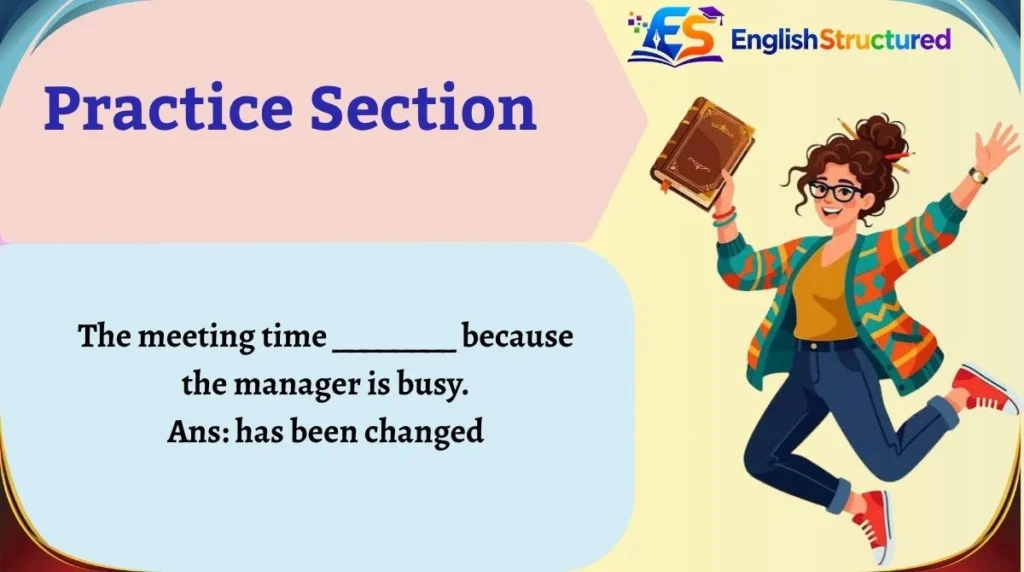
1. The meeting time ________ because the manager is busy.
2. The weather ________ since this morning.
3. The password ________ by the administrator.
4. Her attitude ________ over the past few months.
5. The school rules ________ recently.
Answers
1. has been changed
The meeting time has been changed because the manager is busy.
Someone changed the meeting time.
2. has changed
Has Been Changed vs Has Changed
We are simply describing a difference.
3. has been changed
The password has been changed by the administrator.
This is clearly passive because the administrator performed the action.
4. has changed
Has Been Changed vs Has Changed
Her attitude is different now.
5. have been changed
The school rules have been changed recently.
“Rules” is plural, so we use have, not has.
FAQs
What is the difference between “has changed” and “has been changed”?
Has changed usually focuses on the fact that something is different now. Has been changed focuses on an action performed on something. The second form is passive and often suggests that someone deliberately changed the subject.
Can we use “has changed” in questions?
Yes. You can ask:
Has Been Changed vs Has Changed
Has the price changed?
Has your opinion changed?
These questions ask whether something is different now.
You can also ask:
Has the schedule been changed?
This asks whether someone has changed the schedule.
Is “has been changed” formal or informal?
“Has been changed” is neither strictly formal nor informal. It is a normal grammatical passive structure. It is especially common in announcements, business communication, school notices, instructions, and situations where the person responsible is not important.
Is “the plan has changed” correct?
Yes. The plan has changed is completely correct. It means the plan is different now. It does not necessarily explain why it changed or who caused the change.
Is “the plan has been changed” also correct?
Yes. The plan has been changed is also correct. It suggests that someone has modified the plan. You could say:
The plan has been changed by the manager.
The passive form puts attention on the plan and the result of the action.
Which is more natural: “the price has changed” or “the price has been changed”?
It depends on the meaning. The price has changed is very common when you simply notice that the price is different. The price has been changed is useful when you want to emphasize that someone deliberately adjusted the price.
Can “has changed” describe a deliberate change?
Yes. Context matters. Has changed does not always mean the change was accidental or natural.
For example:
The company has changed its policy.
Here, the company deliberately made the change.
The important difference is that has changed can be active, while has been changed is passive.
Conclusion
The difference between has changed and has been changed becomes much easier when you focus on the main idea of the sentence.
Use has changed when you want to say that something is different now. The person who caused the change may not matter.
Has Been Changed vs Has Changed
My opinion has changed.
The situation has changed.
Use has been changed when you want to show that someone or something has acted on the subject.
The schedule has been changed.
The rules have been changed.
The document has been changed.
Remember the simple question: “Is it different, or was it changed by someone?” If you are describing a difference, choose has changed.
If you are focusing on an action done to something, choose has been changed.
Once you start noticing this difference in everyday conversations, emails, notices, and books, the choice will feel much more natural.
A little practice with real sentences can make this grammar point easy to remember.