Contiguous vs Continuous
At first glance, they seem closely related because both describe something connected in some way.
However, they are not interchangeable, and using the wrong one can change the meaning of your sentence.
Many English learners make mistakes with these two words because both come from the Latin word continuus, which relates to connection.
Over time, each word developed its own specific meaning.
Today, contiguous mainly describes things that touch each other or share a border, while continuous describes something that goes on without stopping.
Understanding this difference is important in everyday English, academic writing, geography, science, mathematics, and even casual conversations.
Once you know when to use each word, your English will sound much more natural and accurate.
By the end of this guide, you will clearly understand what contiguous and continuous mean, how they are different, when to use each one, and how to avoid the most common mistakes.
You’ll also see plenty of simple examples that make these words easy to remember.
What Does Contiguous Mean?
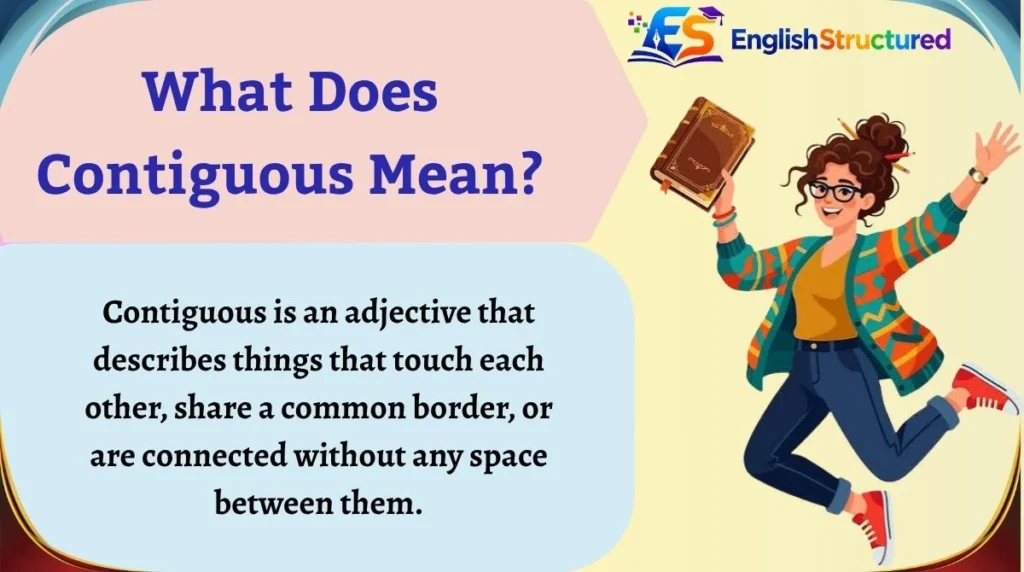
Contiguous is an adjective that describes things that touch each other, share a common border, or are connected without any space between them.
The word focuses on physical connection or location rather than time.
Simple Definition
Contiguous vs Continuous
When to Use “Contiguous”
Use contiguous when talking about:
- Places that share a border
- Pieces joined together
- Land areas connected without gaps
- Rooms or buildings that touch each other
- Objects placed side by side
It is commonly used in geography, architecture, law, computing, and technical writing.
Grammar Rule
Contiguous is an adjective, so it describes a noun.
Pattern
- contiguous + noun
- be + contiguous
Examples:
- contiguous states
- contiguous land
- contiguous rooms
- The two offices are contiguous.
Example Sentences
- The two farms are contiguous, so they share one fence.
- Canada and the United States have many contiguous border areas.
- Their hotel rooms were contiguous, making it easy to visit each other.
- Contiguous vs Continuous
- These plots of land are contiguous and belong to the same owner.
- The forest covers several contiguous valleys.
- Contiguous vs Continuous
- We searched every contiguous section of the park.
Common Learner Confusion
Contiguous vs Continuous. That is incorrect.
For example:
❌ The rain was contiguous for three hours.
The sentence is wrong because rain happens over time, not space.
Correct:
Contiguous vs Continuous
Use contiguous only when something is physically connected or touching.
What Does Continuous Mean?
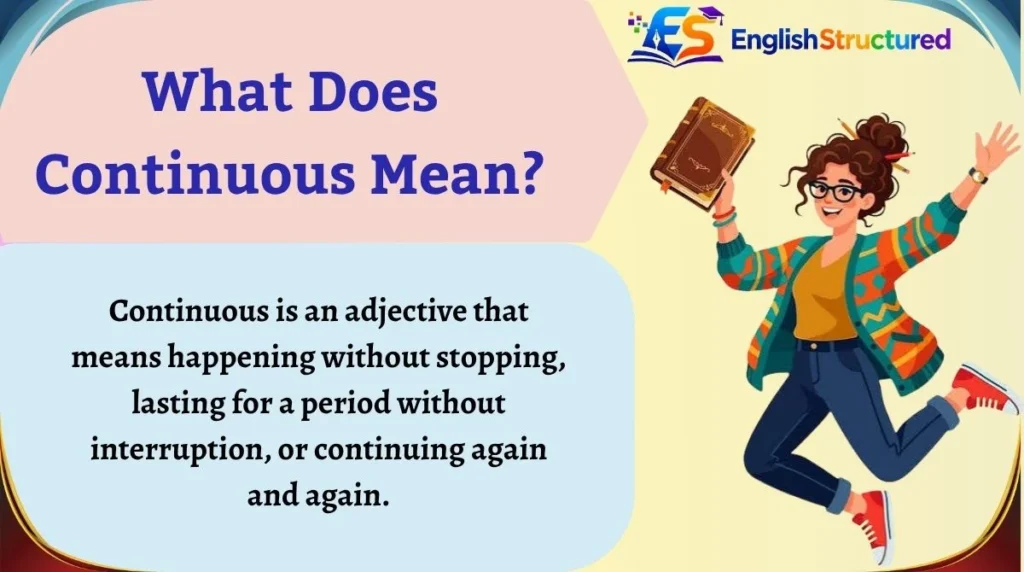
Continuous is an adjective that means happening without stopping, lasting for a period without interruption, or continuing again and again.
Unlike contiguous, this word focuses on time, process, or activity.
Simple Definition
Continuous means without a break, constant, or uninterrupted.
When to Use “Continuous”
Use continuous when talking about:
- Rain
- Noise
- Speech
- Work
- Growth
- Learning
- Movement
- Time
- Production
The main idea is that something keeps going without stopping.
Grammar Rule
Continuous is also an adjective.
Pattern
- continuous + noun
- be + continuous
Examples:
- continuous rain
- Contiguous vs Continuous
- continuous improvement
- Contiguous vs Continuous
Example Sentences
- We had continuous rain all afternoon.
- Contiguous vs Continuous
- The baby cried for continuous hours.
- The factory runs on a continuous production schedule.
- Contiguous vs Continuous
- The road experienced continuous traffic throughout the day.
- Exercise requires continuous effort.
- The teacher encouraged continuous practice.
Common Learner Confusion
Contiguous vs Continuous
For example:
❌ Our houses are continuous.
This sounds incorrect if you mean the houses are side by side.
Correct:
Contiguous vs Continuous
Remember:
- Continuous = no interruption.
- Contiguous = touching each other.
Difference Between Contiguous and Continuous
Although these words look similar, they describe completely different ideas.
| Feature | Contiguous | Continuous |
|---|---|---|
| Main meaning | Touching or sharing a border | Happening without stopping |
| Focus | Space or location | Time or duration |
| Used for | Land, buildings, objects, areas | Rain, work, learning, movement |
| Describes | Physical connection | Ongoing action or process |
| Part of speech | Adjective | Adjective |
Meaning Difference
The easiest way to understand the difference is to think about space and time.
Contiguous vs Continuous
If two things are contiguous, they are physically connected or directly next to each other.
Examples:
- Two contiguous classrooms
- Contiguous counties
- Contiguous gardens
Contiguous vs Continuous
If something is continuous, it keeps happening without a break.
Examples:
- Continuous talking
- Continuous rain
- Continuous improvement
Usage Difference
Ask yourself one simple question.
Am I talking about where something is?
Contiguous vs Continuous
Examples:
- Contiguous vs Continuous
- The fields are contiguous.
- The shops are contiguous.
Am I talking about how long something continues?
Contiguous vs Continuous
Examples:
- Contiguous vs Continuous
- We experienced continuous delays.
- She gave the project continuous attention.
Grammar Logic
Both words are adjectives, but they modify different types of nouns.
Contiguous usually describes physical things.
Examples:
- land
- buildings
- rooms
- territories
- regions
- properties
- borders
Continuous usually describes actions, events, conditions, or processes.
Examples:
- learning
- improvement
- growth
- traffic
- rainfall
- operation
- communication
Because of this difference, the two words cannot normally replace each other.
Sentence Structure Difference
Contiguous vs Continuous
- contiguous + place or object
- be + contiguous
Examples:
- The buildings are contiguous.
- The two gardens are contiguous.
- We purchased contiguous land.
Continuous
- continuous + activity or event
- be + continuous
Examples:
- The noise was continuous.
- We enjoyed continuous service.
- Continuous practice improves your English.
Side-by-Side Examples
| Correct Sentence | Why It Is Correct |
|---|---|
| The two classrooms are contiguous. | They share a wall. |
| We had continuous rain yesterday. | The rain never stopped. |
| Contiguous vs Continuous | The gardens touch each other. |
| She made continuous improvement. | Her progress kept going. |
| The company’s properties are contiguous. | The land is connected. |
| The machine operates continuously with continuous monitoring. | The operation has no interruption. |
Quick Summary
Think of these two keywords:
- Contiguous vs Continuous
- Continuous = Connected in time
That one idea will help you choose the correct word in most situations.
Grammar Rules You Must Remember
Learning a few simple grammar rules can help you use contiguous and continuous correctly every time. Both words are adjectives, but they describe different kinds of things.
Rule #1: Use contiguous for things that touch each other
If two or more places or objects share a border or are directly connected, use contiguous.
Examples:
- The two parks are contiguous.
- Contiguous vs Continuous
- The hotel has contiguous conference rooms.
- Contiguous vs Continuous
Remember: Think about physical location.
Rule #2: Use continuous for something that does not stop
If an action, event, or process keeps going without a break, use continuous.
Examples:
- We had continuous sunshine all weekend.
- She showed continuous improvement.
- Contiguous vs Continuous
- There was continuous traffic during the holiday.
Remember: Think about time, not place.
Rule #3: Never use one word in place of the other
Although the words look alike, they are not synonyms.
Wrong:
- Contiguous vs Continuous
Correct:
- The two houses are contiguous.
Wrong:
- We had contiguous rain for three days.
Correct:
- Contiguous vs Continuous
Choosing the correct word makes your English more natural and precise.
Rule #4: Look at the noun before choosing the word
A simple trick is to look at the noun you are describing.
If the noun is a place or object, contiguous is often the right choice.
Examples:
- contiguous fields
- contiguous countries
- contiguous buildings
- Contiguous vs Continuous
If the noun is an action, event, or process, continuous is usually correct.
Examples:
- continuous learning
- continuous operation
- continuous conversation
- Contiguous vs Continuous
This quick check helps you avoid many common mistakes.
Common Mistakes Students Make
Even advanced English learners sometimes confuse these words because they look and sound similar. Here are the mistakes people make most often.
Mistake 1: Using continuous for places
❌ The two villages are continuous.
Contiguous vs Continuous
Why?
Villages are places. If they share a border, they are contiguous.
Mistake 2: Using contiguous for time
❌ We had contiguous meetings all morning.
Contiguous vs Continuous
Why?
Meetings happen over time, not in space.
Mistake 3: Thinking both words mean “connected”
Both words involve the idea of connection, but they describe different kinds of connection.
- Contiguous vs Continuous
- Continuous = connected by time
Once you understand this, choosing the correct word becomes much easier.
Mistake 4: Translating directly from another language
Many languages use one word for both ideas. English separates them into two different words.
Instead of translating directly, ask yourself:
- Are these things touching?
- Or is something happening without stopping?
The answer tells you which word to choose.
Mistake 5: Ignoring the context
Always read the whole sentence before deciding.
Compare these examples.
- The forest covers contiguous hills.
- The wind blew continuously throughout the night.
- The museum owns several contiguous buildings.
- Contiguous vs Continuous
The surrounding words make the meaning clear.
Easy Correction Tips
Keep these simple tips in mind whenever you write.
- Think about space → use contiguous.
- Contiguous vs Continuous
- Look at the noun being described.
- Read the sentence aloud to see if it sounds natural.
- Practise with real examples instead of memorising definitions.
The more you notice these words while reading, the easier they become to use.
Easy Trick to Remember the Difference
A good memory trick can save you from making mistakes.
The “Map and Clock” Trick
Imagine two pictures.
Picture 1: A map
You see two countries touching each other.
Contiguous vs Continuous
Map = Place = Contiguous
Picture 2: A clock
The clock keeps moving every second without stopping.
That is continuous.
Contiguous vs Continuous
Whenever you forget the difference, ask yourself:
Am I looking at a map or a clock?
If it is about location, choose contiguous.
Contiguous vs Continuous
Another Simple Memory Tip
Notice the beginning of each word.
Contiguous vs Continuous
Think of contact.
Things make contact because they touch.
Continuous
Think of continue.
Something continues because it keeps going.
This simple word association helps many students remember the correct meaning.
Daily Life Examples
These examples show how native English speakers naturally use these words in everyday situations.
- Our gardens are contiguous, so we share one fence.
- Contiguous vs Continuous
- Those two offices are contiguous, making teamwork much easier.
- We experienced continuous rain during our holiday.
- The shopping centre bought three contiguous buildings for expansion.
- Contiguous vs Continuous
- The family’s farmland consists of several contiguous fields.
- The nurse provided continuous care throughout the night.
- The hiking trail passes through contiguous forests.
- Regular reading brings continuous improvement in English.
Short Conversation Examples
Conversation 1
A: Are those two apartments connected?
B: Yes, they’re contiguous.
Conversation 2
A: Why are you so tired?
Contiguous vs Continuous
Conversation 3
A: Is the land in one piece?
B: Yes, it’s all contiguous.
Conversation 4
A: Has the machine stopped today?
B: No, it’s been in continuous operation.
Conversation 5
A: Why has your English improved so much?
B: Because I practise every day with continuous effort.
These conversations show that each word fits naturally in different situations.
Practice Section
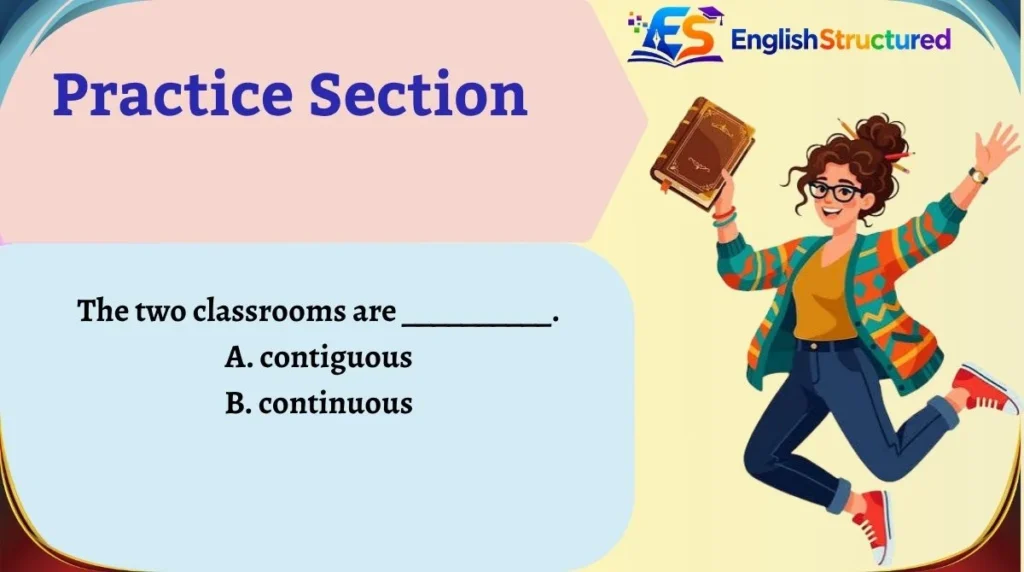
Choose the correct word: contiguous or continuous.
Question 1
The two classrooms are __________.
A. contiguous
B. continuous
Question 2
We had __________ snowfall all evening.
A. contiguous
B. Contiguous vs Continuous
Question 3
The company owns three __________ warehouses.
A. contiguous
B. continuous
Question 4
She made __________ progress after practising every day.
A. contiguous
B. continuous
Question 5
The two gardens are __________ because they share a fence.
A. contiguous
B. continuous
Answers
- A. contiguous
The classrooms are next to each other.
- B. continuous
The snowfall happened without stopping.
- A. contiguous
The warehouses are physically connected or adjacent.
- B. continuous
Progress continued over time.
- A. contiguous
The gardens share a common boundary.
Mini Challenge
Correct the mistakes in these sentences.
- We enjoyed contiguous sunshine all day.
- Their houses are continuous.
- The factory has contiguous production twenty-four hours a day.
Correct Answers
- We enjoyed continuous sunshine all day.
- Contiguous vs Continuous
- The factory has continuous production twenty-four hours a day.
After enough practice, choosing between contiguous and continuous will become almost automatic. The key is to remember that contiguous describes connection in space, while continuous describes connection in time.
FAQs
What is the difference between contiguous and continuous?
The main difference is what each word describes. Contiguous means things are touching or sharing a border, while continuous means something continues without stopping. One refers to space, and the other refers to time.
Can contiguous and continuous be used interchangeably?
No. Although the words look similar, they have different meanings. Using one instead of the other can make your sentence incorrect or confusing. Always think about whether you are describing location or duration before choosing the word.
Can we use continuous in questions?
Yes. Continuous can be used in statements, questions, and negative sentences.
Examples:
- Was the rain continuous all day?
- Contiguous vs Continuous
- Isn’t the noise continuous?
It follows the same grammar rules as other adjectives.
Is contiguous a formal word?
Yes. Contiguous is more common in formal writing, especially in geography, law, science, real estate, and technical documents. In everyday conversation, people often say next to, adjacent, or connected instead.
Examples:
- Contiguous vs Continuous
- Our houses are next to each other.
Both sentences are correct, but the second one sounds more natural in casual speech.
Is continuous formal or informal?
Contiguous vs Continuous. You will hear it in everyday conversations and also see it in books, news articles, business writing, and academic texts.
Examples:
- We had continuous rain.
- Contiguous vs Continuous
It is a very common and useful adjective.
How can I remember the difference between contiguous and continuous?
Use this simple memory trick:
- Contiguous = Contact = Touching places
- Contiguous vs Continuous
If you are talking about where something is, choose contiguous. If you are talking about how long something lasts, choose continuous.
Conclusion
The words contiguous and continuous may look alike, but they describe two completely different ideas. Contiguous vs Continuous.
It describes places, buildings, land, or objects that touch each other or share a common border.
Continuous, on the other hand, is about time. It describes actions, events, or processes that keep going without interruption.
A simple way to choose the correct word is to ask yourself one question. Am I talking about space or time?
If your sentence is about location or objects that touch, use contiguous. If it is about something happening without stopping, use continuous.
Don’t worry if you confuse these words at first. Even many advanced learners need practice.
The more you read, write, and speak English, the more natural the difference will become.
Try making your own sentences using both words every day. Small, regular practice will build your confidence and help you use them correctly in real conversations and writing.