Intelligent vs Intellectual
Both words are connected with the mind, knowledge, and thinking, but they do not mean exactly the same thing.
For example, you might say, “Sara is very intelligent because she solves difficult problems quickly.”
You might also say, “Sara enjoys intellectual discussions about history and science.” Both sentences sound natural, but the two adjectives describe different qualities.
This small difference matters in everyday English. If you choose the wrong word, your sentence may still be understandable, but it may not express the exact idea you want.
Intelligent usually describes someone’s ability to learn, understand, reason, solve problems, and make good decisions.
It can describe a person, animal, machine, or even a decision.
Intellectual, on the other hand, is more closely connected with deep thinking, ideas, knowledge, education, and serious mental activity.
It often describes people who enjoy studying or thinking about complex subjects.
The easiest way to understand the difference is to remember that intelligent describes mental ability, while intellectual often describes a connection with ideas and serious thinking.
By the end of this guide, you will know when to use each word, how they work in sentences, the common mistakes learners make, and how to remember the difference without memorizing complicated grammar rules.
What Does “Intelligent” Mean?
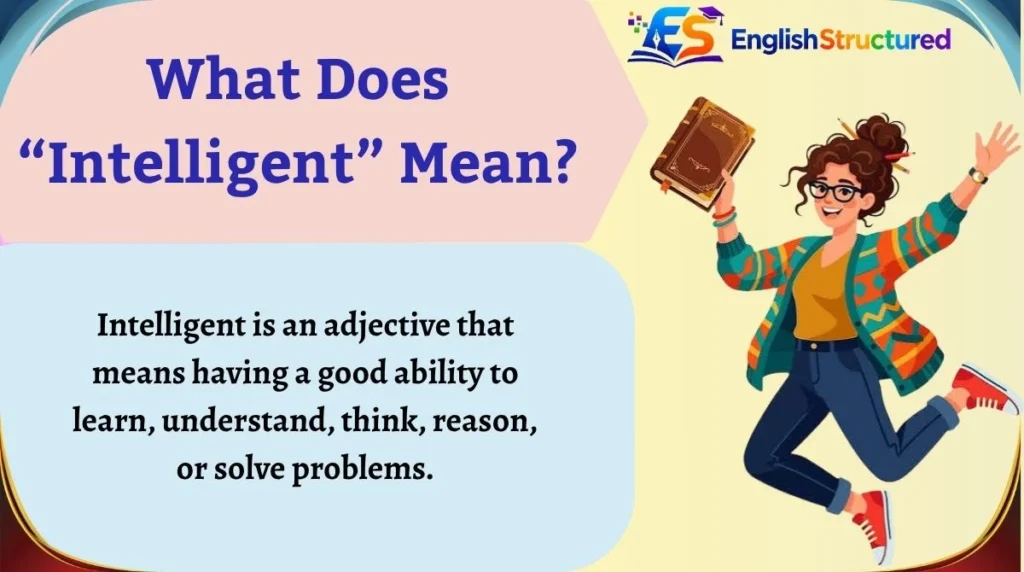
Intelligent is an adjective that means having a good ability to learn, understand, think, reason, or solve problems.
When we call someone intelligent, we are usually talking about their mental ability. An intelligent person can understand new information quickly, recognize patterns, make sensible decisions, or find solutions to difficult problems.
For example:
- Intelligent vs Intellectual
- She is intelligent enough to understand the problem.
- My brother is very intelligent and learns quickly.
- The teacher gave us an intelligent solution to the problem.
- That was an intelligent decision.
- Dogs are intelligent animals.
- He asked an intelligent question during the meeting.
- Intelligent vs Intellectual
Notice that intelligent does not always mean highly educated. Someone can be intelligent without having a university degree or knowing many academic subjects.
A person may have excellent problem-solving skills but not enjoy reading books. Another person may know a lot of facts but not always make good decisions. Intelligence and education can be connected, but they are not identical.
When Should You Use “Intelligent”?
Use intelligent when you want to talk about someone’s ability to think, learn, understand, or solve problems.
It is common in both everyday and formal English.
You can use it for:
- People
- Animals
- Machines or systems
- Decisions
- Questions
- Ideas or solutions
For example, imagine a child who solves a difficult puzzle without help. You could say:
Intelligent vs Intellectual
You are not saying the child has read hundreds of books. You are saying the child has a strong ability to understand and solve problems.
Grammar Rule for “Intelligent”
Intelligent is an adjective.
It usually comes before a noun:
Intelligent vs Intellectual
It can also come after a linking verb such as be, seem, look, or appear:
She is intelligent.
He seems intelligent.
You can also use common adverbs with it:
very intelligent
Intelligent vs Intellectual
extremely intelligent
The noun form is intelligence.
For example:
She has a high level of intelligence.
The adverb is intelligently:
He solved the problem intelligently.
A common mistake is to use “intelligent” as if it were a noun. We normally do not say:
Intelligent vs Intellectual
Instead, say:
“He has a lot of intelligence.”
What Does “Intellectual” Mean?
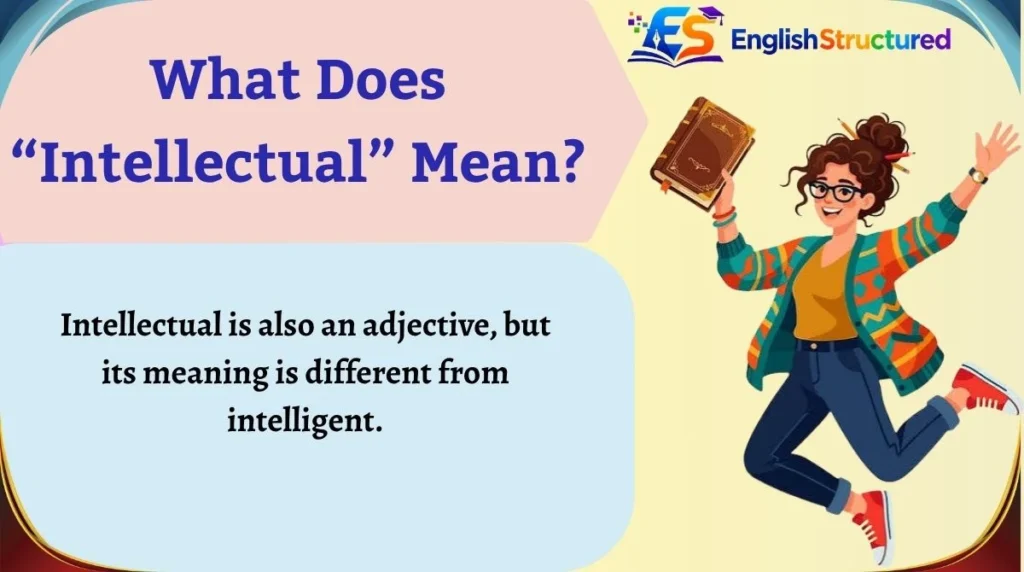
Intellectual is also an adjective, but its meaning is different from intelligent.
Intellectual usually relates to ideas, knowledge, education, learning, reasoning, and serious thought.
It can describe a person who enjoys thinking deeply about subjects such as philosophy, science, literature, politics, history, or art.
For example:
- She enjoys intellectual conversations.
- He is interested in intellectual subjects.
- Intelligent vs Intellectual
- They had a long intellectual discussion about history.
- The university is known for its intellectual community.
- He likes intellectual debates.
- Reading gives her great intellectual pleasure.
- Intelligent vs Intellectual
The word can also be used as a noun.
An intellectual is a person who spends a lot of time studying, thinking about, or discussing serious ideas.
For example:
He is considered an intellectual.
Here, “intellectual” is not simply saying that he is smart. It suggests that he is deeply involved with ideas, knowledge, study, or culture.
When Should You Use “Intellectual”?
Use intellectual when the focus is on ideas, knowledge, study, or deep mental activity.
It is especially common when discussing:
- Academic subjects
- Philosophy
- Literature
- Science
- Art
- Serious discussions
- Books and theories
- Education
- Cultural ideas
For example:
Intelligent vs Intellectual
This sentence focuses on the type of discussion. It was serious and based on ideas.
You could also say:
She has a strong intellectual curiosity.
This means she has a strong desire to learn, understand, and explore ideas.
Grammar Rule for “Intellectual”
Intellectual can be an adjective and a noun.
As an adjective:
Intelligent vs Intellectual
an intellectual challenge
intellectual curiosity
As a noun:
He is an intellectual.
The noun intellect is another related word. It refers to a person’s ability to think and understand.
For example:
Intelligent vs Intellectual
Intelligent vs Intellectual
The book is intellectually challenging.
These forms are related, but they should not be used in exactly the same way.
Difference Between Intelligent and Intellectual
The main difference is simple:
Intelligent focuses on a person’s ability to think and understand.
Intellectual focuses more on ideas, knowledge, study, and deep thinking.
| Word | Main Meaning | Common Use | Example |
|---|---|---|---|
| Intelligent | Having strong mental ability | People, animals, decisions, solutions | She is an intelligent student. |
| Intellectual | Related to ideas, knowledge, or serious thought | Discussions, subjects, activities, people | They had an intellectual discussion. |
Consider these two sentences:
Intelligent vs Intellectual
This means Tom has a good ability to think, learn, or solve problems.
Now compare:
Tom is intellectual.
This sounds less like a simple statement about his intelligence. It may suggest that Tom is interested in serious ideas, academic subjects, books, culture, or deep discussion.
That is why “intelligent person” is much more common when you simply want to say someone is smart.
Intelligent Describes Ability
Think about a student taking a mathematics test.
The student sees a difficult problem, understands it, and finds the answer quickly.
You might say:
Intelligent vs Intellectual
The focus is on her mental ability.
Intellectual Describes Mental Interests or Activities
Now imagine the same student spending hours reading philosophy and discussing questions about human nature.
You might say:
“She has strong intellectual interests.”
Here, the focus is not simply on whether she is smart. The focus is on what she likes to think and learn about.
Sentence Structure Difference
Both words are adjectives, but they often appear with different nouns.
Intelligent vs Intellectual
- intelligent person
- intelligent student
- intelligent child
- intelligent animal
- intelligent decision
- intelligent answer
- intelligent solution
- intelligent question
Common combinations with intellectual include:
- intellectual discussion
- intellectual debate
- intellectual challenge
- intellectual curiosity
- intellectual activity
- intellectual interests
- intellectual development
- Intelligent vs Intellectual
This is not an absolute rule. English has flexible vocabulary. However, these combinations can help you sound more natural.
Meaning in One Simple Comparison
Think of a person who can solve a difficult puzzle very quickly.
Intelligent vs Intellectual
Now think of a person who loves discussing philosophy, reading difficult books, and exploring complex ideas.
That person may be described as intellectual.
Of course, the same person can be both intelligent and intellectual.
Grammar Rules You Must Remember
Rule #1: Use “Intelligent” for Mental Ability
When you mean that someone has a strong ability to understand, learn, reason, or solve problems, use intelligent.
Example:
Maya is intelligent and learns new skills very quickly.
The sentence describes Maya’s ability.
Another example:
That was an intelligent decision.
The decision was sensible and showed good thinking.
Rule #2: Use “Intellectual” for Ideas and Serious Thinking
When you are talking about serious ideas, learning, knowledge, or mental activities, intellectual is often the better choice.
Example:
The students had an intellectual discussion about climate change.
The word describes the nature of the discussion, not the students’ basic ability.
You could also say:
The book presents an intellectual challenge.
The challenge requires serious thought.
Rule #3: “Intellectual” Can Be a Noun
Intelligent vs Intellectual
Example:
He is a well-known intellectual.
Here, “intellectual” refers to someone strongly involved in serious thought, learning, or ideas.
Intelligent vs Intellectual
Do not say:
He is an intelligent.
Instead, say:
Intelligent vs Intellectual
Or:
He is an intelligent person.
Rule #4: “Intelligence” and “Intellect” Are Different Nouns
The noun related to intelligent is intelligence.
Intelligent vs Intellectual
The noun intellect refers more specifically to the mind’s ability to reason and understand.
His powerful intellect helped him solve the problem.
These words can overlap, but they are not always interchangeable.
A useful pattern is:
intelligent → intelligence
intellectual → intellect
Learning these word families makes the difference easier to remember.
Common Mistakes Students Make
Many learners confuse these words because both are connected to the idea of being smart. The problem becomes clearer when you look at the exact focus of the sentence.
Mistake 1: Using “Intellectual” for Every Smart Person
A learner may say:
Wrong: My sister is intellectual because she gets high marks.
This is not necessarily impossible, but it is not the most natural choice if the only meaning is that she is smart.
A better sentence is:
Correct: My sister is intelligent because she gets high marks.
If you want to emphasize her love of serious learning, you could say:
Intelligent vs Intellectual
Mistake 2: Saying “An Intelligent” as a Noun
Another common mistake is:
Wrong: He is an intelligent.
“Intelligent” is normally an adjective, so it needs a noun after it when used with an.
Say:
Correct: He is an intelligent person.
Or simply:
Intelligent vs Intellectual
Remember that intellectual can be a noun:
He is an intellectual.
Mistake 3: Confusing Intelligence With Education
Being intelligent does not automatically mean being highly educated.
For example:
Ahmed left school at a young age, but he is extremely intelligent.
This sentence is perfectly possible.
Likewise, someone may have many academic qualifications but not always make intelligent choices.
Education gives you knowledge and training. Intelligence refers more to your ability to understand and reason.
Mistake 4: Using “Intelligent” for Academic Activities
Consider:
Intelligent vs Intellectual
This can be understood, but if you mean serious discussions about ideas, a more natural phrase is:
She enjoys intellectual discussions.
The discussion itself is related to ideas and serious thought, so intellectual fits better.
Easy Correction Tip
Whenever you are unsure, ask yourself one question:
“Am I describing ability, or am I describing ideas?”
Intelligent vs Intellectual
If you are describing ideas, study, knowledge, or serious thought, choose intellectual.
Easy Trick to Remember the Difference
Here is a simple memory trick:
Intelligent = “How well you think”
Intellectual = “What you think about”
Imagine two friends, Sam and David.
Sam can solve puzzles, understand instructions, and learn new games very quickly.
You can say:
Intelligent vs Intellectual
Now David loves reading philosophy, discussing history, studying science, and talking about complex ideas.
You can say:
David has intellectual interests.
Of course, David may also be intelligent. Sam may also enjoy intellectual subjects. The words are not opposites.
They simply highlight different sides of the mind.
Another useful trick is to remember these pairs:
Intelligent person
Intelligent vs Intellectual
Intelligent decision
Intellectual curiosity
Intelligent solution
Intellectual activity
If you remember a few of these natural combinations, choosing the correct word becomes much easier.
Daily Life Examples
Here are some simple examples showing how native speakers might use the two words in everyday situations.
1. Talking About a Student
“Emma is very intelligent. She understands math problems quickly.”
The speaker is talking about Emma’s ability.
2. Talking About a Conversation
“We had an interesting intellectual conversation after dinner.”
The conversation involved serious ideas or deep topics.
3. Talking About a Decision
“You made an intelligent decision by saving some money.”
The decision showed good judgment.
4. Talking About Reading
“He enjoys intellectual books about history and philosophy.”
The focus is on books that deal with serious ideas.
5. Talking About a Child
“That little girl is incredibly intelligent.”
The speaker means she learns or understands things very well.
6. Talking About Curiosity
“Her intellectual curiosity makes her ask lots of questions.”
She wants to explore and understand ideas.
7. Talking About Technology
Intelligent vs Intellectual
Here, intelligent means the system can perform tasks in a smart or advanced way.
8. Talking About a Debate
“The two professors had an intellectual debate about education.”
The debate involved serious ideas and reasoning.
9. Talking About a Person
“My uncle is intelligent, but he doesn’t enjoy academic discussions.”
This sentence clearly shows that intelligence and intellectual interests are not the same thing.
10. Using Both Words
“She is highly intelligent and has a strong intellectual interest in science.”
This is a good example because both words can naturally describe the same person.
She has strong mental ability, and she also has strong interest in ideas and knowledge.
Practice Section
Intelligent vs Intellectual
1.
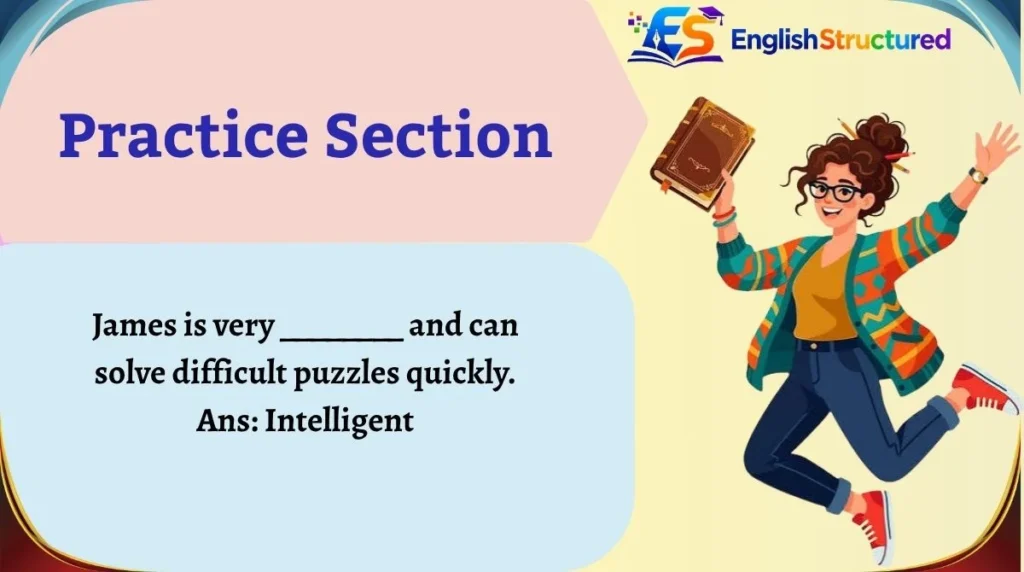
James is very ________ and can solve difficult puzzles quickly.
2.
We had an ________ discussion about the meaning of freedom.
3.
The teacher praised her for making an ________ decision.
4.
He has a strong ________ curiosity and loves learning about philosophy.
5.
Marie is considered an ________ because of her work in literature and public ideas.
Answers
1. Intelligent
James has a strong ability to solve problems.
2. Intellectual
The discussion is about serious ideas.
3. Intelligent
The decision showed good judgment or reasoning.
4. Intellectual
The sentence describes an interest in learning and ideas.
5. Intellectual
Here, “intellectual” is being used as a noun to describe a person involved in serious thought, culture, or ideas.
FAQs
What is the difference between intelligent and intellectual?
Intelligent usually describes someone’s ability to learn, understand, reason, or solve problems. Intellectual usually relates to ideas, knowledge, education, and serious thought. A person can be both intelligent and intellectual.
Can “intellectual” describe a person?
Yes. Intellectual can be used as both an adjective and a noun. As a noun, it can describe someone who is deeply involved in ideas, learning, culture, or serious discussion.
For example:
He is an intellectual.
As an adjective:
He enjoys intellectual discussions.
Is “intelligent” the same as “smart”?
They are very close in many situations. Intelligent is a common and neutral way to describe someone’s mental ability. Smart is often more casual and can have additional meanings depending on context.
For example:
She is intelligent.
She is smart.
Both can mean that she has good mental ability.
Is intellectual a formal word?
Yes, intellectual can sound more formal than intelligent, especially when discussing education, philosophy, literature, culture, or academic subjects.
However, it is also common in everyday English phrases such as intellectual curiosity and intellectual discussion.
Can an intelligent person be non-intellectual?
Yes. A person can be highly intelligent without having a strong interest in academic or philosophical ideas.
For example, someone might be excellent at fixing machines, solving practical problems, or understanding people but have little interest in books or academic debates.
Can someone be both intelligent and intellectual?
Absolutely. These words describe different qualities, so they can describe the same person.
For example:
She is intelligent and has strong intellectual interests.
This means she has strong mental ability and also enjoys learning about complex ideas.
Conclusion
Intelligent vs Intellectual
Intelligent is mainly about mental ability. An intelligent person can learn, understand, reason, solve problems, or make good decisions. You can also describe an intelligent animal, question, solution, or decision.
Intellectual is more closely connected with ideas, knowledge, education, and serious thinking.
We often talk about intellectual discussions, intellectual curiosity, intellectual activities, and intellectual interests.
It can also be a noun for a person who is strongly involved in serious ideas and learning.
The easiest memory trick is:
Intelligent = how well you think.
Intellectual = ideas and serious thinking.
Do not worry if these words seem confusing at first. They are closely related, so even advanced learners sometimes pause before choosing one.
Pay attention to the noun that follows the adjective and ask whether you are talking about ability or ideas.
With a little practice, the difference will start to feel natural.