
Learning English is exciting, but some words and phrases can be confusing because they seem to mean the same thing.
You All vs All of You
The good news is that both phrases are correct. However, they are not always used in exactly the same way.
The choice often depends on the speaker’s purpose, tone, region, and the situation.
Sometimes one sounds more natural in casual conversation, while the other adds emphasis or fits better in formal English.
Understanding this small difference can make your English sound more natural and confident.
It also helps you avoid common mistakes when speaking with friends, writing emails, or talking in class.
Many students hear “you all” in American movies, TV shows, and songs. At the same time, they often see “all of you” in books, classrooms, and formal writing.
This makes it easy to wonder which one should be used.
By the end of this guide, you will clearly understand the meaning of both expressions, when to use each one, their grammar rules, common mistakes, and plenty of real-life examples.
After a little practice, choosing between these two phrases will become simple and natural.
What Does “You All” Mean?
“You all” is a pronoun phrase used to speak directly to more than one person. It simply means every person in the group you are talking to.
In many parts of the United States, especially in the South, “you all” (often shortened to “y’all” in informal writing) is the normal plural form of you. Since modern English uses you for both one person and many people, speakers sometimes add all to make it clear they are talking to a group.
Simple Definition
You All vs All of You
It is used when addressing two or more people at the same time.
When to Use “You All”
Use “you all” when:
- You are talking to a group.
- You want to make it clear that everyone is included.
- You are speaking in a casual or friendly way.
- You are using American English, especially in everyday conversation.
Grammar Rule
You All vs All of You
Basic sentence patterns:
- You all + verb
- You All vs All of You
- Do you all + verb?
- Are you all + adjective?
The phrase works just like the pronoun you, except it clearly refers to more than one person.
Examples of “You All”
- You all did an excellent job today.
- Are you all ready for the meeting?
- I hope you all enjoy the holiday.
- Thank you all for your help.
- You All vs All of You
- You All vs All of You
- I miss you all very much.
- You all look happy today.
Where Is “You All” Common?
Although people around the world understand you all, it is especially common in American English.
For example:
- Teachers often say, “You all need to finish this worksheet.”
- You All vs All of You
- A parent might say, “I want you all to clean your rooms.”
In British English, speakers often say simply you, everyone, or all of you instead.
Is “You All” Formal or Informal?
You All vs All of You. Teachers, presenters, and even business speakers sometimes use it when talking to groups because it sounds warm and inclusive.
For example:
- You All vs All of You
- Thank you all for attending today’s event.
These sentences sound friendly without being rude.
Common Learner Confusion
You All vs All of You
Actually, you all is perfectly correct English. It simply makes the plural meaning clearer.
Another confusion is believing you all only belongs in Southern American English. While it is strongly connected with that region, people across many English-speaking areas use it naturally when addressing groups.
If your goal is clear, friendly communication, you all is a perfectly acceptable choice in many situations.
What Does “All of You” Mean?
“All of you” also refers to every person in the group being addressed. The meaning is almost the same as “you all,” but this phrase often places a little more emphasis on including every individual.
Simple Definition
All of you = every single person in the group.
It highlights that nobody is left out.
When to Use “All of You”
You All vs All of You
- You want to stress that every person is included.
- You are speaking or writing more carefully.
- You want to add emphasis.
- You are using either formal or informal English.
Grammar Rule
You All vs All of You
- All (determiner)
- of
- you (pronoun)
It functions as the subject, object, or complement in a sentence.
Common patterns include:
- All of you + verb
- I want all of you + to + verb
- You All vs All of You
- Are all of you + adjective?
Examples of “All of You”
- All of you worked very hard today.
- I would like all of you to listen carefully.
- Are all of you coming to the party?
- You All vs All of You
- I am proud of all of you.
- Did all of you understand the lesson?
- All of you deserve a reward.
- You All vs All of You
When Does “All of You” Sound Better?
Sometimes all of you sounds more natural because it gives extra emphasis.
For example:
- I want all of you to pay attention.
- I’m grateful to all of you.
- All of you are invited to the celebration.
In these sentences, the speaker is clearly including every member of the group.
Formal and Informal Use
You All vs All of You
You may hear it:
- During classroom lessons
- In speeches
- At business meetings
- In books
- In everyday conversations
Because of its flexibility, many learners choose all of you when they are unsure which expression sounds best.
Common Learner Confusion
You All vs All of You
In reality, neither phrase is rude. The difference is mainly one of style and emphasis, not politeness.
For example:
- You all did great!
- All of you did great!
Both sentences are correct. The second simply places a little more attention on every individual in the group.
Difference Between “You All” and “All of You”
Although these expressions have nearly the same meaning, they are not always used in exactly the same way. Understanding their differences will help you choose the most natural expression for every situation.
| Feature | You All | All of You |
|---|---|---|
| Meaning | The group you are speaking to | Every person in the group |
| Main purpose | Plural form of you | Adds emphasis to the whole group |
| Tone | Friendly and conversational | Neutral to slightly more emphatic |
| Formality | Mostly informal | Formal and informal |
| Common in | American English, especially everyday speech | All varieties of English |
| Emphasis | Less emphasis | Stronger emphasis on everyone |
| Everyday conversation | Very common | Very common |
Usage Difference Between “You All” and “All of You”
Although you all and all of you often refer to the same group of people, they do not always create the same feeling. The biggest difference is how the speaker wants the sentence to sound.
You all is usually friendly, relaxed, and conversational. It feels natural when talking to friends, classmates, family members, or coworkers.
All of you is a little more flexible. It can be casual in everyday speech, but it also fits formal situations such as classrooms, meetings, speeches, and presentations. It often adds extra emphasis, making it clear that every single person is included.
Compare these examples:
- You all did a fantastic job.
- You All vs All of You
Both are correct. The second sentence puts a little more focus on every member of the group.
Here are more comparisons:
| You All | All of You |
|---|---|
| You all look excited today. | All of you look excited today. |
| Can you all hear me? | Can all of you hear me? |
| Thank you all for coming. | Thank all of you for coming. |
| I hope you all enjoy the trip. | I hope all of you enjoy the trip. |
| You all have finished early. | All of you have finished early. |
The meaning hardly changes. The difference is mainly the speaker’s style and emphasis.
Grammar Logic
The easiest way to understand these expressions is to think about their jobs in a sentence.
“You All”
This phrase works like a plural pronoun. It replaces you when the speaker wants to make it clear that more than one person is being addressed.
Examples:
- You all are welcome.
- You all need to be careful.
- Have you all eaten lunch?
You All vs All of You
“All of You”
You All vs All of You
Examples:
- All of you are welcome.
- All of you need to be careful.
- Have all of you eaten lunch?
The grammar is still correct, but the phrase sounds slightly more emphatic.
Sentence Structure Difference
Both expressions fit into almost the same sentence patterns.
Subject
- You all passed the test.
- All of you passed the test.
Object
- I invited you all.
- I invited all of you.
After a Preposition
- This gift is for you all.
- You All vs All of You
Questions
- Are you all ready?
- Are all of you ready?
Commands
- Please sit down, you all.
- I want all of you to sit down.
You All vs All of You
Meaning Comparison
The meanings are extremely close.
You All
- Focuses on the group.
- Sounds warm and conversational.
- Often used naturally in spoken English.
All of You
- Focuses on every individual in the group.
- Adds emphasis.
- Fits both spoken and written English.
Imagine a teacher speaking to a class.
The teacher says:
You all did well today.
This sounds encouraging and friendly.
Now the teacher says:
All of you did well today.
The teacher is stressing that every student succeeded.
The basic meaning stays the same, but the emphasis changes slightly.
Which Expression Should You Choose?
Choose you all when:
- Speaking casually.
- Talking with friends.
- Addressing a group naturally.
- Using conversational American English.
You All vs All of You
- Giving instructions.
- Writing formally.
- Making a speech.
- Emphasizing every person.
In many situations, either choice is perfectly acceptable.
Grammar Rules You Must Remember
Learning a few simple grammar rules makes these expressions much easier to use.
Rule #1: Use Both Only for More Than One Person
Neither phrase should refer to a single person.
✔ Correct:
- You all look happy.
- All of you look happy.
✖ Incorrect:
- You all are my best friend. (when speaking to one person)
- You All vs All of You
Always use these expressions for two or more people.
Rule #2: Match the Verb with a Plural Subject
Because both phrases refer to several people, use plural verb forms.
✔ Correct
- You all are invited.
- You All vs All of You
✔ Correct
- You all have finished.
- All of you have finished.
Do not use singular verbs.
✖ Incorrect
- You all is ready.
- All of you has arrived.
Rule #3: Use Them Naturally Without Repeating “Everyone”
Many learners accidentally repeat the same idea.
✖ Incorrect
- You All vs All of You
- You all everybody come here.
✔ Correct
- All of you should listen.
- You All vs All of You
One group expression is enough.
Rule #4: Choose Based on Style, Not Grammar
This is one of the easiest rules to remember.
Both expressions are grammatically correct.
The choice depends on:
- your audience
- your tone
- your purpose
- how much emphasis you want
For example:
Casual conversation:
You All vs All of You
School announcement:
All of you are expected to attend tomorrow’s meeting.
Both are correct.
Common Mistakes Students Make
Many English learners understand the meanings but still make small mistakes. Knowing these errors will help you sound more natural.
Mistake 1: Using the Expressions for One Person
Wrong:
❌ You all are late.
(to one friend)
Correct:
✅ You are late.
You All vs All of You
Mistake 2: Using Singular Verbs
Wrong:
❌ All of you is welcome.
Correct:
You All vs All of You
Remember that the group is plural.
Mistake 3: Thinking One Phrase Is Always Correct
Some learners believe only all of you is proper English.
Others think only you all is natural.
Both ideas are incorrect.
Both phrases are standard English.
The choice depends on style.
Mistake 4: Adding Extra Words
Wrong:
❌ All of all of you
You All vs All of You
Correct:
✅ All of you
✅ You all
Keep the sentence simple.
Mistake 5: Forgetting the Context
Imagine your teacher says:
I want all of you to finish the assignment.
Replacing it with:
I want you all to finish the assignment.
still works perfectly.
Instead of memorising one “correct” phrase, learn to choose the one that sounds most natural for the situation.
Easy Tips to Avoid Mistakes
- Ask yourself, “Am I talking to more than one person?”
- If yes, both expressions may work.
- You All vs All of You
- Use you all for relaxed conversation.
- Read English dialogues aloud to hear how native speakers naturally use both expressions.
Easy Trick to Remember the Difference
A simple memory trick can help you choose the right phrase quickly.
You All vs All of You
You All = Talking to the Group
Imagine standing in front of your classmates.
You smile and say:
You all did a wonderful job.
You are speaking to the group as one team.
Think:
You all = the whole group together.
All of You = Every Single Person
Now imagine giving each student a certificate.
You say:
I’m proud of all of you.
Now you are thinking about each individual person, even though they are still one group.
Think:
All of you = every person in the group.
The Easy Memory Formula
- You all → group
- You All vs All of You
This simple idea works in almost every situation.
The good news is that if you accidentally use one instead of the other, native speakers will almost always understand exactly what you mean.
Daily Life Examples
The best way to learn these expressions is to see how they are used in everyday conversations. The examples below show natural English that you might hear at school, at work, at home, or while spending time with friends.
At School
Teacher: Are you all ready for today’s quiz?
Students: Yes, we are.
During a Family Dinner
Mother: Thank you all for helping me prepare dinner.
At Work
Manager: All of you have done an excellent job on this project.
Planning a Trip
Friend: Are you all coming with us this weekend?
At a Birthday Party
Host: I’m so happy all of you could come today.
During a Team Meeting
Coach: You all played with great energy today.
In the Classroom
Teacher: I want all of you to finish this exercise before lunch.
Saying Goodbye
Visitor: I’ll miss you all very much.
During a Video Call
Grandmother: It’s wonderful to see all of you together.
Celebrating Success
Principal: Congratulations! You all made the school proud.
Quick Conversation Examples
Here are a few short conversations that show how naturally both expressions fit into spoken English.
Conversation 1
A: Are you all hungry?
B: Yes, let’s order some food.
Conversation 2
Teacher: Did all of you complete the homework?
Students: Yes, we finished it yesterday.
Conversation 3
A: Thank you all for coming.
B: We had a great time.
Conversation 4
Coach: I’m proud of all of you.
Players: Thank you, Coach!
Conversation 5
Friend: I hope you all enjoy your holiday.
Group: Thanks! We can’t wait.
These conversations show that both expressions sound natural. The speaker simply chooses the one that best matches the tone and level of emphasis.
Practice Section
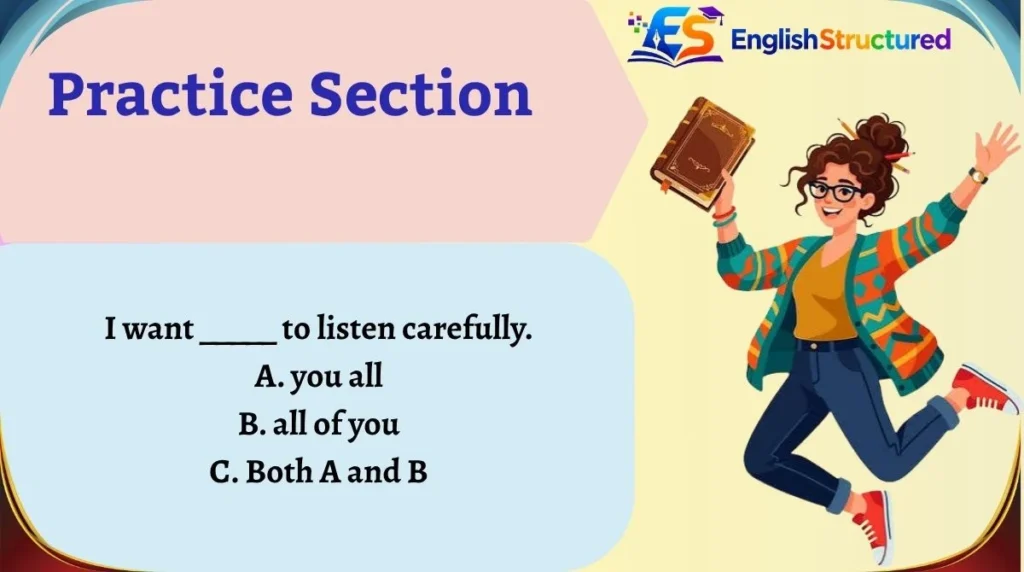
Choose the correct answer in each sentence.
1. _____ are invited to tomorrow’s meeting.
A. You all
B. All of you
C. Both A and B
2. I want _____ to listen carefully.
A. you all
B. all of you
C. Both A and B
3. _____ finished the project on time.
A. You all
B. All of you
C. Both A and B
4. Can _____ help me move these chairs?
A. you all
B. all of you
C. Both A and B
5. Thank _____ for your support.
A. you all
B. all of you
C. Both A and B
Answers
1. C – Both expressions are correct.
2. C – Both work, although all of you adds slightly more emphasis.
3. C – Either expression is natural.
4. C – Both are grammatically correct.
5. C – Both are commonly used in English.
Practice Tip: Try replacing one phrase with the other in your own sentences. Most of the time, the meaning stays the same, but the tone changes slightly.
FAQs
1. What is the difference between “you all” and “all of you”?
Both expressions refer to more than one person. You all sounds more conversational and friendly, while all of you often adds extra emphasis and works well in both formal and informal situations.
2. Can we use “you all” in questions?
Yes. It is very common in questions.
Examples:
- Are you all ready?
- You All vs All of You
- Can you all hear me?
3. Can we use “all of you” in formal writing?
Yes. All of you is suitable for formal writing, speeches, classroom instructions, business meetings, and everyday conversations.
Example:
I would like all of you to complete the report by Friday.
4. Is “you all” informal?
Generally, yes. It is more common in casual speech, especially in American English. However, it is still polite and widely accepted when speaking to groups.
5. Is “all of you” more polite than “you all”?
Not necessarily. Both expressions are polite. All of you simply places a little more emphasis on including every member of the group.
6. Can I always replace one phrase with the other?
In most situations, yes. The meaning usually stays the same. However, all of you may sound stronger when you want to stress that every individual is included, while you all often sounds more relaxed and conversational.
Conclusion
You All vs All of You
Both expressions refer to more than one person, and both are correct English. The biggest difference is not grammar but style and emphasis.
Choose you all when you want your speech to sound friendly, natural, and conversational. It is especially common in everyday American English and makes it clear that you are talking to a group.
Choose all of you when you want to highlight that every individual is included or when writing or speaking in a more formal setting.
It works well in classrooms, speeches, business communication, and everyday conversations.
The more you read, listen, and practise, the more natural these expressions will become.
Pay attention to how native speakers use them in real conversations, books, podcasts, and videos.
Before long, you will be able to choose the right phrase without even thinking about it.
Remember, learning English is not just about memorising rules. It is about using the language with confidence.
Keep practising, make mistakes without fear, and enjoy every step of your learning journey.