
Imitated vs Intimated
Both words come from common English verbs, but their meanings are completely different. Using one in place of the other can change the meaning of a sentence.
For example, if you say, “She imitated her teacher,” you mean that she copied the teacher’s actions, voice, or behavior.
But if you say, “She intimated that she was upset,” you mean that she suggested or hinted that she was upset.
The difference is small in spelling, but big in meaning.
This confusion is especially common for English learners because both words contain the letters -mitated and -timated, and their pronunciation can seem similar when spoken quickly.
The good news is that you do not need a complicated grammar rule to remember them.
Imitated is connected with copying or mimicking someone or something.
Intimated is connected with hinting, suggesting, or indirectly expressing something.
Once you understand these two basic ideas, choosing the right word becomes much easier.
You will also learn how each word works in a sentence, when to use it, common mistakes to avoid, and simple examples from everyday English.
What Does “Imitated” Mean?
Imitated is the past tense and past participle of the verb imitate.
To imitate means to copy the way someone or something looks, sounds, moves, behaves, or works.
So, when someone imitated another person, they copied that person’s actions, voice, style, or behavior.
Simple definition
Imitated = copied or mimicked someone or something.
The word can describe both serious and playful copying.
For example, a child may imitate a parent by copying the way they speak. A comedian may imitate a famous actor’s voice. An artist may imitate another artist’s style.
When do we use “imitated”?
Imitated vs Intimated
The basic structure is:
Subject + imitated + person/thing
For example:
- Imitated vs Intimated
- The actor imitated the politician.
- The child imitated the teacher’s voice.
We can also use it with a person’s actions, behavior, style, or sounds.
Examples of “imitated”
- Imitated vs Intimated. He copied the way his father walked.
- Sarah imitated her favorite singer. Sarah copied the singer’s style or voice.
- The comedian imitated several famous actors. The comedian copied their voices or mannerisms for entertainment.
- The students imitated the teacher’s pronunciation. They copied the way the teacher pronounced the words.
- The parrot imitated the sound of a ringing phone. The bird copied the sound.
- He imitated his friend’s funny laugh. He copied the way his friend laughed.
- Imitated vs Intimated. The artist copied some features of that style.
- The dog imitated the other dog’s movement. It copied what the other dog was doing.
“Imitated” does not always mean making fun of someone
This is an important point for learners.
Sometimes imitate has a negative or funny feeling, especially when someone copies another person’s voice or behavior to make people laugh.
But it can also be completely neutral or positive.
For example:
Imitated vs Intimated
This does not mean they were making fun of the teacher. They may simply have been practicing English pronunciation.
Similarly:
Young players often imitate successful athletes.
Here, imitation can mean learning by copying someone who is skilled.
Common learner confusion
Some students see imitated and think it means “mentioned” or “suggested.” It does not.
If you imitate something, you copy it.
Think about a child copying a parent’s actions. That is imitation.
A useful question is:
“Did someone copy something?”
If the answer is yes, imitated may be the word you need.
What Does “Intimated” Mean?
Intimated is the past tense and past participle of the verb intimate.
As a verb, intimate means to suggest something indirectly or give someone a hint about something without saying it clearly.
Simple definition
Intimated = hinted, suggested, or indirectly expressed something.
When someone intimates something, they do not usually state it in a direct way.
For example:
Imitated vs Intimated
This means he suggested that he might leave, but he did not clearly say, “I am leaving the company.”
When do we use “intimated”?
Intimated is often used when someone communicates an idea without saying it directly.
The basic structure is often:
Subject + intimated + that + clause
For example:
Imitated vs Intimated
It can also appear in structures such as:
He intimated his intention to resign.
The word is more common in formal or written English than in casual conversation.
In everyday speech, people are more likely to say:
- hinted
- suggested
- indicated
- implied
Examples of “intimated”
- Imitated vs Intimated. She hinted that she wanted to leave.
- The manager intimated that changes were coming. The manager suggested that changes would happen.
- He intimated that he was not happy with the decision. He indirectly showed that he was unhappy.
- The politician intimated that he might run again. He suggested that he might run again without clearly announcing it.
- Imitated vs Intimated. She gave a hint that there was a problem.
- The company intimated that prices could increase. The company suggested that prices might go up.
- He intimated his desire to return home. He indirectly expressed that he wanted to return home.
- The teacher intimated that the test would be difficult. The teacher hinted that the test might be difficult.
Why does “intimated” sound formal?
In modern everyday English, intimated is not one of the most common words.
A friend might say:
“She hinted that she was tired.”
A formal report might say:
Imitated vs Intimated
Both sentences communicate a similar idea, but intimated sounds more formal.
This is useful to know because English learners sometimes try to use advanced words everywhere. You do not always need the more formal word.
In normal conversation, hinted or suggested will often sound more natural.
Common learner confusion
The biggest mistake is thinking that intimated means copied because it looks similar to imitated.
It does not.
If someone intimated something, they hinted at it.
If someone imitated something, they copied it.
That one difference will solve most cases.
Difference Between Imitated and Intimated
The easiest way to understand the difference is to focus on the action behind each word.
Imitated = copied
Intimated = hinted or suggested
Here is a quick comparison:
| Word | Meaning | Main idea | Common use |
|---|---|---|---|
| Imitated | Copied or mimicked | Copying | Actions, voices, behavior, styles, sounds |
| Intimated | Suggested or hinted | Indirect communication | Ideas, feelings, plans, intentions |
Meaning comparison
Consider these two sentences:
James imitated his boss.
James copied his boss’s behavior, voice, or actions.
Now compare:
Imitated vs Intimated
James indirectly suggested that he disliked his boss.
The two sentences are very different.
In the first sentence, James is copying someone.
In the second sentence, James is communicating an idea indirectly.
Grammar logic
Both words are past-tense verbs.
Their base forms are:
- Imitated vs Intimated
- intimate → intimated
The endings are similar, which is one reason learners confuse them.
But their objects are often different.
With imitated, the object is usually something that can be copied:
Imitated vs Intimated
He imitated the sound.
They imitated the actor.
With intimated, the object is usually an idea, feeling, intention, or situation that someone is suggesting:
She intimated that she was tired.
Imitated vs Intimated
The report intimated that problems existed.
Sentence structure
A common structure with imitated is:
Subject + imitated + person/thing
Example:
Imitated vs Intimated
A common structure with intimated is:
Subject + intimated + that + idea
Example:
The boy intimated that he was scared.
Another useful pattern is:
Subject + intimated + noun
Example:
Imitated vs Intimated
Another easy comparison
Imagine a teacher walks into a classroom and writes on the board.
A student copies the teacher’s movements.
That student imitated the teacher.
Later, the teacher says:
“You may want to study a little more tonight.”
The teacher does not directly say that a test is coming, but students understand the message.
The teacher may have intimated that there would be a test.
That is the key difference:
Imitated vs Intimated
Hinting → intimated
Grammar Rules You Must Remember
Rule #1: Use “imitated” for copying
Use imitated when someone copies a person, action, sound, appearance, or style.
Example:
The child imitated his father’s voice.
The child copied the voice.
Another example:
Imitated vs Intimated
The comedian copied the actor’s mannerisms or voice.
Rule #2: Use “intimated” for an indirect suggestion
Use intimated when someone hints at an idea without stating it clearly.
Example:
The manager intimated that the meeting might be canceled.
The manager suggested this without making a direct announcement.
A useful structure is:
intimated + that + sentence
She intimated that she was worried.
He intimated that he knew the answer.
Rule #3: “Imitated” can involve physical or verbal behavior
Imitation is not limited to copying someone’s appearance.
You can imitate:
- a voice
- an accent
- a laugh
- a movement
- a writing style
- a behavior
- a sound
- an action
Example:
The children imitated the sound of an ambulance.
They copied the sound.
Rule #4: “Intimated” is often more formal than “hinted”
The verb intimate is correct, but it can sound formal.
In everyday English, you will often hear:
She hinted that she was angry.
Instead of:
Imitated vs Intimated
The second sentence is grammatical, but it sounds more formal.
So, use intimated when the style fits the situation, especially in formal writing, reports, journalism, or serious discussion.
Common Mistakes Students Make
These two words are easy to confuse because their spelling is so close.
Mistake 1: Using “intimated” when you mean “copied”
Wrong:
The boy intimated his father’s voice.
If you mean that the boy copied his father’s voice, this is incorrect.
Correct:
Imitated vs Intimated
Remember: copy = imitate.
Mistake 2: Using “imitated” when you mean “hinted”
Wrong:
The manager imitated that the company would close.
If you mean that the manager indirectly suggested the company might close, use intimated.
Correct:
The manager intimated that the company might close.
Imitated vs Intimated
Mistake 3: Thinking the two words are interchangeable
They are not.
You cannot simply choose either word because they look similar.
Compare:
The actor imitated the singer.
The actor copied the singer.
Imitated vs Intimated
The actor suggested that he knew the singer.
The meaning changes completely.
Mistake 4: Using “intimate” as a verb without understanding its other meaning
This can be confusing because intimate can also be an adjective meaning closely connected or very familiar.
For example:
They are intimate friends.
Imitated vs Intimated
But:
She intimated that she was leaving.
Imitated vs Intimated
Do not let the adjective meaning distract you when you see intimated in a sentence.
Easy correction tip
Whenever you see either word, stop and ask:
Is someone copying?
If yes → imitated
Is someone hinting at an idea?
Imitated vs Intimated
This quick check works in most situations.
Easy Trick to Remember the Difference
Here is a simple memory trick.
IMITATED = IMITATE = COPY
The word imitated comes from imitate.
Think:
Imitate = imitate a movie character.
When you imitate someone, you copy them.
You might copy:
- their voice
- their walk
- their facial expressions
- their behavior
So remember:
IMI → “I mimic it.”
It is not a perfect spelling trick, but it can help you connect imitated with mimicking.
INTIMATED = HINTED
For intimated, think about a hint.
If someone gives you a hint, they do not tell you everything directly.
For example:
“You might want to bring an umbrella tomorrow.”
The person may be hinting that rain is expected.
So remember:
Intimated → indirectly indicated → hinted.
The fastest memory line
You can memorize this:
Imitated means copied. Intimated means hinted.
That is enough for most everyday questions.
Daily Life Examples
Seeing the words in natural conversations can make the difference much easier to remember.
Example 1: At school
Student: Why was Ali moving like the teacher?
Friend: He was imitating the teacher.
Here, Ali was copying the teacher’s movements.
Example 2: At home
Mother: Why is your little brother talking like you?
Sister: He’s imitating me.
He is copying her way of speaking.
Example 3: Watching a comedy show
Friend 1: That comedian sounds exactly like the actor.
Friend 2: Yes, he imitated him really well.
The comedian copied the actor’s voice.
Example 4: At work
Employee: Did the manager say that the company will move?
Coworker: Not exactly. He intimated that a move might happen.
The manager only hinted at the possibility.
Example 5: Talking about future plans
Friend 1: Is Sara going to leave her job?
Friend 2: She intimated that she might leave soon.
Sara indirectly suggested that she might quit.
Example 6: Learning pronunciation
Teacher: Listen to my pronunciation and repeat it.
Student: I imitated the way you said the word.
The student copied the pronunciation.
Example 7: Reading a formal report
Imitated vs Intimated
The report suggested this without stating it in a very direct way.
Example 8: Talking about a child
The child imitated everything his older sister did.
The child copied her actions.
Example 9: A workplace conversation
The director intimated that some employees might be promoted.
The director hinted that promotions could happen.
Example 10: Entertainment
The impressionist imitated several famous singers.
The performer copied their voices and styles.
Practice Section
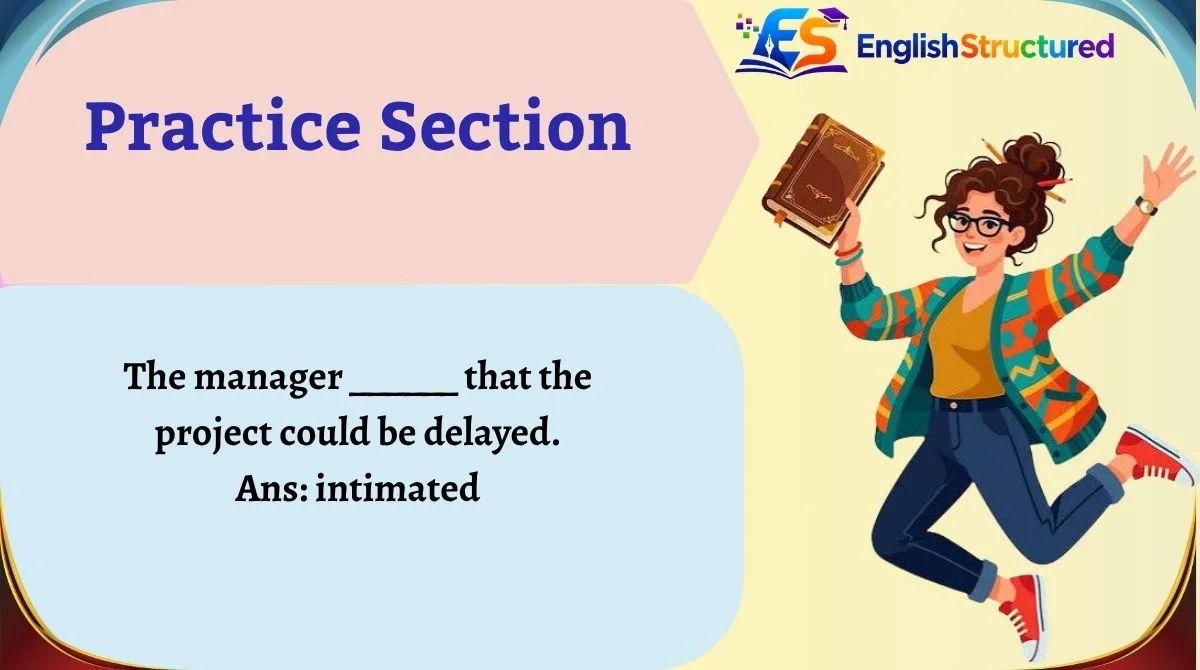
Choose imitated or intimated in each sentence.
1. The child ______ his mother’s accent.
2. The manager ______ that the project could be delayed.
3. The comedian ______ a famous actor.
4. She ______ that she wanted to go home.
5. The students ______ the teacher’s hand movements.
Answers
1. imitated
The child copied his mother’s accent.
2. intimated
The manager indirectly suggested that the project could be delayed.
3. imitated
The comedian copied the actor.
4. intimated
She hinted that she wanted to go home.
5. imitated
The students copied the teacher’s movements.
Quick test
Try replacing the word with one of these:
copied
hinted
Imitated vs Intimated
If hinted works, choose intimated.
For example:
He ______ his brother.
“He copied his brother” makes sense.
So:
He imitated his brother.
Now:
He ______ that he was angry.
“He hinted that he was angry” makes sense.
So:
He intimated that he was angry.
FAQs
What is the difference between imitated and intimated?
Imitated means copied or mimicked someone or something. Intimated means hinted at or indirectly suggested something.
For example, “She imitated her teacher” means she copied the teacher. “She intimated that she was tired” means she indirectly suggested that she was tired.
Is “imitated” the past tense of “imitate”?
Yes. Imitated is the simple past tense and past participle of imitate.
For example:
He imitated his brother yesterday.
The verb means to copy or mimic someone or something.
Is “intimated” the past tense of “intimate”?
Yes. Intimated is the past tense and past participle of the verb intimate when it means to suggest or hint.
For example:
Imitated vs Intimated
Here, she indirectly suggested that she knew it.
Is “intimated” a formal word?
Yes, intimated is generally more formal than everyday words such as hinted or suggested.
You may see it more often in formal writing, reports, news writing, and serious discussions. In casual conversation, “hinted” is usually more natural.
Can “imitated” be used for sounds?
Yes. Imitated can describe copying sounds, voices, accents, or noises.
For example:
The child imitated the sound of a bird.
You can also imitate someone’s laugh, accent, pronunciation, or voice.
Can “intimated” be used in a question?
Yes. There is nothing grammatically wrong with using intimated in a question.
For example:
Did she intimate that she wanted to leave?
This asks whether she indirectly suggested that she wanted to leave.
However, in casual conversation, hint or suggest may sound more natural.
Is “intimated” the same as “implied”?
They can have similar meanings when intimated means indirectly suggested.
For example:
He intimated that he was unhappy.
This means he gave an indirect suggestion that he was unhappy.
Implied can also mean that an idea was communicated without being directly stated. The exact choice depends on the sentence and context.
Conclusion
Imitated vs Intimated
Imitated means copied or mimicked. You can imitate a person’s voice, movements, behavior, style, or sounds.
Intimated means hinted, suggested, or communicated something indirectly.
It is often used when someone does not clearly state an idea but gives you enough information to understand it.
The easiest way to remember the difference is:
Imitated = copied
Intimated = hinted
If a child copies the way a parent walks, the child imitated the parent.
If a manager suggests that changes may be coming without clearly announcing them, the manager intimated that changes were coming.
One final tip: when you see these words, focus on the meaning rather than the spelling.
Ask yourself whether the sentence is about copying or indirect communication. With a little practice, the difference will become natural.