English has many words that look closely related but are used for different people.
Widow vs Widower
Both words describe a person whose spouse has died, but they traditionally refer to different genders.
Because the two words share almost the same meaning, English learners often mix them up.
A widow is traditionally a woman whose husband or spouse has died and who has not remarried.
A widower is traditionally a man whose wife or spouse has died and who has not remarried.
Major dictionaries such as Cambridge, Oxford, and Merriam-Webster give definitions along these lines.
The difference is actually quite simple once you connect each word with the person it describes.
For example, if Sarah’s husband dies, Sarah may be called a widow. If John’s wife dies, John may be called a widower.
These words are common in newspapers, family conversations, biographies, official documents, and everyday English.
You may also see related words such as widowed, widowhood, and surviving spouse.
The good news is that there is no difficult grammar rule behind the basic difference. The main thing to remember is who the word describes.
This guide will also show you how to use both words naturally in sentences, how to avoid common mistakes, and how to choose the right word when speaking or writing.
What Does “Widow” Mean?
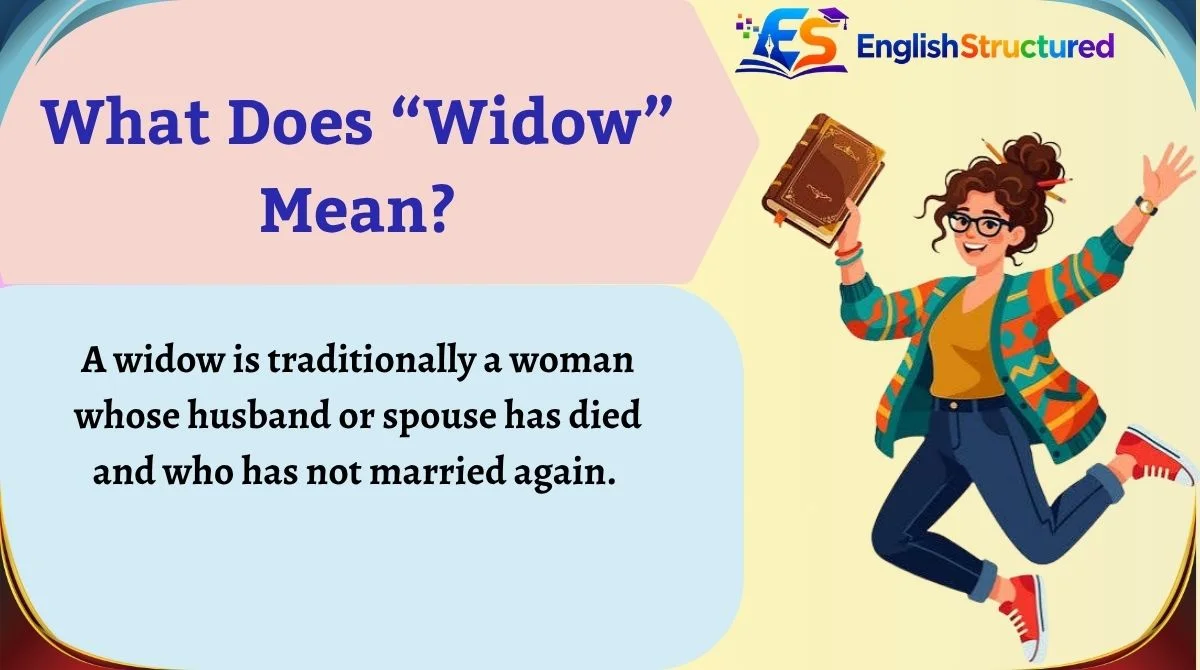
A widow is traditionally a woman whose husband or spouse has died and who has not married again. Cambridge and Oxford both define widow in this general sense.
In simple English:
Widow = a woman whose spouse has died.
For example:
- Widow vs Widower
- The widow lives with her two children.
- She became a widow at a young age.
- The family visited the widow after the funeral.
- Widow vs Widower
- The widow received support from her family.
- She has been a widow for many years.
- The elderly widow lives alone.
The word widow is a noun. It names a person.
When Do We Use “Widow”?
Use widow when you are talking about a woman whose husband or spouse has died.
Consider this sentence:
Widow vs Widower
Here, widow tells us about Linda’s marital situation after the death of her spouse.
You can also use the word after another noun or adjective:
She is a young widow.
The elderly widow lives nearby.
We met a grieving widow at the memorial service.
The word can also be used with possessives:
She is my aunt’s widow.
More naturally, depending on the context, you might say:
Widow vs Widower
This means she was married to your uncle, who has died.
“Widow” as a Verb
Many learners do not realize that widow can also be a verb.
As a verb, to widow someone means to cause someone to become a widow or widower. Merriam-Webster lists this verb use as well.
For example:
The accident widowed her at a young age.
Widow vs Widower
A more common modern construction is be widowed:
She was widowed when she was 40.
This means her spouse died when she was 40.
The related adjective widowed can describe either a man or a woman. Cambridge defines widowed as describing someone whose husband or wife has died.
For example:
She is a widowed mother of three.
Widow vs Widower
Notice something important here: widowed is not limited to women.
Common Confusion About “Widow”
One common mistake is thinking that widow can only mean a woman whose husband has died.
Traditional dictionary definitions often use “woman whose husband has died,” but some current dictionaries also recognize broader wording involving a spouse or partner.
For learners, the easiest rule is:
Widow = traditionally a woman whose spouse has died.
If you want to avoid gender-specific language, surviving spouse or widowed person may be useful in some formal situations.
What Does “Widower” Mean?
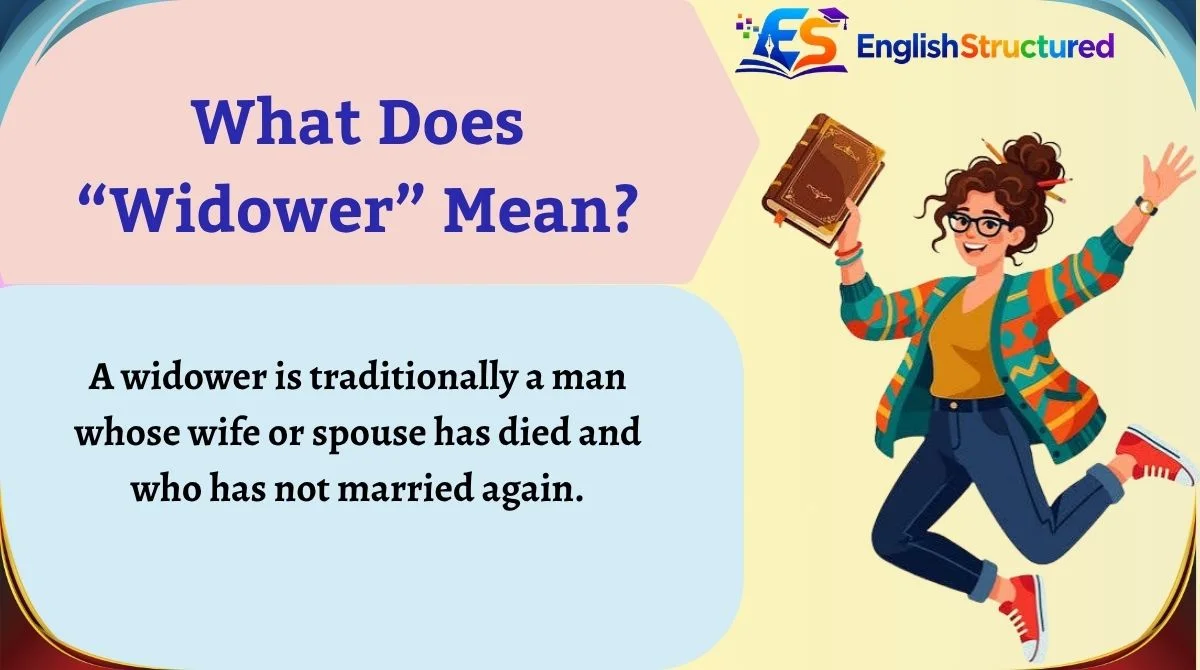
A widower is traditionally a man whose wife or spouse has died and who has not married again. Merriam-Webster, Cambridge, and Oxford all give definitions based on this meaning.
In simple English:
Widow vs Widower
Here are some examples:
- David is a widower.
- Her father became a widower last year.
- The widower lives with his daughter.
- Widow vs Widower
- The elderly widower visits his wife’s grave.
- We met a widower at the community center.
- The widower raised his children alone.
- Widow vs Widower
Again, widower is a noun. It names a man who has lost his spouse through death.
When Do We Use “Widower”?
Use widower when talking about a man whose wife or spouse has died.
For example:
Mr. Brown is a widower.
This tells us that Mr. Brown’s spouse has died.
You can also describe him with an adjective:
Widow vs Widower
The young widower moved closer to his children.
Or you can use the word after another noun:
The widower’s daughter visited him.
Widow vs Widower
Widower and Remarriage
Many dictionary definitions include the idea that the person has not married again.
This gives us an important point about traditional usage.
Suppose a man’s wife dies. He can be described as a widower. If he later marries another person, the situation changes. In ordinary modern English, people generally would not continue to describe him as a widower in the same straightforward way after remarriage.
For example:
Widow vs Widower
This is natural.
If James later marries again, you would normally say:
James remarried.
rather than focusing on widower as his current marital status.
Common Confusion About “Widower”
Widow vs Widower
Incorrect:
Sarah is a widower.
Traditional English usage:
Sarah is a widow.
Similarly, you should not normally use widow for a man when you mean the gender-specific noun.
Incorrect:
Michael is a widow.
Correct:
Widow vs Widower
The difference is based mainly on the gender traditionally associated with each noun.
Difference Between Widow and Widower
The simplest difference is this:
| Word | Traditional meaning | Person described | Example |
|---|---|---|---|
| Widow | A woman whose spouse has died | Woman | Anna is a widow. |
| Widower | A man whose spouse has died | Man | Peter is a widower. |
| Widowed | Having lost a spouse through death | Man or woman | Peter is widowed. |
| Widowhood | The state of being a widow or widower | General state | She experienced widowhood at a young age. |
| Surviving spouse | The spouse who remains alive | Man or woman | The surviving spouse received the documents. |
The Main Difference
The main difference is gender.
Traditionally:
- Woman → widow
- Man → widower
The meaning of the situation is almost the same. The difference is in the person being described.
Compare:
Widow vs Widower
Robert is a widower.
Both people have lost a spouse through death. The first word is used for a woman, while the second is used for a man.
Grammar Logic
Both widow and widower are countable nouns.
You can say:
Widow vs Widower
two widows
a widower
two widowers
Notice the plural forms:
- widow → widows
- Widow vs Widower
Examples:
Two widows attended the meeting.
Several widowers live in the neighborhood.
You can also use possessive forms:
the widow’s children
Widow vs Widower
the widows’ support group
the widowers’ association
Sentence Structure
There is no special sentence structure for these words. They behave like ordinary nouns.
You can use them after be:
She is a widow.
He is a widower.
You can use them as the subject:
The widow lives nearby.
The widower raised his children.
You can use them as an object:
We visited the widow.
They helped the widower.
You can also use them after prepositions:
She spoke with the widow.
He stayed with the widower.
So, the difficult part is not grammar. The difficult part is simply choosing the correct noun.
Grammar Rules You Must Remember
Rule #1: Use “widow” for a woman
When the person is traditionally a woman whose spouse has died, use widow.
My grandmother is a widow.
The widow lives with her son.
Do not use widower for a woman when following traditional gender-specific usage.
Rule #2: Use “widower” for a man
When the person is traditionally a man whose spouse has died, use widower.
Widow vs Widower
The widower has three children.
The ending -er can help you remember that widower is the male-specific traditional noun.
Rule #3: “Widowed” can describe either a man or a woman
This is an especially useful rule.
She is widowed.
He is widowed.
Both sentences are correct.
The adjective widowed describes a person who has lost a spouse through death. Cambridge and Oxford both recognize this use.
So if you are unsure whether to use widow or widower, widowed can sometimes make your sentence easier.
For example:
Widow vs Widower
She is a widowed mother.
Rule #4: Use “widowhood” for the state or period of life
Widowhood refers to the condition or period of being a widow or widower.
For example:
She entered widowhood at the age of 60.
Widow vs Widower
This word is more formal than simply saying widow or widower.
Common Mistakes Students Make
English learners often make mistakes with these words because they focus on the similar spelling instead of the person being described.
Mistake 1: Using “widower” for a woman
Wrong:
My aunt is a widower.
Correct:
My aunt is a widow.
Why? Traditionally, widow is the noun used for a woman, while widower is used for a man.
Mistake 2: Using “widow” for a man
Wrong:
Widow vs Widower
Correct:
His father is a widower.
A quick way to check is to ask yourself:
Am I talking about a man or a woman?
Mistake 3: Thinking “widowed” is only for women
Wrong idea:
“Widowed” is another word for widow.
Not exactly.
Widowed is an adjective and can describe both men and women.
Correct:
Widow vs Widower
His wife died, so he is widowed.
Mistake 4: Confusing “widow” with “divorcee”
A widow or widower has lost a spouse through death.
A divorcee has ended a marriage through divorce.
Compare:
Maria is a widow because her husband died.
Maria is divorced because her marriage ended legally.
These situations are not the same.
Mistake 5: Assuming the word describes someone’s personality
Widow and widower describe a person’s marital situation. They do not tell you whether the person is sad, lonely, old, or living alone.
For example:
She is a widow, but she has a large family and an active social life.
Being a widow does not automatically mean someone is lonely.
Easy Correction Tip
When you see widow vs widower, ask one simple question:
Who is the person?
If the traditional gender-specific noun is needed:
Widow vs Widower
Man → widower
If you want a gender-neutral description:
Person → widowed / surviving spouse
That small check can prevent most mistakes.
Easy Trick to Remember the Difference
Here is a simple memory trick:
“Widow” = woman
The two words look almost identical, but widower has the extra -er.
You can remember:
Widower → man
Think of -er as the clue for the male-specific form in this pair.
Then the shorter word, widow, is traditionally used for a woman.
Another useful trick is to remember two names:
Sarah is a widow.
Widow vs Widower
If Sarah’s husband dies, Sarah becomes a widow.
If Sam’s wife dies, Sam becomes a widower.
You do not need to memorize a complicated grammar formula. Just connect the word to the person.
There is also a third word worth remembering:
Both can be widowed.
That means:
Sarah is widowed.
Widow vs Widower
This is useful when you want to describe the situation without choosing the gender-specific noun.
Daily Life Examples
The following examples show how these words can appear in natural conversations.
Example 1: Talking about a neighbor
A: Who lives in that house?
B: Mrs. Khan. She is a widow and lives with her daughter.
Here, widow is correct because Mrs. Khan is a woman.
Example 2: Talking about a father
A: Is Mr. Ali married?
B: He was married, but his wife passed away. He is now a widower.
Here, widower describes a man whose wife has died.
Example 3: Talking about a family
My grandmother became a widow when she was very young.
The word describes your grandmother’s marital situation after her husband’s death.
Example 4: Talking about a friend
My friend became a widower last year.
Because the friend is a man, widower is the traditional noun.
Example 5: Using “widowed”
She is a widowed mother with two children.
Here, widowed works as an adjective.
Example 6: Using “widowed” for a man
He is a widowed father who takes care of his three daughters.
The same adjective works for a man.
Example 7: Asking a sensitive question
Instead of asking:
Are you a widow?
you may choose a more sensitive sentence depending on the situation:
Has your spouse passed away?
or:
Are you currently married?
The best wording depends on the relationship and context. Topics involving death and loss can be sensitive, so gentle language is often better.
Example 8: Talking about history
The war left many women widows.
Here, widows is the plural form of widow.
Example 9: Talking about several men
The organization provides support for widowers.
The plural widowers refers to men who have lost their spouses.
Example 10: Using “surviving spouse”
The form must be signed by the surviving spouse.
This expression does not require you to specify whether the person is a man or woman.
Practice Section
Choose widow, widower, or widowed to complete each sentence.
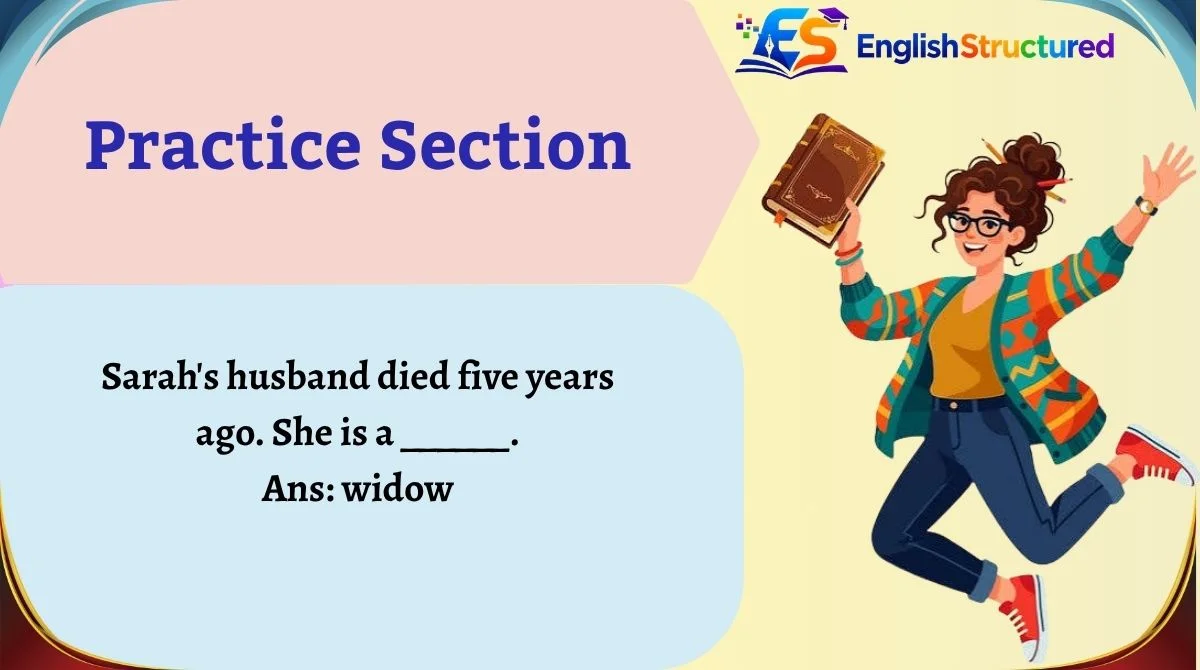
1. Sarah’s husband died five years ago. She is a ______.
2. David’s wife passed away last year. He is a ______.
3. After losing his wife, Mr. Brown was ______.
4. My grandmother has been a ______ for many years.
5. He is a ______ father who raised his children alone.
Answers
1. widow
Sarah is a woman, so the traditional noun is widow.
2. widower
David is a man, so the traditional noun is widower.
3. widowed
Widowed is an adjective and can describe a man or woman.
4. widow
The sentence refers to a woman, so widow is correct.
5. widowed
The adjective widowed works naturally before father.
FAQs
What is the difference between widow and widower?
The traditional difference is based on gender. Widow refers to a woman whose spouse has died, while widower refers to a man whose spouse has died. Both words describe someone who has lost a spouse through death.
Can a man be called a widow?
In traditional gender-specific English, a man is called a widower, not a widow. For example, “John is a widower” is the standard expression. If you want a broader description, you can say “John is widowed.”
Can a woman be called a widower?
Traditionally, no. A woman is called a widow, while a man is called a widower. For example, “Mary is a widow” is the traditional form.
Is “widowed” used for both men and women?
Yes. Widowed is an adjective that can describe either a man or a woman whose spouse has died. You can say “a widowed mother” and “a widowed father.”
What is the plural of widow?
The plural of widow is widows.
For example:
The charity helps widows and their children.
Widow vs Widower
For example:
The group provides support for widowers.
Is widow or widower more formal?
Both are standard English nouns. Neither is simply the “formal” version of the other. The choice depends on the person being described. In some official or inclusive contexts, terms such as surviving spouse may be preferred because they do not require a gender-specific noun.
Conclusion
The difference between widow and widower is much easier than it may first seem. The main point to remember is the person each word traditionally describes.
A widow is a woman whose spouse has died. A widower is a man whose spouse has died. The related adjective widowed can describe either a man or a woman.
So, remember this simple pattern:
Widow vs Widower
Man → widower
Man or woman → widowed
These words are useful in everyday English, family conversations, news reports, biographies, and formal writing.
They can also appear with words such as widowhood, surviving spouse, and bereaved.
The best way to learn the difference is to use the words in simple sentences.
Try making a few examples about imaginary people, and the distinction will quickly become natural.
When you see these two words again, don’t focus on their similar spelling. Simply ask, “Who am I talking about?” That one question will usually lead you to the right word.