On My Resume or In My Resume
You are not alone. Many English learners find this small preposition confusing because both on and in can talk about something connected to a resume.
For example, you may want to say:
- “I have five years of experience on my resume.”
- “I have five years of experience in my resume.”
Which one sounds right?
In most everyday situations, “on my resume” is the natural and correct choice when you are talking about information that appears on your resume.
We normally think of a resume as a document where information is listed or displayed, so we use on.
However, “in my resume” is not always impossible.
It can sometimes be used when you are talking about the contents of the document, especially in certain formal or contextual situations.
The important thing is knowing when each preposition makes sense.
This difference matters because resumes are used in job applications, interviews, emails, cover letters, and professional conversations.
Using the natural preposition can make your English sound clearer and more confident.
By the end, you will know exactly when to use on my resume, when in my resume may work, and which expression is best for professional English.
What Does “On My Resume” Mean?
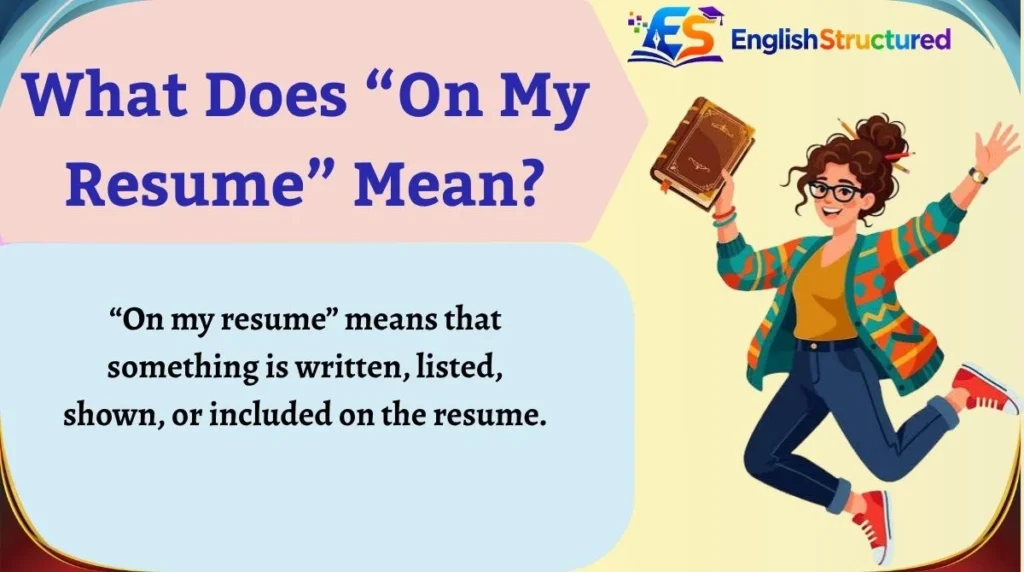
“On my resume” means that something is written, listed, shown, or included on the resume.
This is the most common expression when talking about information that appears on a resume.
Think about your resume as a page. Your name is written on the page. Your education is listed on the page. Your work experience is shown on the page.
That is why we naturally say:
On My Resume or In My Resume
Here, on tells us that the information appears as part of the visible content of the resume.
When Should You Use “On My Resume”?
On My Resume or In My Resume
- listed on the resume
- On My Resume or In My Resume
- shown on the resume
- included as a resume entry
- presented as part of your qualifications
For example:
- I have five years of experience on my resume.
- You can see my education history on my resume.
- I listed my computer skills on my resume.
- There are several certifications on my resume.
- I included my internship experience on my resume.
- My latest job is on my resume.
- I have added my new qualification to my resume.
- On My Resume or In My Resume
Notice how all these sentences describe information that appears on the document.
Why Do We Use “On”?
English commonly uses on for information displayed on a surface or document.
We say:
- on a page
- on a website
- on a form
- on a list
- on a document
- on a resume
- on a schedule
- on a menu
For example:
“Your name is on the list.”
“The information is on the form.”
On My Resume or In My Resume
A resume works in a similar way. Information is placed on its pages.
A Common Learner Confusion
Some learners choose in my resume because they think of a resume as a container.
That idea is understandable. A resume contains information, so it may feel logical to say that something is in it.
However, natural English often focuses on the information being displayed on the document, so on my resume is usually preferred.
Compare:
On My Resume or In My Resume
“My work experience is in my resume.” ⚠️ Possible in some contexts, but less natural for ordinary professional speech.
If you are simply telling someone that information appears on your resume, on is the safer choice.
What Does “In My Resume” Mean?
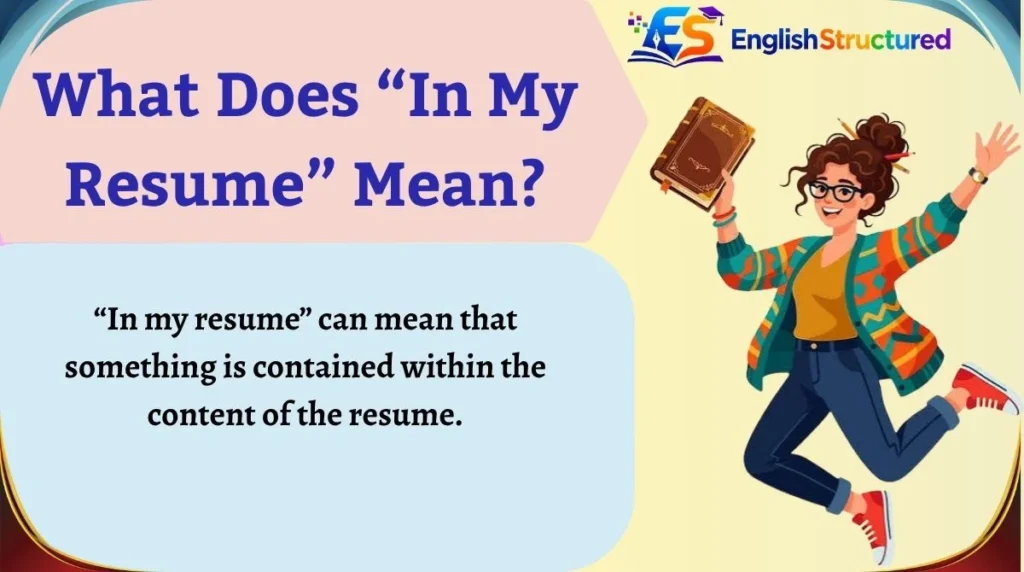
“In my resume” can mean that something is contained within the content of the resume.
The expression is not completely impossible. However, it is generally less natural than “on my resume” when you simply mean that something is listed or displayed there.
The preposition in often gives the idea of something being inside a space, container, text, or body of content.
For example:
- in the book
- in the report
- in the article
- in the email
- in the paragraph
- in the document
So, because a resume contains written content, speakers may sometimes use in my resume, especially when focusing on the wording or content of the document.
When Can “In My Resume” Be Used?
You may hear or see in my resume when the speaker is focusing on the content, wording, or text of the resume rather than simply pointing to information displayed there.
For example:
On My Resume or In My Resume
This can make sense because the speaker is talking about what they said or explained within the written content.
Another example is:
“There is a small error in my resume.”
Here, the speaker is focusing on an error contained within the text.
Still, in many everyday situations, a native speaker would often prefer a different structure, such as:
On My Resume or In My Resume
That sounds very natural when referring to something appearing on the document.
Examples With “In My Resume”
Here are some examples where in can be understandable:
- On My Resume or In My Resume
- I mentioned my volunteer work in my resume.
- There is a spelling mistake in my resume.
- I described my responsibilities in my resume.
- I discussed my previous projects in my resume.
- I explained the gap in my employment history in my resume.
- I used a different format in my resume.
- On My Resume or In My Resume
Some of these sentences sound more natural if rewritten with on, depending on exactly what the speaker means.
For instance:
“I mentioned my volunteer work on my resume.”
This is usually the better choice if you simply mean that volunteer work is listed there.
The Important Point
Do not think that “in my resume” is always grammatically wrong.
The real issue is natural usage and meaning.
If you are talking about information that appears as an item on the document, use on my resume.
On My Resume or In My Resume
Difference Between “On My Resume” and “In My Resume”
The easiest way to understand the difference is to think about surface versus content.
| Expression | Main idea | Commonness | Example |
|---|---|---|---|
| on my resume | Information is listed or displayed there | Very common | My skills are on my resume. |
| in my resume | Something exists within the written content | Less common | I explained this in my resume. |
1. “On My Resume” Is the Standard Choice
When talking about qualifications, skills, jobs, education, awards, or certifications, on my resume is usually the natural expression.
Examples:
On My Resume or In My Resume
“My previous job is on my resume.”
“My programming skills are on my resume.”
On My Resume or In My Resume
These sentences sound natural because the information is presented on the resume.
2. “In My Resume” Focuses More on Content
In my resume can focus on what you wrote or explained within the document.
For example:
“I explained my career change in my resume.”
The focus here is not simply the location of a career-change entry. The focus is on the explanation or written content.
3. Resume vs. Container Thinking
Imagine a resume as a sheet of paper.
If you point to something written on that sheet, you can think:
On My Resume or In My Resume
If you are discussing the actual words and ideas contained in the writing, you might think:
“It is in the resume.”
This is not an absolute rule for every sentence, but it is a useful guide for learners.
4. Which One Should Job Seekers Prefer?
For most job-related conversations, on my resume is the best choice.
If you are unsure, use on my resume.
For example:
On My Resume or In My Resume
That sounds natural and professional.
Grammar Rules You Must Remember
Rule #1: Use “On” for Information Listed on a Resume
When something appears as a qualification, entry, or detail on your resume, use on.
Example:
On My Resume or In My Resume
Other examples include:
“My certifications are on my resume.”
On My Resume or In My Resume
On My Resume or In My Resume
This is the most useful rule for everyday English.
Rule #2: Use “On” When You Mean “Displayed on the Document”
If you can replace the phrase with “listed on the document,” then on is usually a good choice.
For example:
“I listed my customer service experience on my resume.”
The information is displayed as part of the resume.
Similarly:
On My Resume or In My Resume
The details are written there.
Rule #3: “In” Can Focus on Written Content
Use in when you are emphasizing something that was said, explained, described, or written within the content.
Example:
“I explained my career goals in my resume.”
The focus is on the explanation itself.
Another example:
On My Resume or In My Resume
Here, in highlights the written explanation.
Rule #4: When in Doubt, Choose “On My Resume”
For English learners, this simple rule will help in most situations:
On My Resume or In My Resume
For example:
❌ “I have five years of experience in my resume.”
On My Resume or In My Resume
❌ “My skills are in my resume.”
✅ “My skills are on my resume.”
This does not mean in can never be used. It simply means on is the natural default for most resume information.
Common Mistakes Students Make
Many mistakes with this expression happen because learners translate directly from their first language.
A learner may think:
“A resume contains information, so the information must be in the resume.”
That logic is understandable, but English does not always choose prepositions based on the same idea.
Mistake 1: “My experience is in my resume.”
Less natural:
On My Resume or In My Resume
Better:
“My work experience is on my resume.”
If you are simply telling someone where the experience is listed, on is the natural choice.
Mistake 2: “I put my skills in my resume.”
This sentence can be understood, but professional English usually sounds better with:
“I put my skills on my resume.”
Or:
On My Resume or In My Resume
The second version is especially clear.
Mistake 3: “It is written in my resume.”
Learners often use this because in seems connected to writing.
A more natural sentence is:
“It is written on my resume.”
However, you could say:
On My Resume or In My Resume
The difference is subtle.
Written on the resume focuses on the document.
Wrote about it in the resume focuses more on the writing or content.
Mistake 4: Using “At My Resume”
Do not normally say:
❌ “My experience is at my resume.”
The preposition at is not used this way.
Say:
On My Resume or In My Resume
Mistake 5: Saying “Inside My Resume”
“Inside my resume” is understandable, but it is usually unnecessary.
Instead of:
“There is a mistake inside my resume.”
Say:
“There is a mistake on my resume.”
This is much more natural.
Easy Trick to Remember the Difference
Here is a simple trick:
ON = You can point to it.
On My Resume or In My Resume
You can point to your:
- name
- education
- work history
- skills
- certificates
- awards
On My Resume or In My Resume
Think:
“I can see it on the page.”
So:
My skills are on my resume.
My education is on my resume.
On My Resume or In My Resume
IN = Think about the words or ideas.
Now imagine reading the resume.
You are thinking about what the writer explained, described, or discussed.
That can lead to in.
For example:
On My Resume or In My Resume
The focus is on the explanation contained in the writing.
Still, if you are not sure, on my resume will usually be the safer choice.
Daily Life Examples
These examples show how native and fluent speakers commonly use the expression in job-related situations.
Example 1: Talking to a Friend
Friend: “Do you have any marketing experience?”
You: “Yes. I have three years of marketing experience on my resume.”
Example 2: Talking to a Recruiter
Recruiter: “Do you have experience with Excel?”
On My Resume or In My Resume
This sounds professional and clear.
Example 3: Checking a Resume
You: “Can you check my resume?”
Friend: “Sure. I noticed one spelling mistake on your resume.”
Example 4: Adding a New Skill
You: “I recently completed a coding course.”
Friend: “Great! You should put it on your resume.”
Example 5: Discussing Work Experience
Interviewer: “Where did you work before?”
You: “My previous company is listed on my resume.”
Example 6: Talking About Education
Recruiter: “What did you study?”
You: “My degree and university are both on my resume.”
Example 7: Asking Someone to Review a Resume
You: “Could you look at the skills section on my resume?”
Friend: “Sure. I think you should add your communication skills.”
Example 8: Talking About an Error
You: “I need to fix something on my resume.”
Friend: “What happened?”
You: “I wrote the wrong graduation year.”
Example 9: Talking About a Career Explanation
Interviewer: “Why did you change careers?”
You: “I explained my career change in my resume, but I can explain it again.”
Here, in works because the speaker is referring to the explanation written in the resume.
Example 10: Talking About a Missing Qualification
Friend: “Did you add your new certificate?”
You: “Yes, it is on my resume now.”
This is one of the most natural everyday uses.
Practice Section
Choose on or in in each sentence.
1. My education is ___ my resume.
2. I listed my new certification ___ my resume.
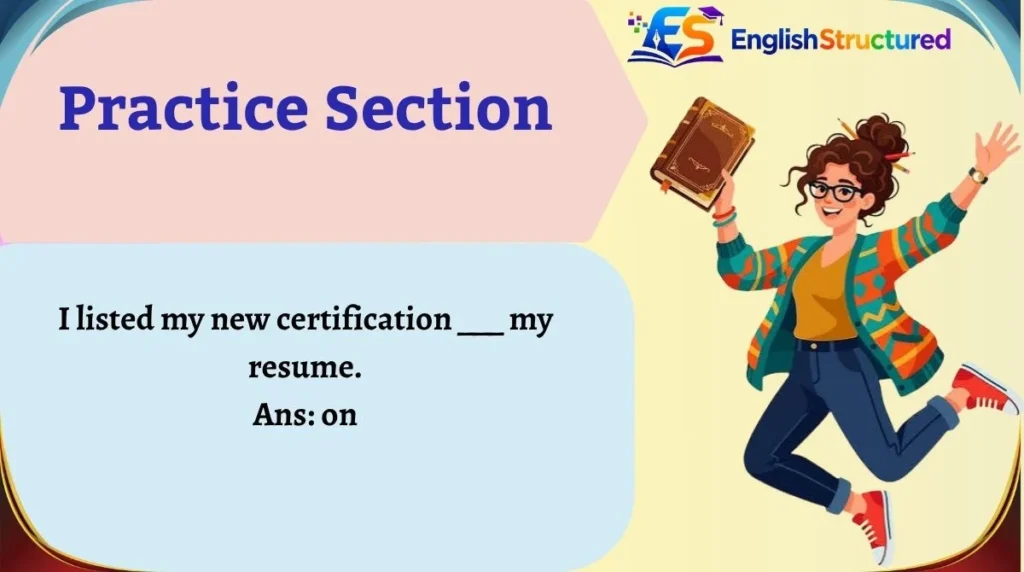
3. I explained my career change ___ my resume.
4. There is a spelling mistake ___ my resume.
5. My previous work experience is ___ my resume.
Answers
1. on
“My education is on my resume.”
2. on
“I listed my new certification on my resume.”
3. in
“I explained my career change in my resume.”
4. on
“There is a spelling mistake on my resume.”
5. on
“My previous work experience is on my resume.”
The key is to notice the meaning. If you are talking about something listed or visible on the document, on is usually the right choice.
FAQs
What is the difference between “on my resume” and “in my resume”?
On my resume usually means that information is listed or displayed on the resume. It is the more common choice for qualifications, skills, education, and work history. In my resume can sometimes refer to information or ideas contained in the written content.
Is “on my resume” grammatically correct?
Yes. “On my resume” is completely correct and very common in English. It is the normal choice when talking about information that appears on a resume. For example, “My work experience is on my resume.”
Is “in my resume” wrong?
Not always. “In my resume” can be used when you are focusing on content, explanations, or ideas written in the resume. However, it is less common when simply saying that a qualification or fact is listed there.
Should I say “experience on my resume” or “experience in my resume”?
On My Resume or In My Resume. For example, “I have five years of experience on my resume.” You can also say, “I listed my experience on my resume,” which sounds especially natural.
Is “on my resume” formal or informal?
“On my resume” is suitable for both normal conversation and professional situations. You can use it when speaking with friends, recruiters, employers, teachers, or colleagues. It is a standard English expression.
Can I use “on” with other documents?
Yes. English often uses on for information displayed on documents, pages, lists, forms, and similar surfaces. For example, “Your name is on the form,” “The date is on the page,” and “My phone number is on my resume.”
Conclusion
On My Resume or In My Resume
You can say:
“My skills are on my resume.”
“My education is on my resume.”
“My work experience is on my resume.”
“I listed my certification on my resume.”
The expression “in my resume” is not always wrong.
It can work when you are focusing on something explained, described, or contained in the written content. For example, “I explained my career change in my resume.”
For everyday job applications and professional conversations, though, remember the easy rule: if the information is listed or visible on the resume, use “on.”
Once you start thinking of your resume as a page where information is displayed, the choice becomes much easier.
A little practice will make this preposition feel natural, especially when you are writing applications or preparing for an interview.