Definite vs Definitive
They also come from the same word family, which makes the confusion even stronger. However, they are not always used in the same way.
The good news is that the difference is actually quite simple once you understand the main idea behind each word.
Definite usually means something is clear, certain, fixed, or specific. For example, if you have a definite plan, you have a clear plan.
If someone gives you a definite answer, there is no doubt about what they mean.
Definitive, on the other hand, usually means something is final, authoritative, or conclusive. A definitive answer settles a question.
A definitive decision is one that is considered final and should not normally be changed.
This small difference matters in everyday English. You may hear phrases such as “a definite answer,” “a definite date,” “definitive proof,” and “the definitive guide.”
Choosing the wrong word can change the meaning of your sentence.
By the end of this guide, you will know exactly when to use definite and when to use definitive.
You will also learn simple grammar rules, common mistakes, real-life examples, and an easy memory trick.
What Does “Definite” Mean?
Definite is an adjective that means clear, certain, known, or specific.
We use it when there is little or no doubt about something. It can also describe something that is clearly identified or limited.
For example:
Definite vs Definitive
Definite vs Definitive. The speaker does not want an uncertain answer such as “maybe” or “I think so.”
Another example is:
Do you have a definite date for the meeting?
The speaker wants to know the exact or confirmed date.
When Do We Use “Definite”?
Definite vs Definitive
- A clear decision
- A certain fact
- A fixed time or date
- A specific person or thing
- Something that is clearly known
- Something that is not vague or uncertain
The word often appears before a noun.
Pattern:
Definite vs Definitive
For example:
- a definite answer
- a definite plan
- a definite date
- Definite vs Definitive
- a definite choice
- a definite improvement
Examples of “Definite”
- Definite vs Definitive
- We have a definite plan for the weekend.
- There has been a definite change in his attitude.
- She gave me a definite time for the appointment.
- Is there a definite reason for the delay?
- I have no definite plans for tonight.
- Definite vs Definitive
- The teacher gave us a definite deadline.
Notice that definite does not necessarily mean “final forever.” It mainly tells us that something is clear, certain, or specific.
For example:
Definite vs Definitive
This means the plan is clear and decided now. It does not necessarily mean the plan can never change.
“Definite” Can Also Mean “Specific”
Definite vs Definitive
Compare:
I want some information.
This is general.
Definite vs Definitive
This means the speaker wants clear and specific information.
Another example:
Definite vs Definitive
This means her goal is clear. She knows what she wants to achieve.
A Common Confusion About “Definite”
Many learners think definite means exactly the same as final.
That is not always true.
Consider:
We have a definite meeting time.
This means the meeting time is confirmed or clear.
But:
We have a definitive meeting decision.
This sounds different and is less natural in everyday speech.
The key idea is that definite focuses on certainty or clarity, while definitive often focuses on final authority or conclusion.
What Does “Definitive” Mean?
Definitive is also an adjective, but its meaning is slightly different.
It usually means final, conclusive, authoritative, or providing the most complete answer to something.
Definite vs Definitive
For example:
The test provided definitive proof of the problem.
This means the proof was strong enough to settle the question.
Another example:
Definite vs Definitive
This suggests that the decision is final and authoritative.
When Do We Use “Definitive”?
Definite vs Definitive
- Final answers
- Conclusive evidence
- Official decisions
- Authoritative explanations
- Complete or highly reliable works
- Results that settle a question
Common combinations include:
- definitive answer
- definitive proof
- definitive evidence
- definitive decision
- definitive statement
- Definite vs Definitive
- definitive explanation
- definitive version
Examples of “Definitive”
- Definite vs Definitive
- We still do not have a definitive answer.
- The report provides a definitive explanation of what happened.
- The judge made a definitive decision.
- This book is considered a definitive guide to the subject.
- Doctors have not yet reached a definitive conclusion.
- The new test gave us definitive results.
- Definite vs Definitive
Here, the word suggests more than simple certainty. It suggests that something settles, confirms, or establishes an issue.
“Definitive” Can Mean “Authoritative”
Another important meaning of definitive is the most authoritative or complete example of something.
For example:
Definite vs Definitive
This does not simply mean that the biography is clear. It suggests that the book is regarded as the most complete, important, or authoritative biography.
Similarly:
Definite vs Definitive
This suggests that her guide is considered an especially complete and authoritative resource.
So, definitive can describe something that people trust as the final or strongest authority on a subject.
Difference Between Definite and Definitive
The easiest way to understand the difference is to focus on the main idea behind each word.
Definite vs Definitive
Definitive = final, conclusive, or authoritative.
They can sometimes appear with the same noun, especially words such as answer, but the meaning can change slightly.
Comparison Table
| Definite | Definitive |
|---|---|
| Means clear or certain | Means final or conclusive |
| Can mean specific | Can mean authoritative |
| Focuses on certainty | Focuses on settling an issue |
| Common in everyday speech | Often more formal |
| Can describe a fixed plan or date | Often describes evidence, decisions, answers, or guides |
| Does not always mean final | Often suggests finality |
Compare These Two Sentences
Definite vs Definitive
This means:
“I need a clear and certain answer.”
The speaker may simply want to know what the answer is.
Now look at:
Definite vs Definitive
This means:
“I need an answer that settles the question.”
The second sentence has a stronger sense of finality and authority.
Another Example
Definite vs Definitive
This means the date is confirmed.
We finally received a definitive decision from the committee.
This means the committee has made a final decision that settles the matter.
Grammar Logic
Both words are adjectives.
They usually come before a noun:
- Definite vs Definitive
- a definite plan
- a definitive answer
- a definitive decision
They can also come after linking verbs such as be, seem, look, and become.
Examples:
Definite vs Definitive
Definite vs Definitive
The important difference is not grammar. Both words can perform the same grammatical job. Their meanings are different.
Grammar Rules You Must Remember
Rule #1: Use “Definite” for Something Clear or Certain
Definite vs Definitive
We need a definite date for the event.
The date is clear and confirmed.
Another example:
Definite vs Definitive
The answer is clear rather than uncertain.
Rule #2: Use “Definitive” for Something Final or Conclusive
Definite vs Definitive
The investigation found definitive evidence.
The evidence is strong enough to establish what happened.
Another example:
There is no definitive proof yet.
This means there is not enough final or conclusive proof to settle the matter.
Rule #3: “Definite” Does Not Always Mean “Final”
This is one of the most useful rules to remember.
Something can be definite now but still change later.
We have a definite plan for tomorrow.
The plan is clear at the moment. However, circumstances could still cause a change.
Definitive usually has a stronger connection with finality.
The committee gave a definitive answer.
This suggests the matter has been settled.
Rule #4: “Definitive” Is Often More Formal
Definite is very common in everyday conversation.
Are you definite about your plans?
We need a definite time.
Definitive is also common, but it often appears in formal, academic, professional, or serious contexts.
The study did not provide definitive evidence.
The report offers a definitive explanation.
This does not mean definitive is always formal. It is simply more common when discussing conclusions, evidence, authority, and final decisions.
Common Mistakes Students Make
The main reason learners confuse these words is simple: they look and sound very similar.
Both come from the same word family, and both can describe answers, decisions, or information.
But similar spelling does not mean identical meaning.
Mistake 1: Treating Them as Exact Synonyms
A learner may think:
definite = definitive
That is not completely correct.
They overlap in some situations, but their focus is different.
Definite focuses on certainty or clarity.
Definitive focuses on finality, authority, or a conclusion.
Mistake 2: Using “Definitive” for Every Certain Thing
Incorrect:
I have a definitive appointment at 3 p.m.
This is understandable, but definite is much more natural if you simply mean the appointment is confirmed.
Better:
I have a definite appointment at 3 p.m.
Use definitive when the idea of a final or authoritative conclusion matters.
Mistake 3: Thinking “Definite” Always Means “Final”
Incorrect understanding:
The plan is definite, so it can never change.
Not necessarily.
A definite plan is simply a clear or settled plan at that time.
For example:
We have a definite plan, but we may change it if the weather gets worse.
This sentence is perfectly natural.
Mistake 4: Using “Definite” When “Definitive” Is Stronger
Consider:
The study provided a definite answer.
This can mean the answer was clear.
But:
The study provided a definitive answer.
This suggests the study settled the question.
When discussing scientific evidence, research findings, legal decisions, or conclusions, definitive may be the better choice when you want to show that the matter has been settled.
Easy Correction Tip
Ask yourself:
“Do I mean clear and certain?”
If yes, choose definite.
Ask:
“Do I mean final, conclusive, or authoritative?”
If yes, choose definitive.
Easy Trick to Remember the Difference
Here is a simple memory trick:
Definite = “Definitely clear”
Think about the word definitely.
If something is definite, it is clear or certain.
We have a definite plan.
Think: The plan is clear.
Definitive = “Decision is finished”
Think of definitive as being connected with a final decision.
The judge made a definitive decision.
Think: The decision settles the matter.
So remember:
DEFINITE → CLEAR
DEFINITIVE → FINAL
This is not a perfect rule for every possible sentence, but it is an excellent shortcut for everyday English.
A Real-Life Example
Imagine your friend asks:
“Are you coming to the party?”
You say:
“Yes. I have a definite plan to go.”
Your plan is clear.
Now imagine someone asks:
“Has the committee decided who won?”
You might say:
“Yes. They made a definitive decision.”
The decision is final and settles the question.
That small difference can help you choose the right word quickly.
Daily Life Examples
Here are some natural examples you may hear in everyday English.
1. Making Plans
A: Are you free this weekend?
B: I don’t have any definite plans yet.
Here, definite means fixed or confirmed.
2. Asking for an Answer
A: Are you going to accept the job?
B: I can’t give you a definite answer yet.
The speaker cannot give a clear or certain answer yet.
3. Confirming a Date
A: When is the meeting?
B: We don’t have a definite date yet.
The date has not been confirmed.
4. Talking About Evidence
A: Do we know what caused the problem?
B: No, we don’t have any definitive evidence.
The available evidence does not settle the question.
5. Talking About a Decision
A: Has the company made a decision?
B: Yes, they made a definitive decision yesterday.
The company has settled the matter.
6. Giving Clear Information
Please give me a definite time so I know when to arrive.
The speaker wants a clear, confirmed time.
7. Discussing Research
The researchers have not found a definitive answer yet.
The researchers have not reached a conclusion that completely settles the question.
8. Talking About a Guide
This is one of the most useful guides, but I wouldn’t call it the definitive guide.
Definite vs Definitive
9. Talking About a Choice
I haven’t made a definite choice yet.
The person has not made a clear decision.
10. Talking About a Final Result
The final test gave us a definitive result.
The result provided a conclusive answer.
Practice Section
Definite vs Definitive
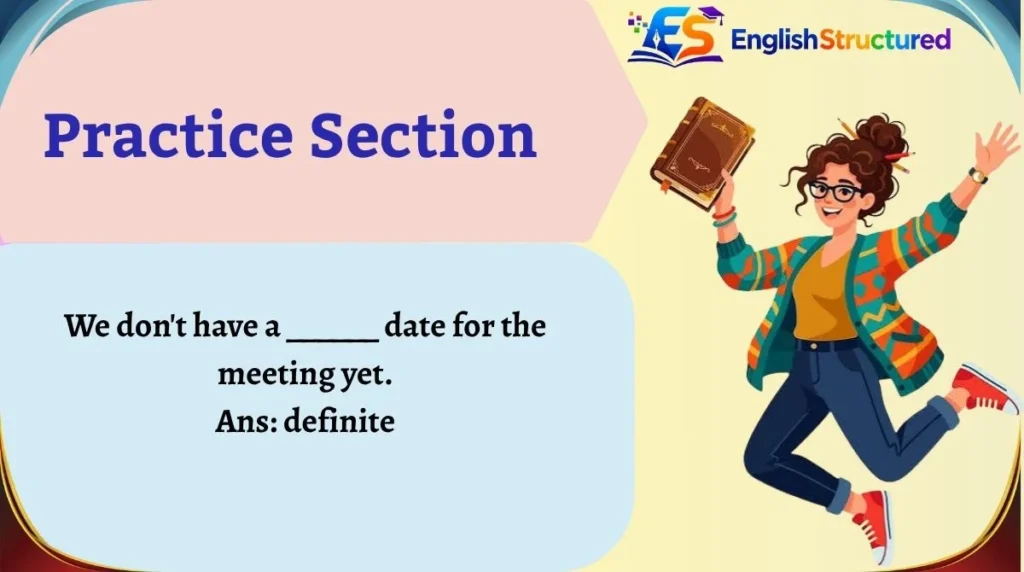
1. We don’t have a ______ date for the meeting yet.
2. The investigation found ______ evidence that the machine was damaged.
3. Please give me a ______ answer before I make the reservation.
4. The committee made a ______ decision about the issue.
5. I don’t have any ______ plans for tonight.
Answers
1. definite
Definite vs Definitive
The date needs to be clear or confirmed.
2. definitive
The investigation found definitive evidence that the machine was damaged.
The evidence is conclusive.
3. definite
Please give me a definite answer before I make the reservation.
The speaker wants a clear and certain answer.
4. definitive
The committee made a definitive decision about the issue.
The decision is final or authoritative.
5. definite
I don’t have any definite plans for tonight.
The speaker has no fixed or confirmed plans.
FAQs
What is the difference between definite and definitive?
Definite means clear, certain, or specific. Definitive usually means final, conclusive, or authoritative.
For example, a definite date is a confirmed date. Definitive evidence is evidence that settles a question.
Can “definite” and “definitive” be used with “answer”?
Yes, both can be used with answer, but there is a small difference in meaning.
A definite answer is clear and certain. A definitive answer is final or conclusive and settles the question.
Is “definitive” more formal than “definite”?
Usually, yes.
Definite is very common in everyday English. Definitive is often used in academic, professional, scientific, legal, and formal contexts, especially when discussing conclusions or evidence.
Does definitive mean final?
Often, yes.
Definitive can mean final, conclusive, or authoritative. If something is described as definitive, it usually carries the idea that it settles an issue or represents the final accepted position.
Does definite mean certain?
Definite vs Definitive
For example:
She gave me a definite answer.
This means her answer was clear and not uncertain.
Which is correct: “definite proof” or “definitive proof”?
Both can be grammatically possible, but they do not carry exactly the same emphasis.
Definite proof emphasizes that the proof is clear or certain. Definitive proof emphasizes that the proof is conclusive and settles the issue.
In many formal contexts, definitive proof is the stronger choice when you mean conclusive evidence.
Conclusion
Definite vs Definitive
Definite means clear, certain, fixed, or specific. You can use it for plans, dates, answers, choices, and information.
Definitive means final, conclusive, or authoritative. It is especially useful when something settles a question, confirms an issue, or represents the strongest accepted conclusion.
Remember this simple shortcut:
Definite = clear.
Definitive = final.
For example, you can have a definite date because the date is confirmed. You can have definitive evidence because the evidence settles the matter.
Do not worry if the two words still feel similar. That is normal. The best way to learn them is to notice how native speakers use them in real sentences.
After seeing enough examples, the difference will start to feel natural.