Seen vs Saw
You may hear someone say, “I saw him yesterday,” and then hear, “I have seen him before.” Why does one sentence use saw while the other uses seen?
The answer is simple once you understand how English verb forms work.
Saw is the simple past form of see. We use it when something happened at a finished time in the past. For example, “I saw Sarah yesterday.”
Seen is the past participle of see. It usually needs a helping verb such as have, has, or had. For example, “I have seen Sarah before.”
This small grammar difference matters a lot. Using the wrong form can make a sentence sound incorrect, even when the meaning is easy to understand.
The good news is that you do not need to memorize complicated grammar rules.
Once you know which helping verbs go with seen and when to use saw, the difference becomes much easier.
By the end of this guide, you will know exactly when to use saw, when to use seen, how they work in questions and negative sentences, and how to avoid the mistakes that English learners commonly make.
What Does “Saw” Mean?
Saw is the simple past form of the verb see.
The verb see means to notice something with your eyes or to look at and recognize someone or something. When you talk about seeing something that happened in the past, you can use saw.
For example:
Seen vs Saw
The action happened in the past, and the time is finished. That is why saw is correct.
When Do We Use “Saw”?
Seen vs Saw
It often appears with past-time expressions such as:
- yesterday
- last night
- last week
- two days ago
- this morning, when the morning has finished
- in 2024
- when I was a child
- an hour ago
The basic structure is:
Subject + saw + object
For example:
I saw a bird.
She saw her teacher.
Seen vs Saw
Unlike seen, saw does not normally need have, has, or had before it.
Examples of “Saw”
- I saw your brother yesterday.
The seeing happened yesterday, so saw is used.
- She saw a beautiful sunset last night.
The action happened at a finished time in the past.
- We saw John at the airport.
This tells us about a completed past event.
- Seen vs Saw
The person noticed the car in the past.
- I saw that movie last weekend.
The movie-watching event is finished.
- They saw each other at school yesterday.
Again, the action happened at a specific past time.
- Seen vs Saw
The word saw shows that the event happened in the past.
- I saw your message this morning.
If the morning is now finished, simple past saw can naturally describe the completed event.
“Saw” in Questions
You can also use saw in questions, but the structure changes when you use did.
The important rule is:
Did + subject + see, not did + subject + saw.
For example:
Did you see Mike yesterday?
Not:
Seen vs Saw
Why? Because did already shows the past tense. The main verb goes back to its base form, see.
This is one of the most common mistakes learners make.
What Does “Seen” Mean?
Seen is the past participle form of the verb see.
Unlike saw, seen normally cannot stand alone as the main past-tense verb.
We usually use seen with a helping verb such as:
- have
- has
- had
- be, in certain passive structures
The most common pattern is:
Subject + have/has/had + seen + object
For example:
Seen vs Saw
She has seen this before.
Seen vs Saw
When Do We Use “Seen”?
Seen is commonly used in perfect tenses.
For example, in the present perfect:
I have seen him before.
In the present perfect, have/has + past participle is used.
Because seen is the past participle of see, it follows have or has.
We can also use it with had in the past perfect:
I had seen the movie before you recommended it.
Here, had seen tells us that one past event happened before another past event.
Examples of “Seen”
- I have seen that movie three times.
The exact time is not important. The experience is important.
- Seen vs Saw
She has previous experience with it.
- Have you seen my keys?
This is a very common everyday question.
- We have seen many changes this year.
The period being discussed is connected to the present.
- Seen vs Saw
The seeing happened before another past event.
- They have seen better days.
This is an expression meaning that things were better in the past.
- I have never seen snow.
The sentence talks about life experience up to now.
- She had never seen the ocean before that trip.
The experience happened before a particular past event.
A Very Important Rule
Do not normally use seen by itself to mean simple past.
For example:
Seen vs Saw
This is incorrect in standard English.
The correct sentence is:
✅ I saw him yesterday.
But:
✅ I have seen him before.
Here, seen is correct because it follows have.
Think of it this way:
Saw can be the main past-tense verb.
Seen vs Saw
Difference Between “Seen” and “Saw”
The main difference is not the meaning of the verb. Both words come from see.
The main difference is grammar.
Saw is the simple past form.
Seen is the past participle.
That means they are used in different verb structures.
Comparison Table
| Feature | Saw | Seen |
|---|---|---|
| Base verb | See | See |
| Verb form | Simple past | Past participle |
| Usually needs a helping verb? | No | Yes |
| Common helpers | — | Have, has, had |
| Example | I saw him yesterday. | I have seen him before. |
| Main use | Finished past action | Perfect tenses |
| Can follow “did”? | No | No |
| Correct after “have”? | No | Yes |
Compare These Sentences
Seen vs Saw
This tells us about a finished event at a specific past time.
Now compare:
I have seen Maria before.
This tells us that I have the experience of seeing Maria. The exact time is not given.
The difference becomes clearer with time expressions.
I saw that movie last Friday.
I have seen that movie before.
The first sentence gives a finished past time. The second focuses on experience.
Grammar Logic
English verbs can have several forms.
For see, the important forms are:
- see — base form
- saw — simple past
- seen — past participle
You can think of them like this:
Seen vs Saw
Each form has a different job.
See is used for the present or after certain helping verbs:
I see the problem.
Did you see the problem?
Saw is used for simple past:
I saw the problem yesterday.
Seen is used with perfect constructions:
Seen vs Saw
Sentence Structure
With saw:
Subject + saw + object
She saw a dog.
With seen:
Subject + have/has/had + seen + object
She has seen a dog.
With a question using did:
Seen vs Saw
Did she see a dog?
Seen vs Saw
Grammar Rules You Must Remember
Rule #1: Use “Saw” for a Finished Past Action
Use saw when you are talking about something that happened and ended in the past.
I saw James yesterday.
We saw a movie last night.
She saw her old teacher on Monday.
A finished past time often makes saw the natural choice.
Rule #2: Use “Seen” After Have, Has, or Had
Seen vs Saw
I have seen this movie.
She has seen him before.
They had seen the house already.
Do not say:
❌ I have saw this movie.
Say:
✅ I have seen this movie.
The pattern is:
have/has/had + seen
Rule #3: After “Did,” Use “See”
This rule is extremely important.
When did is used to form a past question or negative sentence, the main verb returns to its base form.
Correct:
Seen vs Saw
Incorrect:
❌ Did you saw him?
Correct:
I didn’t see him.
Incorrect:
❌ I didn’t saw him.
Why?
Because did already carries the past tense.
You can remember:
Did + see
Not:
Did + saw
Rule #4: Do Not Use “Seen” Alone for Simple Past
In standard English, avoid using seen as the simple past form.
Incorrect:
❌ I seen her yesterday.
Correct:
✅ I saw her yesterday.
But if you add have, has, or had, then seen works:
Seen vs Saw
✅ I had seen her earlier.
This one rule can prevent many common grammar errors.
Common Mistakes Students Make
Many learners confuse these words because they know that both are connected to see. They may remember the three forms but forget which form belongs in which sentence.
Here are some common mistakes.
Mistake 1: “I Seen Him Yesterday”
Incorrect:
❌ I seen him yesterday.
Correct:
✅ I saw him yesterday.
The word yesterday points to a finished past event. Use the simple past form saw.
Mistake 2: “I Have Saw It”
Incorrect:
❌ I have saw that movie.
Correct:
✅ I have seen that movie.
After have, use the past participle seen.
The pattern is:
have + seen
Not:
have + saw
Mistake 3: “Did You Saw Her?”
Incorrect:
Seen vs Saw
Correct:
✅ Did you see Sarah?
After did, use the base form see.
This rule applies to many verbs, not just see.
For example:
Did you go?
Not:
❌ Did you went?
Seen vs Saw
Mistake 4: “I Have Seen Him Yesterday”
Incorrect in standard usage:
❌ I have seen him yesterday.
Better:
✅ I saw him yesterday.
Why?
Yesterday is a finished past time. Simple past is normally used with a finished time like yesterday.
Compare:
I saw him yesterday.
I have seen him before.
The first gives a specific finished time. The second talks about experience without giving a finished past time.
Mistake 5: Using “Saw” After “Have”
Incorrect:
❌ She has saw the new store.
Correct:
Seen vs Saw
Remember the three forms:
see → saw → seen
The perfect form uses the third form:
has seen
Easy Trick to Remember the Difference
Here is a simple trick that works well for beginners.
Think: “Saw = Past Time”
When you hear words like:
yesterday, last night, last week, two days ago, in 2020
think:
Seen vs Saw
For example:
I saw him yesterday.
We saw it last night.
Seen vs Saw
Think: “Seen = Helper Verb”
When you see:
have, has, had
think:
SEEN
For example:
Seen vs Saw
She has seen it.
They had seen it.
So your quick memory rule is:
Saw = finished past
Seen = have/has/had + past participle
There is one more useful trick.
If the sentence starts with Did, use see:
Did you see him?
Seen vs Saw
You can remember the three common patterns:
I saw him yesterday.
I have seen him before.
Did you see him?
Once these three patterns feel natural, most seen vs saw questions become easy.
Daily Life Examples
These examples show how native speakers commonly use saw and seen in everyday situations.
1. Talking About Yesterday
A: Did you see Anna yesterday?
B: Yes, I saw her at the café.
Notice that the question uses see after did, while the answer uses saw.
2. Looking for Something
A: Have you seen my phone?
B: No, I haven’t seen it.
Here, seen follows have and haven’t.
3. Talking About a Movie
A: Have you seen the new superhero movie?
B: Yes, I saw it last Saturday.
Both forms can appear in the same conversation.
The first question asks about experience. The second gives a specific past time.
4. Talking About a Friend
A: Have you seen David recently?
B: Yes. I saw him at the gym yesterday.
Again, seen appears with have, while saw describes a finished past event.
5. Talking About a Place
A: Have you ever seen the Grand Canyon?
B: No, I’ve never seen it.
The question and answer are about life experience.
6. Talking About a Problem
A: Did you see what happened?
B: Yes, I saw everything.
The question uses did + see. The answer uses saw.
7. Talking About a Family Member
A: Have you seen your sister today?
B: Yes, I saw her this morning.
Depending on the context and whether the time period is finished, both forms can naturally occur.
8. Talking About an Old Photo
A: Have you seen this picture?
B: Yes, I saw it last week.
The first sentence asks whether the person has the experience of seeing the picture. The second gives a particular past time.
9. Talking About a Concert
A: Did you see that concert last month?
Seen vs Saw
Both sentences refer to a finished past event.
10. Talking About Life Experience
A: Have you ever seen snow?
B: Yes, I’ve seen snow many times.
Here, seen is used because the speakers are talking about experience rather than one specific finished event.
Practice Section
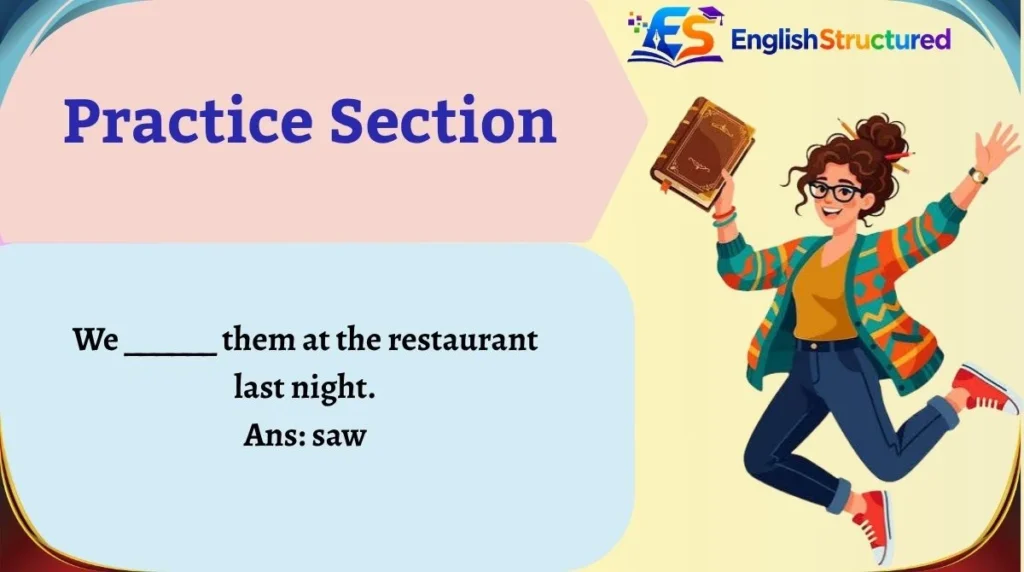
Choose the correct word: see, saw, or seen.
1. I ______ your brother yesterday.
2. Have you ______ my keys?
3. Did you ______ that accident?
4. She has ______ this movie before.
5. We ______ them at the restaurant last night.
Answers
1. saw
Seen vs Saw
The action happened at a finished past time.
2. seen
Have you seen my keys?
The word seen follows have.
3. see
Did you see that accident?
After did, use the base form see.
4. seen
She has seen this movie before.
The pattern is has + past participle.
5. saw
We saw them at the restaurant last night.
The event happened at a finished time in the past.
FAQs
1. What is the difference between “seen” and “saw”?
Saw is the simple past form of see. Seen is the past participle.
Use saw for a finished past action, such as “I saw him yesterday.” Use seen with helping verbs such as have, has, or had, as in “I have seen him before.”
2. Can we use “saw” in questions?
Yes, but not directly after did.
You should say:
“Did you see him?”
not:
“Did you saw him?”
However, saw can appear in a question without did, depending on the sentence structure and context, such as “Who saw the accident?”
3. Can we use “seen” without “have,” “has,” or “had”?
Usually, no, when seen is being used as the past participle of see.
You generally need a helping verb:
I have seen it.
Seen vs Saw
They had seen it.
Saying “I seen it yesterday” is not standard English.
4. Is “saw” formal or informal?
Saw is neither especially formal nor informal. It is the normal simple past form of see.
You can use it in everyday conversations, school writing, emails, stories, and formal writing.
For example:
The researcher saw a significant change.
5. Is “I have seen him yesterday” correct?
No, this is generally incorrect in standard English.
Use:
I saw him yesterday.
The word yesterday refers to a finished past time, so the simple past is normally appropriate.
You can say:
I have seen him before.
Here, no specific finished past time is given.
6. Which is correct: “I saw” or “I seen”?
Both forms are related to the verb see, but they have different grammatical jobs.
Use I saw for simple past:
I saw her yesterday.
Use I have seen for the present perfect:
I have seen her before.
“I seen” by itself is not standard English for the simple past.
Conclusion
Understanding seen vs saw becomes much easier when you stop thinking of them as two words with different meanings.
Seen vs Saw
Use saw when you are talking about a completed event in the past:
I saw him yesterday.
Use seen as the past participle, usually after have, has, or had:
I have seen him before.
And remember one more important point: after did, use the base form see:
Did you see her?
A simple way to remember everything is this:
See → present/base form
Saw → simple past
Seen → past participle
Once you practice these three forms in real sentences, the difference will start to feel natural.
Try making a few sentences about things you saw yesterday and things you have seen in your life. A little practice can make this grammar point much easier.