Mad vs Angry
Because their meanings are so close, English learners often wonder if they can use them in exactly the same way.
The good news is that the difference is not very difficult.
In many everyday situations, mad and angry can mean the same thing. For example, “I am angry with him” and “I am mad at him” can both mean that you are upset because of something he did.
However, there are some important differences in American and British English, formality, and sentence patterns.
The word mad can also have another meaning: mentally ill or crazy. This second meaning can sometimes cause confusion.
Knowing when to use each word can make your English sound much more natural.
It can also help you understand movies, conversations, books, and social media because native speakers use both words often.
By the end, you will know what each word means, how to use it in a sentence, which word sounds more natural in different situations, and what mistakes to avoid.
You will also see simple examples from daily conversations.
So, if you have ever asked yourself, “Should I say mad or angry?”, the answer will become much clearer after looking at how real English speakers use these words.
What Does “Mad” Mean?
The word mad has more than one meaning, so context is important.
In everyday American English, mad commonly means angry or annoyed. When someone says, “I’m mad at you,” they usually mean, “I’m angry with you.”
For example:
- I’m mad at my brother.
- She was mad because I forgot her birthday.
- Mad vs Angry
- He gets mad when people interrupt him.
- My mom was mad about the broken window.
- Don’t be mad at me.
- Mad vs Angry
- I was really mad after the argument.
In these examples, mad = angry.
When Should You Use “Mad”?
Mad is especially common in informal spoken English. It is frequently heard in everyday conversations, particularly in American English.
You might hear a friend say:
Mad vs Angry
Or someone might say:
“I’m still mad about what happened yesterday.”
Both sentences sound completely natural in casual American English.
The word is useful when talking about personal feelings, arguments, small problems, and everyday situations.
For example, imagine your friend takes your phone without asking. You could say:
“I’m mad at you for taking my phone.”
This sounds natural and conversational.
Grammar Rule for “Mad”
When mad means angry, it is usually used as an adjective.
Common patterns include:
Subject + be + mad
- I am mad.
- She is mad.
- Mad vs Angry
You can also say:
Mad vs Angry
- I’m mad at Tom.
- She is mad at her sister.
- They were mad at us.
Another useful pattern is:
Subject + be + mad about + thing/situation
- He is mad about the decision.
- She was mad about the delay.
- I’m mad about what happened.
The preposition can change depending on what you are talking about.
Mad Can Have Another Meaning
Here is where things become interesting.
Mad vs Angry
For example:
- He must be mad to drive that fast.
- Mad vs Angry
- Are you mad?
In these examples, mad does not necessarily mean angry.
If someone says:
“She is mad.”
The sentence could mean that she is angry, especially in American English. But depending on the context, it could also suggest that she is crazy or mentally unstable.
Because this meaning can be sensitive or unclear, learners should pay attention to the situation.
More Examples with “Mad”
Here are some natural examples:
- Why are you mad at me?
The speaker wants to know why someone is angry. - Mad vs AngryHe was angry because the speaker arrived late.
- She gets mad when people lie to her.
Lying makes her angry. - I’m not mad anymore.
The speaker was angry before but is calm now. - Don’t make him mad.
Do not do something that will make him angry. - He was really mad about losing the game.
Losing made him very upset. - Mad vs AngryThe speaker asks whether the person is still angry with Sarah.
- I was mad, but I decided not to argue.
The speaker felt angry but controlled the reaction.
What Does “Angry” Mean?
Angry means feeling strong displeasure or irritation because something has happened that you do not like.
It is one of the most common words for describing the emotion of anger.
For example:
- I’m angry with him.
- She was angry about the decision.
- My teacher looked angry.
- Mad vs Angry
- Why are you angry?
- They were angry with the company.
- I was too angry to speak.
- She sounded angry on the phone.
Mad vs Angry
When Should You Use “Angry”?
Angry works in both casual and more formal English.
You can use it when talking with a friend:
Mad vs Angry
You can also use it in writing:
“The customers were angry about the sudden price increase.”
This makes angry a very useful word for English learners because you do not have to worry as much about another meaning.
It can describe a small amount of irritation or a very strong emotional reaction, depending on the context.
For example:
Mad vs Angry
This may describe ordinary frustration.
But:
“She was extremely angry after discovering the truth.”
This suggests a much stronger emotion.
Grammar Rule for “Angry”
Mad vs Angry
A common structure is:
Mad vs Angry
- I am angry.
- He is angry.
- She was angry.
- They were angry.
You can also use:
angry with + person
- I’m angry with my brother.
- She is angry with me.
- He was angry with his boss.
Another common structure is:
angry about + thing/situation
- I’m angry about the delay.
- She was angry about the decision.
- They are angry about the new rule.
You may also hear:
Mad vs Angry
- He was angry at me.
- She was angry at the situation.
Both angry with and angry at are used, although usage can vary by region and context.
Angry Can Be Made Stronger
English speakers often add words before angry to show the level of emotion.
For example:
- slightly angry
- a little angry
- Mad vs Angry
- really angry
- extremely angry
- deeply angry
You can also use furious when you want to describe extremely strong anger.
For example:
“She was furious when she found out.”
This is stronger than simply saying:
Mad vs Angry
More Examples with “Angry”
- I’m angry with you.
The speaker feels anger toward the listener. - She was angry about the unfair decision.
The decision caused her anger. - Why is your brother angry?
The speaker asks about the reason for his anger. - Mad vs AngryHis emotional state changed during the meeting.
- My parents were angry with me.
His parents were upset because of something he did. - She sounded angry on the phone.
Her voice suggested that she was angry. - I was angry, but I stayed quiet.
The speaker felt anger but did not react loudly. - The customers were angry about the poor service.
Their dissatisfaction caused anger.
Difference Between Mad and Angry
The biggest point to remember is simple:
When mad means angry, mad and angry are often interchangeable.
For example:
Mad vs Angry
and
Mad vs Angry
Both can communicate the same basic idea.
However, they are not always identical in tone or meaning.
| Point | Mad | Angry |
|---|---|---|
| Basic meaning | Angry or upset | Feeling anger |
| Common in American English | Very common | Very common |
| Common in British English | Can mean crazy | Commonly means angry |
| Formal writing | More informal | More neutral |
| Casual conversation | Very natural | Very natural |
| Other meaning | Can mean crazy | Usually no second everyday meaning |
| Common pattern | mad at someone | angry with/at someone |
| Emotion | Can be mild or strong | Can be mild or strong |
1. Mad Often Sounds More Casual
In everyday American conversation, mad can sound relaxed and informal.
For example:
Mad vs Angry
This is extremely natural between friends, family members, or partners.
You could also say:
“Are you angry with me?”
That is correct too, but it may sound a little more serious depending on the situation.
2. Angry Is More Neutral
Mad vs Angry
You can use it in conversation, school writing, articles, reports, and other situations.
For example:
“The residents were angry about the new policy.”
This sounds natural and neutral.
Using mad here is possible in some contexts, especially American English, but angry may sound more suitable in formal writing.
3. Mad Has a Second Meaning
This is one of the most important differences.
Mad vs Angry
For example:
Mad vs Angry
Depending on the variety of English and context, this could mean:
“You must be crazy!”
But angry does not normally have this meaning.
So if you want to clearly describe the emotion, angry is often the safer word.
4. American and British English Can Differ
In modern American English, mad commonly means angry.
Mad vs Angry
This is why learners may notice different uses in movies, books, or conversations from different countries.
Neither usage should automatically be treated as wrong. English changes across regions.
Grammar Rules You Must Remember
Rule #1: Use “mad at” for a person
Mad vs Angry
Correct:
I’m mad at my brother.
She is mad at me.
Why are you mad at him?
This is especially common in American English.
A useful pattern is:
Mad vs Angry
Rule #2: “Angry with” is common for people
With angry, you can use with when talking about a person.
Examples:
I’m angry with my brother.
She was angry with me.
He is angry with his manager.
Mad vs Angry
So both can occur:
She is angry with me.
She is angry at me.
Rule #3: Use “about” for a situation or thing
Both adjectives can describe anger caused by a situation.
Mad vs Angry
I’m mad about the delay.
Mad vs Angry
I’m angry about the delay.
The basic idea is the same.
The thing after about is the reason or subject causing the emotion.
Rule #4: Remember that “mad” can mean crazy
Mad vs Angry
Look at this sentence:
Mad vs Angry
Here, mad clearly means angry.
Now look at:
He would have to be mad to do that.
Mad vs Angry
The surrounding words help you understand the intended meaning.
Common Mistakes Students Make
Learners often make mistakes because they try to translate these words directly from their first language. English does not always follow the same patterns as other languages.
Mistake 1: Thinking “mad” always means angry
This is not always true.
Example:
You are mad if you think that is a good idea.
Mad vs Angry
Tip: Look at the whole sentence instead of translating one word by itself.
Mistake 2: Using the wrong preposition
A common learner sentence is:
I am mad with him.
This may be understood, but mad at him is especially common in American English.
A natural choice is:
I am mad at him.
With angry, both of these are common:
I am angry with him.
I am angry at him.
Mistake 3: Thinking “angry” is always stronger than “mad”
Not necessarily.
The strength comes from the context and the words around the adjective.
Compare:
I’m a little mad.
I’m extremely angry.
The second sentence is clearly stronger.
But you can also say:
I’m really mad.
So neither word automatically tells you how strong the emotion is.
Mistake 4: Thinking one word is correct and the other is wrong
This is perhaps the most common misunderstanding.
In many everyday situations, both are correct.
For example:
She is mad at me.
She is angry with me.
Both sentences can describe the same situation.
The difference is mainly about usage, tone, regional preference, and context.
Easy Trick to Remember the Difference
Here is a simple trick:
MAD = casual anger
ANGRY = clear and neutral anger
Think of a normal conversation with a friend.
Your friend asks:
“Are you mad at me?”
That sounds very natural.
Now imagine a newspaper or formal report:
“The workers were angry about the new policy.”
That also sounds natural.
There is another trick:
If “crazy” could fit the meaning, be careful with “mad.”
For example:
“He must be mad to jump from there.”
Mad vs Angry
But:
“He is mad at his brother.”
Here, crazy does not fit. The meaning is angry.
This simple replacement test can help you understand the meaning of mad from context.
Daily Life Examples
These examples show how native speakers might use the two words in ordinary conversations.
Example 1: Talking to a Friend
Tom: Why didn’t you call me?
Ali: Sorry. My phone died.
Tom: I was mad at you!
Here, mad means angry or upset. The situation is casual, so mad sounds very natural.
Example 2: Asking About Feelings
Sara: Are you angry with me?
Mia: No, I’m just tired.
The word angry clearly describes an emotional state.
Example 3: A Parent and Child
Dad: Why did you break the window?
Son: It was an accident.
Dad: I’m really mad about this.
Here, mad is used naturally in an informal family conversation.
Example 4: Workplace Situation
Manager: The customers are angry about the delay.
Mad vs Angry
Example 5: After an Argument
A: Are you still mad at me?
B: A little, but I’m okay now.
This is a very natural casual use of mad.
Example 6: Talking About a Decision
A: Why is she angry?
B: She’s angry about the new schedule.
Here, angry about introduces the situation causing the emotion.
Example 7: Strong Emotion
A: What happened to Mark?
B: He was extremely angry when he heard the news.
The word extremely makes the emotion stronger.
Example 8: Not Angry Anymore
A: Are you mad at me?
B: No. I’m not mad anymore.
This is common in casual conversation.
Example 9: Possible “Crazy” Meaning
A: You’re going to climb that mountain without a guide?
B: Yes.
A: You must be mad!
Here, depending on the variety of English and context, mad can mean crazy or unreasonable, not angry.
Example 10: A Formal Situation
The residents were angry about the sudden closure of the road.
Here, angry is a natural choice because the sentence has a more formal, neutral tone.
Practice Section
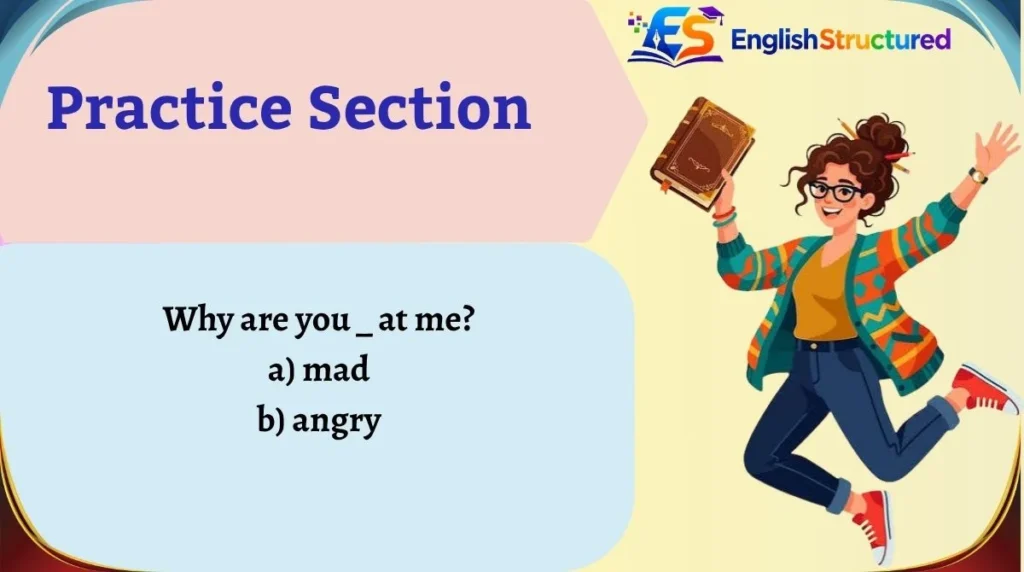
Choose mad or angry in each sentence.
1. Why are you _ at me?
a) mad
b) angry
2. The customers were _ about the poor service.
a) mad
b) angry
3. Are you still _ at your brother?
a) mad
b) angry
4. She became extremely _ after hearing the news.
a) mad
b) angry
5. He must be _ to take such a risk.
a) mad
b) angry
Answers
1. Mad — “Mad at me” is a very common everyday expression.
2. Angry — “Angry about the poor service” is natural and neutral.
3. Mad — “Mad at your brother” is especially common in casual American English.
4. Angry — “Extremely angry” is a natural way to describe strong anger.
5. Mad — Here, mad can mean crazy or unreasonable.
Remember that some sentences may allow both mad and angry when the intended meaning is simply “angry.” Context is important.
FAQs
1. What is the difference between mad and angry?
When mad means angry, the two words are very similar. Both describe a feeling of anger or irritation.
Mad vs Angry
2. Is “mad” an informal word for angry?
Often, yes. In everyday American English, mad is a very common informal way to say angry.
For example:
“My sister is mad at me.”
This sounds completely natural in casual conversation. However, mad also has other meanings in some contexts.
3. Is “angry” more formal than “mad”?
Generally, angry is more neutral and can fit formal writing more easily.
For example:
“The residents were angry about the decision.”
This works well in a formal report. Mad is also correct in many contexts, but it often sounds more conversational.
4. Can I say “I am mad at you”?
Yes. “I am mad at you” is a very common sentence, especially in American English.
It means that you are angry or upset with the person. It is often used in everyday conversations between friends, family members, and partners.
5. Can “mad” mean crazy?
Yes. Mad can mean crazy, mentally unstable, or unreasonable in certain contexts, especially in British English.
For example:
“You must be mad to do that.”
Here, mad does not mean angry. The meaning comes from the context.
6. Should I use “mad” or “angry” in formal writing?
Angry is usually the safer choice in formal writing because its meaning is clear and neutral.
For example:
“The employees were angry about the changes.”
In casual American conversation, however, mad is completely natural:
“I’m mad about the changes.”
Conclusion
Mad vs Angry
The main difference is how they are used and understood. Mad is especially common in casual American English and often means angry.
Angry is more neutral and works comfortably in casual speech, school writing, professional situations, and formal contexts.
There is one important point to remember: mad can also mean crazy or unreasonable. The context tells you which meaning is intended.
For everyday conversation, phrases such as “I’m mad at you” and “I’m angry with you” are both natural.
Pay attention to the prepositions, too: mad at, angry with, and angry at are common patterns.
The best way to learn this difference is to notice how these words appear in real conversations.
Once you hear and use them regularly, choosing between them will feel much easier.