Compared to vs As Compared To
The two expressions look almost the same, and both are used to put two people, things, ideas, or situations side by side. So, is there really a difference?
The short answer is: sometimes, but not a big one.
In most everyday sentences, compared to is the shorter and more natural choice. For example, you can say, “This phone is cheap compared to that one.”
You can also say, “This phone is cheap as compared to that one.” Both sentences can make sense.
However, the two expressions can have a slightly different tone and focus. “Compared to” is common in normal conversation and general writing.
“As compared to” can sound more formal, more deliberate, or more common in academic and business writing.
Another important point is that “as compared to” does not create a completely different grammar rule. It still introduces the thing you are using as a basis for comparison.
By the end of this guide, you will know when to use each expression, how they fit into sentences, which one sounds more natural, and which common mistakes to avoid.
You will also see plenty of simple examples that you can use in school, work, conversation, and everyday English.
What Does “Compared To” Mean?
Compared to means “when you look at one thing in relation to another thing.”
It is used when you want to show a difference, similarity, advantage, disadvantage, size, amount, quality, or other relationship between two things.
For example:
Compared to vs As Compared To
Here, the speaker is looking at the new laptop in relation to the old laptop.
The expression compared to is very common in modern English. It works well in both speaking and writing, although the exact sentence structure can vary.
When Should You Use “Compared To”?
Use compared to when you want to make a simple comparison.
You can compare:
- two people
- two places
- two products
- two ideas
- two periods of time
- two situations
- two amounts
- two qualities
For example:
This road is much safer compared to the old road.
Compared to vs As Compared To
You can also use it without a comparative adjective:
The new design looks simple compared to the previous design.
The two designs are being compared in terms of appearance.
Grammar Rule for “Compared To”
A common pattern is:
Subject + verb + adjective + compared to + noun/pronoun
Examples:
This bag is cheaper compared to that bag.
The city is quieter compared to last year.
Compared to vs As Compared To
Another common structure is:
Noun + compared to + noun
For example:
The population of the town is small compared to the capital.
Here, “compared to the capital” tells us what the town’s population is being measured against.
Compared to vs As Compared To
Compared to last year, sales are much higher.
This structure is especially useful when the comparison is the main point of the sentence.
Examples of “Compared To”
- This room is much brighter compared to the old one.
- My new shoes are more comfortable compared to my previous pair.
- The test was easy compared to the one we took last month.
- Compared to vs As Compared To
- Ali is very tall compared to his brother.
- The weather today is cooler compared to yesterday.
- This computer uses less energy compared to the older model.
- Life in the countryside is quieter compared to life in a big city.
Notice that the expression simply introduces the standard or point of reference for the comparison.
A Common Learner Confusion
Some learners think “compared to” can only be used with words such as bigger, smaller, better, faster, or cheaper.
That is not true.
You can use it with many kinds of descriptions:
Compared to vs As Compared To
The room feels warm compared to the hallway.
Compared to vs As Compared To
The key idea is not the word before “compared to.” The key idea is that one thing is being considered in relation to another.
What Does “As Compared To” Mean?
As compared to has almost the same basic meaning as compared to.
It introduces something that is being used as a point of comparison.
For example:
Compared to vs As Compared To
The speaker is comparing the new system with the old system.
The word as makes the expression a little longer, but it does not normally change the basic meaning.
When Should You Use “As Compared To”?
“As compared to” is often used when the writer wants a somewhat formal or deliberate style.
You may see it in:
- academic writing
- reports
- research writing
- business documents
- formal explanations
- statistical discussions
For example:
Compared to vs As Compared To
This sounds more formal than:
The company recorded higher profits compared to the previous year.
Both can be understood, but the first version has a more formal feel.
That does not mean “as compared to” is always better in formal writing. In many cases, compared to is still cleaner and more direct.
Grammar Rule for “As Compared To”
The basic pattern is:
Subject + verb + description + as compared to + noun
Examples:
Compared to vs As Compared To
The number of students is higher as compared to last year.
You can also place the phrase at the beginning:
Compared to vs As Compared To
However, many writers would simply say:
Compared to last year, the company has grown quickly.
The shorter version usually sounds more natural.
Examples of “As Compared To”
- The new building is much larger as compared to the old one.
- Compared to vs As Compared To
- This method is faster as compared to the traditional method.
- The second test was easier as compared to the first one.
- The company has fewer employees as compared to last year.
- This year’s results are better as compared to last year’s results.
- Compared to vs As Compared To
- The village is peaceful as compared to the busy city.
These sentences are grammatically understandable, but in several cases, a native speaker may prefer the shorter compared to.
Is “As Compared To” Wrong?
No. “As compared to” is not automatically wrong.
This is an important point for learners.
Some style guides and teachers prefer compared to because it is shorter and more direct. But “as compared to” is widely used and can be grammatically acceptable when the sentence is constructed properly.
The bigger issue is often style, not grammar.
If you are writing simple everyday English, “compared to” is usually the safer choice.
Difference Between “Compared To” and “As Compared To”
The biggest difference is length and style, not basic meaning.
Both expressions can introduce the thing that serves as the basis for comparison.
| Point | Compared to | As compared to |
|---|---|---|
| Basic meaning | Makes a comparison | Makes a comparison |
| Length | Shorter | Longer |
| Everyday speech | Very common | Less common |
| Informal writing | Natural | Can sound formal |
| Academic writing | Common | Also possible |
| Business writing | Very common | Common |
| Main function | Shows a relationship between two things | Shows a relationship between two things |
| Naturalness | Usually more natural | Often more formal or wordy |
1. Meaning
There is usually no major difference in meaning.
Compare:
Compared to vs As Compared To
and:
The new phone is cheaper as compared to the old phone.
Both tell us that the new phone has a lower price than the old phone.
2. Style
The main difference is often the tone.
“Compared to” is short and direct:
Compared to vs As Compared To
“As compared to” sounds slightly more formal:
This car is fast as compared to my old car.
In normal conversation, the first sentence would usually be preferred.
3. Sentence Structure
Both expressions can follow a statement that describes one thing and then introduce the thing being used for comparison.
For example:
The apartment is small compared to the house.
The apartment is small as compared to the house.
The structure is nearly identical.
4. Natural English
When two expressions mean almost the same thing, English speakers often prefer the simpler expression.
That is why “compared to” is often the better choice.
Instead of:
The new plan is cheaper as compared to the old plan.
You can simply write:
Compared to vs As Compared To
Even better, depending on the sentence:
The new plan is cheaper than the old plan.
This brings us to an important point: “than” is often the most natural choice when using a comparative adjective.
Grammar Rules You Must Remember
Rule #1: “Compared to” is usually the simpler choice
When you are unsure which expression to use, compared to is usually a safe and natural option.
Compared to vs As Compared To
It works well in conversation and writing.
You do not need to add “as” just because the sentence is formal.
Rule #2: “As compared to” is not a completely different expression
Do not think that “as compared to” has a special meaning that is completely separate from “compared to.”
Both can introduce the point of comparison.
The price is lower compared to last year.
The price is lower as compared to last year.
The basic message remains the same.
Rule #3: Use “than” when it gives you a cleaner comparative sentence
This is one of the most useful tips.
Instead of:
Compared to vs As Compared To
You can say:
Sarah is taller than Maria.
Instead of:
This phone is cheaper as compared to that phone.
You can say:
This phone is cheaper than that phone.
“Than” is often the most natural word after a comparative adjective.
However, “compared to” can still be useful when you want to emphasize the act of comparison or when the sentence structure naturally calls for it.
For example:
Compared to vs As Compared To
Here, “than” would not replace the phrase in the same way.
Rule #4: Make sure the comparison is logical
The things you compare should make sense together.
For example:
This car is faster compared to that car.
This is logical because you are comparing one car with another car.
But be careful with sentences where the grammatical subject and the comparison do not match clearly.
For example:
Compared to vs As Compared To
This can suggest that Ali’s grades are being compared to other students, which is not logically precise.
A clearer version is:
Compared to the grades of other students, Ali’s grades are excellent.
Or:
Compared with other students, Ali performs very well.
The second version makes the comparison clearer.
Common Mistakes Students Make
Mistake 1: Thinking “as compared to” is always more correct
Some learners believe that adding as makes a sentence more grammatical.
It does not.
Compared to vs As Compared To
is perfectly understandable.
You do not need:
Compared to vs As Compared To
The longer version is not automatically more correct.
Tip: Do not add extra words just to make English sound formal.
Mistake 2: Using “compared to” when “than” is much more natural
Consider:
John is taller compared to Peter.
This is understandable, but:
John is taller than Peter.
is usually more natural.
The same applies to:
My car is cheaper than yours.
This test is easier than the previous one.
Use than freely with ordinary comparative structures.
Mistake 3: Mixing “as” with an incorrect comparison structure
A common learner error is creating patterns such as:
Compared to vs As Compared To
This is incorrect.
The problem is the combination of as + cheaper + as.
If you mean the phone costs less, say:
This phone is cheaper compared to that phone.
Or more naturally:
This phone is cheaper than that phone.
Remember that “as … as” is a different comparison structure:
This phone is as cheap as that phone.
Here, “as cheap as” means the two phones have the same level of cheapness.
Mistake 4: Using both “than” and “compared to” unnecessarily
Avoid sentences like:
Compared to vs As Compared To
That structure is wrong.
Choose one suitable construction:
This car is faster than that car.
or:
This car is faster compared to that car.
Do not combine the two.
Mistake 5: Assuming “compared with” and “compared to” are always completely different
You may also see compared with.
For most everyday uses, “compared to” and “compared with” can overlap in meaning.
For example:
Compared to last year, sales are higher.
Compared to vs As Compared To
Both can work.
Some traditional grammar discussions try to give “compared with” and “compared to” separate meanings, but modern English does not always follow such a strict division.
For a learner, the easiest approach is to focus on clear meaning and natural usage.
Easy Trick to Remember the Difference
Here is a simple trick:
Think: “Compared to” = Short and Everyday
When you are speaking with friends, writing a simple email, or explaining something normally, choose:
compared to
For example:
Compared to vs As Compared To
It is short, clear, and natural.
Think: “As Compared To” = Longer and More Formal-Sounding
When you see:
Compared to vs As Compared To
think:
“This is the longer version.”
It may appear in formal reports or academic-style sentences.
For example:
The current figures are higher as compared to the previous period.
But remember: longer does not always mean better.
A good writer removes unnecessary words when they do not add meaning.
The Three-Way Memory Trick
You can remember these three choices:
Compared to vs As Compared To
Comparative adjective → often than
Formal/longer style → as compared to
For example:
My car is faster than yours.
My car is fast compared to yours.
My car is fast as compared to older models.
This simple pattern will help you avoid many mistakes.
Daily Life Examples
Here are natural examples you might hear or use in everyday situations.
1. Talking About Phones
A: How is your new phone?
B: It’s much faster compared to my old one.
Compared to vs As Compared To
2. Talking About Prices
This supermarket is expensive compared to the one near my house.
This means the speaker thinks the first supermarket has higher prices.
3. Talking About Weather
Today feels cold compared to yesterday.
The speaker uses yesterday as the point of comparison.
4. Talking About School
This math test was easy compared to the last one.
Compared to vs As Compared To
5. Talking About Work
My new job is less stressful compared to my previous job.
This is a natural way to compare two work situations.
6. Talking About Travel
The train is cheap compared to flying.
The speaker compares the cost of train travel with air travel.
7. Talking About Food
This soup is spicy compared to the soup we had yesterday.
The two soups are being compared.
8. Talking About Exercise
Walking is easy compared to running.
Here, the speaker is making a general comparison.
9. Talking About Cities
Lahore is very busy compared to the small town where I grew up.
The speaker compares the level of activity in two places.
10. Formal Business Example
The company’s profits increased significantly as compared to the previous year.
This version has a more formal business-report style.
In everyday speech, you could simply say:
The company’s profits increased a lot compared to last year.
Practice Section
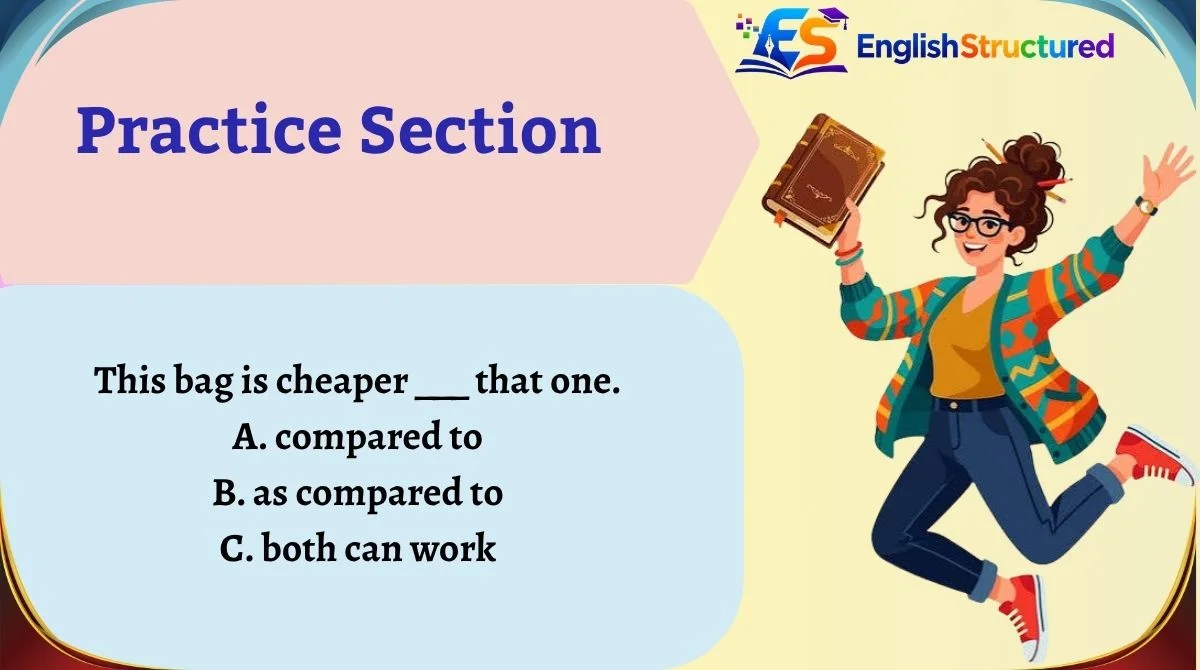
Choose the best option in each sentence.
1. This bag is cheaper ___ that one.
A. compared to
B. as compared to
C. both can work
2. My new computer is faster ___ my old one.
A. than
B. than compared to
C. as than
3. ___ last year, the company has grown.
A. Compared to
B. Than compared to
C. As than
4. Which sentence is better for normal conversation?
A. This restaurant is expensive compared to that one.
B. This restaurant is expensive as compared to that one.
5. Which sentence is incorrect?
A. This car is faster than that car.
B. This car is faster compared to that car.
C. This car is faster than compared to that car.
Answers
1. C — both can work.
“Compared to” is usually the more natural choice.
2. A — than.
The simple comparative structure is “faster than.”
3. A — Compared to.
“Compared to last year” works naturally at the beginning.
4. A — This restaurant is expensive compared to that one.
It is shorter and more natural for ordinary conversation.
5. C — This car is faster than compared to that car.
Do not combine “than” and “compared to” in this way.
FAQs
1. What is the difference between “compared to” and “as compared to”?
Both expressions are used to compare one thing with another. Their basic meaning is almost the same.
“Compared to” is shorter and usually more natural. “As compared to” can sound more formal or wordy.
2. Is “as compared to” grammatically correct?
Yes, “as compared to” can be grammatically correct.
It is used in English to introduce a point of comparison. However, it is not automatically better than “compared to.”
In many sentences, the shorter version is clearer.
3. Is “compared to” better than “as compared to”?
Usually, “compared to” is the better everyday choice because it is simple and direct.
For example:
Compared to vs As Compared To
“As compared to” can also work, especially in formal writing.
The best choice depends on the sentence and the tone you want.
4. Can I use “compared to” in formal writing?
Yes.
“Compared to” is completely suitable for many formal contexts, including reports, essays, and professional writing.
You should not assume that formal English always requires longer expressions.
Clear and direct writing is often better.
5. Should I use “than” or “compared to”?
It depends on the sentence.
With a normal comparative adjective, than is often the most natural choice:
This car is faster than that car.
But “compared to” is also useful:
Compared to last year, sales are higher.
Learn to recognize the sentence pattern rather than trying to use one expression everywhere.
6. Is “compared with” also correct?
Yes. Compared with is also a standard English expression.
In many situations, “compared with” and “compared to” have the same basic meaning.
For example:
Compared with last year, sales have increased.
and:
Compared to last year, sales have increased.
Both are natural English.
Conclusion
The expressions “compared to” and “as compared to” are very similar.
Both can be used to place two things side by side and show how they are different or similar.
The main difference is usually style and length, rather than meaning. “Compared to” is shorter, more common, and often more natural in everyday English.
“As compared to” can sound more formal, but it is not automatically more correct.
Also remember that “than” is often the best choice when you are using a normal comparative adjective:
This book is cheaper than that one.
Use compared to when you want to introduce a clear point of reference:
Compared to vs As Compared To
Most importantly, do not make English harder than it needs to be. When two expressions communicate the same idea, the shorter and clearer one is often a great choice.
With a little practice, these comparisons will soon feel natural.
Pay attention to how people use than, compared to, and as compared to in real sentences, and choosing the right form will become much easier.