Especially vs Particularly
Both words add extra focus to a person, thing, or idea. Because they have similar meanings, it is easy to mix them up.
You may hear someone say, “I love fruit, especially mangoes.” Another person might say, “I was particularly happy today.”
Both sentences sound natural, but the two words are not always interchangeable. Choosing the right one can make your English sound more fluent and more natural.
This difference is important because especially and particularly appear in everyday conversations, books, news articles, emails, and school writing.
If you understand how they work, you will be able to speak and write with greater confidence.
The good news is that the difference is not difficult once you see how native speakers use them.
A few simple grammar rules and real-life examples can help you remember when each word fits best.
By the end of this guide, you will understand what especially means, what particularly means, when to use each one, the grammar behind them, and how to avoid common mistakes.
You will also see plenty of simple examples that make the difference easy to remember.
What Does Especially Mean?
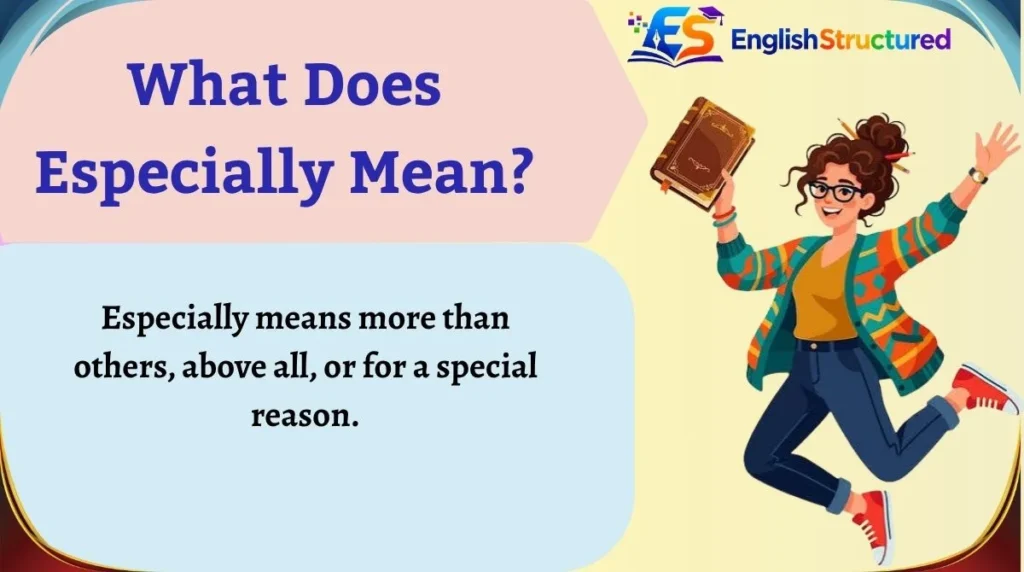
Especially means more than others, above all, or for a special reason. It highlights one person, thing, or situation from a larger group.
Think of it as saying “most of all” or “above everything else.”
When to Use Especially
Especially vs Particularly
It is very common in everyday English and sounds natural in both speaking and writing.
Grammar Rule
Especially is an adverb. It usually modifies:
- a noun
- a verb
- an adjective
- another adverb
- an entire clause
It often comes:
- before the word or phrase it emphasizes
- after a comma when adding extra information
Structure Examples
- especially + noun
- Especially vs Particularly
- verb + especially
- sentence, especially + noun phrase
Example Sentences
- I enjoy reading, especially mystery novels.
- Especially vs Particularly
- The weather is beautiful, especially in spring.
- She works hard, especially before exams.
- We like all kinds of music, especially jazz.
- Especially vs Particularly
- I miss my hometown, especially during the holidays.
- This jacket is useful, especially on cold mornings.
Common Situations Where We Use Especially
Native speakers often use especially when talking about:
- favorite foods
- favorite hobbies
- seasons
- holidays
- people
- special occasions
- things that stand out
For example:
- I like desserts, especially chocolate cake.
- Especially vs Particularly
- We need to save water, especially in summer.
Especially vs “Very”
Especially vs Particularly
Compare these:
✅ She is very kind.
(Kind to a high degree.)
Especially vs Particularly(Mr. Khan stands out from the others.)
The first sentence talks about how kind someone is.
The second sentence compares one teacher with the rest.
Especially vs “Specially”
Another common confusion is between especially and specially.
Although they look similar, they are different.
Especially vs Particularly
Specially means for a special purpose.
Examples:
- I love fruit, especially apples.
- This chair was made specially for children.
Notice the difference.
In the first sentence, apples are the favorite.
In the second sentence, the chair was designed for a specific purpose.
Common Learner Confusion
Many students use especially whenever they want to add emphasis. Sometimes that works, but not always.
Look at these examples.
❌ I was especially surprised because nobody told me.
This sentence is possible, but native speakers often prefer:
Especially vs Particularly
Why?
The sentence focuses on the degree of surprise, not on choosing one thing from a group.
Now compare another example.
Especially vs Particularly
Here, football is one sport chosen from many sports.
That is exactly what especially is meant to do.
Quick Summary of Especially
Remember these key points:
- It means above all or more than others.
- It highlights one item from a larger group.
- It is very common in everyday English.
- It often introduces your favorite or most important example.
- Especially vs Particularly
What Does Particularly Mean?
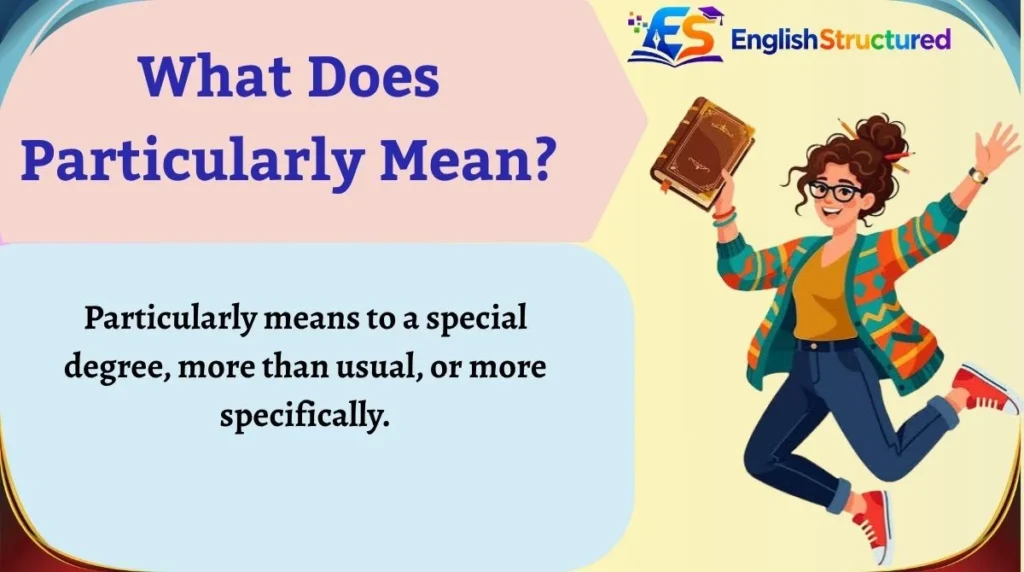
Particularly means to a special degree, more than usual, or more specifically. Instead of picking one item from a group, it often adds extra emphasis to a quality, feeling, action, or situation.
You can think of it as saying:
- Especially vs Particularly
- notably
- to a great extent
- more specifically
The exact meaning depends on the sentence.
Unlike especially, particularly is often used to describe how strong something is rather than which thing stands out.
When to Use Particularly
Use particularly when you want to emphasize:
- a feeling
- an opinion
- an adjective
- an action
- a situation
- a specific detail
It is common in both spoken and written English, but it appears more often in formal writing, reports, academic English, and professional communication.
Grammar Rule
Especially vs Particularly
It can modify:
- verbs
- adjectives
- adverbs
- entire clauses
It usually appears:
- before an adjective
- before a verb
- before another adverb
- before the part you want to emphasize
Example Sentences
- I was particularly tired after the long journey.
- Especially vs Particularly
- We were particularly pleased with the results.
- The teacher was particularly helpful today.
- He doesn’t particularly enjoy spicy food.
- This lesson is particularly important for beginners.
- I found the movie particularly interesting.
- Especially vs Particularly
Different Ways Particularly Is Used
Especially vs Particularly
1. To Show a High Degree
It strengthens an adjective or feeling.
Examples:
- She was particularly excited.
- The exam was particularly difficult.
- Today is particularly hot.
In these sentences, particularly means very much or to an unusual degree.
2. To Mean “More Specifically”
Sometimes it narrows the focus.
Examples:
- I’m interested in science, particularly biology.
- We study many languages, particularly English and Spanish.
Here, it points to a more specific example.
Especially vs Particularly
Particularly in Negative Sentences
Especially vs Particularly
Examples:
- I don’t particularly like coffee.
- She wasn’t particularly worried.
- Especially vs Particularly
In these examples, particularly softens the sentence. It sounds more polite than saying:
- I don’t like coffee.
- She wasn’t worried.
Instead, it suggests that the feeling is not very strong.
Particularly vs Very
Especially vs Particularly
Compare:
- She is very intelligent.
- Especially vs Particularly
The first sentence simply says she is highly intelligent.
The second suggests she stands out in intelligence or is intelligent to a notable degree.
The second sentence sounds more thoughtful and slightly more formal.
Common Learner Confusion
Especially vs Particularly
For example:
❌ I love animals, particularly dogs.
This sentence is grammatically correct.
However, in casual conversation, native speakers usually say:
✅ I love animals, especially dogs.
Why?
Because dogs are one member of the larger group of animals.
Now compare:
Especially vs Particularly
This sentence talks about the degree of friendliness.
It is not comparing dogs with other animals.
Quick Summary of Particularly
Keep these points in mind:
- It means to a special degree or more specifically.
- It often emphasizes qualities, feelings, and actions.
- Especially vs Particularly
- It appears frequently before adjectives and verbs.
- It is very common in negative sentences.
- It often describes how much, not which one.
Difference Between Especially and Particularly (Detailed)
Both especially and particularly are adverbs that add emphasis. Because they have similar meanings, learners often think they are exactly the same. In reality, they are close in meaning but not always interchangeable.
A simple way to understand them is this:
- Especially usually chooses one thing from a group.
- Especially vs Particularly
Many sentences can use either word, but one choice often sounds more natural than the other.
Comparison Table
| Feature | Especially | Particularly |
|---|---|---|
| Main meaning | More than others | To a special degree or more specifically |
| Main purpose | Highlights one item from a group | Gives extra emphasis |
| Part of speech | Adverb | Adverb |
| Everyday conversation | Very common | Common but slightly more formal |
| Formal writing | Yes | Very common |
| Before adjectives | Sometimes | Very common |
| Before verbs | Yes | Yes |
| Negative sentences | Less common | Very common |
| Typical idea | Favorite or standout item | Strong feeling, quality, or detail |
Usage Difference
The biggest difference is what each word emphasizes.
Use Especially to Highlight One Choice
Imagine you have many options but want to mention the one that stands out.
Examples:
- I enjoy sports, especially basketball.
- Especially vs Particularly
- We travel a lot, especially in winter.
- My father enjoys old movies, especially westerns.
Each sentence selects one example from a larger group.
Use Particularly to Add Strength
Now imagine you are talking about how strong a feeling or quality is.
Examples:
- I was particularly nervous before the interview.
- She looked particularly happy today.
- The soup is particularly delicious.
- Especially vs Particularly
These sentences do not compare one thing with others.
Instead, they emphasize the degree of something.
Grammar Logic
The grammar behind these words is easier than many learners expect.
Especially usually answers:
Which one stands out?
Example:
- Especially vs Particularly
Question:
Which dessert stands out?
Answer:
Ice cream.
Particularly usually answers:
How much? or To what degree?
Example:
- Especially vs Particularly
Question:
How excited?
Answer:
More than usual.
Sentence Structure Difference
Both words are flexible, but some sentence patterns are more common.
Common Patterns with Especially
Verb + especially + noun
- We enjoy especially seafood.
Sentence + especially + noun phrase
- Many students need extra practice, especially beginners.
Especially + when
- Especially vs Particularly
Common Patterns with Particularly
Particularly + adjective
- She is particularly patient.
Particularly + verb
- Especially vs Particularly
Particularly + adverb
- He spoke particularly clearly.
Meaning Comparison
Compare these pairs carefully.
Pair 1
I like fruit, especially oranges.
This means oranges are your favorite fruit.
Especially vs Particularly
This also means you like oranges a lot, but the focus is on the strength of your preference instead of comparing oranges with every other fruit.
Both are correct.
The first sounds more natural in everyday conversation.
Pair 2
The weather is especially beautiful in spring.
Spring stands out among the seasons.
Especially vs Particularly
Today’s weather is beautiful to an unusual degree.
Pair 3
Children need enough sleep, especially young children.
Young children are one group that deserves special attention.
Young children are particularly active.
This describes their activity level.
Pair 4
I enjoy visiting cities, especially London.
London is one city chosen from many.
Especially vs Particularly
The sentence focuses on how crowded London was.
Can They Replace Each Other?
Sometimes yes.
Sometimes no.
Look at these examples.
Correct with both:
- I especially enjoyed the concert.
- Especially vs Particularly
Both sound natural.
The second sounds slightly more formal.
Another example:
- Especially vs Particularly
- She is particularly kind to children.
Both are acceptable.
The first highlights kindness toward children.
The second emphasizes the degree of kindness.
The meaning changes only slightly.
Now look at examples where one word clearly sounds better.
More Natural
- Especially vs Particularly
Less natural:
- I love animals, particularly cats.
Especially vs Particularly
Another example:
More natural:
- Especially vs Particularly
Less common:
- I wasn’t especially worried.
Native speakers almost always choose particularly in this kind of negative sentence.
Especially vs Particularly in Formal English
In everyday speech, people often choose especially because it sounds simple and natural.
Examples:
- I love summer, especially the evenings.
- Especially vs Particularly
Especially vs Particularly
Examples:
- This research is particularly important.
- The policy is particularly useful for small businesses.
- Especially vs Particularly
This does not mean especially is informal.
It simply means particularly is more common in professional and academic writing.
Quick Side-by-Side Examples
| Especially | Particularly |
|---|---|
| I love music, especially jazz. | I particularly enjoy jazz. |
| Especially vs Particularly | The park is particularly quiet today. |
| Everyone came, especially my cousins. | Everyone was particularly excited. |
| She likes desserts, especially cheesecake. | She was particularly hungry after work. |
| The museum is busy, especially during holidays. | The museum was particularly crowded this weekend. |
Which Word Should You Choose?
Ask yourself one simple question.
Am I choosing one thing from a group?
If the answer is yes, use especially.
Example:
- I enjoy reading, especially history books.
Am I emphasizing how strong something is?
If the answer is yes, use particularly.
Example:
- I was particularly impressed by her speech.
Quick Recap
Here is the easiest way to remember the difference:
- Especially = one thing stands out from many.
- Especially vs Particularly
If you remember just these two ideas, choosing the correct word becomes much easier in everyday English.
Grammar Rules You Must Remember
Understanding a few simple grammar rules will help you use especially and particularly correctly in almost every situation.
Rule #1: Use Especially to Highlight One Thing from a Group
When you mention several people or things and want to focus on one of them, use especially.
Correct Examples
- Especially vs Particularly
- We sell many fruits, especially mangoes.
- Everyone helped, especially my brother.
Tip: Think of especially as meaning “above all the others.”
Rule #2: Use Particularly to Emphasize Degree
Choose particularly when describing how strong a feeling, quality, or action is.
Correct Examples
- She was particularly excited about the trip.
- This road is particularly dangerous at night.
- The teacher was particularly patient today.
Especially vs Particularly
Rule #3: Particularly Is Common in Negative Sentences
Native speakers often use particularly after don’t, doesn’t, didn’t, isn’t, wasn’t, and similar negatives.
Correct Examples
- I don’t particularly like rainy weather.
- He wasn’t particularly surprised.
- Especially vs Particularly
Using especially here sounds much less natural.
Rule #4: Both Are Adverbs, but Their Focus Is Different
Remember what each adverb emphasizes.
Especially
- Focuses on which one.
Example:
- I like pets, especially dogs.
Particularly
- Focuses on how much.
Example:
- Especially vs Particularly
When you understand this difference, choosing the right word becomes much easier.
Common Mistakes Students Make
Especially vs Particularly. Since both words add emphasis, it is easy to think they always mean the same thing. However, using the wrong one can make a sentence sound unusual or less natural.
The good news is that these mistakes are easy to fix once you know what each word is meant to do.
Mistake #1: Using Particularly Instead of Especially for Favorites
Especially vs Particularly
Wrong:
❌ I love desserts, particularly ice cream.
More Natural:
✅ I love desserts, especially ice cream.
Why?
Ice cream is one dessert chosen from many desserts. Especially is the better choice because it highlights one item in a group.
Mistake #2: Using Especially in Negative Sentences
Another common mistake is using especially after negative verbs.
Less Natural:
❌ I don’t especially like cold weather.
More Natural:
Especially vs Particularly
Why?
Native speakers usually use particularly with negative verbs like:
- don’t
- doesn’t
- didn’t
- isn’t
- wasn’t
- haven’t
This sounds smoother and more natural.
Mistake #3: Thinking Both Words Always Mean “Very”
Some learners replace very with either word in every sentence.
Wrong Idea:
❌ The movie was especially funny.
This sentence is possible, but ask yourself what you mean.
If you mean the movie was funnier than expected, particularly is often the better choice.
✅ The movie was particularly funny.
Especially vs Particularly
Context matters.
Mistake #4: Forgetting the Group Idea
Especially vs Particularly
Wrong:
❌ I was especially tired today.
This sentence is not incorrect, but many native speakers would naturally say:
✅ I was particularly tired today.
Why?
There is no group to compare.
The sentence describes the degree of tiredness.
Mistake #5: Forgetting That Some Sentences Accept Both
Sometimes students spend too much time worrying about choosing the perfect word.
The truth is that many sentences sound natural with either choice.
Example:
✅ I especially enjoyed the concert.
Especially vs Particularly
The meanings are very close.
The second simply sounds a little more formal.
Don’t worry if you occasionally use one where the other also works.
Wrong vs Correct Examples
| Wrong | Correct |
|---|---|
| I love animals, particularly cats. | I love animals, especially cats. |
| I don’t especially enjoy coffee. | I don’t particularly enjoy coffee. |
| Today is especially cold. | Today is particularly cold. |
| She was particularly my favorite teacher. | She was especially my favorite teacher. (Better: She was my favorite teacher.) |
| The lesson was especially difficult. | The lesson was particularly difficult. |
Easy Correction Tips
Whenever you are unsure, ask yourself these questions.
Question 1
Am I choosing one thing from many?
If yes, use especially.
Example:
- Especially vs Particularly
Question 2
Am I talking about how strong something is?
If yes, use particularly.
Example:
- I felt particularly nervous.
Question 3
Is my sentence negative?
Especially vs Particularly
Example:
- I don’t particularly like horror movies.
A Simple Checklist
Before you finish your sentence, quickly check:
✅ Is there a group?
→ Use especially.
✅ Is there strong emphasis?
→ Use particularly.
✅ Is the sentence negative?
→ Particularly usually sounds more natural.
These three questions solve most learner problems.
Easy Trick to Remember the Difference
Grammar rules are helpful, but memory tricks are even better.
Here is an easy way to remember these two words forever.
Trick #1: Think of a Star ⭐
Imagine a group of ten students.
One student wins the science competition.
That student stands out.
Which word fits?
Especially.
Example:
- I like all my classmates, especially Ali.
Ali is the star of the group.
Whenever one person or thing stands out from others, think:
⭐ Especially = the star of the group.
Trick #2: Think of a Volume Button 🔊
Imagine your happiness has different levels.
Today your happiness is much higher than usual.
Which word fits?
Particularly.
Example:
- I was particularly happy today.
Nothing is being compared with a group.
The “volume” of happiness simply becomes stronger.
Think:
🔊 Particularly = turn the volume up.
Trick #3: Remember Two Questions
Ask yourself:
Which one?
Answer:
➡️ Especially
Example:
- Which fruit?
Especially mangoes.
How much?
Answer:
➡️ Particularly
Example:
- How tired?
Particularly tired.
This tiny trick works in most situations.
Real-Life Logic
Imagine you visit a buffet restaurant.
There are fifty dishes.
You love one dish the most.
You say:
“I liked everything, especially the biryani.”
Now imagine you eat one spoonful.
The flavor is much stronger than you expected.
You say:
“The biryani is particularly spicy.”
Notice the difference.
The first sentence picks one dish from many.
The second describes the degree of spiciness.
One Sentence to Remember Forever
If you remember only one sentence, make it this:
Especially chooses. Particularly strengthens.
That simple idea explains hundreds of English sentences.
Daily Life Examples
Here are some natural examples you may hear every day.
- I enjoy all sports, especially football.
- She was particularly cheerful this morning.
- We love traveling, especially during winter vacations.
- I’m not particularly hungry right now.
- Children need healthy food, especially fresh fruit.
- This chair is particularly comfortable.
- My grandmother loves flowers, especially roses.
- The traffic is particularly heavy today.
- I like watching movies, especially comedies.
- He wasn’t particularly interested in the meeting.
Short Conversation 1
Sara: What’s your favorite season?
Emma: I like every season, especially autumn.
Short Conversation 2
Tom: How was the exam?
Jack: It wasn’t easy. The last section was particularly difficult.
Short Conversation 3
Mother: Which cake do you want?
Son: I like them all, especially the chocolate one.
Short Conversation 4
Friend: Are you tired?
Alex: Yes, I’m particularly tired after today’s football match.
Short Conversation 5
Teacher: Which subject do you enjoy most?
Student: I like science, especially biology.
Spoken English Tip
Native speakers often use:
- especially when giving examples or favorites.
- particularly when describing feelings, opinions, or levels of intensity.
Listening for this pattern in movies, podcasts, and conversations will help you remember the difference naturally.
Practice Section
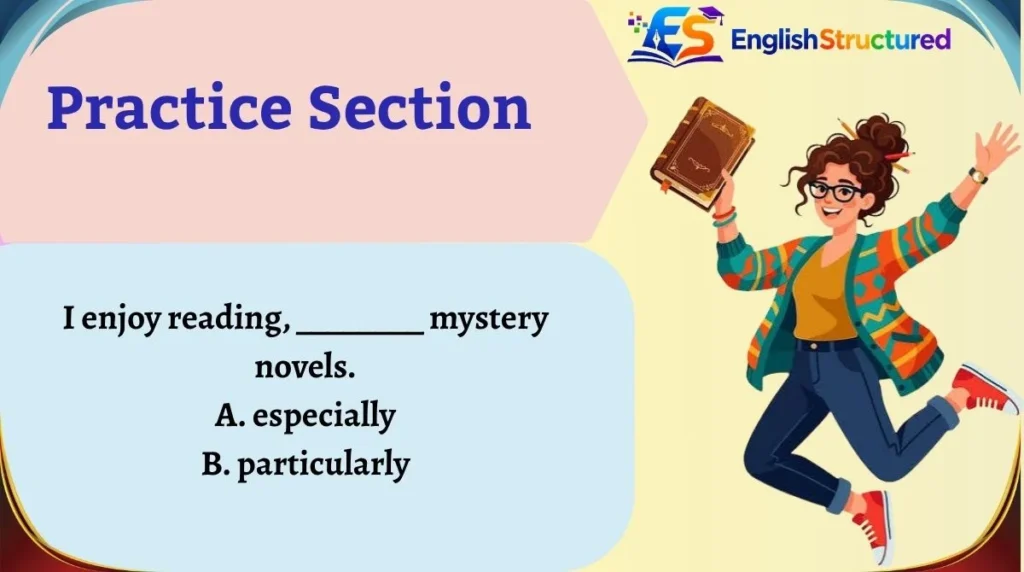
Now it’s time to test what you’ve learned. Read each sentence carefully and choose the correct word: especially or particularly.
Choose the Correct Option
1. I enjoy reading, ________ mystery novels.
A. especially
B. particularly
2. She wasn’t ________ happy with the final result.
A. especially
B. particularly
3. The park is beautiful, ________ in the spring.
A. especially
B. particularly
4. This lesson is ________ useful for beginners.
A. especially
B. particularly
5. We like all kinds of fruit, ________ mangoes.
A. especially
B. particularly
Answers and Explanations
1. A. especially
Mystery novels are one type of book chosen from a larger group.
Correct: I enjoy reading, especially mystery novels.
2. B. particularly
The sentence is negative (wasn’t), so particularly is the more natural choice.
Correct: She wasn’t particularly happy with the final result.
3. A. especially
Spring is one season chosen from all the seasons.
Correct: The park is beautiful, especially in the spring.
4. B. particularly
The sentence emphasizes how useful the lesson is.
Correct: This lesson is particularly useful for beginners.
5. A. especially
Mangoes are one fruit selected from many kinds of fruit.
Correct: We like all kinds of fruit, especially mangoes.
Bonus Practice
Fill in the blanks with especially or particularly.
- I love animals, __________ dogs.
- He wasn’t __________ interested in football.
- The roads are __________ busy during the holidays.
- She is __________ kind to young children.
- We enjoy visiting beaches, __________ in summer.
Bonus Answers
- especially
- particularly
- particularly
- particularly
- especially
FAQs
What is the difference between especially and particularly?
Both words add emphasis, but they are used differently. Especially highlights one person or thing from a group, while particularly emphasizes the degree of a quality, feeling, or situation. In some sentences, both words work, but one usually sounds more natural.
Can we use especially and particularly in questions?
Yes. Both words can appear in questions.
Examples:
- Do you especially enjoy any type of music?
- Is there anything you particularly want to discuss?
The choice depends on the meaning. Use especially for favorites or standout examples, and particularly for stronger emphasis.
Is particularly more formal than especially?
Yes. Particularly is often considered slightly more formal. It appears frequently in academic writing, reports, business communication, and professional speech. Especially is very common in both spoken and written English and usually sounds more conversational.
Can especially and particularly always replace each other?
No. Although they have similar meanings, they are not always interchangeable. Especially is better when selecting one item from a group, while particularly is better when emphasizing intensity or degree. In many everyday sentences, either word is acceptable, but one may sound more natural.
Why is particularly common in negative sentences?
Native speakers often use particularly after negative verbs because it creates a softer and more natural tone.
Examples:
- I don’t particularly like horror movies.
- She wasn’t particularly worried.
Especially vs Particularly
Which word should beginners use more often?
For everyday conversations, beginners can safely use especially when talking about favorite things or examples. As your English improves, start using particularly to describe stronger feelings, opinions, and qualities. Learning both words will make your English sound more natural and fluent.
Conclusion
Especially vs Particularly
Although both words add emphasis, they do not always serve the same purpose.
Especially is used when one person, thing, or idea stands out from a larger group.
Particularly, on the other hand, emphasizes the strength or degree of a feeling, quality, or situation.
A simple way to remember the difference is this: especially chooses, while particularly strengthens.
If you are talking about your favorite food, hobby, or place, especially is usually the right choice.
If you are describing how happy, tired, useful, or important something is, particularly often fits better.
Don’t worry if you make mistakes at first. Even advanced learners sometimes pause before choosing between these two words.
The more you read, listen, speak, and write in English, the more natural the difference will become.
Practice using both words in your daily conversations.
Try making your own example sentences, notice how native speakers use them, and review the grammar rules whenever you feel unsure.
With regular practice, choosing between especially and particularly will soon become second nature, helping you communicate with greater confidence and accuracy.