Congratulations On or For
If yes, you are not alone. Many English learners make this mistake because both on and for are common prepositions.
They often seem similar, but they are not always used in the same way.
You may hear someone say, “Congratulations on your new job!” Then another person says, “Thank you for your help.”
Since both expressions talk about positive things, it is easy to wonder if you can also say “Congratulations for your new job.”
This confusion is very common among students and non-native English speakers.
Learning the correct preposition is important because people use the word congratulations in everyday conversations.
You may need it when someone gets married, passes an exam, wins a competition, gets a promotion, or celebrates another happy event.
Using the right preposition makes your English sound natural, polite, and confident.
English grammar often depends on small words like on, for, to, and with.
These little words can completely change whether a sentence sounds correct. That is why understanding them is just as important as learning new vocabulary.
By the end of this guide, you will clearly understand when to use “congratulations on,” when “for” appears in related expressions, why learners get confused, and how to avoid common grammar mistakes.
With plenty of simple explanations and real-life examples, choosing the correct expression will become much easier.
What Does “Congratulations” Mean?
Congratulations is an expression that you say when you are happy about another person’s success, achievement, good news, or special event.
It shows that you share their happiness and want to celebrate their accomplishment.
Congratulations On or For. Although it ends in -s, it is treated as a fixed expression. Native speakers normally say “Congratulations!” instead of “Congratulation!”
Simple Definition
Congratulations means “I am happy about your success or good news.”
It is a polite way to praise someone for achieving something important or reaching a special milestone.
When Do We Use “Congratulations”?
We use congratulations when someone:
- Passes an exam
- Gets a new job
- Wins a game or competition
- Gets married
- Has a baby
- Graduates from school or university
- Receives a promotion
- Buys a new house
- Achieves a personal goal
The focus is always on another person’s happy achievement or special event.
Grammar Rule
The most common pattern is:
Congratulations On or For
or
Congratulations + on + verb (-ing)
Notice that on usually follows congratulations when you mention the reason.
Examples:
- Congratulations On or For
- Congratulations on your new job.
- Congratulations on winning the competition.
- Congratulations on passing your driving test.
- Congratulations On or For
If you simply want to express happiness without mentioning the reason, you can say:
- Congratulations!
- Many congratulations!
- Congratulations On or For
- Congratulations, everyone!
Is “Congratulations” a Verb?
No. Congratulations is not a verb.
Congratulations On or For
Compare these sentences:
- I congratulated my brother on his success.
- Congratulations On or For
- Everyone congratulated the happy couple.
But when speaking directly, we usually use the expression:
- Congratulations On or For
- Congratulations on your wedding!
Common Sentence Patterns
Here are some natural sentence structures:
Pattern 1
Congratulations On or For
- Congratulations on your promotion.
- Congratulations on your achievement.
- Congratulations on the new house.
Pattern 2
Congratulations + on + verb (-ing)
- Congratulations on graduating.
- Congratulations On or For
- Congratulations on winning first prize.
Pattern 3
Congratulations On or For
- Congratulations, David!
- Congratulations, everyone!
- Congratulations On or For
Everyday Examples
Here are some common examples that native speakers use every day.
- Congratulations on your new job!
- Congratulations on passing the exam.
- Congratulations On or For
- Congratulations on buying your first car.
- Congratulations on your wedding.
- Congratulations on finishing the marathon.
- Congratulations On or For
- Congratulations! You worked really hard for this.
Common Learner Confusion
Congratulations On or For
For example:
- Thank you for your help. ✅
- Congratulations On or For
Congratulations On or For
Another common mistake is saying:
❌ Congratulations for your new job.
The natural sentence is:
✅ Congratulations on your new job.
Congratulations On or For
Compare these examples:
- Congratulations On or For
- Congratulations on your success! ✅
Notice that both expressions are followed by “on” when introducing the achievement.
Quick Summary
Remember these important points:
- Congratulations is an expression of happiness for another person’s success.
- It is usually followed by on when mentioning the achievement.
- Congratulations On or For
- Congratulations On or For
- The most common grammar pattern is Congratulations on + achievement.
What Does “On” Mean?
The word on is one of the most common prepositions in English. It has many different meanings, depending on the sentence.
Sometimes it shows position, sometimes time, and sometimes it connects an expression to its reason or topic.
Congratulations On or For. In this case, on does not mean physical position. Instead, it links the congratulatory message to the reason for celebrating.
Simple Definition
Congratulations On or For
“because of this achievement or special event.”
Congratulations On or For
When Do We Use “On” After “Congratulations”?
Use on when you mention:
- An achievement
- A success
- A happy event
- A completed action
- A life milestone
This is the standard and most natural pattern in English.
Grammar Rule
The basic structure is:
Congratulations On or For
Examples:
- Congratulations on your graduation.
- Congratulations on your promotion.
- Congratulations on your success.
- Congratulations on the award.
- Congratulations on your engagement.
You can also use:
Congratulations On or For
Examples:
- Congratulations on graduating.
- Congratulations on winning.
- Congratulations On or For
- Congratulations on getting your driver’s license.
- Congratulations on finishing your degree.
Real-Life Examples
Here are several examples you may hear in daily conversations.
- Congratulations On or For
- Congratulations on your baby girl.
- Congratulations on passing the interview.
- Congratulations on getting accepted into college.
- Congratulations On or For
- Congratulations on your first book.
- Congratulations on reaching one million subscribers.
- Congratulations on your retirement.
Why Is “On” Used Here?
English has many expressions where the preposition is fixed. These combinations have developed through common usage over many years.
For example:
- Congratulations On or For
- focus on
- insist on
- Congratulations On or For
The preposition is part of the expression and should be learned together with the main word. Trying to replace it with another preposition often creates unnatural English.
Common Learner Confusion
Many learners ask:
Congratulations On or For
The reason is that on is the accepted preposition after congratulations when introducing the achievement.
The word for is used in many other expressions, such as:
- Thank you for your help.
- Sorry for being late.
- Famous for its beaches.
- Rewarded for hard work.
Congratulations On or For. However, standard English prefers on in this situation.
Examples: Correct and Incorrect
❌ Congratulations for your graduation.
Congratulations On or For
❌ Congratulations for winning the race.
✅ Congratulations on winning the race.
❌ Congratulations for your promotion.
✅ Congratulations on your promotion.
Key Points to Remember
- Congratulations On or For
- It introduces the achievement or happy event.
- It can be followed by a noun or an -ing verb.
- Congratulations On or For
What Does “For” Mean?
The preposition for is one of the most useful words in English. It has many meanings, and native speakers use it every day. It can show a reason, purpose, benefit, time, destination, or support. Congratulations On or For. However, that is usually not correct.
Congratulations On or For
Simple Definition
For usually means:
- because of
- intended for
- to help or benefit someone
- in exchange for
- during a period of time
The exact meaning depends on the sentence.
When Do We Use “For”?
We commonly use for to talk about:
- A reason
- A purpose
- A benefit
- A period of time
- A destination or recipient
Look at these examples:
- Congratulations On or For
- This gift is for you.
- We waited for two hours.
- She studied for the exam.
- He was rewarded for his bravery.
- Congratulations On or For
- This medicine is for headaches.
- I bought flowers for my mother.
Congratulations On or For
Grammar Rule
Some common sentence patterns with for include:
Pattern 1
Verb + for + noun
Examples:
- Thank you for your support.
- We apologize for the delay.
- She paid for the meal.
- He asked for help.
Pattern 2
Congratulations On or For
Examples:
- Famous for its beaches.
- Responsible for the project.
- Ready for school.
- Good for your health.
Pattern 3
Congratulations On or For
Examples:
- Congratulations On or For
- A gift for your birthday.
- Respect for others.
- Love for music.
Can We Say “Congratulations For”?
This is the question that confuses many learners.
In standard English, we normally say:
- Congratulations on your success.
- Congratulations On or For
- Congratulations on your graduation.
Using for after congratulations sounds unnatural in most situations.
Although you may occasionally hear congratulations for in informal speech or in some regional varieties of English, it is not the standard choice and is generally avoided in formal writing, exams, business communication, and most everyday English.
Congratulations On or For
Examples of Correct Usage
Correct:
- Thank you for your help.
- We are grateful for your support.
- Congratulations On or For
- He apologized for arriving late.
- They praised her for her honesty.
- I bought this for my sister.
- This letter is for you.
- Congratulations On or For
Common Learner Confusion
Many students create sentences like these:
❌ Congratulations for your wedding.
❌ Congratulations for passing the exam.
❌ Congratulations for your promotion.
These sentences follow the grammar pattern of expressions such as:
- Thank you for your help.
- Sorry for the mistake.
- Congratulations On or For
Congratulations On or For
The correct versions are:
- Congratulations on your wedding.
- Congratulations on passing the exam.
- Congratulations On or For
Learning these fixed expressions together is much easier than translating word by word.
Difference Between “On” and “For” After Congratulations
Congratulations On or For
When you congratulate someone, on introduces the achievement or happy event. The preposition for usually explains the reason for an action, thanks, praise, apology, reward, or benefit—not the event being celebrated.
Quick Comparison Table
| Feature | On | For |
|---|---|---|
| Congratulations On or For | ✅ Yes | ❌ Usually no |
| Introduces an achievement | ✅ Yes | ❌ No |
| Shows purpose or benefit | ❌ Rare | ✅ Yes |
| Standard English choice | ✅ Yes | ❌ No |
| Common in exams | ✅ Yes | ❌ Incorrect in most cases |
Meaning Difference
Consider these two sentences.
✅ Congratulations on your promotion.
This means you are celebrating the person’s success.
Now compare it with:
Congratulations On or For
Although many people understand the meaning, it does not sound natural in standard English.
Grammar Logic
The expression congratulate someone on something has been a fixed grammar pattern for a very long time.
The structure is:
Congratulations On or For
Examples:
- We congratulated Anna on her success.
- Congratulations On or For
- I congratulated my parents on their anniversary.
Congratulations On or For
- Congratulations on your success.
- Congratulations on graduating.
- Congratulations On or For
Because both forms share the same grammar pattern, changing on to for is not considered standard English.
Sentence Structure Comparison
Congratulations + on + noun
- Congratulations on your graduation.
- Congratulations on the promotion.
- Congratulations on your achievement.
Congratulations + on + verb (-ing)
- Congratulations on winning.
- Congratulations on finishing your book.
- Congratulations on passing the driving test.
Compare these with common for expressions:
- Thank you for your patience.
- Sorry for the mistake.
- Rewarded for hard work.
- Praised for honesty.
- Famous for its history.
These are completely different grammar patterns.
Why Do Learners Mix Them Up?
There are several reasons.
1. Translation from Other Languages
Many languages use one preposition for both situations. Learners naturally translate directly into English.
2. Similar Expressions
Students already know:
- Thank you for…
- Sorry for…
- Happy for…
- Proud of…
Because these expressions all use different prepositions, learners often guess instead of remembering the fixed pattern.
3. Small Words Are Easy to Ignore
Prepositions are tiny words, but they carry important grammar meaning. A single wrong preposition can make a sentence sound unnatural.
Meaning Comparison
Compare these natural English expressions.
| Expression | Meaning |
|---|---|
| Congratulations on your graduation. | Celebrating someone’s achievement. |
| Thank you for your help. | Showing gratitude. |
| Sorry for the delay. | Giving an apology. |
| Rewarded for hard work. | Explaining the reason for the reward. |
| Praised for honesty. | Explaining why someone received praise. |
Notice that only congratulations takes on.
Which Should You Choose?
If you are congratulating someone about a success, always ask yourself:
“Am I talking about their achievement?”
If the answer is yes, use on.
Examples:
- Congratulations on your promotion.
- Congratulations on your graduation.
- Congratulations on your wedding.
- Congratulations on your new baby.
- Congratulations on winning first prize.
This simple habit will help you sound much more like a native English speaker.
Grammar Rules You Must Remember
Remembering a few simple grammar rules can save you from making the same mistake again and again.
Rule #1: Use “Congratulations on” Before an Achievement
Whenever you mention a success, celebration, or milestone, use on.
Examples:
- Congratulations on your new house.
- Congratulations on your excellent grades.
- Congratulations on your promotion.
Rule #2: Use “On” Before an -ing Verb
If the achievement is written as an action, use the -ing form.
Examples:
- Congratulations on winning the tournament.
- Congratulations on completing your degree.
- Congratulations on getting your dream job.
Rule #3: “Congratulations” Can Stand Alone
You do not always have to explain the reason.
Examples:
- Congratulations!
- Congratulations, Emma!
- Many congratulations!
- Congratulations, everyone!
These are perfectly natural when the achievement is already clear from the conversation.
Rule #4: Do Not Replace “On” with “For”
Even though for is common after many English expressions, it should not replace on after congratulations.
Wrong:
- Congratulations for your success.
- Congratulations for passing the exam.
- Congratulations for your engagement.
Correct:
- Congratulations on your success.
- Congratulations on passing the exam.
- Congratulations on your engagement.
Quick Review
Keep these points in mind:
- Congratulations → on
- Thank you → for
- Sorry → for
- Rewarded → for
- Praised → for
- Congratulated → on
Learning these fixed combinations will make your English more accurate and much more natural.
Common Mistakes Students Make
Even advanced learners sometimes choose the wrong preposition after congratulations. The mistake usually happens because English has many similar expressions that use for instead of on.
The good news is that once you understand the pattern, these mistakes become much easier to avoid.
Mistake 1: Using “For” After “Congratulations”
This is the most common error.
❌ Congratulations for your graduation.
✅ Congratulations on your graduation.
Remember that on introduces the achievement being celebrated.
Mistake 2: Copying the Pattern of “Thank You For”
Students often think:
- Thank you for your help.
So they also write:
❌ Congratulations for your success.
The correct sentence is:
✅ Congratulations on your success.
These expressions follow different grammar rules.
Mistake 3: Forgetting the -ing Form
When talking about an action, use on + verb-ing.
❌ Congratulations on win the competition.
✅ Congratulations on winning the competition.
The -ing form is required after the preposition on.
Mistake 4: Using the Singular Form “Congratulation”
Many learners say:
❌ Congratulation on your new job.
The natural expression is:
✅ Congratulations on your new job.
The word congratulations is almost always used in the plural form.
Mistake 5: Translating Directly
Direct translation from your first language often leads to incorrect prepositions.
Instead of translating, try to remember the complete expression:
Congratulations on…
Think of it as one phrase rather than two separate words.
Easy Correction Tips
Whenever you want to congratulate someone, ask yourself these questions:
- Am I celebrating a success?
- Am I talking about an achievement?
- Am I mentioning good news?
If the answer is yes, use:
Congratulations on…
This simple check will help you avoid one of the most common English grammar mistakes.
Easy Trick to Remember the Difference
Many English learners struggle with small words like on and for because both are common prepositions. The good news is that you do not need to memorize long grammar rules. A simple memory trick can help.
Memory Trick #1: Think of a Medal
Imagine someone wins a medal.
You say:
“Congratulations on your medal!”
The word on points to the achievement. It is like placing a spotlight on the success.
Whenever you celebrate something a person has achieved, think:
Success → On
Examples:
- Congratulations on your promotion.
- Congratulations on your graduation.
- Congratulations on your new home.
- Congratulations on winning first prize.
Memory Trick #2: Think of a Thank-You Card
Now imagine someone helps you carry heavy bags.
You say:
“Thank you for your help.”
Here, for explains the reason you are thanking someone.
So remember:
- Congratulations → On
- Thank you → For
Mixing these patterns is one of the biggest mistakes English learners make.
Memory Trick #3: Learn the Whole Phrase
Instead of learning one word at a time, memorize the complete expression.
Learn these together:
- Congratulations on…
- Thank you for…
- Sorry for…
- Apologize for…
- Congratulate someone on…
Native speakers remember these as fixed expressions, and you can do the same.
Real-Life Logic
Imagine your friend says:
“I got promoted today!”
Your natural reply is:
“Congratulations on your promotion!”
Now imagine your friend helps you move to a new apartment.
Your reply changes:
“Thank you for your help.”
The achievement takes on, while the reason for thanks takes for.
The more you notice these patterns in conversations, books, and movies, the easier they become to remember.
Daily Life Examples
Here are some natural conversations you might hear every day. Pay attention to how congratulations on is used.
Example 1
A: I passed my driving test today.
B: Congratulations on passing your driving test!
Example 2
A: I finally graduated from college.
B: Congratulations on your graduation!
Example 3
A: We bought our first house.
B: Congratulations on your new home!
Example 4
A: I got the job!
B: Congratulations on your new job. You deserve it.
Example 5
A: My sister is getting married next month.
B: Congratulations on her wedding!
Example 6
A: Our team won the championship.
B: Congratulations on winning the title!
Example 7
A: I finished writing my first novel.
B: Congratulations on finishing your book!
Example 8
A: We just had a baby girl.
B: Congratulations on your beautiful baby!
Example 9
A: I received a promotion today.
B: Congratulations on your promotion. That’s wonderful news!
Example 10
A: I completed the marathon.
B: Congratulations on completing such a difficult race!
These examples show that on naturally introduces the achievement or happy event.
Practice Section
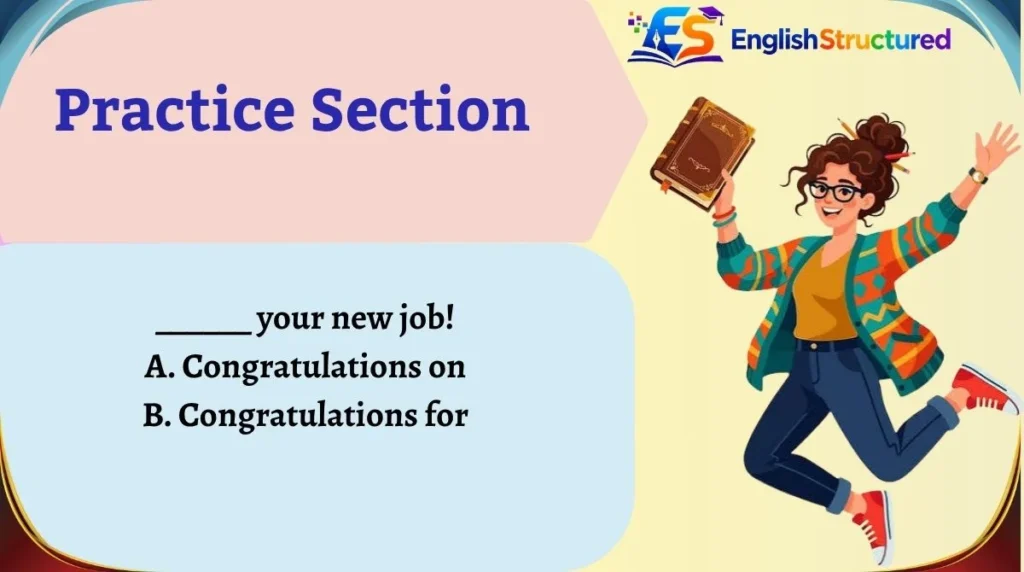
Choose the correct answer in each sentence.
1. ______ your new job!
A. Congratulations on
B. Congratulations for
2. Thank you ______ your kindness.
A. on
B. for
3. We congratulated Sarah ______ winning the competition.
A. on
B. for
4. Sorry ______ being late.
A. on
B. for
5. Congratulations ______ passing your final exam.
A. on
B. for
Answers
- ✅ A — Congratulations on your new job.
- ✅ B — Thank you for your kindness.
- ✅ A — We congratulated Sarah on winning the competition.
- ✅ B — Sorry for being late.
- ✅ A — Congratulations on passing your final exam.
If you answered all five correctly, you have a solid understanding of this grammar point.
FAQs
1. What is the difference between congratulations on and congratulations for?
Congratulations on is the standard and natural expression in English. It is used before achievements, celebrations, and good news. Congratulations for is generally not considered standard English in this context and should usually be avoided.
2. Can we use congratulations for in English?
In standard English, it is better to use congratulations on. Although you may occasionally hear for in informal speech or some regional varieties, on is the accepted choice in writing, exams, and most conversations.
3. Is congratulations on formal or informal?
It works in both situations. You can use it in casual conversations, emails, business messages, speeches, and formal letters.
4. Can we use congratulate and congratulations in the same way?
They are closely related but have different sentence structures.
- I congratulated him on his success.
- Congratulations on your success!
Both use on before the achievement.
5. Can on be followed by a verb?
Yes. After on, use the -ing form of the verb.
Examples:
- Congratulations on winning.
- Congratulations on graduating.
- Congratulations on completing the course.
6. Why do learners confuse on and for?
Many English expressions use for, such as thank you for, sorry for, and rewarded for. Learners often apply the same pattern to congratulations, but this expression follows a different grammar rule and uses on.
Conclusion
Choosing between congratulations on and congratulations for becomes much easier once you understand the grammar behind these expressions.
In standard English, congratulations on is the correct and natural choice when you are celebrating someone’s achievement, success, or happy news.
Whether a person gets a new job, graduates, wins a competition, or reaches an important life milestone, on is the preposition that native speakers normally use.
The confusion often happens because many other English expressions use for, such as thank you for, sorry for, and praised for.
While these phrases are correct, they follow different grammar patterns. Remember that congratulations and the verb congratulate are both commonly followed by on.
The best way to master this grammar point is through regular practice.
Read English books, listen to native speakers, and notice how they congratulate others in real conversations.
The more often you use congratulations on, the more natural it will feel.
Before long, choosing the correct preposition will become a habit, helping you speak and write English with greater confidence and accuracy.