Take It or Leave It
Does it mean someone should take an object and then leave it? Not quite.
“Take it or leave it” is a common English expression used when someone offers something and says that the other person can accept it or refuse it.
The speaker usually does not want to negotiate or make further changes.
For example, imagine that you are selling an old phone for $100. The buyer asks, “Can you sell it for $80?” You might say, “No, $100.
Take it or leave it.” This means the price is fixed. The buyer can pay $100 or decide not to buy the phone.
The expression is useful in daily conversations, business, shopping, negotiations, and informal speech.
However, its tone can sometimes sound strong or even rude, depending on how you say it.
By the end of this guide, you will understand the meaning of “take it or leave it,” how to use it correctly, its grammar, common mistakes, polite alternatives, and many natural examples.
You will also see how native speakers use this phrase in real conversations.
What Does “Take It” Mean?
“Take it” is made from the verb take and the pronoun it.
The basic meaning is to accept, receive, pick up, carry, or choose something, depending on the situation.
Take It or Leave It
The word “it” usually refers to something that has already been mentioned. It could be a price, offer, deal, object, job, suggestion, or arrangement.
For example:
“I can give you this chair for $20. Take it or leave it.”
Here, “it” refers to the chair and the offer to buy it for $20.
The grammar is simple:
Take + it
“Take” is the base form of the verb because the expression is an imperative sentence. Imperatives are commonly used to give instructions, commands, or suggestions.
Examples of “Take It”
- Take it if you like it.
- Take it. I don’t need it anymore.
- You can take it home with you.
- Take it or leave it.
- Take It or Leave It
- Take it before someone else buys it.
- I offered him the deal, but he didn’t take it.
- You can take it now or wait until tomorrow.
In ordinary English, “take it” does not always mean “accept an offer.” The context tells you what it means.
For example:
“Take it outside.”
Here, “take it” means carry something outside.
But:
Take It or Leave It
Here, “take it” means accept the $50 offer.
Why Do Learners Get Confused?
Many English learners try to understand every word separately. That can cause problems with expressions such as this one.
If you translate “take it” word by word, you may think only about physically picking something up. But English expressions often have meanings that depend on context.
In “take it or leave it,” the idea is not simply physical movement. It is about accepting or refusing an offer.
What Does “Leave It” Mean?
“Leave it” normally means to let something remain where it is, not touch it, or not take it with you.
For example:
- Leave it on the table.
- Please leave it alone.
- Leave it there for me.
- Don’t move it. Leave it where it is.
But in “take it or leave it,” the meaning is slightly different.
Here, “leave it” means reject or refuse the offer.
So the expression gives two choices:
Take it = accept it.
Leave it = refuse it.
Imagine a shop owner says:
Take It or Leave It
The shop owner means:
“You can buy it for $50, or you can decide not to buy it.”
Examples of “Leave It”
- If you don’t want the offer, leave it.
- You don’t have to accept it. You can leave it.
- I gave him my price, but he decided to leave it.
- Take the deal or leave it.
- If the conditions don’t suit you, leave it.
- You can accept my offer or leave it.
- I won’t change the price, so take it or leave it.
- She didn’t like the proposal and chose to leave it.
However, there is an important point here. Outside the fixed expression, native speakers do not always use “leave it” alone to mean “reject an offer.”
For example, saying:
“Do you want this job?”
“I’ll leave it.”
would sound unusual if you mean “No, I don’t want the job.”
More natural choices would be:
“No, I’ll pass.”
or:
“I’ll decline the offer.”
That is why learners should treat “take it or leave it” as a common expression rather than assuming that every use of “leave it” means “reject.”
Difference Between “Take It” and “Leave It”
The two parts create an either-or choice.
The speaker is basically saying:
Accept this offer, or refuse it.
| Expression | Basic meaning | Meaning in the phrase |
|---|---|---|
| Take it | Take or accept something | Accept the offer |
| Leave it | Leave or not take something | Refuse the offer |
| Take it or leave it | Choose between two options | Accept it as offered or reject it |
The important idea is that “take it or leave it” usually presents a fixed offer.
The speaker is often saying:
“This is what I am offering. I am not going to change it.”
For example:
Take It or Leave It
The seller is not inviting a long negotiation.
If the buyer says:
“Can you do $175?”
The seller may respond:
Take It or Leave It
Grammar Logic
The expression uses two imperatives:
Take it
or
Leave it
An imperative normally does not need a subject such as “you.”
Instead of saying:
You take it.
we normally say:
Take It or Leave It
Instead of:
You leave it.
we can say:
Take It or Leave It
The word “or” connects the two choices.
So the structure is:
Take it + or + leave it
This is why the phrase is grammatically simple even though its meaning is idiomatic.
Meaning Comparison
The phrase can communicate several related ideas:
- This is my final offer.
- I will not change the terms.
- You can accept it or refuse it.
- The choice is yours.
- I am not going to negotiate further.
The exact feeling depends heavily on tone.
A friendly speaker might say:
Take It or Leave It
A serious businessperson might say:
“That is our final price. Take it or leave it.”
The second version sounds much firmer.
Grammar Rules You Must Remember
Rule #1: “Take it or leave it” is an imperative expression
Take It or Leave It
You do not normally say:
❌ Takes it or leaves it.
The natural expression is:
Take It or Leave It
Imperatives use the base form of the verb.
Rule #2: “It” refers to something already understood
The pronoun it needs a clear meaning from the context.
For example:
“I’ll sell you my old laptop for $300. Take it or leave it.”
Here, it refers to the laptop and the offer connected with it.
The listener already knows what “it” means.
Rule #3: “Or” gives two choices
The word or connects the two possible actions.
Take it or leave it.
The listener has two choices:
- Accept it.
- Reject it.
This structure is common in English when someone presents alternatives.
Rule #4: The expression often means “final offer”
This is one of the most important points for learners.
When someone says:
“Take it or leave it.”
they often mean:
“This is my offer, and I am not going to change it.”
For example:
“I’ll work for $500 a week, but that’s my final offer. Take it or leave it.”
The speaker is showing that further negotiation may not be welcome.
Common Mistakes Students Make
Mistake 1: Thinking it is only about physical objects
A learner may hear:
“Take it or leave it.”
and think the person is literally asking someone to pick up an object.
That can happen in some contexts, but the expression is usually about accepting or rejecting something.
For example:
“I can offer you the position for $40,000 a year. Take it or leave it.”
Nobody is physically taking the job and leaving it behind.
Take It or Leave It
Mistake 2: Changing the verb forms
Some learners say:
❌ “Take it or leaves it.”
The correct fixed expression is:
✅ “Take it or leave it.”
Both verbs use the base form.
Mistake 3: Adding “to”
A common mistake is:
❌ “Take to it or leave to it.”
This is incorrect.
The correct expression is:
✅ “Take it or leave it.”
There is no to before “it.”
Mistake 4: Using it in every situation
The expression is useful, but it can sound too strong in some situations.
Imagine your friend asks:
“Which movie should we watch?”
You say:
“Watch this one. Take it or leave it.”
That may sound unnecessarily harsh.
A softer response would be:
“How about this one?”
or:
“We could watch this one if you want.”
Mistake 5: Thinking it is always rude
The expression is not automatically rude.
Its tone depends on the situation, relationship, and voice.
Between close friends, it can be playful:
Take It or Leave It
In a serious negotiation, it can sound firm:
“This is our final price. Take it or leave it.”
So the phrase is better described as firm or direct, rather than always rude.
Easy Trick to Remember the Difference
Here is a simple memory trick:
TAKE = YES
LEAVE = NO
When you hear:
Take It or Leave It
think:
Take It or Leave It
You can also remember it as:
Take = accept.
Leave = reject.
For example:
“I’ll sell you the phone for $150. Take it or leave it.”
Your choices are:
Take it → Buy the phone for $150.
Take It or Leave It
There is another useful clue. The expression often appears when someone has already made a decision about an offer, price, condition, or deal.
If someone is still open to negotiation, they may say:
“We can discuss the price.”
But if they say:
Take It or Leave It
they are usually saying:
“The offer is already decided.”
That makes the expression easy to recognize in real conversations.
Daily Life Examples
1. Buying a Used Phone
Buyer: Can you sell it for $180?
Seller: No, $200 is my final price.
Buyer: That’s a little high.
Seller: Take it or leave it.
Here, the seller does not want to lower the price.
2. Selling a Car
Seller: I’m asking $5,000 for the car.
Buyer: Would you take $4,500?
Seller: No. $5,000. Take it or leave it.
The seller is making a firm offer.
3. A Job Offer
Manager: The salary is $2,000 a month.
Applicant: Is there room for negotiation?
Take It or Leave It
The manager means that the salary will not change.
4. Sharing Food
Friend: I made some sandwiches.
You: Can I have one?
Friend: Sure. Take it or leave it!
Here, the phrase can be playful. It does not necessarily sound rude.
5. A Room for Rent
Tenant: Can you lower the rent?
Landlord: No. The rent is $600.
Tenant: I was hoping for $550.
Landlord: Sorry. $600. Take it or leave it.
The landlord is not willing to negotiate.
6. Choosing a Restaurant
Friend: I really want to try this restaurant.
You: I’m not sure about it.
Take It or Leave It
This can sound humorous between friends, although the tone matters.
7. A Freelance Project
Client: Can you complete the project for $300?
Designer: I normally charge $400.
Client: $300 is our budget.
Designer: Okay, $300. Take it or leave it.
The designer is setting a clear condition.
8. Selling Furniture
Customer: Could you sell the table for $70?
Seller: No, $90 is the lowest I can go.
Customer: I need to think about it.
Take It or Leave It
The seller is leaving the final choice to the customer.
9. Making Plans
Friend: I’m going hiking Saturday morning.
You: I don’t like waking up early.
Friend: We’re leaving at 6 a.m. Take it or leave it!
This use may be joking or playful. The speaker is saying the plan is fixed.
10. A Simple Offer
Dad: I’ll give you my old headphones.
Son: Really?
Dad: Yes. Take them or leave them.
This sentence is slightly different because the object is plural. The speaker says “take them or leave them” because “headphones” is plural.
That shows an important grammar point: the pronoun can change according to the noun.
Practice Section
Choose the best answer for each sentence.
1. “The price is $50. ______.”
Take It or Leave It
B. Take it or leave it
C. Take to it or leave it
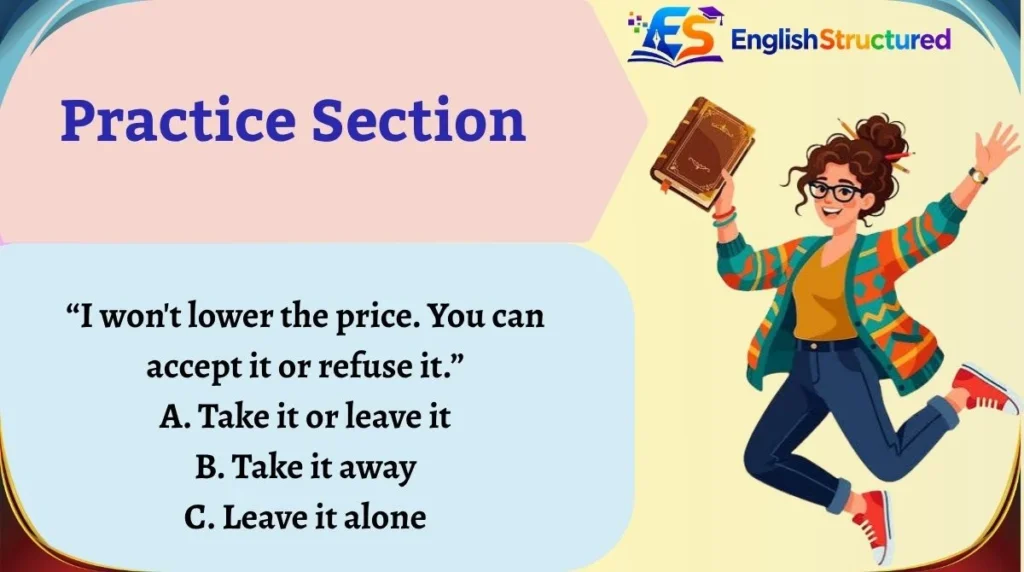
2. “I won’t lower the price. You can accept it or refuse it.”
Which expression fits best?
A. Take it or leave it
B. Take it away
C. Leave it alone
3. Which sentence is correct?
A. Take it or leaves it.
B. Takes it or leave it.
C. Take it or leave it.
4. What does “take it” usually mean in this expression?
A. Physically carry something
B. Accept the offer
C. Hide something
5. What does “leave it” usually mean in this expression?
A. Reject the offer
B. Carry the offer
C. Change the offer
Answers
1. B — Take it or leave it.
This is the standard expression.
Take It or Leave It
The speaker is offering something without wanting further negotiation.
3. C — Take it or leave it.
Both verbs stay in the base form.
4. B — Accept the offer.
“Take it” means accept what is being offered.
5. A — Reject the offer.
“Leave it” means decide not to accept it.
FAQs
What does “take it or leave it” mean?
Take It or Leave It. It is often used when a person makes a firm offer and does not want to negotiate further.
For example, “I’ll sell it for $100. Take it or leave it” means the price is $100, and the buyer must decide whether to accept it.
Is “take it or leave it” rude?
It can sound firm, direct, or even rude, depending on the situation and tone. Between friends, it may be playful.
In a business or negotiation setting, it can sound quite strong because it suggests that the speaker does not want to discuss the offer further.
Is “take it or leave it” formal or informal?
The expression is common in everyday spoken English and is generally considered informal or conversational.
It can also appear in business situations, especially during negotiations. However, a softer phrase may be better in formal communication.
Can I use “take it or leave it” in a question?
Usually, “take it or leave it” is not used as a normal question. It is generally a statement or command that gives someone a choice.
For example:
Take It or Leave It
If you want to ask politely, you could say:
“Would you like to accept the offer?”
What is another way to say “take it or leave it”?
Depending on the situation, you can say:
- “The choice is yours.”
- “That’s my final offer.”
- “That’s the best I can do.”
- “Accept it or decline it.”
- “I can’t change the offer.”
These alternatives can sound softer or more professional.
Does “leave it” always mean reject?
No. “Leave it” can have several meanings depending on context.
For example:
“Leave it on the desk.”
means do not move it.
But in:
Take It or Leave It
it means reject or refuse the offer.
The context is very important.
What is the difference between “take it or leave it” and “take it or leave”?
The standard expression is:
“Take it or leave it.”
The word “it” appears after both verbs because it refers to the offer or thing being discussed.
“Take it or leave” sounds incomplete in most situations.
Conclusion
Take It or Leave It. It often tells the listener that the speaker has made a final decision and is not planning to negotiate.
The easiest way to remember it is:
Take = accept.
Leave = reject.
The grammar is also simple. Both take and leave are base-form verbs used as imperatives, and it refers to something already understood from the conversation.
Remember that tone matters. With friends, the phrase can sound funny or casual. In a negotiation, it can sound firm or even a little harsh.
Once you understand the context, the expression becomes easy to recognize. Listen for it in conversations about prices, jobs, deals, plans, and offers.
Then try using it yourself when the situation feels natural. With a little practice, this common phrase will become a normal part of your everyday English.