Many English learners know the word “embed,” but they often feel confused about which preposition should follow it.
Embed in, Into, On, or Onto
The confusion happens because English prepositions often have similar meanings. A small word like in, into, on, or onto can change the meaning of a sentence.
Some combinations sound natural, while others are only correct in special situations.
If you choose the wrong preposition, your sentence may sound strange to native speakers, even if people still understand your meaning.
This topic is especially important if you write emails, create websites, study English grammar, or work with technology.
For example, web developers often talk about embedding a video into a webpage, while teachers may explain that a quote is embedded in a paragraph.
Understanding these small differences helps you write and speak more naturally.
By the end of this guide, you will know when to use each preposition after “embed,” understand the grammar behind each choice, avoid common learner mistakes, and feel more confident using these expressions in everyday English.
What Does “Embed” Mean?
The verb embed means to place something firmly inside something else so that it becomes a natural or fixed part of it.
The thing being embedded usually stays there instead of being removed easily.
Embed in, Into, On, or Onto
Simple Definition
Embed = to fix, insert, or place something securely inside another thing.
It often suggests that something becomes part of a larger object or system.
When to Use “Embed”
Use embed when something:
- becomes a permanent or important part of something else
- is inserted inside another object
- is included naturally in a text, website, design, or material
- is fixed so it does not move easily
Grammar Rule
The verb embed is usually followed by a noun and then a preposition.
Basic pattern:
embed + object + preposition + place
Examples:
- The engineer embedded the chip in the device.
- Embed in, Into, On, or Onto
- Tiny stones were embedded in the wall.
Different prepositions create slightly different meanings, which you will learn throughout this guide.
Common Uses of “Embed”
Here are some common situations where English speakers use embed.
Technology
- embed a video
- embed a map
- embed code
- Embed in, Into, On, or Onto
Writing
- Embed in, Into, On, or Onto
- embed evidence
- embed examples
Construction
- embed metal rods
- embed stones
- embed pipes
Everyday English
- embed an idea
- embed a habit
- embed a value
Example Sentences
- The workers embedded steel bars in the concrete.
- She embedded a quote in her essay.
- Embed in, Into, On, or Onto
- The scientist embedded a tiny sensor in the machine.
- Good teachers embed new vocabulary in everyday lessons.
- The artist embedded colorful glass in the wall.
- Developers can embed videos into blog posts.
- The memory is deeply embedded in his mind.
Common Learner Confusion
Many students think embed always uses the same preposition. That is not true.
For example:
- embed in
- Embed in, Into, On, or Onto
- embed on
- embed onto
All four exist, but they are not used equally.
The most common combinations are:
- embedded in
- Embed in, Into, On, or Onto
The forms embed on and embed onto are much less common and usually describe placing something on a surface rather than inside something.
Another common mistake is confusing embed with insert.
Compare these sentences:
- She inserted the key into the lock. ✅
- She embedded the key into the lock. ❌
Embed in, Into, On, or Onto
However:
- The workers embedded the anchor bolts in the concrete. ✅
The bolts become a permanent part of the concrete, so embed is the correct verb.
What Does “Into” Mean?
The preposition into shows movement from outside to inside. It tells us that something goes from one place to another until it reaches the inside.
This idea of movement is the biggest clue for choosing into.
Simple Definition
Into = moving from outside to inside something.
Think of it as showing a change of position.
When to Use “Into”
Use into when someone or something:
- moves inside another object
- is placed inside something
- changes from outside to inside
- enters a space or object
When paired with embed, into often emphasizes the action of putting something inside.
Grammar Rule
Use this pattern:
embed + object + into + place
This structure focuses on the process of embedding.
Examples:
- They embedded the video into the webpage.
- The company embedded a tracking chip into the package.
After the embedding is complete, English speakers often switch to embedded in to describe the final position.
Compare these two ideas:
Action
They embedded the chip into the device.
Final Result
The chip is embedded in the device.
This difference is one of the most important grammar points to remember.
Example Sentences
- The programmer embedded the code into the website.
- She embedded the photo into the presentation.
- Workers embedded the pipes into the concrete.
- The doctor embedded a tiny sensor into the patient’s arm.
- They embedded subtitles into the video.
- The designer embedded the logo into the image.
- Embed in, Into, On, or Onto
- The teacher embedded new vocabulary into every lesson.
Common Learner Confusion
Many students ask:
Should I say embed in or embed into?
Both can be correct.
The difference is mainly about movement versus location.
Compare these examples:
Embed in, Into, On, or Onto
This sentence focuses on the action of placing the chip.
The chip is embedded in the machine.
This sentence focuses on where the chip is now.
Think of into as showing the journey, while in shows the final destination.
Here is another comparison:
- She embedded the image into the article. ✅
- The image is embedded in the article. ✅
Both are natural, but each highlights a different stage.
Tip for Everyday English
When you are describing how something is added, into often sounds more natural.
When you are describing where something already is, in is usually the better choice.
For example:
- The editor embedded several links into the blog post before publishing it.
- Those links are now embedded in the blog post.
Native speakers use this pattern very often because it clearly separates the action from the result.
What Does “In” Mean?
The preposition in shows that something is inside a place, object, or area. Unlike into, it does not describe movement. Instead, it describes the position or final state of something.
When people use embedded in, they usually mean that something is already fixed inside another object.
Simple Definition
In = inside something or already located within it.
Think of in as describing where something is, not how it got there.
When to Use “In”
Use in when:
- something is already inside another object
- you describe the final position after embedding
- something has become a permanent part of something else
- you talk about ideas, memories, values, or information that are firmly established
This is the most common preposition after embed in everyday English.
Grammar Rule
The usual pattern is:
Embed in, Into, On, or Onto
Examples:
- The chip is embedded in the card.
- The picture is embedded in the document.
You can also use it with active sentences.
- The company embedded security features in the software.
Although embed into is also correct, embedded in is much more common when talking about the finished result.
Example Sentences
- The key is embedded in the wall.
- Small stones are embedded in the road.
- The video is embedded in the webpage.
- Her ideas are deeply embedded in the company’s culture.
- The quotation is embedded in the second paragraph.
- Gold was embedded in the rock.
- Tiny air bubbles are embedded in the glass.
- The memory remains embedded in his mind.
“Embedded in” with Abstract Ideas
Embed in, Into, On, or Onto
Examples:
- Respect is embedded in our school culture.
- These traditions are deeply embedded in society.
- Good habits become embedded in daily life.
- Trust is embedded in every successful relationship.
Here, nothing is physically inside something. Instead, the idea has become a natural and lasting part of a group, culture, or habit.
Common Learner Confusion
Many learners write:
❌ The image is embedded into the webpage.
While native speakers understand this sentence, embedded in the webpage is more natural because the image is already there.
Compare these examples:
Action
- The developer embedded the image into the webpage.
Result
- The image is embedded in the webpage.
This action-versus-result pattern appears throughout English grammar.
What Does “On” and “Onto” Mean?
The prepositions on and onto are much less common after embed, but they are still correct in certain situations.
Many learners believe they should never use these prepositions with embed. That is not true. They simply have more limited uses.
Understanding their meanings will help you know when they sound natural and when another preposition is a better choice.
What Does “On” Mean?
On means resting on or attached to the surface of something.
Unlike in, it does not suggest that something is inside another object.
Simple Definition
On = touching or attached to a surface.
When to Use “On”
Use on when something is fixed to a surface rather than placed inside it.
Examples include:
- signs
- labels
- decorative pieces
- electronic components attached to a board
- objects secured to a surface
Grammar Rule
Typical pattern:
Embed in, Into, On, or Onto
Although correct, this structure is much less common than embed in.
Example Sentences
- The artist embedded crystals on the wooden frame.
- Decorative stones were embedded on the wall’s surface.
- Tiny lights were embedded on the stage floor.
- Embed in, Into, On, or Onto
- Small mirrors were embedded on the artwork.
- The designer embedded jewels on the crown.
- The logo is embedded on the front cover.
- The buttons are embedded on the control panel.
Notice that these examples describe something attached to a surface, not placed inside it.
Common Learner Confusion About “On”
Many students write:
❌ The video is embedded on the webpage.
In normal web and computer English, native speakers usually say:
Embed in, Into, On, or Onto
Even though users see the video on the page, the code is considered part of the webpage itself. Embed in, Into, On, or Onto.
What Does “Onto” Mean?
Onto describes movement toward a surface.
It is similar to the relationship between in and into.
- On = location
- Onto = movement
Simple Definition
Embed in, Into, On, or Onto
When to Use “Onto”
Use onto when an object is being attached or fixed onto a surface.
This use is uncommon with embed, but it appears in engineering, manufacturing, art, and design.
Grammar Rule
Pattern:
Embed in, Into, On, or Onto
The focus is on the action of placing something onto a surface.
Example Sentences
- Workers embedded decorative stones onto the pathway.
- The artist embedded glass pieces onto the sculpture.
- Engineers embedded sensors onto the metal plate.
- The designer embedded jewels onto the bracelet.
- They embedded tiny lights onto the ceiling panel.
- Craftsmen embedded shells onto the wooden table.
- The company embedded a tracking label onto the package.
- Students embedded colorful tiles onto the mural.
Common Learner Confusion About “Onto”
Many learners think onto and into mean the same thing.
They do not.
Compare these examples:
- The worker embedded the chip into the device. ✅ (inside)
- The worker embedded the label onto the device. ✅ (surface)
The first object goes inside.
The second object is attached to the outside surface.
Choosing the correct preposition depends on where the object ends up.
Difference Between “Embed in,” “Embed into,” “Embed on,” and “Embed onto”
These four expressions are related, but each highlights a different idea. The choice depends on whether you are talking about movement, location, or surface attachment.
| Expression | Main Meaning | Focus | Most Common Use | Example |
|---|---|---|---|---|
| Embed in | Already inside | Final position | Very common | The chip is embedded in the card. |
| Embed into | Move inside | Action | Very common | They embedded the chip into the card. |
| Embed on | Located on a surface | Final position | Less common | Decorative stones are embedded on the wall. |
| Embed onto | Move onto a surface | Action | Rare | Workers embedded stones onto the pathway. |
Meaning Comparison
Here is the easiest way to understand the differences.
- Embed in, Into, On, or Onto
- In focuses on the final position inside.
- Onto focuses on moving something onto a surface.
- On focuses on the final position on a surface.
Think of them like this:
- into → in
- Embed in, Into, On, or Onto
This pattern is the same with many other English verbs.
Examples:
- She walked into the room. → She is in the room.
- The cat jumped onto the table. → The cat is on the table.
- Embed in, Into, On, or Onto
- They embedded crystals onto the frame. → The crystals are embedded on the frame.
Grammar Logic
A simple question can help you choose the correct preposition:
Is the object moving or already there?
- If it is moving inside → into
- If it is already inside → in
- Embed in, Into, On, or Onto
- If it is already on a surface → on
Which Forms Do Native Speakers Use Most?
In modern English, the most natural and frequent combinations are:
- embedded in ✅ (most common)
- Embed in, Into, On, or Onto
- embedded on ⚠️ (used only for surface attachment)
- embed onto ⚠️ (least common and mainly used in technical or artistic contexts)
Embed in, Into, On, or Onto. These are the combinations that learners should master first before using the less common on and onto forms.
Grammar Rules You Must Remember
Learning a few simple grammar rules will help you choose the correct preposition every time. Instead of memorizing long lists, focus on the meaning of each preposition. Once you understand the idea behind in, into, on, and onto, using them becomes much easier.
Rule #1: Use into for Movement
Use into when something is being placed or inserted inside another object. The action is still happening.
Formula:
embed + object + into + place
Examples:
- The developer embedded the video into the website.
- She embedded the photo into the presentation.
- Workers embedded steel rods into the concrete.
- Embed in, Into, On, or Onto
Why it works:
The object is moving from the outside to the inside.
Rule #2: Use in for the Final Position
After something has been embedded, use in to describe where it is.
Formula:
be + embedded + in + noun
Examples:
- The video is embedded in the website.
- The steel rods are embedded in the concrete.
- The quotation is embedded in the article.
- Tiny diamonds are embedded in the ring.
Why it works:
The action is finished, and the object is now inside something.
Rule #3: Use on or onto Only for Surface Attachment
These prepositions are used when something is attached to a surface rather than placed inside.
- Onto shows movement.
- On shows location.
Examples:
- The artist embedded small mirrors onto the frame.
- The mirrors are embedded on the frame.
- Embed in, Into, On, or Onto
- The stones are embedded on the pathway.
Remember:
These forms are much less common than in and into.
Rule #4: Think About the Meaning Before Choosing the Preposition
Instead of asking, “Which preposition comes after embed?” ask yourself:
Where does the object end up?
If it ends up:
- inside → use in or into
- Embed in, Into, On, or Onto
This simple question helps you choose the correct preposition in almost every situation.
Examples:
- Embed in, Into, On, or Onto
- The security chip is embedded in the card.
- The designer embedded gems onto the crown.
- The gems are embedded on the crown.
Common Mistakes Students Make
Many English learners make the same mistakes because the prepositions seem very similar. The good news is that once you know the pattern, these errors are easy to fix.
Mistake #1: Using in Instead of into for an Action
Wrong:
❌ The engineer embedded the chip in the phone yesterday.
Better:
Embed in, Into, On, or Onto
Why?
The sentence describes the action of putting the chip inside the phone. Into highlights movement.
Mistake #2: Using into for the Final Result
Wrong:
Embed in, Into, On, or Onto
More Natural:
✅ The chip is embedded in the phone.
Why?
The embedding has already happened. The sentence describes the chip’s location, not the action.
Mistake #3: Using on for Websites
Many learners think:
Embed in, Into, On, or Onto
Native speakers almost always say:
✅ The video is embedded in the webpage.
Why?
The video becomes part of the webpage’s content or code, so in is the standard choice.
Mistake #4: Thinking Every Sentence Needs Into
Embed in, Into, On, or Onto
Examples:
❌ The quotation is embedded into the paragraph.
Natural English usually prefers:
✅ The quotation is embedded in the paragraph.
Again, the sentence describes the finished position.
Mistake #5: Confusing Embed with Insert
These verbs are similar but not identical.
Insert usually means placing something where it can easily be removed later.
Examples:
- Insert the key into the lock.
- Embed in, Into, On, or Onto
- Insert your password.
Embed usually means making something a permanent or fixed part of something else.
Examples:
- Embed steel bars in concrete.
- Embed a video in a webpage.
- Embed in, Into, On, or Onto
Knowing this difference makes your English sound much more natural.
Easy Correction Tips
When checking your writing, ask yourself these questions:
- Is something moving inside another object?
- Use into.
- Is something already inside?
- Use in.
- Is something moving onto a surface?
- Use onto.
- Is something already attached to a surface?
- Use on.
These four questions solve most preposition problems with embed.
Easy Trick to Remember the Difference
You don’t need to memorize dozens of grammar rules. A simple memory trick can help you remember the correct preposition every time.
Memory Trick
Think of these pairs:
- Into → In
- Onto → On
The longer words (into and onto) describe movement.
The shorter words (in and on) describe the final place.
Imagine carrying a book.
You move into a room.
Now you are in the room.
You place the book onto a table.
Now the book is on the table.
Embed in, Into, On, or Onto
- Embed the chip into the phone.
- The chip is embedded in the phone.
- Embed in, Into, On, or Onto
- The decoration is embedded on the wall.
Another Easy Way to Remember
Ask yourself one simple question:
Is the action happening now, or is it already finished?
If the action is happening:
- use into
- Embed in, Into, On, or Onto
If the action is finished:
- use in
- use on
This rule works in most everyday situations.
Real-Life Logic
Imagine building a house.
Embed in, Into, On, or Onto
Later, those steel bars are embedded in the concrete.
Now imagine decorating a picture frame.
First, you press tiny jewels onto the frame.
Embed in, Into, On, or Onto
Visualizing these situations makes the grammar much easier to remember.
Student-Friendly Reminder
Keep this short sentence in mind:
Embed in, Into, On, or OntoPosition = In / On
If you remember only these four words, you’ll avoid most mistakes with embed and its prepositions.
Daily Life Examples
The best way to learn grammar is by seeing it in real conversations. Embed in, Into, On, or Onto.
Conversation Examples
- A: Can you add this YouTube video to our website?
B: Sure. I’ll embed it into the homepage this afternoon. - A: Where is the video now?
B: It’s already embedded in the homepage. - The company embedded a security chip into every employee ID card.
- The security chip is embedded in the card, so it cannot be removed easily.
- The artist embedded colorful stones onto the garden wall yesterday.
- Embed in, Into, On, or Onto
- Our teacher embedded new vocabulary into every classroom activity.
- Those new words are now embedded in the students’ daily conversations.
- Engineers embedded sensors into the bridge to monitor its condition.
- The sensors are permanently embedded in the bridge.
More Everyday Sentences
- The designer embedded the company logo into the presentation.
- The logo is embedded in every slide.
- My grandfather embedded family values in all of us.
- The coach embedded discipline into the team’s daily routine.
- Small diamonds were embedded in the necklace.
- Embed in, Into, On, or Onto
Notice how into usually describes the action, while in describes the final result.
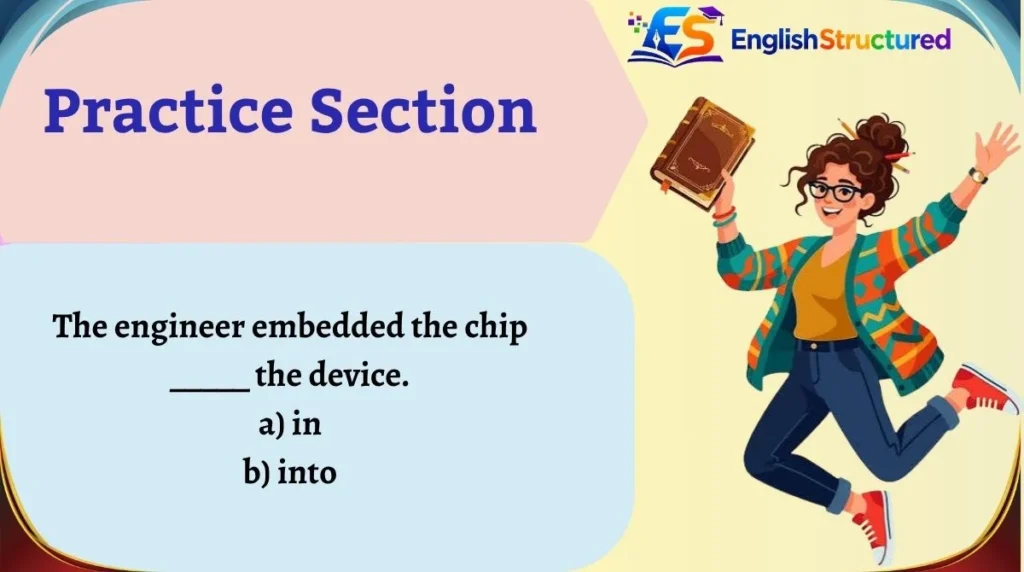
Practice Section
Embed in, Into, On, or Onto
Practice Questions
1. The engineer embedded the chip _____ the device.
a) in
b) into
2. The chip is embedded _____ the device.
a) in
b) into
3. The artist embedded tiny crystals _____ the wooden frame.
a) onto
b) into
4. The crystals are embedded _____ the wooden frame.
a) on
b) into
5. The teacher embedded new grammar lessons _____ every class.
a) into
b) on
Answers
1. ✅ into
The sentence describes the action of placing the chip inside the device.
2. ✅ in
The chip is already inside the device.
3. ✅ onto
The crystals are being attached to a surface.
4. ✅ on
The crystals are already on the surface.
5. ✅ into
The teacher is adding grammar lessons to each class.
FAQs
1. What is the difference between embed in and embed into?
Embed in, Into, On, or Onto. Both are correct, but they are used at different stages of the action.
2. Is embedded in more common than embedded into?
Yes. In everyday English, embedded in is much more common because people often describe where something already is. It is especially common in writing, technology, education, and business English.
3. Can I say embed on?
Yes, but only in certain situations. Embed on is mainly used when something is attached to a surface. It is much less common than embed in, especially when talking about websites or documents.
4. Is embed onto correct English?
Yes. Embed onto is grammatically correct when something is being attached to a surface. However, it is relatively rare and usually appears in technical, engineering, artistic, or manufacturing contexts.
5. Which preposition should I use for websites?
For websites, embed into is commonly used for the action.
- The developer embedded the video into the webpage.
Embed in, Into, On, or Onto
- The video is embedded in the webpage.
6. How can I remember which preposition to use after embed?
Remember this simple pattern:
- Into = movement inside
- In = final position inside
- Embed in, Into, On, or Onto
- On = final position on a surface
If you first decide whether you’re talking about movement or location, choosing the correct preposition becomes much easier.
Conclusion
Embed in, Into, On, or Onto
The key idea is simple: into and onto describe movement, while in and on describe the final position.
In everyday English, embedded in and embed into are the most common and natural combinations.
You’ll hear them in conversations about websites, documents, technology, education, engineering, and many other fields.
The expressions embed on and embed onto are correct too, but they are mainly used when something is attached to a surface.
The best way to master these expressions is through regular practice.
Read English books, pay attention to real examples, and create your own sentences using each preposition.
Over time, choosing the correct form will become automatic, and your English will sound more accurate, natural, and confident.