Quicker vs More Quickly
Many English learners wonder if these expressions mean the same thing or if one is more correct than the other. It is easy to see why this causes confusion.
Both are connected to the idea of speed, but they are not used in the same way.
You may hear someone say, “She finished the test quicker than I did.” Another person might say, “She finished the test more quickly than I did.”
Both sentences sound natural to many native speakers, yet they follow different grammar patterns.
Knowing when to use each one helps you speak and write with greater confidence.
Learning this difference is important because English uses adjectives and adverbs in different ways.
If you understand how these two word types work, you will make fewer grammar mistakes in school, at work, and in everyday conversations.
You will also understand books, movies, and spoken English more easily.
By the end of this guide, you will clearly know what quicker means, what more quickly means, how they are different, and which one to choose in different situations.
Along the way, you will also see plenty of easy examples that you can use in your own English.
What Does “Quicker” Mean?
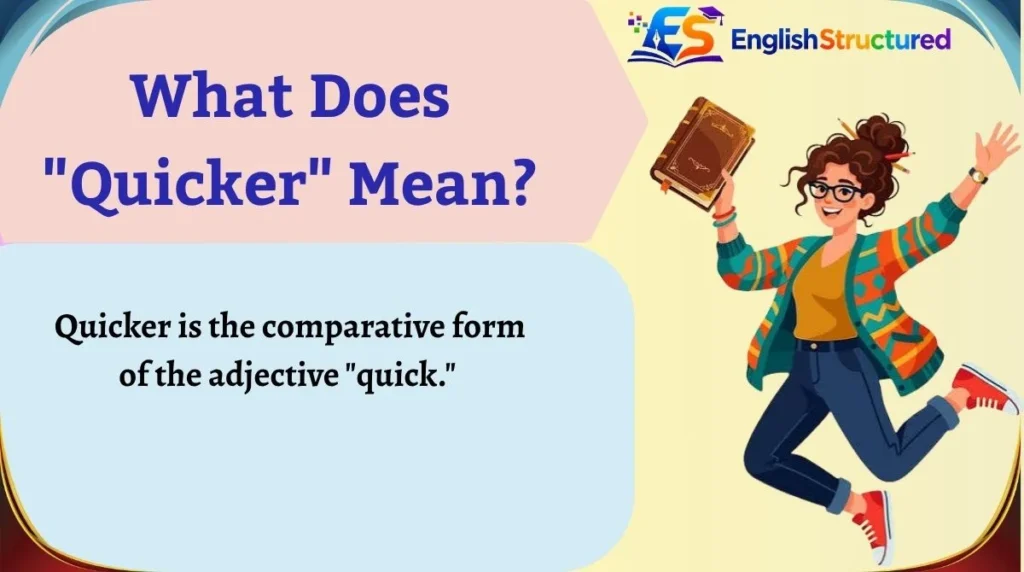
Quicker is the comparative form of the adjective “quick.” It is used to compare people, animals, objects, or actions described as qualities. In simple words, it means more quick or faster.
Simple Definition
Quicker means faster than another person or thing when describing a noun or, in everyday English, sometimes describing an action after certain verbs.
Examples:
- Quicker vs More Quickly
- Emma is quicker than her brother.
- This route is quicker than the highway.
Quicker vs More Quickly
When Do We Use “Quicker”?
Use quicker when comparing the quality of something.
Common situations include:
- Comparing people
- Comparing animals
- Comparing vehicles
- Comparing methods
- Comparing routes
- Comparing products
Examples:
- A rabbit is quicker than a turtle.
- This phone is quicker than my last one.
- Quicker vs More Quickly
- Our internet connection is quicker now.
- The blue printer is quicker than the black one.
- Jane gave a quicker answer than Tom.
- We found a quicker solution.
- Quicker vs More Quickly
Grammar Rule
Quicker vs More Quickly
Its forms are:
| Form | Example |
|---|---|
| Positive | quick |
| Comparative | quicker |
| Superlative | quickest |
The comparative form is usually made by adding -er to short adjectives.
Examples:
- quick → quicker
- fast → faster
- slow → slower
- small → smaller
Can “Quicker” Describe an Action?
This is where many learners become confused.
Traditionally, grammar books say that actions should be described with adverbs, not adjectives. Quicker vs More Quickly
However, modern English is more flexible. Native speakers often use quicker after verbs like:
- finish
- arrive
- work
- heal
- recover
- respond
For example:
- We finished quicker than expected.
- Quicker vs More Quickly
These sentences are very common in everyday English, especially in conversation. Many dictionaries now accept this usage because it has become natural among native speakers.
Common Learner Confusion
Quicker vs More Quickly
That is not true.
Compare these sentences:
- She completed the work quicker than I did.
- Quicker vs More Quickly
Both are widely accepted today. The second sentence is slightly more formal because quickly is an adverb.
More Example Sentences
Here are more examples to help you understand how quicker is used.
- My little sister learns quicker than I expected.
- This knife is quicker for cutting vegetables.
- A train is usually quicker than a bus.
- Quicker vs More Quickly
- Sarah answered quicker this time.
- Exercise helped him recover quicker after surgery.
- We reached the station quicker by taking the shortcut.
- Quicker vs More Quickly
Tips for Using “Quicker”
Remember these simple points:
- Use quicker to compare two things.
- Quicker vs More Quickly
- It commonly describes nouns.
- In everyday English, it can also describe actions after some verbs.
- It is very common in spoken English and informal writing.
What Does “More Quickly” Mean?
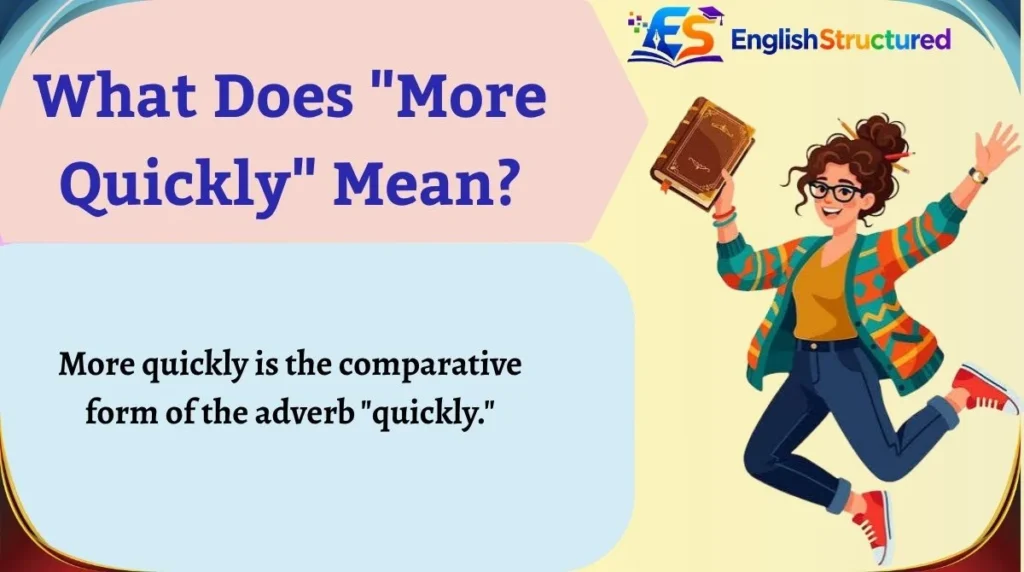
More quickly is the comparative form of the adverb “quickly.” It explains how an action happens rather than describing a person or thing.
Quicker vs More Quickly. This small difference is the key to using the correct expression.
Simple Definition
More quickly means at a faster speed or in a faster way while describing an action.
Examples:
- She finished the project more quickly than her classmates.
- Quicker vs More Quickly
- Our website loads more quickly now.
In each sentence, more quickly tells us how something happened.
When Do We Use “More Quickly”?
Use more quickly when modifying a verb. It explains the manner in which an action is done.
Common examples include actions such as:
- speak
- run
- write
- answer
- finish
- react
- learn
- recover
Grammar Rule
Quicker vs More Quickly
Most adverbs ending in -ly form the comparative by adding more, not -er.
Examples:
| Positive | Comparative |
|---|---|
| quickly | more quickly |
| carefully | more carefully |
| quietly | more quietly |
| slowly | more slowly |
This is why we say:
- She worked more quickly.
- Quicker vs More Quickly
- They moved more quietly.
Instead of adding -er, English uses more before these adverbs.
Example Sentences
Here are several examples of more quickly in everyday English.
- The students finished the test more quickly than last week.
- She replied more quickly after turning on notifications.
- My computer starts more quickly after the update.
- We solved the puzzle more quickly together.
- Quicker vs More Quickly
- He learned the new skill more quickly with practice.
- The children cleaned the room more quickly than expected.
- She spoke more quickly because she was excited.
Common Learner Confusion
Many learners believe more quickly is always the only correct choice when talking about actions.
While it is the traditional grammatical form, native speakers often use quicker in everyday conversation after certain verbs. Quicker vs More Quickly
In the next part, we’ll compare quicker and more quickly side by side with a detailed comparison table, grammar logic, sentence patterns, common mistakes, memory tricks, and real-life examples.
Difference Between “Quicker” and “More Quickly”
Although quicker and more quickly both express the idea of doing something at a greater speed, they belong to different parts of speech. That is the biggest difference. Once you understand this grammar rule, choosing the correct expression becomes much easier.
In modern English, you will often hear native speakers use either expression in conversation. However, formal grammar still makes a distinction between them.
Quick Comparison Table
| Feature | Quicker | More Quickly |
|---|---|---|
| Part of speech | Comparative adjective | Comparative adverb |
| Base word | Quick | Quickly |
| Main purpose | Describes a noun or compares a quality | Describes how an action happens |
| Grammar style | Common in everyday speech | Preferred in formal writing |
| Formality | Neutral to informal | More formal and grammatically traditional |
| Example | This route is quicker. | She finished more quickly. |
The Main Grammar Difference
The easiest way to remember the difference is this:
- Quicker vs More Quickly
- More quickly describes actions.
Look at these examples:
- This car is quicker than my old one.
- Maria completed the race more quickly than last year.
In the first sentence, quicker describes the car.
Quicker vs More Quickly
Why Do Native Speakers Sometimes Say “Quicker”?
If you watch English movies or listen to everyday conversations, you will probably hear sentences like these:
- Finish quicker.
- Come quicker.
- We got there quicker.
- Quicker vs More Quickly
These examples are extremely common, especially in American English.
Why?
Because spoken English often becomes more natural and less strict than grammar taught in classrooms. Over time, many adjectives have started to work like adverbs in certain situations.
This does not mean grammar rules disappeared. Instead, English has become more flexible in everyday conversation.
Which Form Is Better?
The answer depends on the situation.
Choose quicker when:
- You are describing a noun.
- You are speaking casually.
- You want a natural conversational style.
- You are comparing people or things.
Examples:
- This solution is quicker.
- Quicker vs More Quickly
- We found a quicker method.
Choose more quickly when:
- You are describing how an action happens.
- You are writing an academic paper.
- You are taking an English exam.
- You want the most traditional grammar.
Examples:
- She answered more quickly than before.
- Quicker vs More Quickly
- Students learn more quickly with regular practice.
Comparing Similar Sentences
These sentence pairs show how both forms can appear in similar situations.
Pair 1
✔ This computer is quicker.
Quicker vs More Quickly
The first describes the computer itself.
The second describes how it starts.
Pair 2
✔ We found a quicker solution.
Quicker vs More Quickly
One describes the solution.
The other describes the action.
Pair 3
✔ She gave a quicker response.
Quicker vs More Quickly
Again, one modifies the noun response, while the other modifies the verb responded.
Pair 4
✔ This road is quicker.
✔ We arrived more quickly by taking this road.
The first compares the road.
The second compares the action of arriving.
Can Both Be Correct?
Sometimes, yes.
Consider this sentence:
- She finished quicker than I did.
- Quicker vs More Quickly
Many native speakers accept both.
The difference is mainly one of style rather than meaning.
- Quicker sounds more conversational.
- More quickly sounds more formal.
Quicker vs More Quickly
Which Form Appears More in Formal Writing?
In formal English, editors usually prefer more quickly because it follows the traditional rule that adverbs modify verbs.
Examples:
Academic writing:
- The patients recovered more quickly after treatment.
- Quicker vs More Quickly
Business writing:
- Orders were completed more quickly this month.
- Quicker vs More Quickly
Professional reports often follow this pattern because it sounds more precise.
Which Form Is More Common in Everyday Speech?
Quicker vs More Quickly
Friends might say:
- Hurry up and walk quicker.
- Can you answer quicker?
- We need to finish quicker.
- Quicker vs More Quickly
Although some grammar teachers would replace these with more quickly, native speakers usually understand both without any confusion.
British English vs. American English
Quicker vs More Quickly
However, conversational English in both varieties often prefers the shorter form quicker because it sounds smoother and more natural.
Formal books, newspapers, and educational materials still tend to use more quickly when modifying verbs.
So, no matter which variety of English you learn, understanding both forms is useful.
Grammar Rules You Must Remember
These four rules will help you choose the correct expression every time.
Rule #1: Use quicker to compare nouns
Quicker vs More Quickly
Examples:
- Quicker vs More Quickly
- My laptop is quicker now.
- We need a quicker solution.
Tip: Ask yourself, “Am I describing a thing?” If the answer is yes, quicker is usually correct.
Rule #2: Use more quickly to describe actions
When explaining how someone does something, use more quickly.
Examples:
- She answered more quickly today.
- They completed the task more quickly.
- Quicker vs More Quickly
Tip: If the word describes a verb, the adverb is normally the best choice.
Rule #3: Everyday English is more flexible
Quicker vs More Quickly
Examples:
- Finish quicker.
- Heal quicker.
- Quicker vs More Quickly
- Arrive quicker.
These are widely accepted in casual conversation.
However, in school writing or formal tests, more quickly is often the safer answer.
Rule #4: Match your writing style
Think about who will read your writing.
Use more quickly when writing:
- essays
- reports
- research papers
- business emails
- exams
Use quicker naturally when:
- chatting with friends
- speaking
- writing informal messages
- telling stories
- having everyday conversations
Choosing the form that matches the situation makes your English sound more natural and appropriate.
Common Mistakes Students Make
Many English learners understand the meanings of quicker and more quickly, but they still use them incorrectly. Most mistakes happen because adjectives and adverbs have different jobs. The good news is that these errors are easy to fix once you know what to look for.
Here are the most common mistakes and how to avoid them.
Mistake #1: Using an adjective instead of an adverb
Quicker vs More Quickly
❌ Wrong: She completed the project quicker than before. (Often heard in conversation, but less formal.)
✅ Better (formal): She completed the project more quickly than before.
Quicker vs More Quickly
Mistake #2: Using “more quicker”
Some students combine more and quicker, but this creates a double comparative.
❌ Wrong: This car is more quicker than mine.
✅ Correct: This car is quicker than mine.
Quicker vs More Quickly
More examples:
❌ He became more quicker after training.
✅ He became quicker after training.
Mistake #3: Using “quickly” to describe a noun
An adverb cannot normally describe a noun.
❌ Wrong: This is a more quickly method.
✅ Correct: This is a quicker method.
Here, method is a noun, so you need the adjective quicker.
Mistake #4: Thinking only one form is always correct
Many learners believe one expression is right and the other is always wrong.
That is not true.
For example:
- We finished quicker than expected.
- Quicker vs More Quickly
Both are common in modern English. The second follows traditional grammar more closely, while the first sounds more conversational.
Mistake #5: Forgetting the situation
Context matters.
In casual conversation:
- Hurry up!
- Drive quicker!
- Come back quicker!
These sound natural to many native speakers.
In formal writing:
- Please respond more quickly to customer requests.
Always think about who is reading or listening.
Easy Correction Tips
Use these simple questions before choosing your words.
Question 1
Are you describing a thing?
→ Use quicker.
Example:
- This route is quicker.
Question 2
Are you describing how someone does something?
→ Use more quickly.
Example:
- She answered more quickly.
Question 3
Is this everyday conversation?
Both forms may sound natural.
Question 4
Is this an exam or formal writing?
Choose more quickly if you are modifying a verb.
Easy Trick to Remember the Difference
Grammar becomes much easier when you connect it to a simple memory trick.
The “Thing vs. Action” Trick
Think about these two questions.
Is it talking about a thing?
Use quicker.
Examples:
- A quicker computer
- A quicker train
- A quicker solution
The word tells you something about a noun.
Is it talking about an action?
Use more quickly.
Examples:
- She typed more quickly.
- He answered more quickly.
- They finished more quickly.
The phrase explains how the action happened.
Another Easy Way to Remember
Imagine two boxes.
📦 Box 1: People and Things
Use quicker.
📦 Box 2: Actions
Use more quickly.
Whenever you make a sentence, ask yourself:
Am I describing a thing or describing an action?
That one question will help you choose the correct form most of the time.
A Classroom Example
Your teacher gives two students the same math test.
Student A finishes in 20 minutes.
Student B finishes in 30 minutes.
You can say:
- Quicker vs More Quickly
Now compare two computers.
Computer A starts in five seconds.
Computer B starts in ten seconds.
You can say:
- Computer A is quicker than Computer B.
Notice how one sentence describes an action, while the other describes a thing.
Daily Life Examples
Here are some natural conversations that show how native speakers use these expressions.
Example 1
A: Which road should we take?
B: The highway is quicker.
Example 2
A: Why did you arrive early?
B: I drove more quickly because there wasn’t much traffic.
Example 3
A: Your new laptop looks great.
B: Yes, it’s much quicker than my old one.
Example 4
A: Did Emma finish first?
B: Yes, she completed the race more quickly than everyone else.
Example 5
A: Which checkout line should we use?
B: That one looks quicker.
Example 6
A: Your internet seems better.
B: Websites load more quickly after the upgrade.
Example 7
A: Why are you smiling?
B: I solved the puzzle more quickly this time.
Example 8
A: Which delivery service should I choose?
B: This company is usually quicker.
Example 9
A: How did you finish your homework so fast?
B: I worked more quickly because I wasn’t distracted.
Example 10
A: Which elevator should we use?
Quicker vs More Quickly
These examples show that both expressions are useful in everyday English. Choosing the right one depends on whether you are describing a thing or how an action happens.
Practice Section
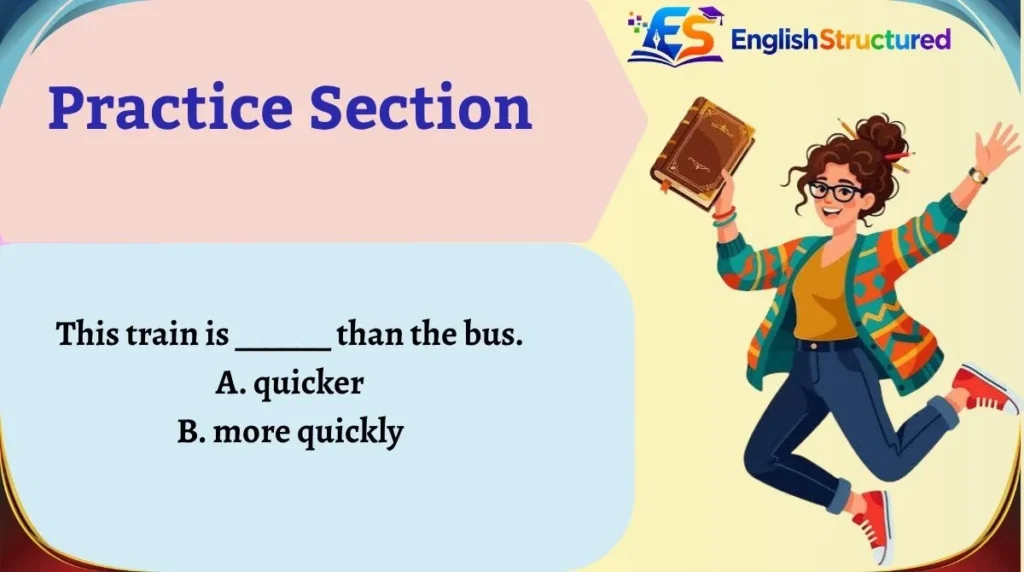
Choose the correct option.
1. This train is ______ than the bus.
A. quicker
B. more quickly
2. Sarah answered the teacher ______ than yesterday.
A. quicker
B. more quickly
3. We found a ______ way to solve the problem.
A. quicker
B. more quickly
4. The new software loads pages ______ than before.
A. quicker
B. more quickly
5. My new phone is much ______ than my old one.
A. quicker
B. more quickly
FAQs
1. What is the difference between quicker and more quickly?
The main difference is their grammar. Quicker is a comparative adjective, so it usually describes a noun or compares people and things. More quickly is a comparative adverb, so it describes how an action happens. In everyday conversation, native speakers sometimes use quicker for actions as well, but more quickly is generally preferred in formal writing.
2. Can I use quicker and more quickly in the same sentence?
Yes, you can if they have different jobs in the sentence.
Example:
- Quicker vs More Quickly
Here, quicker describes the noun route, while more quickly describes the verb arrived.
3. Is quicker grammatically correct when describing an action?
In modern English, many native speakers say things like “Finish quicker” or “She recovered quicker.” These expressions are common and widely understood, especially in conversation. However, traditional grammar recommends more quickly when modifying a verb, particularly in formal writing and academic English.
4. Which expression should I use in an English exam?
For grammar tests, school assignments, and formal writing, more quickly is usually the safest choice when describing an action.
For example:
- ✅ She answered more quickly than before.
Following the traditional grammar rule helps you avoid losing marks in exams.
5. Is quicker more common in spoken English?
Yes. Native speakers often choose quicker because it is shorter and sounds natural in everyday conversation.
Examples include:
- Hurry up and walk quicker.
- We finished quicker than expected.
Although these sentences are common in speech, formal writing often prefers more quickly.
6. How can I remember when to use quicker or more quickly?
A simple trick is to ask yourself one question:
Am I describing a thing or an action?
- If you are describing a person, object, place, or idea, use quicker.
- If you are describing how someone does something, use more quickly.
This simple habit will help you choose the correct form in most situations.
Conclusion
Quicker vs More Quickly
Both expressions are related to speed, but they serve different grammatical purposes.
Quicker is the comparative form of the adjective quick, so it usually describes people, things, or ideas.
More quickly is the comparative form of the adverb quickly, so it explains how an action is performed.
Modern English is flexible, and native speakers often use quicker in everyday conversation, even after certain verbs.
However, if you are writing an essay, taking an exam, or preparing a professional document, more quickly is usually the better choice when describing actions.
The best way to master this topic is through regular practice. Read English books, listen to native speakers, and create your own example sentences.
Over time, choosing between quicker and more quickly will become natural.
The more you practice, the more confident and accurate your English will be in both speaking and writing.