Have you ever remembered someone’s birthday a few days too late and wondered what to say?
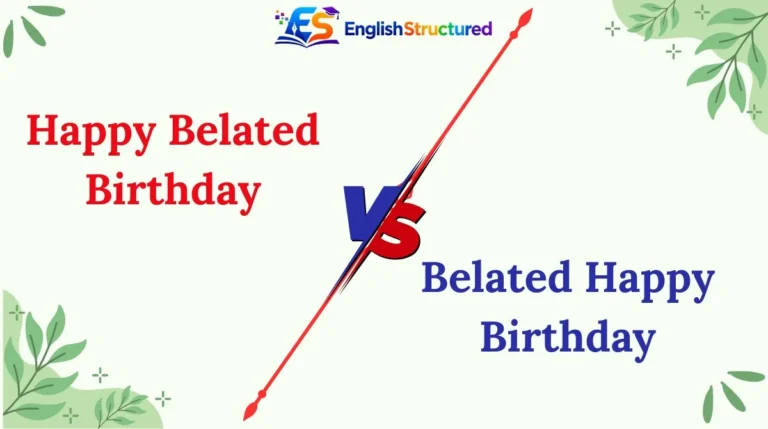
Happy Belated Birthday vs Belated Happy Birthday
You may also have seen people write “Belated happy birthday!” Both expressions are common in everyday English, so it is easy to feel confused.
The good news is that both phrases can be understood, and both are used by English speakers.
However, there is a small difference in how the words work grammatically.
“Belated happy birthday” is generally considered the more logical and traditional form because belated describes the birthday wish, not the birthday itself.
This difference matters when you want your English to sound natural and polished.
It is especially useful when writing birthday messages to friends, classmates, coworkers, teachers, or family members.
By the end of this guide, you will know what “happy belated birthday” means, what “belated happy birthday” means, which one is preferred, why people use both, and how to use them naturally in real conversations.
So, if you missed someone’s birthday and need the right words, you will not have to guess anymore.
What Does “Happy Belated Birthday” Mean?
“Happy belated birthday” is a common expression used when you wish someone a happy birthday after their birthday has already passed.
For example, imagine your friend’s birthday was Monday, but you remembered on Wednesday. You might say:
Happy Belated Birthday vs Belated Happy Birthday
The message means something like:
“I am wishing you a happy birthday, but I am doing it late.”
The word belated means late or delayed. When something happens later than it should, we can describe it as belated.
For example:
- a belated apology = an apology given late
- a belated thank-you = a thank-you given late
- a belated response = a response given late
- Happy Belated Birthday vs Belated Happy Birthday
So, when someone says “Happy belated birthday,” the intended meaning is clear: the birthday greeting is late.
When Do We Use “Happy Belated Birthday”?
You use this phrase when someone’s birthday has already passed and you have not wished them on time.
For example, if Sarah’s birthday was yesterday and you forgot, you could text:
“Happy belated birthday, Sarah! I hope you had a wonderful day.”
You can use it with friends, family members, classmates, coworkers, and other people you know.
It is especially common in casual messages and social media comments.
Is “Happy Belated Birthday” Grammatically Correct?
This is where the confusion begins.
The phrase “happy belated birthday” is very common in modern English. Native speakers use it frequently, and most people will immediately understand what you mean.
However, from a strict grammatical point of view, the phrase can sound slightly unusual because belated appears to describe birthday.
A birthday itself is not normally “late.” Your birthday happens on its proper date. What is late is your greeting or wish.
Think about it this way:
- The birthday happened on time.
- Your message came late.
- Therefore, the birthday wish is belated.
Happy Belated Birthday vs Belated Happy Birthday
Still, “happy belated birthday” is so common that it cannot simply be called wrong in everyday English.
Examples of “Happy Belated Birthday”
Here are some natural examples:
- Happy belated birthday! I hope you had a great day.
- Happy belated birthday, Mike! Sorry I missed your special day.
- Happy belated birthday! I hope this year brings you lots of happiness.
- I know I’m late, but happy belated birthday!
- Happy belated birthday, Emma. I hope you enjoyed your celebration.
- Sending you a happy belated birthday wish!
- Happy belated birthday! Sorry for forgetting the date.
- A very happy belated birthday to you!
These examples show how commonly the expression appears in normal communication.
A Common Learner Confusion
English learners sometimes think belated means “after the birthday person was born late.” That is not the meaning.
In this context, belated means late in being given or expressed.
So:
Happy Belated Birthday vs Belated Happy Birthday
It does not mean:
a birthday that happened late.
That distinction is important.
What Does “Belated Happy Birthday” Mean?
“Belated happy birthday” is another way to wish someone a happy birthday after their birthday has passed.
For example:
Happy Belated Birthday vs Belated Happy Birthday
The meaning is:
“My happy birthday wish is late.”
This version is often considered grammatically clearer because belated describes the entire birthday greeting.
Happy Belated Birthday vs Belated Happy Birthday
When Do We Use “Belated Happy Birthday”?
Use it when you forgot someone’s birthday, missed their birthday celebration, or simply did not get a chance to send your greeting on time.
For example:
“Belated happy birthday! I’m sorry I couldn’t message you yesterday.”
This sounds natural and friendly.
You can also make the message warmer:
Happy Belated Birthday vs Belated Happy Birthday
Why Is “Belated Happy Birthday” Preferred by Some Teachers?
The main reason is meaning and word attachment.
Consider the phrase:
belated happy birthday
Here, belated tells us that the birthday greeting is late.
Now consider:
happy belated birthday
Here, belated appears directly before birthday. This can suggest that the birthday itself is belated.
But birthdays do not normally happen late. Your birthday is still your birthday, whether someone remembers it or not.
Happy Belated Birthday vs Belated Happy Birthday
It is similar to saying:
“a belated thank-you”
Nobody thinks the “thank-you” happened late as an event. The person simply gave the thank-you late.
Examples of “Belated Happy Birthday”
Here are some examples:
- Belated happy birthday! I hope you had an amazing celebration.
- Belated happy birthday, Lisa! Sorry I missed your birthday.
- Please accept my belated happy birthday wishes.
- Belated happy birthday! I hope this new year of your life is wonderful.
- A belated happy birthday to one of my favorite people!
- I’m a little late, but belated happy birthday!
- Sending you belated happy birthday wishes and lots of love.
- Belated happy birthday! I hope you enjoyed every moment.
Notice that belated is connected to the wish, not the actual birthday.
Is “Belated Happy Birthday” Formal?
It can work in both casual and somewhat formal situations.
For a friend, you could simply say:
Happy Belated Birthday vs Belated Happy Birthday
For a coworker, you might write:
“Belated happy birthday! I hope you had a wonderful celebration.”
For a more formal message, you could say:
Happy Belated Birthday vs Belated Happy Birthday
The last version is especially useful when writing to someone you do not know very closely.
Difference Between “Happy Belated Birthday” and “Belated Happy Birthday”
Happy Belated Birthday vs Belated Happy Birthday
Both expressions are widely understood as late birthday greetings. However, “belated happy birthday” is generally more logical from a grammar perspective.
| Expression | Meaning | Common Use | Grammar Logic |
|---|---|---|---|
| Happy belated birthday | A birthday greeting given late | Very common | “Belated” appears to modify “birthday” |
| Belated happy birthday | A late happy-birthday greeting | Very common | “Belated” describes the greeting |
| Belated birthday wishes | Birthday wishes given late | Very common | Clearly describes the wishes |
| Sorry I’m late—happy birthday! | A late birthday greeting | Very natural | Avoids the adjective issue |
1. Meaning
In everyday communication, there is almost no difference in intended meaning.
If you say:
Happy Belated Birthday vs Belated Happy Birthday
People understand that you are late.
If you say:
Happy Belated Birthday vs Belated Happy Birthday
People also understand that you are late.
So, communication is not usually a problem.
2. Grammar
The more interesting difference is grammatical.
In “belated happy birthday,” the word belated naturally points to the birthday greeting.
The structure is roughly:
Happy Belated Birthday vs Belated Happy Birthday
Here, happy birthday acts as the greeting or expression being given late.
In “happy belated birthday,” the word belated comes directly before birthday.
That makes it look as though belated describes the birthday itself.
This is not the intended meaning, but English speakers commonly use the phrase anyway.
3. Usage
“Happy belated birthday” is extremely common in everyday English.
You will hear it in texts, social media comments, cards, emails, and conversations.
Happy Belated Birthday vs Belated Happy Birthday
4. Which One Should You Choose?
If you want the safest choice for standard, careful English, use:
Belated happy birthday!
If you are chatting casually with a friend, this is also perfectly understandable:
Happy Belated Birthday vs Belated Happy Birthday
You do not need to panic if you have already used the second form. It is widely accepted in everyday speech.
5. Another Very Natural Option
There is an even easier way to avoid the issue:
Sorry I’m late. Happy birthday!
This sounds very natural.
You could also say:
Happy Belated Birthday vs Belated Happy Birthday
Or:
Sorry for the late birthday wishes!
These options make your meaning completely clear.
Grammar Rules You Must Remember
Rule #1: “Belated” Means Late
Happy Belated Birthday vs Belated Happy Birthday
For example:
Happy Belated Birthday vs Belated Happy Birthday
The reply came later than expected.
Another example:
Happy Belated Birthday vs Belated Happy Birthday
The apology came late.
So, with birthdays, the thing that is late is normally the wish, not the birthday.
Rule #2: A Birthday Is Not Usually Belated
A person’s birthday occurs on a specific date every year.
For example:
“David’s birthday was August 5.”
Happy Belated Birthday vs Belated Happy Birthday
If you remembered it on August 8, your birthday message was late.
That is why this meaning is clearer:
“Belated birthday wishes!”
rather than thinking:
Happy Belated Birthday vs Belated Happy Birthday
This simple idea helps you understand the grammar.
Rule #3: “Happy Birthday” Is a Greeting
Happy Belated Birthday vs Belated Happy Birthday
You are not literally describing a birthday as “happy” in the same way you might describe a happy person.
You are giving someone a good wish for their birthday.
For example:
“Happy birthday, Tom!”
means something like:
“I hope you have a happy birthday.”
Happy Belated Birthday vs Belated Happy Birthday
Therefore:
Happy Belated Birthday vs Belated Happy Birthday
makes the intended meaning easy to see.
Rule #4: Both Forms Are Used in Real English
Do not assume that every common phrase must fit a simple grammar rule perfectly.
Language changes through everyday use.
Happy Belated Birthday vs Belated Happy Birthday
For practical English:
- Happy Belated Birthday vs Belated Happy Birthday
- Happy belated birthday → very common and easily understood
- Sorry I’m late—happy birthday! → very natural and clear
The important thing is to understand the meaning and choose the form that fits your situation.
Common Mistakes Students Make
Many learners make mistakes with these expressions because they try to translate birthday messages directly from their first language.
Happy Belated Birthday vs Belated Happy Birthday
Here are some common problems.
Mistake 1: Thinking the Birthday Is Late
A learner may think:
“Belated means late, so the birthday must be late.”
Not quite.
The birthday happened on its normal date. The greeting was late.
A better way to think about it is:
“My birthday wish is late.”
That is the idea behind the expression.
Mistake 2: Saying “Belated Birthday” Without a Wish
The phrase:
“Belated birthday!”
can sound incomplete.
You normally want to say:
“Belated happy birthday!”
or:
“Belated birthday wishes!”
The second option is especially clear.
Mistake 3: Using “Late Happy Birthday”
Some learners say:
“Late happy birthday!”
This is understandable, but it does not sound as natural as the common expressions.
Better choices include:
“Belated happy birthday!”
or:
“Sorry I’m late. Happy birthday!”
Mistake 4: Overthinking the Phrase
Sometimes learners become so worried about the grammar that they avoid saying anything.
There is no need for that.
If you remember someone’s birthday late, simply say:
“Sorry I’m late. Happy birthday!”
This is friendly, clear, and natural.
Mistake 5: Forgetting the Apology
A late birthday message often sounds warmer when you briefly acknowledge the delay.
For example:
“Belated happy birthday! Sorry I missed your birthday.”
This sounds more personal than simply writing:
“Belated happy birthday.”
However, an apology is not required every time.
Easy Trick to Remember the Difference
Here is a simple trick:
Ask: What was late?
If your message or wish was late, then belated is describing the greeting.
Think:
Happy Belated Birthday vs Belated Happy Birthday
That gives you:
Belated happy birthday!
Now imagine this:
Your friend’s birthday was June 10.
You remembered on June 12.
Ask yourself:
Happy Belated Birthday vs Belated Happy Birthday
No.
Was my birthday wish late?
Yes.
That is the whole idea.
A Second Memory Trick
Remember this sentence:
Happy Belated Birthday vs Belated Happy Birthday
If you remember that sentence, you will understand why “belated happy birthday” is the more logical construction.
Still, if you hear someone say:
“Happy belated birthday!”
do not think they are making a serious English mistake. The phrase is extremely common and the intended meaning is clear.
Daily Life Examples
Real conversations make this difference much easier to understand.
Example 1: Texting a Friend
Ali: Hey, I just realized I missed your birthday!
Sam: Haha, yes, it was two days ago.
Ali: Belated happy birthday! I hope you had an amazing day.
This sounds friendly and natural.
Example 2: Social Media Comment
You see a friend’s birthday post two days after the event.
You could write:
Happy Belated Birthday vs Belated Happy Birthday
This is very common on social media.
Example 3: Talking to a Coworker
Mia: Sorry, I missed your birthday last week.
John: No problem!
Mia: Belated happy birthday! I hope you enjoyed your weekend.
This is polite without being too formal.
Example 4: A Close Friend
“Oh no! I can’t believe I forgot. Happy belated birthday! I’ll make it up to you!”
This sounds natural in casual conversation.
Example 5: A Teacher
“Belated happy birthday, Mrs. Khan. I hope you had a lovely birthday.”
This is polite and respectful.
Example 6: A Family Member
“Happy belated birthday, Uncle! Sorry I couldn’t call you yesterday.”
This works well in a family message.
Example 7: A Formal Message
“Please accept my belated birthday wishes. I hope you had a wonderful celebration.”
This is more formal than a simple text message.
Example 8: When You Are Very Late
Suppose the birthday was three weeks ago.
You might say:
“I know this is very late, but I still wanted to wish you a happy birthday. I hope you had a wonderful day!”
This can sound more thoughtful than simply writing “Happy belated birthday.”
Example 9: A Short Text
If you want to keep your message very short:
“Belated happy birthday! 🎉”
That is enough for a casual conversation.
Example 10: A Warm Birthday Message
“Belated happy birthday! I’m sorry I missed your special day. I hope this year brings you lots of happiness, good health, and great memories.”
This works well when you want to sound caring and sincere.
Practice Section
Choose the option that sounds better in each sentence.
1. You forgot your friend’s birthday yesterday.
A. Belated happy birthday!
B. Belated birthday happy!
Answer: A. Belated happy birthday!
The first option uses the normal word order for the greeting.
2. You want to send a polite message to a coworker.
A. Please accept my belated birthday wishes.
B. Please accept my late birthday happy.
Answer: A. Please accept my belated birthday wishes.
This is clear and polite.
3. Your friend’s birthday was three days ago.
A. Happy belated birthday!
B. Happy late birthday!
Answer: A. Happy belated birthday!
Happy Belated Birthday vs Belated Happy Birthday
4. You want the clearest possible message.
A. Sorry I’m late. Happy birthday!
B. Sorry, your birthday was late.
Answer: A. Sorry I’m late. Happy birthday!
The first sentence clearly shows that you are late, not the birthday.
5. Which form is generally preferred in careful English?
A. Belated happy birthday
B. Belated birthday happy
Answer: A. Belated happy birthday
This construction makes it clearer that the birthday greeting is belated.
FAQs
1. What is the difference between “happy belated birthday” and “belated happy birthday”?
Both expressions are used to give someone a birthday wish after their birthday has passed.
“Belated happy birthday” is often preferred because belated clearly refers to the late greeting.
“Happy belated birthday” is also very common and easily understood in everyday English.
2. Is “happy belated birthday” grammatically correct?
It is widely used in modern English, especially in casual speech, texts, and social media.
Some teachers prefer “belated happy birthday” because the birthday itself is not late.
However, “happy belated birthday” is common enough that most speakers will not find the meaning confusing.
3. Is “belated happy birthday” better than “happy belated birthday”?
Happy Belated Birthday vs Belated Happy Birthday
It makes it clear that your birthday greeting is late.
But “happy belated birthday” is also natural in everyday communication, so using it does not usually cause a communication problem.
4. Can I say “happy belated birthday” to a friend?
Yes. It is very common in friendly conversations.
For example:
“Happy belated birthday! Sorry I missed your big day!”
You can use it in text messages, social media comments, cards, and casual conversations.
5. Is “belated happy birthday” formal or informal?
It can be used in both casual and somewhat formal situations.
With a friend, simply saying “Belated happy birthday!” is perfectly natural.
For a formal message, you might write, “Please accept my belated birthday wishes.”
6. What is the most natural way to wish someone late?
Several choices sound natural.
You can say:
“Belated happy birthday!”
or:
Happy Belated Birthday vs Belated Happy Birthday
You can also say:
“Sorry I’m late. Happy birthday!”
The last option is especially clear because it directly explains who was late.
Conclusion
When you miss someone’s birthday, you have several natural ways to send your wishes.
Happy Belated Birthday vs Belated Happy Birthday
The main grammar point is simple. The birthday itself is not late. Your wish or greeting is late. That is why many teachers and careful writers prefer “belated happy birthday.”
At the same time, “happy belated birthday” is extremely common in everyday English. Native speakers use it often, and there is normally no confusion about what it means.
If you want to play it safe, use “Belated happy birthday!” You can also say, “Sorry I’m late. Happy birthday!” when you want your message to sound especially natural.
The most important thing is not to worry too much. A late birthday wish is still a kind gesture. Choose a clear phrase, add a sincere message, and send it with a smile.