If She Was vs If She Were
This small difference can confuse even students who already speak English quite well.
The main problem is that both forms can appear after if, and both can sound natural in everyday speech. So, how do you know which one to choose?
The answer depends on what you mean.
We usually use if she were when we are talking about an unreal, imaginary, unlikely, or hypothetical situation. For example, If she were here, she would help us.
We can use if she was when we are talking about a possible past situation or when we are unsure whether something actually happened. For example, If she was at the meeting yesterday, I didn’t see her.
There is also an important point about modern English.
In everyday conversation, many native speakers use if she was in situations where traditional grammar would prefer if she were. This is especially common in informal speech.
So, the choice is not simply about memorizing one rule. You need to understand the meaning and situation behind the sentence.
By the end of this guide, you will know when to use each form, why were is special in hypothetical sentences, which mistakes to avoid, and how to choose the correct form naturally.
What Does “If She Was” Mean?
If she was is used when she was refers to a real or possibly real situation in the past.
The speaker may not know whether the situation actually happened. The condition is connected to a past event, and the speaker is considering it as a possibility.
For example:
If She Was vs If She Were
Here, the speaker does not know for sure whether she was at school. It is a question or possibility about the real past.
When Should You Use “If She Was”?
Use if she was when the condition may have actually happened.
Think about a situation where you are trying to discover what happened.
For example:
If She Was vs If She Were
Maybe she was tired. Maybe she was not. The speaker is considering a real possibility.
Another example is:
If she was at the party, I didn’t notice her.
The speaker is talking about a real party in the past and is unsure whether she attended.
Grammar Rule for “If She Was”
The basic structure is:
If She Was vs If She Were
You can use this structure when was refers to a real or possible past state.
Examples include:
- If she was sick yesterday, she probably stayed home.
- If she was at work this morning, she didn’t answer my call.
- If she was angry, I didn’t notice.
- If she was late, the teacher may have started without her.
- If she was tired after the trip, she should get some rest.
- If she was there last night, she might remember what happened.
- If She Was vs If She Were
- If she was nervous before the interview, she didn’t show it.
Notice that these sentences describe possible facts about the past.
A Common Confusion
If She Was vs If She Were
That is not true.
For example:
If She Was vs If She Were
This sentence is perfectly understandable and grammatically acceptable because the speaker is considering whether a real past event happened.
The important question is:
Am I talking about a possible real situation, or an unreal/imaginary situation?
If it is a possible real past situation, was can be the right choice.
What Does “If She Were” Mean?
If she were is commonly used for an unreal, imaginary, hypothetical, or unlikely situation.
This is one of the most important uses of the subjunctive mood in English.
For example:
If She Was vs If She Were
The speaker is saying that she is not here now, or at least the situation is being treated as unreal or hypothetical.
The sentence imagines a different situation.
When Should You Use “If She Were”?
Use if she were when you imagine something that is not true, is unlikely, or is only a possibility in your imagination.
For example:
If She Was vs If She Were
The speaker is imagining her being their teacher.
It does not mean that she really is their teacher.
Another example:
If she were here, we could ask her.
This usually suggests that she is not here.
Grammar Rule for “If She Were”
The common structure is:
If She Was vs If She Were
Examples:
- If she were here, she would help us.
- If she were my sister, I would protect her.
- If she were taller, she could reach the shelf.
- If she were more careful, she wouldn’t make so many mistakes.
- If she were available, we could ask her to join us.
- If she were the manager, she would change the policy.
- If she were older, she might understand the problem better.
- If she were in my position, she would probably do the same thing.
Here, were helps show that the situation is hypothetical.
Why Do We Say “Were” With “She”?
Normally, we say:
- If She Was vs If She Were
- She was happy.
- She was here.
But in certain hypothetical or unreal conditions, traditional English uses were:
- If she were tired…
- If She Was vs If She Were
- If she were here…
This is sometimes called the subjunctive were or irrealis were.
It is a special grammar pattern.
Difference Between “If She Was” and “If She Were”
The biggest difference is meaning.
If She Was vs If She Were
If she were usually points to an unreal, imaginary, or hypothetical situation.
| Expression | Main use | Typical meaning | Example |
|---|---|---|---|
| If she was | Possible past situation | Maybe it happened | If she was tired, I understand. |
| If she were | Unreal or hypothetical situation | Imagine it happened | If she were here, she would help. |
1. Real Possibility vs Imaginary Situation
Compare these two sentences:
If She Was vs If She Were
The speaker is thinking about a real past possibility. Maybe she was at the office.
Now compare:
If She Was vs If She Were
This sounds hypothetical. The speaker is imagining her being at the office.
The difference becomes clearer when you think about time and reality.
2. Past Facts and Uncertainty
Use was when you are checking or discussing something that may have happened.
If she was at the restaurant last night, she probably saw us.
The restaurant visit is a real past event. The only question is whether she was there.
You could also say:
If she was angry, that explains her reaction.
Again, perhaps she was angry. The speaker is not necessarily imagining an impossible situation.
3. Hypothetical Present Situations
If She Was vs If She Were
If she were here, she would know what to do.
This normally means she is not here.
Another example:
If She Was vs If She Were
She is not the boss. The speaker is imagining what would happen if she were.
4. The Result Can Give You a Clue
A sentence with were often contains would, could, or might in the other clause.
For example:
If She Was vs If She Were
If she were older, she could drive.
If she were available, she might join us.
This pattern is very common.
However, do not think that would automatically means were. English has several conditional structures, and the meaning always matters.
Grammar Rules You Must Remember
Rule #1: Use “Was” for a Possible Real Past Situation
When you are talking about something that may have happened in the past, was is often the natural choice.
If She Was vs If She Were
Maybe she was there. Maybe she wasn’t.
The speaker is trying to reason about a real past event.
Another example:
If she was sick yesterday, that explains why she missed class.
The speaker is considering a possible explanation.
Rule #2: Use “Were” for Unreal or Hypothetical Situations
When the condition is imaginary or contrary to reality, traditional grammar uses were.
If she were here, she would know what to do.
She is not here, so the speaker imagines another situation.
More examples:
If she were rich, she would travel the world.
If she were my boss, I would ask her for advice.
If she were more confident, she would speak in public.
These are hypothetical ideas.
Rule #3: “Were” Can Be Used With I, He, She, and It
This is an important point.
In normal past-tense sentences, we use was with I, he, she, and it:
- I was
- He was
- She was
- It was
But in hypothetical subjunctive constructions, traditional English uses were:
- If She Was vs If She Were
- If he were…
- If she were…
- If it were…
For example:
If I were you, I would apologize.
If he were older, he could apply.
If she were here, she would understand.
If She Was vs If She Were
The famous expression If I were you is a good phrase to remember.
Rule #4: Meaning Is More Important Than the Word “If”
Do not simply memorize:
“After if, always use were.”
That rule is incorrect.
Look at these examples:
If she was sick yesterday, she may have stayed home.
Possible past event → was
If she were sick now, she would stay home.
If She Was vs If She Were
The word if appears in both sentences, but the meaning is different.
Ask yourself:
“Am I discussing something that might really have happened, or am I imagining a different situation?”
That question will usually guide you to the right form.
Common Mistakes Students Make
Mistake 1: Thinking “If She Was” Is Always Wrong
Some students learn that hypothetical sentences require were, then start changing every if she was into if she were.
For example, they may see:
If She Was vs If She Were
and automatically change it to:
If she were at the meeting yesterday…
But this can change the meaning.
If you are unsure whether she actually attended the meeting, was is appropriate.
Mistake 2: Using “Was” for a Clear Hypothetical
A learner might say:
If She Was vs If She Were
This is common in casual speech, and many native speakers use it.
However, in formal or careful English, especially when the situation is clearly hypothetical, were is traditionally preferred:
If she were here, she would help us.
For school writing, exams, grammar exercises, and formal English, were is usually the safer choice for an unreal condition.
Mistake 3: Confusing Past Time With Unreal Meaning
The presence of a past form does not always mean the sentence is about a real past event.
Compare:
If She Was vs If She Were
This is about a possible past event.
But:
If she were at the party, she would be having fun.
This can be hypothetical. The speaker is imagining her being at the party.
So, don’t look only at the verb tense. Look at the whole meaning.
Mistake 4: Thinking “Were” Always Means Past
Usually, was/were are past forms of be. But hypothetical were can refer to a present or future situation.
For example:
If She Was vs If She Were
The situation is about now, not the past.
This is why hypothetical were can feel strange to learners.
Easy Correction Tip
Before choosing was or were, ask:
“Is this a real possibility from the past, or an imagined situation?”
- Real/possible past → was
- If She Was vs If She Were
This simple question solves many problems.
Easy Trick to Remember the Difference
Here is a simple memory trick:
Was = What may have happened
Were = What I am imagining
Think of these two sentences:
If She Was vs If She Were
You are trying to work out what happened.
Now:
If she were here, she would see me.
You are imagining a situation.
The first sentence looks backward toward a possible past event.
The second sentence creates an imaginary situation.
If She Was vs If She Were
When you see a sentence like:
If She Was vs If She Were
your brain should recognize a hypothetical situation.
For example:
If she were rich, she would buy a house.
If she were free, she would come with us.
If She Was vs If She Were
This pattern is very common.
But Remember One Important Detail
This trick is helpful, but it is not a perfect rule.
English speakers sometimes use was in informal hypothetical sentences:
If She Was vs If She Were
You may hear this often in conversation.
Still, if she were is the traditional and more formal choice when the situation is clearly unreal.
Daily Life Examples
Here are some natural examples you may hear or use in everyday English.
Example 1: Talking About Yesterday
A: Why didn’t Sara answer?
B: If she was at work yesterday, she was probably too busy.
This is a possible explanation about the past.
Example 2: Imagining Someone Being Present
A: I wish Sara could help us.
B: If she were here, she would know exactly what to do.
She is not here, so this is hypothetical.
Example 3: Talking About a Past Party
If she was at the party last night, I didn’t see her.
The speaker is unsure whether she attended.
Example 4: Giving Advice
If She Was vs If She Were
The speaker is imagining the situation.
Example 5: Talking About a Possible Past Problem
If she was upset yesterday, I didn’t realize it.
Maybe she was upset. The speaker is considering a real possibility.
Example 6: Imagining a Different Job
If she were the manager, she would change the schedule.
She is not the manager. This is an imaginary situation.
Example 7: Talking About School
If She Was vs If She Were
The absence is a possible past fact.
Example 8: Imagining the Future
If she were available tomorrow, we could invite her.
This is a hypothetical possibility.
Example 9: Talking About a Past Phone Call
If she was calling me earlier, I didn’t hear my phone.
The speaker thinks the call may really have happened.
Example 10: Giving a Hypothetical Opinion
If she were in my position, she would probably feel the same way.
The speaker is imagining another person in their situation.
Practice Section
If She Was vs If She Were
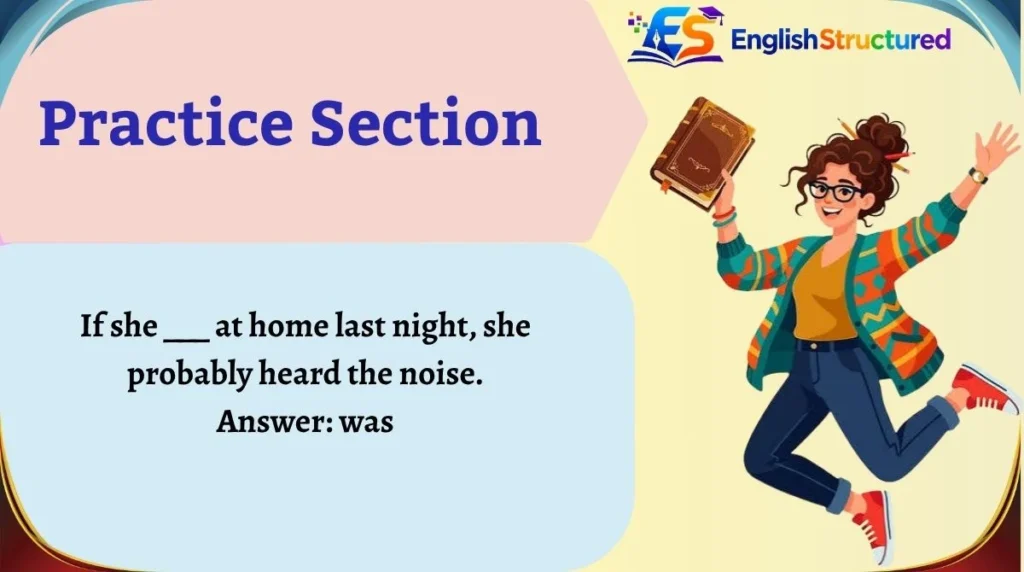
1. If she ___ at home last night, she probably heard the noise.
Answer: was
This refers to a possible real situation in the past.
2. If she ___ here now, she would help us.
Answer: were
This is a hypothetical present situation.
3. If she ___ sick yesterday, she probably stayed home.
Answer: was
The speaker is considering whether she was actually sick.
4. If she ___ my teacher, I would ask her many questions.
Answer: were
She is not the speaker’s teacher. It is an imaginary situation.
5. If she ___ at the office this morning, she may have seen your message.
Answer: was
This is a possible event that may have happened earlier.
Quick Practice Rule
When you answer these questions, do not simply look for if.
Look at the meaning:
Possible past fact? → was
Imaginary or unreal condition? → were
That is the key distinction.
FAQs
1. What is the difference between “if she was” and “if she were”?
If she was usually refers to a possible real situation, especially in the past. If she were is traditionally used for an unreal, imaginary, or hypothetical situation. For example, If she was there, she saw us considers a past possibility, while If she were here, she would help imagines a different situation.
2. Is “if she were” grammatically correct?
Yes. If she were is grammatically correct and is the traditional subjunctive form for hypothetical situations. It is especially common in formal English, academic writing, and careful speech. For example: If she were here, she would understand.
3. Can I say “if she was” instead of “if she were”?
Sometimes, especially in informal spoken English. Many native speakers use if she was in hypothetical sentences. However, when writing formally or answering a grammar question, if she were is usually preferred for a clearly unreal or hypothetical condition.
4. Is “if she was” only used for the past?
Not necessarily. Its most important use in this comparison is for a possible past situation, such as If she was at school yesterday… However, English usage can be flexible in casual speech. Always consider the intended meaning rather than looking at the tense alone.
5. Which is better: “If she was here” or “if she were here”?
If you mean that she is not here and you are imagining her being here, the traditional and more formal choice is:
If She Was vs If She Were
You may hear if she was here in casual conversation, but were is the safer choice for formal English.
6. Why do we say “if she were” instead of “if she was”?
Because hypothetical were is a special form called the subjunctive. It helps show that the condition is unreal, imagined, or contrary to fact. This is why we say If I were you and If she were here in careful English.
Conclusion
If She Was vs If She Were
Use if she was when you are considering a real or possible past situation. You may not know whether it happened, but you are thinking about it as a real possibility.
Use if she were when you are imagining an unreal, hypothetical, or unlikely situation. This is the traditional subjunctive form, and it is especially useful in formal English.
Remember the simple idea:
Was = possible real past situation.
Were = imagined or hypothetical situation.
You may hear native speakers use was in casual hypothetical sentences, so don’t be surprised by it.
But when you are writing formally, taking an English test, or following traditional grammar rules, were is generally the better choice for an unreal condition.
The more examples you read and use, the more natural the difference will feel.