Conceded or Conceited
Both words contain the letters -ceded and -ceited, and both can appear in conversations about people, opinions, or actions. However, their meanings are completely different.
Conceded is connected with admitting something is true, giving in, or accepting that another person is right. For example, if two students are arguing and one says, “You are right,” that student has conceded the point.
Conceited, on the other hand, describes a person who thinks too highly of themselves.
A conceited person may believe they are smarter, more attractive, or more talented than everyone else. For example, “He is very conceited because he always talks about how talented he is.”
The confusion matters because using the wrong word can change the meaning of a sentence completely.
Saying that someone conceded is usually about accepting a fact, point, defeat, or argument. Calling someone conceited is a comment about their personality.
These words are also useful in everyday English, school writing, news reports, stories, and conversations.
Once you understand the small difference between them, choosing the right word becomes much easier.
By the end of this guide, you will know what conceded and conceited mean, how they work grammatically, how they differ, and how to remember them without guessing.
What Does “Conceded” Mean?
Conceded is the past tense and past participle of the verb concede.
To concede means to admit that something is true, accept that someone else is right, or stop resisting a point. It can also mean accepting defeat or giving something to another person.
Conceded or Conceited
“I admit it.”
Imagine two friends discussing which restaurant serves better pizza. One friend gives several reasons for their choice. Finally, the other friend says, “Okay, you have a point.” That person has conceded the argument.
The word can be used in several situations.
1. Conceded means “admitted something”
This is one of its most common meanings.
Example:
Conceded or Conceited
Here, she admitted that her brother was right.
Example:
“Tom conceded that he had made a mistake.”
Tom accepted that he had made a mistake.
2. Conceded means “accepted defeat”
The word is also common in sports, competitions, debates, and elections.
Example:
“The team conceded defeat after the final goal.”
The team accepted that it had lost.
Example:
Conceded or Conceited
The candidate accepted that they had lost the election.
3. Conceded means “gave something up”
Sometimes concede means to allow someone to have something or to give up a position.
Example:
“The company conceded some of its demands.”
The company agreed to give up some of its demands.
Example:
Conceded or Conceited
He stopped arguing about that point and accepted the other person’s argument.
Grammar Rule for “Conceded”
Because conceded is a verb form, it normally describes an action.
Common structures include:
Subject + conceded + noun
- “She conceded defeat.”
- “The player conceded the point.”
Another useful structure is:
Subject + conceded + that + clause
- “He conceded that she was right.”
- “They conceded that the plan had failed.”
You can also use conceded in passive constructions.
- “It was conceded that the plan needed changes.”
More Examples of “Conceded”
- Conceded or Conceited
- “The losing player conceded defeat.”
- “He finally conceded that he needed help.”
- “The coach conceded that the other team played better.”
- “She conceded the point during the debate.”
- “The company conceded that the product had a problem.”
- “After several hours, he conceded that they were right.”
- “The candidate conceded after the results were announced.”
A Common Confusion
Learners sometimes see conceded and think it describes a person’s character.
It does not.
If you say:
“John is conceded.”
you are probably using the wrong word.
Conceded or Conceited
What Does “Conceited” Mean?
Conceited is an adjective.
It describes someone who has an overly high opinion of themselves. A conceited person may think they are unusually intelligent, attractive, successful, talented, or important.
In simple English:
Conceited = thinking you are better than you really are.
For example:
Conceded or Conceited
This means he has an exaggerated opinion of himself.
A conceited person does not simply have confidence. Confidence can be positive. A confident person believes they can do something well without believing they are better than everyone else.
Being conceited usually suggests too much self-admiration.
When to Use “Conceited”
Use conceited when you are describing someone’s personality, attitude, or behavior.
Because it is an adjective, it commonly appears after forms of be:
- “She is conceited.”
- “He was conceited.”
- Conceded or Conceited
It can also come before a noun:
- “He is a conceited person.”
- “She made a conceited remark.”
Examples of “Conceited”
- “He is too conceited to listen to other people’s advice.”
- “She became conceited after winning several awards.”
- “Nobody likes his conceited attitude.”
- “The actor seemed confident, not conceited.”
- “That was a very conceited thing to say.”
- “Her brother is talented, but he is not conceited.”
- “The student sounded conceited when he said nobody could beat him.”
- “His conceited behavior annoyed his classmates.”
Conceited vs. Confident
This is an important distinction.
Conceded or Conceited
“I think I can do this.”
A conceited person might say:
“Nobody here is as good as me.”
Confidence is generally about believing in your own ability. Conceit suggests an inflated or excessive sense of your own importance.
So, calling someone conceited is usually not a compliment.
Grammar Rule for “Conceited”
Conceded or Conceited
Common patterns include:
Subject + be + conceited
- “He is conceited.”
- “She was conceited.”
Or:
Conceited + noun
- “a conceited man”
- “a conceited student”
- “a conceited attitude”
You can also use adverbs with it:
- “He is extremely conceited.”
- “She is rather conceited.”
- Conceded or Conceited
Difference Between Conceded and Conceited
The biggest difference is simple:
Conceded is a verb.
Conceded or Conceited
Their meanings are also very different.
| Word | Part of Speech | Basic Meaning | Common Use |
|---|---|---|---|
| Conceded | Verb | Admitted, accepted, or gave in | Arguments, defeat, mistakes |
| Conceited | Adjective | Having an overly high opinion of yourself | Personality and behavior |
Consider these two sentences:
“Mark conceded that Anna was right.”
Mark admitted that Anna was right.
“Mark is conceited.”
Mark thinks too highly of himself.
The first sentence describes an action. The second describes a personality trait.
Meaning Comparison
Conceded often involves accepting something that may not be what you wanted to accept.
You might concede:
- a mistake
- an argument
- a point
- defeat
- a fact
- an election
- a weakness
Conceded or Conceited
- personality
- pride
- self-importance
- excessive self-confidence
- vanity
- behavior
Grammar Comparison
Conceded:
Subject + conceded + something
Example:
“The manager conceded the point.”
Or:
Subject + conceded + that + clause
Example:
“The manager conceded that the employee was right.”
Conceited:
Conceded or Conceited
Example:
“The manager is conceited.”
Or:
conceited + noun
Example:
“He has a conceited attitude.”
Sentence Structure Difference
Look at these examples:
Conceded or Conceited
Here, conceded is the verb. It tells us what she did.
“She is conceited.”
Here, conceited is an adjective. It tells us what she is like.
This grammar difference is one of the easiest ways to choose the correct word.
Grammar Rules You Must Remember
Rule #1: “Conceded” is a verb
Conceded or Conceited
Example:
“The player conceded defeat.”
The player accepted that they had lost.
Another example:
“She conceded that she was wrong.”
She admitted her mistake.
Rule #2: “Conceited” is an adjective
Use conceited to describe a person who thinks too highly of themselves.
Example:
Conceded or Conceited
The sentence describes his personality.
Another example:
“She has a conceited attitude.”
The adjective conceited describes the noun attitude.
Rule #3: “Conceded” often works with “that”
A very common pattern is:
conceded + that + sentence
For example:
“The teacher conceded that the student had a good point.”
You can also say:
Conceded or Conceited
This pattern is especially useful in formal writing and discussions.
Rule #4: “Conceited” describes excessive self-opinion
Use conceited when someone believes they are more impressive or important than they really are.
Example:
“He is so conceited that he never accepts criticism.”
The word does not simply mean “confident.” It carries a negative idea of excessive self-admiration.
Common Mistakes Students Make
These two words are often confused because their spelling and pronunciation are similar. However, the grammar gives you a strong clue.
Mistake 1: Using “conceited” as a verb
Wrong:
Conceded or Conceited
Correct:
“He conceded that he was wrong.”
Why?
Because conceded is the verb meaning “admitted.”
Correction tip: If you can replace the word with admitted, use conceded.
Mistake 2: Using “conceded” to describe a proud person
Wrong:
“She is very conceded.”
Correct:
Conceded or Conceited
Why?
The sentence describes her personality. You need an adjective.
Correction tip: If you mean “too proud of yourself,” choose conceited.
Mistake 3: Confusing conceited with confident
A learner may write:
“My sister is conceited because she believes she can pass the exam.”
That sentence may not be correct if the sister simply believes in her ability.
A better sentence could be:
“My sister is confident because she believes she can pass the exam.”
Use conceited when there is an idea of excessive pride or superiority.
Mistake 4: Forgetting the meaning of “concede”
Conceded or Conceited
You can concede:
- that someone is right
- that you made a mistake
- defeat
- a point
- an argument
For example:
“I concede that your idea is better.”
This does not necessarily mean you lost a competition. It simply means you admit the other person’s point.
Easy Trick to Remember the Difference
Here is a simple memory trick:
Conceded = “I admit.”
Think about the word concede as something you do when you finally say:
“Okay, you are right.”
So:
Conceded or Conceited
Example:
“He conceded that she was right.”
Conceited = “I think I’m great.”
Think of a person standing in front of a mirror and admiring themselves too much.
Conceded or Conceited
Example:
“He is conceited because he thinks he is better than everyone else.”
You can remember the difference with this tiny rule:
Conceded = gave in.
Conceited = thinks highly of self.
Another useful clue is grammar.
If you need an action, think conceded.
If you need a description, think conceited.
For example:
“She conceded the argument.”
Action.
Conceded or Conceited
Description.
That simple test can save you from many spelling and grammar mistakes.
Daily Life Examples
These examples show how the words may appear in normal conversations.
Example 1: During an argument
Ali: “The movie started at eight.”
Sara: “I checked the ticket. You’re right.”
Ali: “So you concede?”
Sara: “Yes, I concede. You were right.”
Conceded or Conceited
Example 2: Talking about a friend
“David is very talented, but he is not conceited.”
This means David has ability but does not think he is better than everyone else.
Example 3: After making a mistake
“I conceded that I had forgotten the meeting.”
The speaker admitted the mistake.
Example 4: Talking about a winner
Conceded or Conceited
The team accepted that it had lost.
Example 5: Talking about someone’s personality
“My cousin can be quite conceited.”
This means the cousin sometimes thinks too highly of himself or herself.
Example 6: At school
“The student conceded that her answer was wrong.”
She admitted that her answer was incorrect.
Example 7: At work
“The manager conceded that the employee had a valid point.”
The manager admitted that the employee’s argument had some truth.
Example 8: Talking about an actor
Conceded or Conceited
The speaker says the actor is not overly proud of himself.
Example 9: During a game
“Our team conceded two goals in the first half.”
Here, conceded has another common meaning in sports. It means the team allowed the other team to score.
This is an important use of the verb.
Example 10: Talking about behavior
“Her conceited attitude made it difficult for her to make friends.”
The adjective describes an attitude that shows too much self-importance.
Practice Section
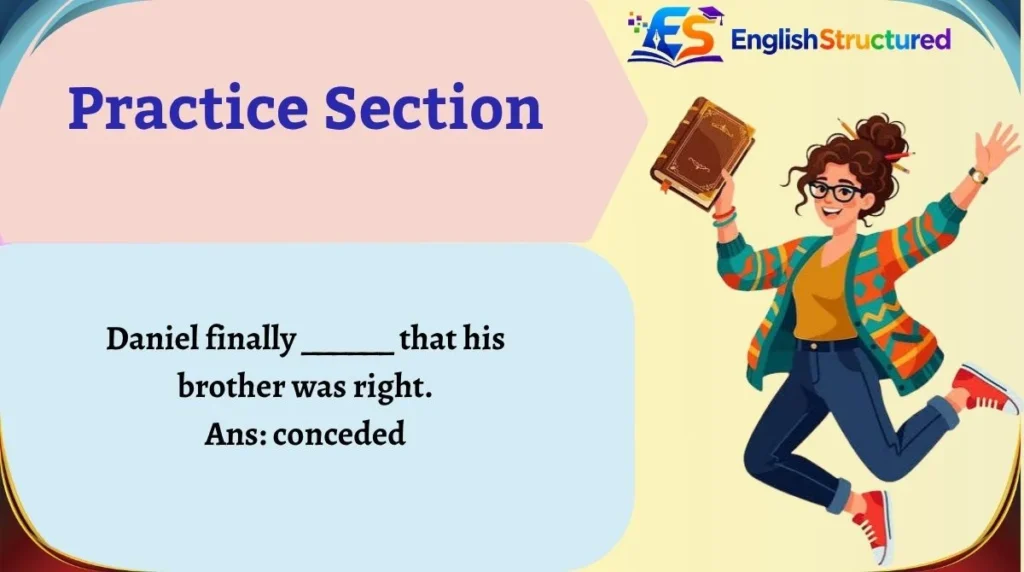
Choose conceded or conceited in each sentence.
1. Daniel finally ______ that his brother was right.
2. Emma is talented, but she is not ______.
3. The team ______ defeat after the final whistle.
4. He sounded very ______ when he said nobody was smarter than him.
5. She ______ that she had made a mistake.
Answers
1. conceded
“Daniel finally conceded that his brother was right.”
He admitted that his brother was right.
2. conceited
“Emma is talented, but she is not conceited.”
The word describes her personality.
3. conceded
“The team conceded defeat after the final whistle.”
The team accepted that it had lost.
4. conceited
“He sounded very conceited when he said nobody was smarter than him.”
He showed an exaggerated opinion of himself.
5. conceded
“She conceded that she had made a mistake.”
She admitted her mistake.
A Quick Test
When you see one of these words in a sentence, ask:
Does it mean “admitted” or “accepted”?
If yes, use conceded.
Does it describe someone who thinks too highly of themselves?
If yes, use conceited.
FAQs
What is the difference between conceded and conceited?
Conceded is a verb meaning admitted, accepted, or gave in. Conceited is an adjective describing someone who thinks too highly of themselves. For example, “He conceded that he was wrong,” but “He is conceited.”
Is “conceded” a verb or an adjective?
Conceded is a verb form. It is the past tense and past participle of concede. It can mean admitted something, accepted defeat, or allowed something, especially in sports.
Is “conceited” a negative word?
Yes, conceited usually has a negative meaning. It suggests that someone has an overly high opinion of themselves. It is stronger than simply saying someone is confident.
Can “conceded” be used in sports?
Yes. Conceded is very common in sports. A team can “concede a goal,” which means it allows the opposing team to score. A player or team can also “concede defeat,” meaning they accept that they have lost.
Can I say “He is conceded”?
Usually, no. If you mean that a person thinks too highly of himself, the correct word is conceited. If you mean that he admitted something, use conceded as a verb: “He conceded that he was wrong.”
Is conceited the same as confident?
No. Confident usually means believing in your own ability. Conceited suggests having an excessive or unreasonable opinion of yourself. A confident person may trust their skills, while a conceited person may believe they are better than others.
Conclusion
Conceded or Conceited
Conceded is a verb. It means admitted, accepted, or gave in. You might concede that someone is right, concede a mistake, concede defeat, or concede a goal in sports.
Conceited is an adjective. It describes someone who has too high an opinion of themselves.
A conceited person may think they are smarter, more talented, more attractive, or more important than other people.
The easiest memory trick is simple: conceded means “I admit,” while conceited means “I think I’m great.”
When you are unsure, look at the sentence. Is the word showing an action? Choose conceded. Is it describing a person’s personality or attitude? Choose conceited.
A little practice will make the difference natural.
Once these two words stop looking like interchangeable spellings, you will be able to use each one with confidence in both everyday English and formal writing.