Reason vs Purpose
We use them when we explain why something happens, why someone does something, or what something is meant to do.
Because both words are connected with the idea of “why,” English learners often use them as if they mean exactly the same thing.
However, there is a small but important difference.
A reason explains the cause or motivation behind an action or situation. A purpose explains the goal or intended result of an action.
In simple terms, a reason tells us why something happened, while a purpose often tells us what someone wants to achieve.
For example:
I stayed home because I was sick.
Here, being sick is the reason for staying home.
Now look at this sentence:
I went to the library to study.
Here, studying is the purpose of going to the library.
The difference may seem small, but it matters in everyday English, school writing, conversations, interviews, and formal communication.
Once you understand the basic idea, choosing the right word becomes much easier.
What Does “Reason” Mean?
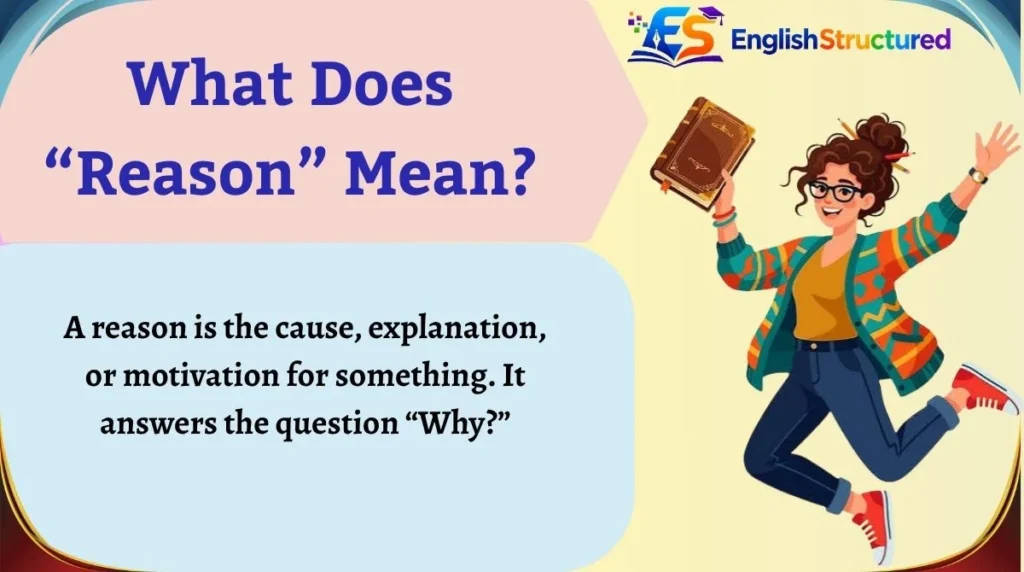
A reason is the cause, explanation, or motivation for something. It answers the question “Why?”
When we want to explain why something happened, why someone made a choice, or why someone behaved in a certain way, we usually talk about a reason.
For example:
I was late because I missed the bus.
Why was I late?
The answer is: I missed the bus.
Reason vs Purpose
A reason can be a fact, event, feeling, problem, or personal choice. It does not have to be something planned.
When Do We Use “Reason”?
We use reason when we explain the cause behind an action or situation.
Consider these examples:
- I left early because I was tired.
Reason vs Purpose - She was absent because she was ill.
Her illness explains her absence. - What is the reason for your decision?
This question asks why the person made the decision. - There is a good reason for his behavior.
The sentence says that his behavior has an explanation. - The reason I called you is that I need some help.
The speaker explains why the call was made. - He gave me a reason to trust him.
Something gave the speaker confidence in him. - We canceled the trip because of the bad weather.
The bad weather was the reason for the cancellation. - Reason vs Purpose
The speaker does not know why she left.
Notice that none of these examples needs a future goal. They focus on an explanation or cause.
Common Grammar Patterns With “Reason”
The noun reason appears in several useful patterns.
Reason vs Purpose
What is the reason for the delay?
Reason vs Purpose
Do you know the reason for the change?
Here, for is followed by a noun or noun phrase.
Reason + why + clause
I know the reason why she left.
That is the reason why I called.
In everyday English, the reason why is very common. Sometimes why can be omitted:
I know the reason she left.
Both versions are natural.
Reason vs Purpose
The reason that I stayed was simple.
This pattern is also grammatically possible, although many speakers prefer the reason why or simply the reason + clause.
For this reason
This phrase means because of this.
The road was dangerous. For this reason, we turned back.
It is especially common in formal writing.
Reason Does Not Always Mean “Excuse”
Reason vs Purpose
A reason explains why something happened. An excuse is often a reason given to defend or justify someone’s behavior, especially when the behavior is considered wrong or disappointing.
For example:
I missed the bus because I woke up late.
Reason vs Purpose
But if someone repeatedly arrives late and keeps giving weak explanations, another person might say:
That’s just an excuse.
So, a reason can be neutral or genuine, while an excuse can suggest that the explanation is not convincing.
What Does “Purpose” Mean?
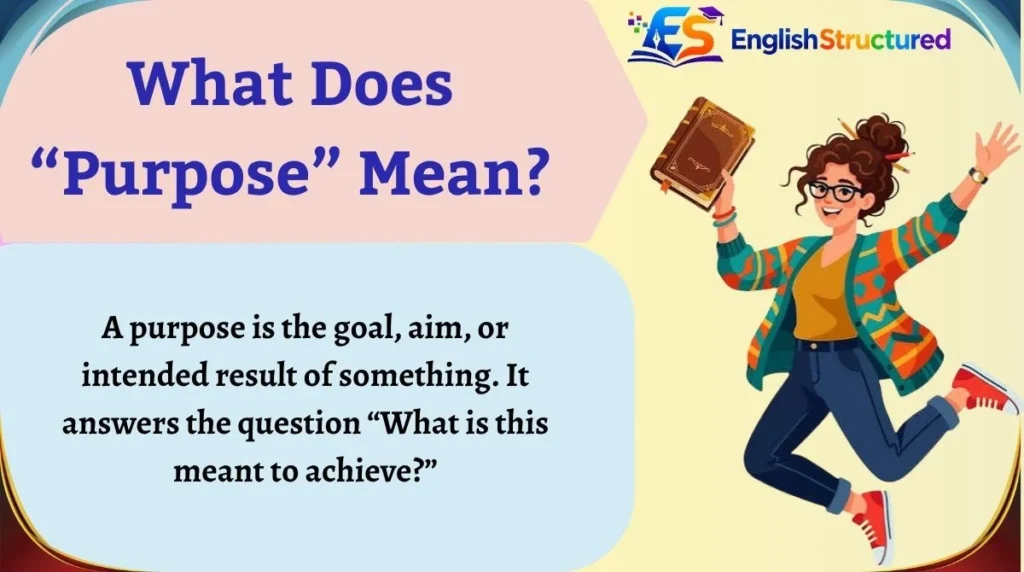
A purpose is the goal, aim, or intended result of something. It answers the question “What is this meant to achieve?”
Think about something you do intentionally.
If you go to the gym to exercise, exercising is the purpose of your visit.
If you open a book to learn, learning is the purpose of opening the book.
If a company creates a product to help customers, helping customers is part of the product’s purpose.
When Do We Use “Purpose”?
We use purpose when we talk about an intended goal or function.
Look at these examples:
- I went to the store to buy some milk.
Reason vs Purpose - The purpose of this meeting is to discuss the new project.
Discussing the project is the meeting’s goal. - She joined the course to improve her English.
Improving English was her purpose. - What is the purpose of this machine?
The question asks what the machine is designed to do. - The purpose of the exercise is to improve your writing.
Improving writing is the intended goal. - He saved money for the purpose of buying a car.
Buying a car was the planned goal. - Reason vs Purpose
Safety is the intended result of the rule. - This tool was created for the purpose of making the job easier.
Making the job easier is its intended function.
Purpose Is Often Connected With Plans
A purpose is usually connected with intention.
For example:
I went outside because I heard a noise.
Reason vs Purpose
But:
I went outside to check the door.
Reason vs Purpose
The first sentence explains what caused the action. The second explains what the person wanted to achieve.
Common Grammar Patterns With “Purpose”
Purpose + of + noun
What is the purpose of this meeting?
The purpose of the test is to measure your knowledge.
The main purpose of the law is public safety.
Reason vs Purpose
The purpose of exercising is to keep your body healthy.
This pattern describes the goal or function of an activity.
For the purpose of + -ing
This is a more formal structure.
Reason vs Purpose
In casual English, a simpler sentence is usually better:
The room was designed for meetings.
To + base verb
One of the easiest ways to express purpose is to + verb.
I went to the kitchen to get some water.
She called me to ask a question.
He studied hard to pass the exam.
This structure is extremely common in everyday English.
Difference Between Reason and Purpose
The easiest way to understand the difference is to remember this:
Reason vs Purpose
Purpose = what someone wants to achieve.
They are closely related, but they look at an action from different directions.
| Point | Reason | Purpose |
|---|---|---|
| Basic meaning | Cause or explanation | Goal or intended result |
| Main question | Why? | What for? |
| Focus | Cause or motivation | Aim or intention |
| Usually connected with | Past or present situation | Planned action or desired result |
| Common pattern | because, because of, reason for | to, in order to, purpose of |
| Example | I stayed home because I was sick. | I stayed home to rest. |
Look carefully at the two sentences:
I stayed home because I was sick.
Reason vs Purpose
I stayed home to rest.
Resting explains what I wanted to achieve by staying home. It is the purpose.
Both sentences can describe the same event, but they answer different questions.
Reason Focuses on the Cause
A reason often exists before or behind an action.
She went home because she felt tired.
Her tiredness caused or motivated the action.
Ask:
Why did she go home?
Answer:
Because she felt tired.
Purpose Focuses on the Goal
Reason vs Purpose
She went home to sleep.
Ask:
What did she want to do by going home?
Answer:
She wanted to sleep.
Reason vs Purpose
One Action Can Have Both a Reason and a Purpose
This is important.
Imagine that Tom goes to the library.
Tom went to the library because he had an exam.
Reason vs Purpose
Tom went to the library to study.
Reason vs Purpose
The exam explains why he decided to go. Studying explains what he intended to do there.
So, an action can have both a reason and a purpose.
Grammar Rules You Must Remember
Rule #1: Use “reason” for a cause or explanation
When you are explaining why something happened, reason is usually the right word.
The reason I stayed home was that I was sick.
What was the reason for the delay?
A helpful question is:
“Why did this happen?”
If the answer gives a cause or explanation, you are probably talking about a reason.
Rule #2: Use “purpose” for a goal or intended result
Reason vs Purpose
The purpose of the meeting is to solve the problem.
I went there to speak with the manager.
The second sentence does not use the word purpose, but it expresses purpose.
Ask:
“What was the person trying to achieve?”
If the answer is a goal, you are talking about purpose.
Rule #3: “Because” commonly introduces a reason
Because is one of the most common words used to give a reason.
I stayed inside because it was raining.
She was happy because she passed her test.
We canceled the game because the field was wet.
You can also use because of before a noun or noun phrase.
We stayed inside because of the rain.
The flight was delayed because of bad weather.
Remember the basic difference:
because + clause
because it was raining
because of + noun
because of the rain
Rule #4: “To” commonly expresses purpose
English speakers often use to + base verb to show purpose.
I went to the bank to deposit money.
She called me to ask for advice.
He bought a laptop to study online.
The structure is simple:
Action + to + goal
For example:
I opened the window to get some fresh air.
The action is opening the window.
Reason vs Purpose
You can also use in order to for purpose:
She woke up early in order to catch the train.
This is correct, but to is usually more natural in ordinary conversation:
She woke up early to catch the train.
Common Mistakes Students Make
English learners often confuse these words because both can be translated with a word similar to “why” in some languages.
The best solution is to focus on the meaning rather than translation.
Mistake 1: Treating reason and purpose as exact synonyms
A student might say:
Reason vs Purpose
This is incorrect.
The natural sentence is:
Reason vs Purpose
Traffic explains the cause of the lateness.
If you want to talk about purpose, you could say:
I left early for the purpose of avoiding traffic.
But in normal conversation, that sounds too formal. A natural sentence is:
I left early to avoid traffic.
Mistake 2: Using “purpose” for every “why” question
Not every “why” question asks about purpose.
Why did you leave?
Possible answer:
Because I was tired.
Reason vs Purpose
But:
Why did you go to the library?
Possible answer:
To study.
Reason vs Purpose
The word why can lead to either type of answer, so you must look at the meaning.
Mistake 3: Confusing “because” with “to”
Compare:
I went outside because it was hot.
Reason vs Purpose
I went outside to get some fresh air.
This gives a purpose.
Do not replace one with the other without changing the meaning.
Mistake 4: Using “for” incorrectly
Learners sometimes write:
I went to the shop for buy bread.
This is incorrect.
Say:
I went to the shop to buy bread.
After to in this purpose structure, use the base form of the verb.
Another option is:
I went to the shop for bread.
Here, for is followed by a noun.
Mistake 5: Making purpose sound too formal
This sentence is grammatically correct:
Reason vs Purpose
But it sounds formal and heavy in everyday conversation.
Most speakers would simply say:
I went to the store to buy bread.
Good English is not only about grammar. It is also about choosing the most natural expression for the situation.
Easy Trick to Remember the Difference
Here is a simple classroom trick:
Reason looks backward. Purpose looks forward.
Think about an action as a point in time.
Reason vs Purpose
A purpose explains what the person wanted to achieve through the action.
For example:
I studied because I had an exam.
Exam → studying
The exam is the reason.
Now:
I studied to pass the exam.
Studying → passing
Passing the exam is the purpose.
Another easy trick is to remember two questions:
Reason vs Purpose
Purpose: “What for?”
For example:
Why did you buy a new phone?
Because my old phone was broken.
That’s the reason.
What did you buy the new phone for?
To take better pictures.
Reason vs Purpose
This trick works well because it helps you focus on meaning instead of memorizing complicated grammar rules.
Daily Life Examples
The difference becomes much easier when you see it in normal conversations.
Example 1
A: Why are you carrying an umbrella?
B: Because it looks like rain.
Here, the speaker gives a reason.
Example 2
A: Why did you take your laptop?
B: I took it to finish my work.
Here, finishing work is the purpose.
Example 3
A: Why is Sarah staying home?
B: Because she isn’t feeling well.
Her health explains the situation, so it is the reason.
Example 4
A: Why are you going to the supermarket?
B: I’m going to buy some vegetables.
Reason vs Purpose
Example 5
A: Why did you cancel the meeting?
B: Because the manager was unavailable.
The manager’s absence is the reason.
Example 6
A: Why are you saving money?
B: I’m saving money to buy a car.
Buying a car is the purpose.
Example 7
A: Why did you call John?
B: Because I needed his advice.
Needing advice is the reason.
You could also say:
I called John to ask for his advice.
Reason vs Purpose
Example 8
A: Why did you open the door?
B: Because I heard someone outside.
The sound was the reason.
If the person says:
I opened the door to see who it was.
Then seeing who was outside is the purpose.
Example 9
The reason she went to the doctor was that she felt sick.
This explains what caused her visit.
She went to the doctor to get treatment.
This explains what she wanted to achieve.
Example 10
He joined the class because his friend recommended it.
Reason vs Purpose
He joined the class to improve his speaking skills.
Improving his speaking is the purpose.
Practice Section
Reason vs Purpose
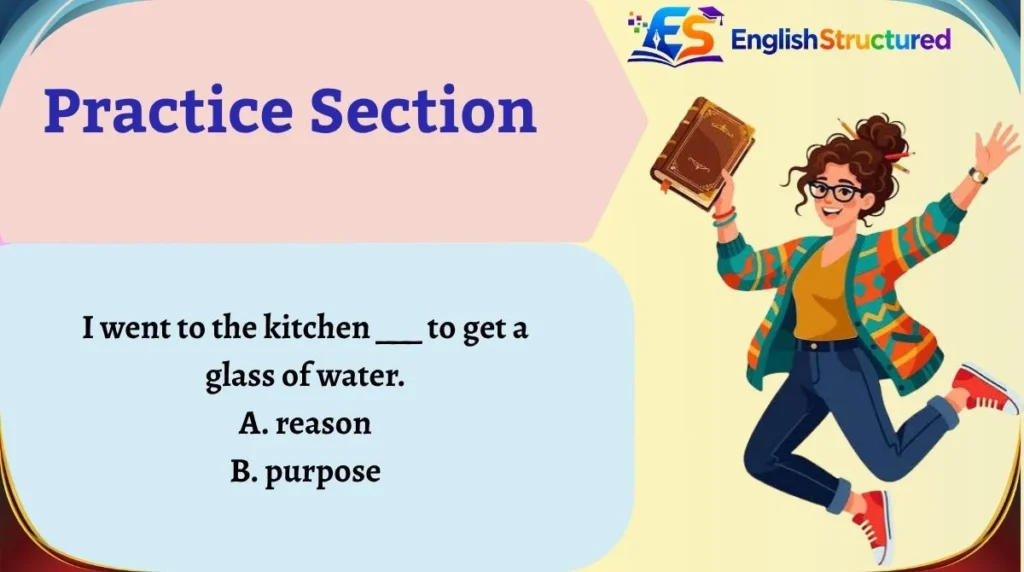
1. I went to the kitchen ___ to get a glass of water.
A. reason
B. purpose
2. The ___ I missed the bus was that I woke up late.
A. reason
B. purpose
3. What is the ___ of this machine?
A. reason
B. purpose
4. She stayed home because she was sick. Her illness was the ___.
A. reason
B. purpose
5. He studied hard to pass his final exam. Passing the exam was his ___.
A. reason
B. purpose
Answers
1. Purpose — Getting water was the goal of going to the kitchen.
2. Reason — Waking up late explains why the bus was missed.
3. Purpose — The question asks what the machine is designed to do.
4. Reason — Her illness explains why she stayed home.
5. Purpose — Passing the exam was the intended goal of studying.
FAQs
What is the difference between reason and purpose?
A reason is the cause or explanation behind an action or situation. A purpose is the goal or intended result of an action. In simple terms, a reason explains why, while a purpose explains what for.
Can “reason” and “purpose” mean the same thing?
Sometimes they can seem similar because both are related to the question “why?” However, they are not exact synonyms. A reason usually explains a cause, while a purpose focuses on an intended goal.
Can we use “reason” in questions?
Reason vs Purpose
What is the reason for the delay?
What was the reason you left?
Do you know the reason why he called?
These questions ask for an explanation or cause.
Can we use “purpose” in questions?
Yes. We often use purpose when asking about the goal or function of something.
What is the purpose of this meeting?
What is the purpose of this tool?
What did you do that for?
The last example is an informal way to ask about purpose.
Is “purpose” more formal than “reason”?
Not always, but purpose can sound more formal in some expressions. For example, “the purpose of this meeting” is common in formal settings. In everyday speech, we often express purpose with to + verb, such as “I went there to talk to him.”
Which word should I use with “because”?
Use reason when because gives the explanation.
I stayed home because I was sick.
You can also say:
Reason vs Purpose
For purpose, English commonly uses to:
I stayed home to rest.
What is the difference between “reason for” and “purpose of”?
Reason for introduces a cause or explanation:
What is the reason for the delay?
Purpose of introduces a goal or function:
What is the purpose of the meeting?
The easiest way to remember it is reason = cause and purpose = goal.
Conclusion
Reason vs Purpose
A reason gives the cause or explanation behind something. It tells us why an event happened or why someone made a choice.
A purpose, on the other hand, gives the goal or intended result. It tells us what someone wanted to achieve.
Compare these two sentences:
I went home because I was tired.
The tiredness is the reason.
I went home to rest.
Resting is the purpose.
Remember the simple trick: reason looks backward, while purpose looks forward. A reason explains what led to an action. A purpose explains what the action is meant to achieve.
You do not need to memorize dozens of rules. Pay attention to the meaning of the sentence.
Ask yourself, “Am I explaining a cause?” If yes, think reason. Ask, “Am I describing a goal?” If yes, think purpose.
With a little practice, this difference will become natural in both your speaking and writing.