Replicate vs Duplicate
Even native English speakers sometimes use them in similar situations.
However, there is a small but useful difference. Replicate usually focuses on making something again or producing a similar result.
Duplicate often means making an exact copy of something that already exists.
For example, you can replicate an experiment to see whether you get the same result. But you can duplicate a document when you want another copy of the same document.
The difference becomes even clearer when you look at common phrases. We often say replicate a process, replicate a result, or replicate a study.
We commonly say duplicate a file, duplicate a key, or duplicate a document.
There is also an important grammar point. Both words can work as verbs and nouns, although their noun forms are not always used in exactly the same way.
Understanding this difference can make your English sound more natural, especially at school, at work, or when talking about computers, research, design, and everyday objects.
By the end, you will know when to use replicate and when to use duplicate, with simple rules and real-life examples that are easy to remember.
What Does “Replicate” Mean?
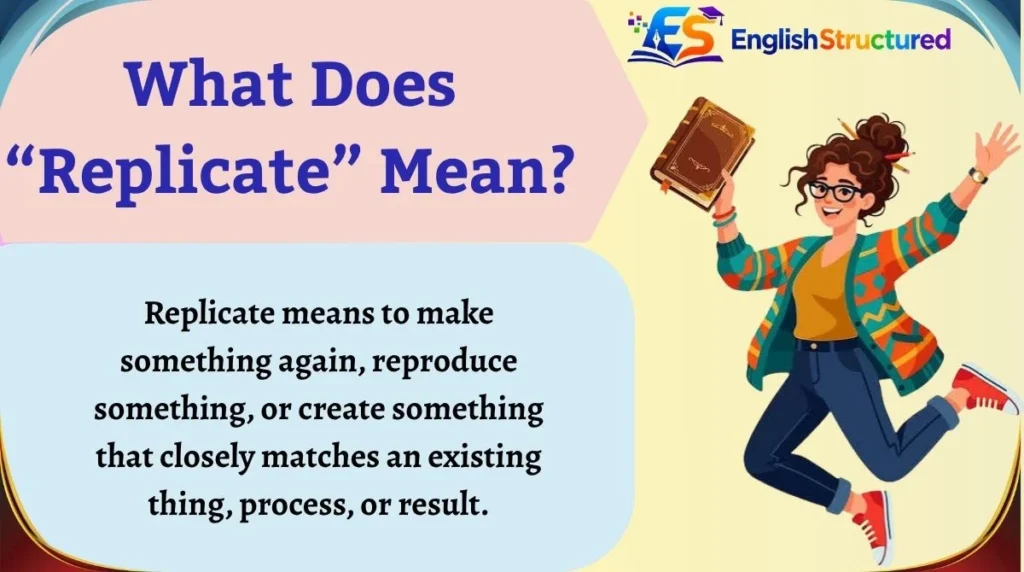
Replicate means to make something again, reproduce something, or create something that closely matches an existing thing, process, or result.
Replicate vs Duplicate
When you replicate something, you try to produce it again, often by following the same method or conditions. The new result may be very similar to the original, but it does not always have to be an exact physical copy.
For example:
- Replicate vs Duplicate
- The company wants to replicate its successful business model.
- The artist tried to replicate the original painting.
- We could not replicate the same result.
- The chef learned how to replicate the restaurant’s famous sauce.
- The machine can replicate the movement of a human hand.
- The team hopes to replicate last year’s success.
- Replicate vs Duplicate
Notice that some of these examples are about copying a method, result, experience, or success, not simply making another physical copy.
When Should You Use “Replicate”?
Use replicate when you want to talk about producing something again, especially when the process or result matters.
It is very common in:
- Science
- Research
- Business
- Technology
- Art and design
- Medicine
- Engineering
- Manufacturing
For instance, imagine a scientist performs an experiment and gets an interesting result. Another scientist repeats the experiment under similar conditions.
We can say:
Replicate vs Duplicate
The second scientist is not necessarily making a physical copy of the first experiment. Instead, they are repeating the process to see if the same result happens again.
This is one of the most important uses of replicate.
Replicate Can Mean “Produce Again”
Sometimes replicate simply means to produce something again.
For example:
Replicate vs Duplicate
Here, the designer created a new version that closely matches the original.
You could sometimes use duplicate in a similar situation, but the choice depends on what you are emphasizing.
If you are talking about an exact copy, duplicate is often more natural.
If you are talking about recreating something or achieving the same effect, replicate is often the better choice.
Replicate as a Verb
The most common grammatical pattern is:
Replicate vs Duplicate
Examples:
- replicate a process
- replicate a result
- Replicate vs Duplicate
- replicate a design
- replicate a model
- replicate a successful strategy
You can also use it in passive sentences:
The experiment was successfully replicated by another research team.
Here, replicated means that another team repeated the experiment and was able to produce a similar result.
Replicate as a Noun
The noun replicate is less common in everyday English but is used in science and research.
A replicate can refer to a repeated experiment, test, or sample.
For example:
The researchers prepared three replicates for each test.
Replicate vs Duplicate
A Common Confusion About Replicate
Many learners think replicate always means make an exact copy.
That is not always true.
Consider this sentence:
The company replicated its successful store model in another city.
The new store is not necessarily an exact physical copy. The company has copied the idea, structure, or strategy that made the first store successful.
That is why replicate can be broader than duplicate.
What Does “Duplicate” Mean?
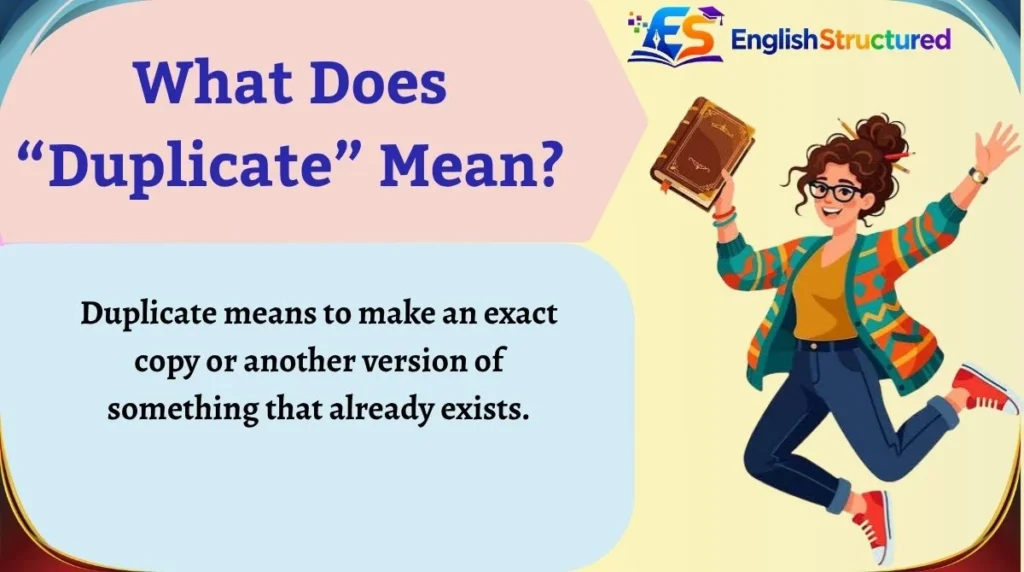
Duplicate means to make an exact copy or another version of something that already exists.
The main idea is copying.
If you duplicate a document, for example, you create another copy of that document. If you duplicate a key, you make another key with the same purpose and design.
Here are some examples:
- Replicate vs Duplicate
- I need to duplicate the key.
- She accidentally duplicated the file.
- The system automatically duplicates the information.
- Can you duplicate this photo?
- He duplicated the original design almost perfectly.
- Replicate vs Duplicate
- The office made a duplicate copy of the report.
The word is especially common when talking about documents, files, records, keys, objects, and information.
When Should You Use “Duplicate”?
Use duplicate when the main idea is making another copy of something.
For example:
Replicate vs Duplicate
This means you created another copy of the file.
The original file still exists, and you now have a second version.
You can also use duplicate as an adjective:
We found a duplicate file on the computer.
Here, duplicate describes a file that is another copy of an existing file.
Duplicate as a Verb
As a verb, duplicate means to copy or reproduce.
Common patterns include:
Replicate vs Duplicate
Examples:
- duplicate a file
- duplicate a document
- duplicate a key
- Replicate vs Duplicate
- duplicate a payment
- duplicate an image
For example:
Please duplicate this spreadsheet before making changes.
The speaker wants another copy of the spreadsheet.
Duplicate as a Noun
Duplicate can also be a noun.
A duplicate is a copy of something.
For example:
Replicate vs Duplicate
This means the speaker has another copy of the certificate.
You may also hear:
Keep the original and give me the duplicate.
Here, duplicate clearly means copy.
Duplicate as an Adjective
Duplicate can describe something that is an unnecessary or repeated copy.
For example:
I deleted the duplicate file.
This means there was another file that contained the same information or was essentially the same file.
Another example is:
The system detected duplicate entries.
This means the same information appeared more than once.
A Common Confusion About Duplicate
Replicate vs Duplicate
But duplicate is usually stronger than simply repeating an action.
For example:
She duplicated the experiment.
This can mean she made another version of the experiment or repeated it in a similar way.
However, in scientific writing, replicate the experiment is often more natural when the goal is to repeat the experiment and check whether the same result can be obtained.
Difference Between Replicate and Duplicate
The easiest way to understand the difference is to focus on the central idea of each word.
Replicate vs Duplicate
Duplicate = make another copy of something.
They can overlap, but they are not always interchangeable.
| Word | Main Meaning | Common Use | Example |
|---|---|---|---|
| Replicate | Produce or reproduce something again | Experiments, results, methods, designs, success | We replicated the experiment. |
| Duplicate | Make an exact or near-exact copy | Files, documents, keys, records, objects | I duplicated the file. |
Replicate Focuses on Reproduction
Suppose a restaurant creates a very popular recipe.
Another branch uses the same ingredients and cooking method to create the same taste.
You could say:
Replicate vs Duplicate
The focus is on recreating the result.
The two dishes may not be physically identical, but the goal is to achieve the same experience.
Duplicate Focuses on Copying
Now imagine you have a PDF file and need another copy.
You can say:
I duplicated the PDF.
The focus is on creating another copy of the existing file.
You are not trying to recreate the idea behind the PDF. You simply want another version of it.
Replicate a Result, Duplicate a File
This is a useful beginner rule.
We often:
- Replicate vs Duplicate
- replicate an experiment
- replicate a process
- replicate a strategy
- duplicate a file
- duplicate a document
- duplicate a key
- duplicate a record
These are not absolute rules, but they will help you choose the more natural word in many situations.
The Difference in Sentence Structure
Both words commonly work as transitive verbs. That means they can be followed directly by an object.
Replicate + object
Scientists replicated the experiment.
Replicate vs Duplicate
The assistant duplicated the document.
Both sentences have the same basic grammar structure.
The difference is mainly in meaning and context, not sentence structure.
Exact Copy vs Similar Reproduction
This is perhaps the most useful distinction.
Duplicate often suggests an exact copy.
Replicate often suggests a reproduction that aims to match the original.
For example:
I duplicated the photo.
This suggests that you made another copy of the photo.
But:
Replicate vs Duplicate
This could suggest that you recreated the image, perhaps by drawing or photographing it again.
The second sentence is more about recreating than simply copying a digital file.
Grammar Rules You Must Remember
Rule #1: Use “Replicate” for Repeating a Process or Result
When the goal is to perform something again and see whether you get the same result, replicate is usually a strong choice.
The scientists replicated the experiment.
The scientists repeated the experiment to check the result.
Another example:
Replicate vs Duplicate
The team repeated the research using a similar method.
Rule #2: Use “Duplicate” for Making Another Copy
When you want another copy of a document, file, object, or record, duplicate is usually more natural.
Please duplicate this document.
You are asking someone to make another copy.
Another example:
I duplicated the folder before deleting anything.
The speaker made another copy of the folder for safety.
Rule #3: “Duplicate” Can Be a Noun
Replicate vs Duplicate
It can be a noun meaning a copy.
I need a duplicate of my receipt.
Here, duplicate is the thing that is being requested.
It can also be an adjective:
There are duplicate records in the system.
So you may see duplicate used in several grammatical roles.
Rule #4: “Replicate” Often Appears in Formal and Technical English
Replicate is especially common in scientific, technical, and professional writing.
For example:
Replicate vs Duplicate
This sounds natural in research writing.
You can also use it in everyday English:
I tried to replicate my grandmother’s recipe.
So replicate is not limited to science. It simply becomes especially useful when talking about reproducing a process, result, or effect.
Common Mistakes Students Make
Mistake 1: Thinking the Two Words Are Always Identical
A common mistake is believing that replicate and duplicate can always replace each other.
They cannot.
For example:
Replicate vs Duplicate
This is possible, but in a research context, replicated the experiment may better express the idea of repeating the experiment to test the result.
A better choice is often:
The researchers replicated the experiment.
Mistake 2: Using “Replicate” for Every Computer Copy
When talking about computers, duplicate is often the clearer word.
Less natural:
Please replicate this file.
More natural:
Replicate vs Duplicate
The second sentence clearly means make another copy.
Mistake 3: Assuming “Duplicate” Always Means Perfectly Identical
Duplicate usually suggests an exact or very close copy, but real-world duplicates are not always perfectly identical.
For example, a duplicate key is made to work like the original, but tiny physical differences may exist.
So think of duplicate as another copy, rather than demanding mathematical perfection.
Mistake 4: Forgetting the Idea of “Same Result”
Students sometimes see replicate and think only about physical objects.
But you can replicate something that is not a physical object.
You can replicate:
- success
- a process
- a method
- a result
- a study
- an experience
- a strategy
For example:
The team wants to replicate last year’s success.
You cannot physically copy “success” like a document. Instead, you want to achieve the same kind of success again.
Mistake 5: Confusing “Duplicate” With “Repeat”
Repeat is a broader word.
You can repeat a sentence:
Please repeat the question.
You can repeat an action:
He repeated the exercise.
You can repeat an event:
We repeated the test.
But duplicate normally carries the stronger idea of creating a copy or matching an existing thing.
That is why the three words should not be treated as perfect synonyms.
Easy Trick to Remember the Difference
Here is a simple memory trick:
Duplicate = Double
The words both begin with a D sound.
Think:
Replicate vs Duplicate
If you duplicate a file, you make another copy.
If you duplicate a key, you make another key.
If you duplicate a document, you make another document.
Now remember:
Replicate = Reproduce
Both ideas are connected to repeating or reproducing something.
Think:
Replicate → Reproduce → make the result happen again
Replicate vs Duplicate
If you replicate a successful strategy, you try to produce the same success.
If you replicate a design, you recreate it.
A very simple formula is:
Duplicate = copy it.
Replicate = recreate it.
This trick is not a perfect grammar rule, but it works well for everyday choices.
Daily Life Examples
Real conversations make the difference much easier to understand.
1. Computer Files
A: Did you delete the original spreadsheet?
B: No. I duplicated it before making changes.
Here, duplicated means made another copy.
2. Scientific Research
A: Did another team get the same result?
B: Yes. They replicated the experiment.
Here, replicated means they repeated the experiment to see if the result could be produced again.
3. A House Key
A: Do you have a spare key?
B: Yes. I had a duplicate made yesterday.
The second key is a copy of the original.
4. Cooking
A: This cake tastes amazing.
Replicate vs Duplicate
The speaker tried to recreate the same taste and result.
5. Business
A: How did the company grow so quickly?
B: They want to replicate their successful business model in other countries.
The company wants to use the same approach again, not simply photocopy a physical object.
6. Office Documents
A: Can you give me another copy of this report?
B: Sure. I’ll duplicate the document.
The speaker will make another copy.
7. Art
A: Did you copy this old painting?
B: I tried to replicate the original style.
The artist tried to recreate the appearance or effect of the original.
8. Research Results
A: Were the findings confirmed?
B: Yes. A different group replicated the study.
The second group repeated the study to see whether it produced similar findings.
9. Phone Photos
A: Why are there two identical photos in your gallery?
B: I accidentally duplicated the picture.
There are two copies of the same digital image.
10. Learning a Skill
A: How did you make that complicated design?
B: I watched the tutorial and tried to replicate the technique.
The person tried to recreate the same method or effect.
Practice Section
Replicate vs Duplicate
1. Please ______ this file before you edit it.
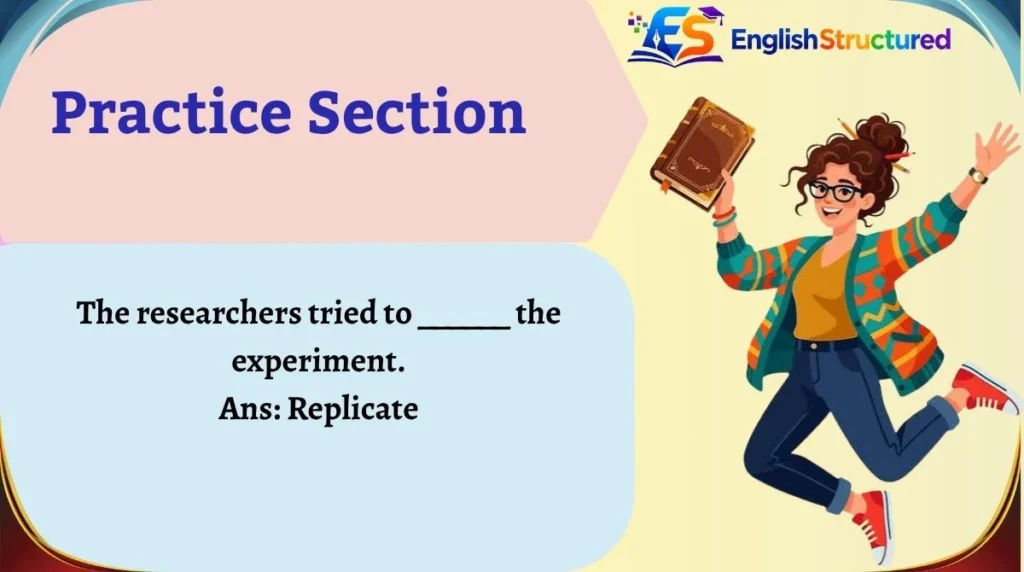
2. The researchers tried to ______ the experiment.
3. I need a ______ of my house key.
4. The company wants to ______ its successful business model.
5. There are three ______ records in the database.
Answers
1. Duplicate
Replicate vs Duplicate
You need another copy of the file.
2. Replicate
The researchers tried to replicate the experiment.
They repeated the experiment to see if they could get a similar result.
3. Duplicate
I need a duplicate of my house key.
A duplicate is another copy of the key.
4. Replicate
The company wants to replicate its successful business model.
The company wants to reproduce the success by using a similar model.
5. Duplicate
Replicate vs Duplicate
The records appear more than once as copies or repeated entries.
FAQs
What is the difference between replicate and duplicate?
Replicate usually means to reproduce something, such as a process, result, experiment, or strategy. Duplicate usually means to make another copy of something. The words can overlap, but duplicate has a stronger connection with copying.
Can “replicate” mean “copy”?
Yes. Replicate can mean to copy or reproduce something closely. However, it often focuses on recreating a result, process, design, or effect rather than simply making another physical or digital copy.
For example, you can replicate a recipe, experiment, or design.
Is “duplicate” the same as “copy”?
In many situations, yes. Duplicate can mean to make another copy of something. It can also be used as a noun or adjective.
Replicate vs Duplicate
Can I say “duplicate an experiment”?
Yes, the phrase is grammatically possible. However, replicate an experiment is often more natural in scientific and research contexts when you mean repeating the experiment to check whether similar results can be obtained.
The exact choice depends on what you want to emphasize.
Is “replicate” formal English?
Replicate is common in both everyday and formal English. It is especially frequent in science, research, business, and technology.
For example, “The researchers replicated the study” sounds very natural in academic English.
Is “duplicate” formal or informal?
Duplicate can be used in both formal and informal English. It is very common in offices, technology, administration, and everyday situations.
Examples include “duplicate the file,” “duplicate the record,” and “a duplicate copy.”
Conclusion
Replicate vs Duplicate
Remember the basic idea: duplicate usually means make another copy, while replicate often means reproduce something again or achieve a similar result.
You might duplicate a file, document, key, or record. On the other hand, you might replicate an experiment, process, strategy, design, or successful result.
There are situations where the two words overlap. That is normal. English has many words with similar meanings, and context often decides which one sounds best.
If you are unsure, ask yourself one simple question: Am I making another copy, or am I trying to recreate something?
If it is another copy, duplicate is often the better choice. If you are recreating a process, result, or effect, replicate is often more suitable.
A little practice with real sentences will make the difference feel natural.