Prescribe vs Proscribe
This is one of those English word pairs that can cause trouble even for learners who already have a good vocabulary.
The confusion is easy to understand. Both words contain scribe, and both are often used in formal English.
However, their meanings move in opposite directions. Prescribe usually means to officially recommend, order, or set a rule for something.
Proscribe means to officially forbid or reject something.
For example, a doctor may prescribe medicine for a patient. A government may proscribe an activity that is considered illegal.
One word tells you what should be done, while the other tells you what should not be done.
Knowing the difference matters because using the wrong word can completely change your meaning.
Imagine saying that a doctor “proscribed” a medicine when you actually mean that the doctor ordered the patient to take it.
That small spelling mistake creates a very different message.
The good news is that the difference becomes simple once you connect each word with its main idea. Prescribe = recommend or order. Proscribe = forbid or ban.
By the end of this guide, you will know how both words work, where they come from, how to use them in sentences, and how to remember the difference without getting confused again.
What Does “Prescribe” Mean?
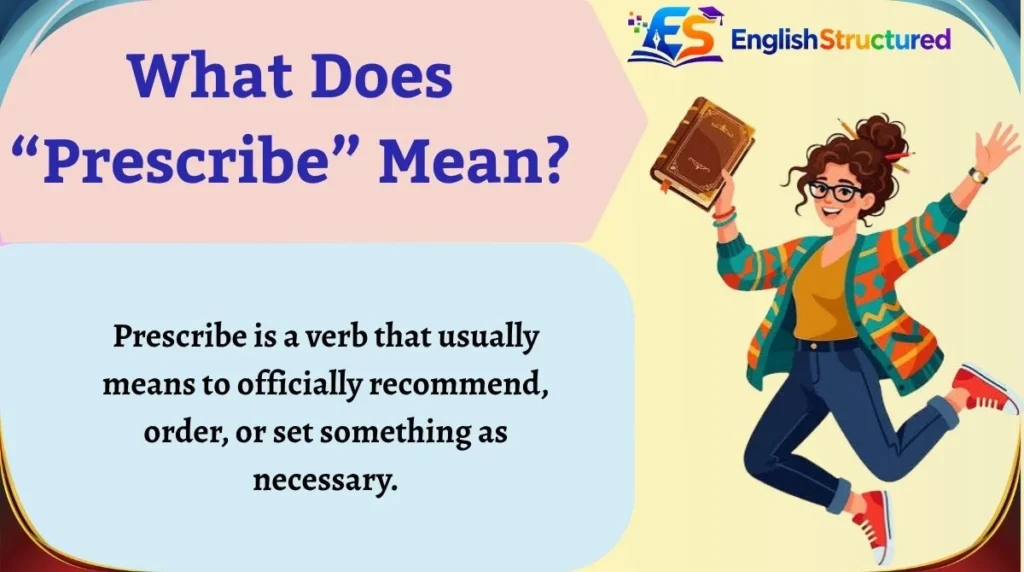
Prescribe is a verb that usually means to officially recommend, order, or set something as necessary.
The word is especially common in medicine. When a doctor tells a patient to take a particular medicine, the doctor prescribes it.
For example:
Prescribe vs Proscribe
Here, prescribed means the doctor officially ordered or recommended the medicine.
But medicine is not the only area where we use this word. Prescribe can also mean to officially state what should happen or what people should do.
A law, rule, system, or authority can prescribe a particular action.
The basic meaning of prescribe
Prescribe vs Proscribe
“Tell someone what should be done.”
It can involve medicine, treatment, rules, procedures, or requirements.
The common grammar pattern is:
Prescribe vs Proscribe
Example:
The doctor prescribed a new medicine for me.
Another common pattern is:
prescribe + something + to + someone
Example:
The doctor prescribed the treatment to the patient.
You can also use the word without mentioning the person receiving the recommendation.
Prescribe vs Proscribe
Prescribe in medical English
This is probably the most familiar use of the word.
Prescribe vs Proscribe
For example:
- The doctor prescribed some tablets for my headache.
- She prescribed antibiotics after examining the patient.
- My dentist prescribed a special mouthwash.
- The doctor prescribed two weeks of rest.
- He was prescribed a new medicine for his condition.
- The nurse explained how to take the prescribed medicine.
- Prescribe vs Proscribe
- I went back to the clinic because the prescribed treatment was not helping.
Notice that prescribe does not simply mean “suggest” in every situation. In medical contexts, it often carries the idea of an official medical instruction.
A doctor may suggest that you drink more water, but when the doctor officially orders a particular medicine, we normally say that the medicine was prescribed.
Prescribe outside medicine
The word also appears in formal discussions about rules and procedures.
For example:
Prescribe vs Proscribe
This means the school officially sets those rules.
Another example:
Prescribe vs Proscribe
Here, the law states what procedure should be followed.
You may also see the adjective prescribed:
Students must follow the prescribed procedure.
This means the procedure has already been officially decided.
Common learner confusion with prescribe
Many learners remember that prescribe has something to do with medicine and stop there. That can make it difficult when they see the word in legal, academic, or general formal writing.
The larger idea is not simply “give medicine.”
The larger idea is:
Prescribe vs Proscribe
Medicine is simply one of its most common uses.
What Does “Proscribe” Mean?
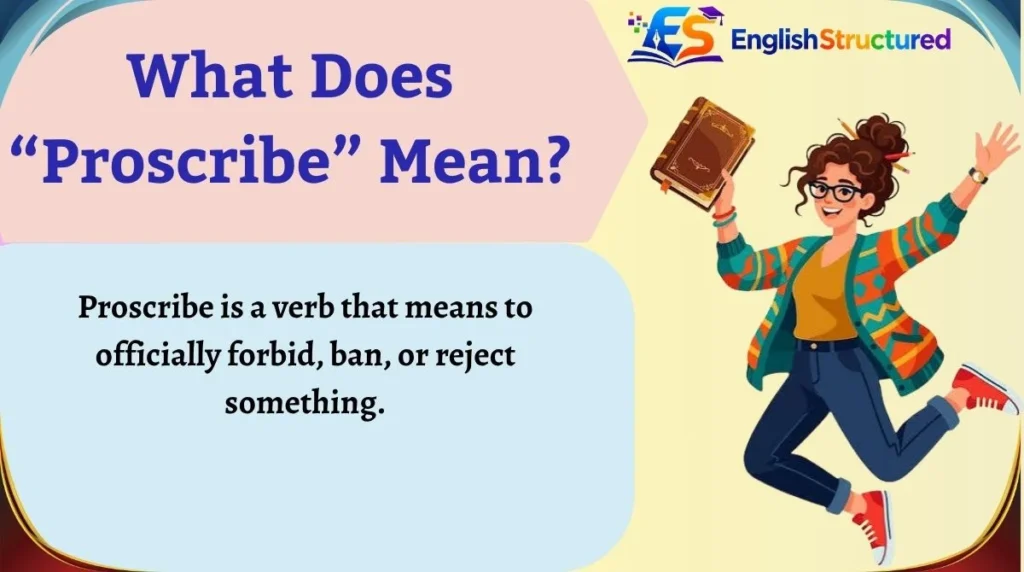
Proscribe is a verb that means to officially forbid, ban, or reject something.
This is where the big difference appears.
If you prescribe something, you say that it should be done.
Prescribe vs Proscribe
For example:
The government proscribed the organization.
This means the government officially banned or prohibited the organization.
The basic meaning of proscribe
A simple way to understand proscribe is:
“Officially say that something is not allowed.”
It is often used in formal writing, especially when talking about governments, laws, organizations, rules, or activities.
Common patterns include:
Prescribe vs Proscribe
The law proscribes discrimination.
proscribe + something + as + unacceptable/illegal/etc.
The practice was proscribed as dangerous.
The verb is less common in everyday conversation than ban, forbid, or prohibit.
For example, in casual speech, people are more likely to say:
The government banned the activity.
In formal writing, you might see:
Prescribe vs Proscribe
Both express the idea of an official ban.
Examples of proscribe
Here are some clear examples:
- The law proscribes the use of certain materials.
- The government proscribed the organization.
- The school proscribes violent behavior.
- The rules proscribe the use of phones during the examination.
- Prescribe vs Proscribe
- The activity was proscribed by the authorities.
- The new regulation proscribes unsafe practices.
- The organization has strict rules that proscribe dishonest conduct.
In each sentence, the word carries the idea of prohibition.
Proscribe is a formal word
One important point for English learners is that proscribe is relatively formal.
You may not hear it often in everyday conversations.
A friend is unlikely to say:
My parents proscribed video games after dinner.
They would probably say:
My parents banned video games after dinner.
However, proscribe is useful when reading newspapers, legal documents, academic writing, government statements, and formal reports.
Common learner confusion with proscribe
The biggest mistake is assuming that proscribe means something similar to “prescribe” because the words look so alike.
They are actually very different.
Remember:
Prescribe vs Proscribe
Prescribe vs Proscribe
That contrast is the key to using them correctly.
Difference Between Prescribe and Proscribe
The easiest way to understand these words is to place them side by side.
| Word | Basic meaning | Main idea | Common use | Example |
|---|---|---|---|---|
| Prescribe | Recommend, order, or officially set | What should be done | Medicine, rules, procedures | The doctor prescribed medicine. |
| Proscribe | Forbid, ban, or officially reject | What must not be done | Laws, policies, authorities | The law proscribes the practice. |
The words may look like close relatives, but their meanings point in opposite directions.
Prescribe tells you what to do
When someone prescribes something, they are saying:
“This is what you should do.”
A doctor prescribes medicine.
A rule may prescribe a certain procedure.
A regulation may prescribe safety standards.
For example:
The doctor prescribed three days of rest.
The doctor is giving an instruction about what the patient should do.
Proscribe tells you what not to do
When someone proscribes something, they are saying:
“This is not allowed.”
For example:
Prescribe vs Proscribe
The rules are telling students what they must not do.
The difference in sentence structure
Both words are verbs, so they can take a direct object.
With prescribe:
The doctor prescribed medicine.
“Medicine” is the object.
With proscribe:
The law proscribed the activity.
“The activity” is the object.
The grammar is similar, but the meaning is different.
Compare these two sentences
Prescribe vs Proscribe
This means the doctor ordered or recommended the medicine.
Now look at:
The doctor proscribed the medicine.
This would mean the doctor forbade or prohibited the medicine.
The difference is only one letter in spelling, but the meaning changes completely.
That is why these words deserve special attention.
Another useful comparison
The rules prescribe protective equipment.
This means the rules require or specify protective equipment.
The rules proscribe unsafe behavior.
This means the rules forbid unsafe behavior.
Both words can appear in discussions about rules, but they perform opposite jobs.
Grammar Rules You Must Remember
Rule #1: Use “prescribe” for something officially recommended or ordered
Use prescribe when someone with authority tells another person what should be done.
Prescribe vs Proscribe
The doctor is giving an official medical instruction.
This can also apply to rules:
The policy prescribes regular safety checks.
The policy says that regular safety checks should happen.
Rule #2: Use “proscribe” for something officially forbidden
Use proscribe when an authority bans or prohibits an action, practice, object, or organization.
The law proscribes bribery.
The law says bribery is not allowed.
A useful replacement is ban or prohibit.
Prescribe vs Proscribe
Rule #3: Prescribe and proscribe can both be used for rules
This is an important point.
Do not assume that prescribe is only a medical word.
Rules can prescribe required behavior:
The regulations prescribe regular inspections.
Rules can also proscribe forbidden behavior:
The regulations proscribe unsafe practices.
So, when you see either word with “rules,” focus on the direction of the rule.
Prescribe = required or recommended
Prescribe vs Proscribe
Rule #4: Do not confuse “proscribe” with “prescribe” because of pronunciation and spelling
The words are close in spelling, and their pronunciations can also cause confusion.
Prescribe is commonly pronounced approximately:
prih-SKRIBE
Proscribe is commonly pronounced approximately:
proh-SKRIBE
The first parts are different, but the ending sounds very similar.
When writing, stop for a moment and ask yourself:
Am I saying “do this” or “do not do this”?
If you mean “do this,” choose prescribe.
Prescribe vs Proscribe
Common Mistakes Students Make
Mistake 1: Using “proscribe” when they mean “prescribe”
A student might write:
The doctor proscribed antibiotics.
If the meaning is that the doctor ordered the patient to take antibiotics, this is incorrect.
The correct sentence is:
The doctor prescribed antibiotics.
Why?
Because the doctor recommended or ordered the treatment.
Mistake 2: Using “prescribe” when they mean “ban”
Consider:
Prescribe vs Proscribe
This sentence could confuse the reader because prescribe normally suggests that something is recommended, ordered, or set as a requirement.
If you mean smoking is not allowed, say:
The law proscribes smoking in the building.
Or, in everyday English:
The law prohibits smoking in the building.
Mistake 3: Thinking “proscribe” means “write a prescription”
The spelling can trick learners into thinking that proscribe is related to a doctor’s prescription.
It is not.
Prescribe vs Proscribe
A law can proscribe an activity.
Mistake 4: Using “prescribe” only for doctors
This is too narrow.
For example:
The regulations prescribe a minimum safety standard.
Here, no doctor is involved.
The word means that the regulations officially set or require something.
Mistake 5: Using “proscribe” in casual conversation
This is not always grammatically wrong, but it can sound unnecessarily formal.
Instead of:
My father proscribed television after ten.
Most people would naturally say:
My father banned television after ten.
Prescribe vs Proscribe
Quick correction tip
Whenever you are unsure, replace the word in your head.
If you can replace it with:
recommend → prescribe
order → prescribe
require → prescribe
ban → proscribe
forbid → proscribe
prohibit → proscribe
This simple test can solve many questions.
Easy Trick to Remember the Difference
Here is a simple memory trick:
Prescribe = Please do it
Think of the first part of prescribe as connected with a positive instruction:
Prescribe → “Please do this.”
A doctor says:
Take this medicine.
That is a prescription.
The doctor is telling you what to do.
Proscribe = Prohibit it
Think of proscribe as being close in meaning to prohibit.
Both begin with pro, and both can appear in formal discussions of rules and bans.
Prescribe vs Proscribe
So you can remember the pair like this:
Prescribe = put something into practice.
Proscribe = put something off-limits.
The spelling is close, but the direction is opposite.
A classroom trick
Imagine a teacher standing in front of two signs.
The first sign says:
“Wear safety goggles.”
That is something the rules prescribe.
The second sign says:
“Do not use your phone.”
That is something the rules proscribe.
One tells you what is required.
The other tells you what is forbidden.
That picture can make the difference much easier to remember.
Daily Life Examples
These examples show how the two words work in natural situations.
1. At the doctor’s office
Patient: What did the doctor say?
Friend: She prescribed some medicine and told me to rest.
Prescribe vs Proscribe
2. Talking about school rules
The school rules prescribe a uniform for all students.
The rules state what students are expected to wear.
3. Talking about prohibited behavior
The school rules proscribe cheating during exams.
The rules forbid cheating.
4. Discussing workplace safety
Prescribe vs Proscribe
The policy requires the training.
5. Talking about forbidden actions
The company policy proscribes sharing confidential information.
The policy says employees must not share it.
6. Talking about medicine
Friend: Why are you taking those tablets?
Patient: My doctor prescribed them for me.
This is a very natural everyday use of prescribed.
7. Discussing government rules
The new regulation prescribes how waste should be handled.
The regulation sets out the required procedure.
8. Discussing a ban
The regulation proscribes the dumping of waste into the river.
The regulation forbids that action.
9. In academic writing
The study guidelines prescribe a specific method for collecting data.
The guidelines require or specify the method.
10. In a formal report
The policy proscribes discrimination in the workplace.
The policy formally forbids discrimination.
Notice how prescribe and proscribe can both appear in serious discussions about rules and policies. The difference is not the subject. The difference is what the rule says.
Practice Section
Choose prescribe or proscribe to complete each sentence.
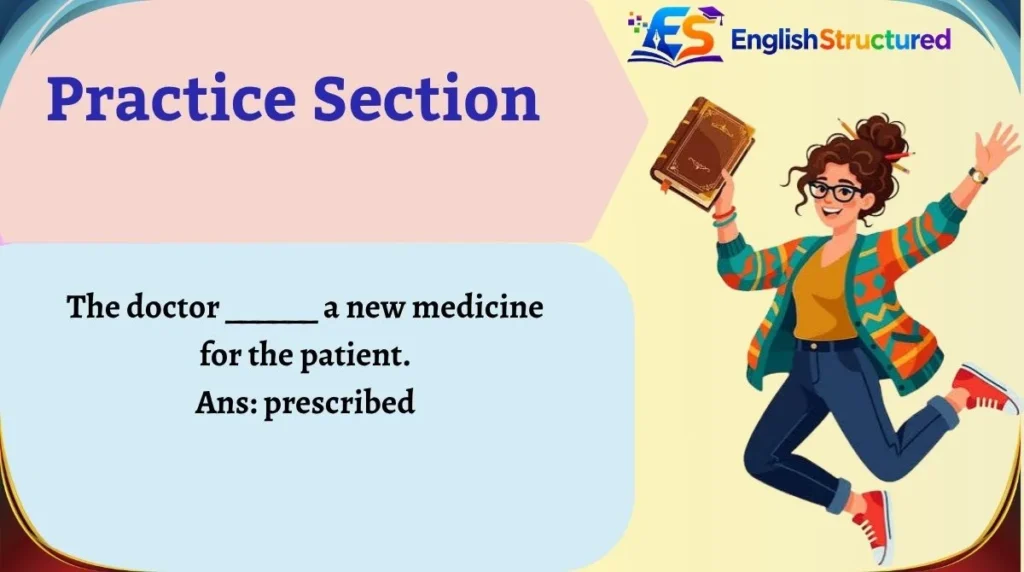
1. The doctor ______ a new medicine for the patient.
2. The law ______ the use of false documents.
3. The safety rules ______ protective clothing in the laboratory.
4. The school rules ______ cheating during examinations.
5. The doctor ______ two weeks of rest.
Answers
1. prescribed
The doctor prescribed a new medicine for the patient.
The doctor ordered or recommended the medicine.
2. proscribes
Prescribe vs Proscribe
The law forbids the use.
3. prescribe
The safety rules prescribe protective clothing in the laboratory.
The rules require it.
4. proscribe
The school rules proscribe cheating during examinations.
The rules forbid cheating.
5. prescribed
The doctor prescribed two weeks of rest.
The doctor officially recommended or ordered the rest.
Quick self-test
Before choosing your answer, ask:
Is the sentence telling someone what to do?
Prescribe vs Proscribe
Is it telling someone what not to do?
Choose proscribe.
That question works surprisingly well.
FAQs
What is the difference between prescribe and proscribe?
Prescribe means to recommend, order, or officially set something that should be done. Proscribe means to officially forbid or ban something.
A doctor may prescribe medicine, while a law may proscribe an illegal activity.
Is prescribe only used for medicine?
No. Medicine is one of its most common uses, but prescribe has a wider meaning.
Rules, laws, policies, and procedures can also prescribe requirements.
For example, “The regulations prescribe regular inspections” means the regulations require or specify those inspections.
Is proscribe the same as prohibit?
In many formal contexts, yes. Proscribe means to officially forbid or ban something.
“Prohibit” is much more common in everyday English, while “proscribe” often sounds more formal.
For example, “The law prohibits smoking” is more common than “The law proscribes smoking.”
Can a doctor proscribe medicine?
Yes, if the intended meaning is that the doctor forbids or prohibits the use of a medicine. However, this is much less common than saying that the doctor prescribed medicine.
For example, “The doctor proscribed the drug” would mean the doctor prohibited it, not recommended it.
Are prescribe and proscribe opposites?
They can express opposite ideas in many contexts.
Prescribe can mean to officially require or recommend something, while proscribe means to officially forbid it.
A rule can prescribe safety equipment and proscribe dangerous behavior.
Is proscribe a formal word?
Prescribe vs Proscribe
You are more likely to encounter it in legal, academic, government, political, or formal writing than in casual conversation.
That does not make it difficult. Just remember that it means officially forbid or ban.
Conclusion
Prescribe and proscribe are easy to confuse because they look and sound very similar. However, their meanings are clearly different once you focus on the direction of the action.
Prescribe means to recommend, order, or officially state what should be done. Doctors prescribe medicine, while rules can prescribe procedures or requirements.
Proscribe means to officially forbid, ban, or prohibit something. Laws, policies, and authorities may proscribe certain actions or practices.
The simplest memory trick is:
Prescribe vs Proscribe
Proscribe = don’t do this.
When you see either word, ask yourself what the speaker is communicating. Is something being recommended or required? Use prescribe. Is something being banned or forbidden? Use proscribe.
A few examples in real sentences will make the difference stick.
Once you connect each word with its basic idea, this confusing pair becomes much easier to use correctly in both everyday and formal English.