On the Side or At the Side
Both can talk about a position beside something, so it is easy to think they can be used in exactly the same way.
However, they are not equally common, and they do not always carry the same meaning.
The good news is that the difference is easier than it first appears. In everyday English, “on the side” is much more common.
It can describe a position, an additional item, or something done separately from a main activity. For example, you can say, “The pharmacy is on the side of the building,” or “I ordered fries on the side.”
“At the side” is possible in English, but it is more limited. It usually focuses on a person or thing being at a particular side or edge of something.
In many sentences, native speakers would choose “beside,” “at the side of,” or “on the side of” instead.
Knowing this small difference can make your English sound much more natural.
It can also help you avoid awkward sentences when talking about places, food, people, objects, and activities.
By the end, you will know when to use each expression, why “on the side” is usually the safer choice, and how to choose the right phrase in everyday conversation.
What Does “On the Side” Mean?
“On the side” is a common English expression with several meanings. Its exact meaning depends on the sentence.
The most basic meaning is at or along the side of something. It can describe the position of a person or object.
For example:
- On the Side or At the Side
- “The buttons are on the side of the machine.”
Here, “on the side” tells us where something is located.
However, this phrase has other common meanings too. It can mean separately, as an extra, or in addition to the main thing.
You may hear a waiter ask:
On the Side or At the Side
This means the sauce will be served separately, rather than already placed on the food.
You can also use the phrase for an additional job or activity:
“She works as a teacher and writes books on the side.”
Here, “on the side” means that writing books is an extra activity apart from her main job.
When Should You Use “On the Side”?
Use “on the side” when you want to talk about something that is:
- Located beside something.
- Served separately.
- Done as an extra activity.
- Kept separate from the main thing.
- Positioned along an edge or side.
It is a very natural phrase in everyday spoken English.
Grammar Rule for “On the Side”
“On the side” is usually a prepositional phrase or an adverbial phrase. It gives extra information about location, manner, or an additional activity.
When describing location, you may see this pattern:
On the Side or At the Side
For example:
- “The garage is on the side of the house.”
- “There is a window on the side of the building.”
You can also use it without “of” when the context is already clear:
- On the Side or At the Side
- “The switch is on the side.”
Examples of “On the Side”
- On the Side or At the Side
- “The emergency button is on the side of the machine.”
- “Can I get some ketchup on the side?”
- “She teaches English and tutors students on the side.”
- “He does photography on the side.”
- “The restaurant has a small entrance on the side.”
- On the Side or At the Side
- “There is a narrow road on the side of the mountain.”
Notice that these examples do not all have exactly the same meaning. In some, “on the side” describes location. In others, it means separately or as an extra activity.
A Common Learner Confusion
Many students think “on” always means that something is physically touching a surface.
That is not always true.
In English, “on the side” can describe a position along the side or edge of something. It does not necessarily mean that the object is physically resting on it.
For example:
On the Side or At the Side
The mirror is located along the wardrobe’s side. The phrase is about position, not simply physical contact.
Another common mistake is thinking that “on the side” and “at the side” are always interchangeable. They are not. Although both can sometimes refer to a location, “on the side” is far more natural in many everyday sentences.
What Does “At the Side” Mean?
“At the side” can be correct English, but it is less common than “on the side” in many everyday situations.
The phrase generally focuses on something being at a particular side or position. It often appears when the speaker is describing where a person or thing is standing, sitting, waiting, or located.
For example:
On the Side or At the Side
This sentence is possible, especially when the speaker wants to emphasize a particular position beside the road.
You may also see:
On the Side or At the Side
The expression points to a specific place at the side.
Still, in many situations, a native speaker may naturally choose “beside,” “by,” “next to,” or “at the side of” rather than using “at the side” by itself.
When Should You Use “At the Side”?
Use “at the side” when you are talking about a specific position at a side or edge, especially when the location itself is important.
It can work well in descriptions of:
- Roads
- Stages
- Buildings
- Fields
- Rooms
- Crowds
- Sports areas
- Specific positions
For example:
- On the Side or At the Side
- “The manager waited at the side of the stage.”
The phrase often sounds more descriptive or formal than everyday “on the side.”
Grammar Rule for “At the Side”
A common structure is:
at the side of + noun
Examples:
- On the Side or At the Side
- “at the side of the stage”
- “at the side of the field”
- “at the side of the building”
The phrase normally identifies a specific position.
You should be careful about dropping “of” when the sentence becomes unclear.
For example:
“She stood at the side of the road.”
This is clear.
But:
On the Side or At the Side
This can sound incomplete unless the listener already knows what side you mean.
In ordinary conversation, “She stood beside me” or “She stood on the side” may be more natural depending on the intended meaning.
Examples of “At the Side”
- On the Side or At the Side
- “The coach stood at the side of the field.”
- “She was sitting at the side of the stage.”
- “There was a guard at the side of the entrance.”
- “He remained at the side of his friend.”
- “A small table stood at the side of the bed.”
- “The nurse was standing at the side of the patient.”
- On the Side or At the Side
These sentences show why the expression can be correct. However, the choice between at and on depends heavily on the exact meaning and natural English usage.
A Common Learner Confusion
A learner may think:
“If something is beside another thing, I can use either ‘on’ or ‘at.’”
That is not a reliable rule.
English prepositions do not always translate directly from one language to another. A phrase that seems logical in your first language may sound unusual in English.
That is why it is better to learn common combinations as complete phrases.
On the Side or At the Side
Difference Between “On the Side” and “At the Side”
The biggest difference is common usage and focus.
“On the side” is extremely common and has several meanings. “At the side” is less common and usually focuses on a specific location at the side of something.
Quick Comparison Table
| Expression | Main idea | Commonness | Example |
|---|---|---|---|
| on the side | Along or beside a side; separately; additionally | Very common | “The door is on the side.” |
| at the side | At a particular position beside a side or edge | Less common | “He stood at the side of the road.” |
| on the side of | Located along a particular side | Very common | “There is a window on the side of the house.” |
| at the side of | At a particular position beside something | Less common/formal | “She waited at the side of the stage.” |
| beside | Next to something or someone | Very common | “She sat beside me.” |
| next to | Immediately beside | Very common | “The bank is next to the store.” |
1. “On the Side” Usually Sounds More Natural
Consider these sentences:
“There is a door on the side of the building.”
This sounds completely natural.
Now compare:
On the Side or At the Side
The second sentence is possible in some contexts, but it sounds less natural to many speakers. The first is normally the better choice for a simple description of location.
2. “At the Side” Can Emphasize a Position
Look at this example:
“The coach was standing at the side of the field.”
The speaker is describing the coach’s particular position.
The phrase can suggest that the coach is located at that spot, rather than simply describing a feature of the field.
3. “On the Side” Has Meanings Beyond Location
This is one of the most important differences.
You can say:
“I work at a school and drive for a delivery company on the side.”
Here, “on the side” does not mean a physical side.
It means as an additional activity.
You can also say:
“Please serve the sauce on the side.”
This means separately.
“At the side” cannot normally replace “on the side” in these meanings.
You cannot naturally say:
“Please serve the sauce at the side.”
That changes the meaning and sounds incorrect for the intended idea.
4. The Preposition Changes the Meaning
Compare:
On the Side or At the Side
This means teaching is an additional job or activity.
But:
“He works at the side of the office.”
This describes a physical location.
The words may look similar, but the meanings are completely different.
Grammar Rules You Must Remember
Rule #1: Use “On the Side” for Common Location Descriptions
When something is located along the side of another object, “on the side” is usually a natural choice.
Example:
On the Side or At the Side
Here, the phrase tells us where the control panel is located.
Another example:
On the Side or At the Side
This is a normal way to describe a building.
Rule #2: Use “On the Side” for Something Extra
“On the side” can mean in addition to the main activity.
Example:
“He works as a driver and repairs computers on the side.”
His main work may be driving, while computer repair is something he does additionally.
More examples:
- “She sells handmade cards on the side.”
- “I do freelance writing on the side.”
- “He teaches guitar on the side.”
This meaning is very common in spoken English.
Rule #3: Use “On the Side” for Food Served Separately
Restaurants often use this expression.
For example:
On the Side or At the Side
This means you want the sauce in a separate container or separate portion.
You can say:
- On the Side or At the Side
- “I’d like some extra cheese on the side.”
- “Please put the gravy on the side.”
This is a fixed and very natural use of the expression.
Rule #4: Use “At the Side of” for a Specific Position When Appropriate
“At the side of” can describe someone or something located at a particular position beside another thing.
Example:
On the Side or At the Side
The phrase focuses on the guard’s position.
However, remember that “at the side of” is not automatically better simply because you are talking about a physical location. In many sentences, “on the side of,” “beside,” “by,” or “next to” will sound more natural.
Common Mistakes Students Make
Mistake 1: Using “At the Side” for Food
Incorrect or unnatural:
“Can I have the sauce at the side?”
Better:
On the Side or At the Side
The restaurant meaning is strongly associated with “on the side.”
Mistake 2: Thinking Both Phrases Are Always Interchangeable
Incorrect idea:
“The window is on the side of the house.”
Therefore:
“The window is at the side of the house.”
Although the second sentence may be understood, it is not necessarily the most natural choice.
For a simple description of a feature located along a side, “on the side of” is generally the safer option.
Mistake 3: Forgetting “of”
A learner may write:
On the Side or At the Side
This is incorrect.
Use:
“There is a door on the side of the house.”
The word “of” connects the side with the thing whose side you are describing.
Mistake 4: Using “At the Side” for “As an Extra”
Incorrect:
“She works as a nurse and sells clothes at the side.”
Better:
“She works as a nurse and sells clothes on the side.”
Here, “on the side” means as an extra job or activity.
Mistake 5: Confusing “On the Side” With “Beside”
These expressions can overlap, but they are not always identical.
“Tom sat beside me.”
This clearly means Tom sat next to me.
But:
“Tom sat on the side.”
This does not necessarily mean Tom sat next to me. The listener may ask, “On the side of what?”
When you mean immediately next to a person, “beside” or “next to” is often clearer.
Easy Trick to Remember the Difference
Here is a simple trick:
Think “ON = side or extra.”
On the Side or At the Side
SIDE → something is located along a side.
EXTRA → something is additional or separate.
For example:
“The door is on the side.”
That is about location.
“I teach English on the side.”
That is about an extra activity.
“Put the sauce on the side.”
That is about something being separate.
Now think of AT = a particular spot.
“At the side” often points to a specific position.
On the Side or At the Side
Imagine someone standing at one particular point beside the road.
A Very Short Memory Formula
ON THE SIDE = common, side position, extra, or separate.
AT THE SIDE = a particular position at the side.
If you are unsure in ordinary English, do not automatically choose “at the side.” First ask what you actually mean.
If you mean beside something, “on the side of,” “beside,” “by,” or “next to” may be better.
On the Side or At the Side
If you mean served separately, use “on the side.”
Daily Life Examples
These examples show how the phrases work in real conversations.
Example 1: At a Restaurant
Customer: “Could I have some mayonnaise?”
Server: “Sure.”
Customer: “Please put it on the side.”
Here, the mayonnaise should be served separately.
Example 2: Talking About a House
A: “Where is the garage?”
B: “It’s on the side of the house.”
The phrase describes the garage’s location.
Example 3: Talking About a Second Job
A: “What do you do?”
B: “I’m a teacher, but I design websites on the side.”
Here, web design is an additional activity.
Example 4: Talking About a Road
A: “Where did you see him?”
B: “He was standing at the side of the road.”
The phrase identifies a particular position.
Example 5: Ordering a Salad
Customer: “Can I have the dressing on the side?”
Server: “Of course.”
The dressing will be separate from the salad.
Example 6: Talking About a Machine
A: “Where is the power button?”
B: “It’s on the side of the machine.”
This is a simple location description.
Example 7: Talking About Freelance Work
A: “Do you have another job?”
On the Side or At the Side
The phrase means the work is additional.
Example 8: Talking About a Stage
A: “Where was the director?”
B: “He was waiting at the side of the stage.”
The phrase describes his particular location.
Example 9: Talking About a Building
A: “I can’t find the entrance.”
B: “Try the door on the side of the building.”
The side location helps the listener find the door.
Example 10: Talking About Extra Work
A: “How do you earn extra money?”
B: “I make cakes on the side.”
Again, “on the side” means as an additional activity.
Practice Section
On the Side or At the Side
1. “Can I have the sauce ______?”
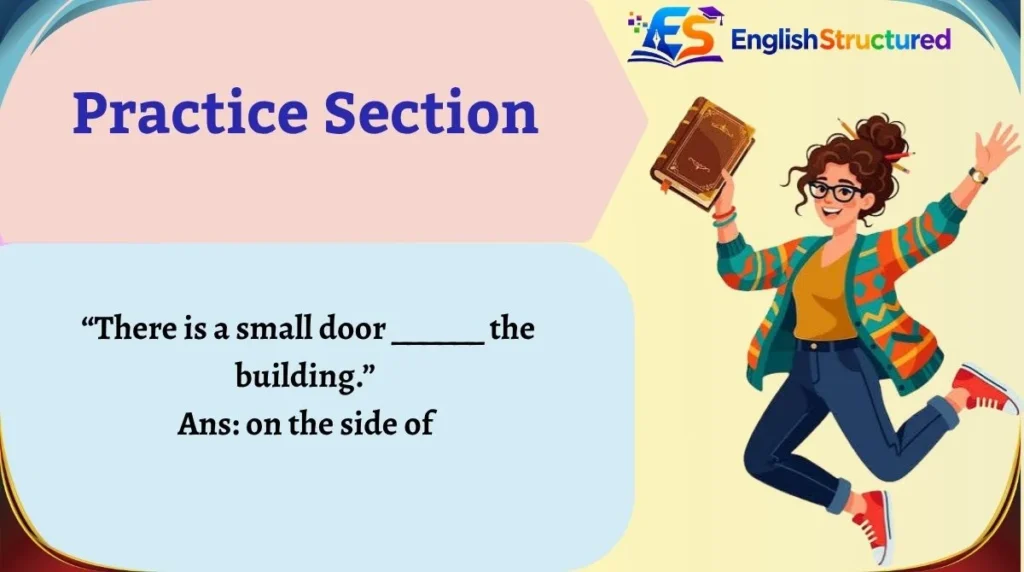
2. “There is a small door ______ the building.”
3. “She teaches piano ______ to earn extra money.”
4. “A man was standing ______ the road.”
5. “The power button is ______ of the machine.”
Answers
1. on the side
“Can I have the sauce on the side?”
This means you want it separately.
2. on the side of
“There is a small door on the side of the building.”
This is a natural location description.
3. on the side
On the Side or At the Side
This means teaching is an additional activity.
4. at the side of
“A man was standing at the side of the road.”
This emphasizes his position beside the road.
5. on the side of
“The power button is on the side of the machine.”
This is a natural way to describe the machine’s design.
FAQs
What is the difference between “on the side” and “at the side”?
“On the side” is much more common in everyday English. It can describe location, something served separately, or an extra activity.
“At the side” usually describes a particular position beside something. In many location sentences, “on the side of,” “beside,” or “next to” may sound more natural.
Is “on the side” grammatically correct?
Yes. “On the side” is completely correct and very common. It has several meanings depending on context.
It can describe location, such as “a door on the side of the house,” or an additional activity, such as “I work on the side.”
Is “at the side” grammatically correct?
On the Side or At the Side
For example, “He stood at the side of the road” is understandable and can be natural in the right context. However, it is less common than “on the side” for many everyday uses.
Can I say “on the side of the road”?
Yes. “On the side of the road” is a very common expression.
For example:
“We stopped on the side of the road.”
It means the vehicle stopped beside the road rather than in the normal traffic lane.
Can “on the side” mean “extra”?
Yes. This is one of its most common meanings.
For example:
On the Side or At the Side
The jewelry business is an additional activity, not her main job.
Can “on the side” mean “separately”?
Yes. This is especially common when ordering food.
For example:
On the Side or At the Side
This means you want the dressing served separately instead of mixed into the food.
Conclusion
On the Side or At the Side
“On the side” is the more common and flexible expression.
You can use it to describe something located along a side, something served separately, or an extra job or activity. For example, “The door is on the side,” “Please put the sauce on the side,” and “I work on the side” are all natural uses.
“At the side” is also possible, but it is more limited.
It often describes a particular position beside something, especially in phrases such as “at the side of the road” or “at the side of the stage.”
When you are unsure, first ask yourself what you mean. If you mean extra or separate, choose “on the side.”
If you are describing a feature located along a side, “on the side of” is often the natural choice. For a particular position, “at the side of” may work well.
With a little practice, these small preposition choices will start to feel natural.