Bath or Bathe
Both words are connected with washing the body, but they do not work in the same way. One is usually a noun, while the other is mainly a verb.
For example, you can say, “I am going to take a bath,” but you would not normally say, “I am going to take a bathe.” On the other hand, you can say, “I need to bathe the baby.”
This small difference can cause many problems for English learners.
The confusion becomes even greater because bath can also be used as a verb in some varieties of English, especially British English.
In addition, American and British speakers sometimes use different everyday expressions for washing.
Knowing the difference is useful because these words appear in daily conversations, instructions, stories, and ordinary spoken English.
Once you understand their grammar, choosing the right word becomes much easier.
The easiest idea to remember is this: a bath is usually the thing or experience, while bathe describes the action of washing.
However, there are a few important details you should know.
Let’s look at each word carefully and see how real speakers use them.
What Does “Bath” Mean?
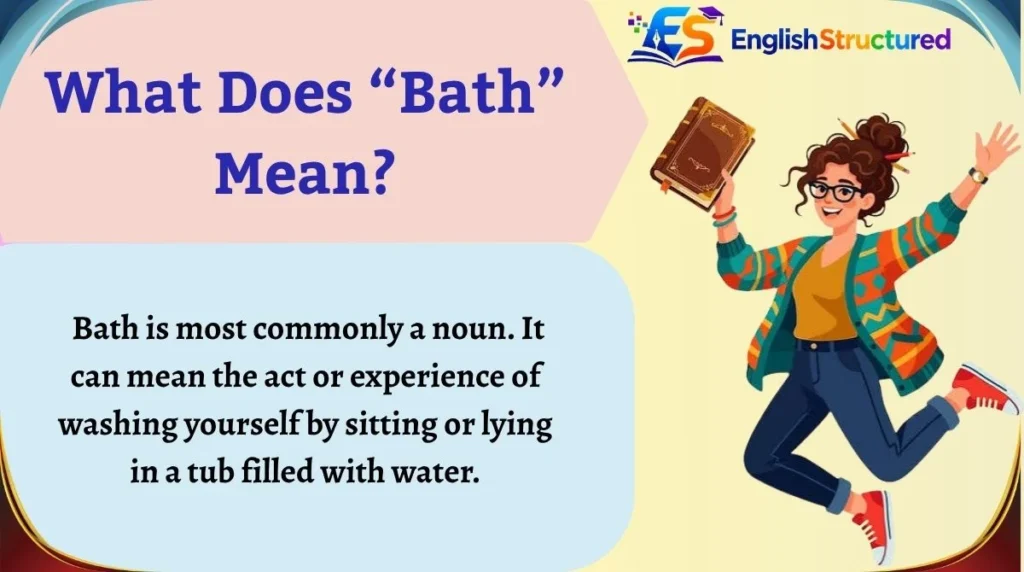
Bath is most commonly a noun. It can mean the act or experience of washing yourself by sitting or lying in a tub filled with water. It can also mean the actual container used for bathing, especially in British English.
Bath or Bathe
For example:
- Bath or Bathe
- The baby needs a bath.
- She is taking a bath.
- The bath was very relaxing.
- Please clean the bath.
- I filled the bath with warm water.
- He likes to have a bath at night.
- Bath or Bathe
In the sentence “I had a bath,” bath is a noun. The verb is had.
This is an important point for learners. You do not need to use bathe just because someone is washing. English has many ways to describe the activity, and have a bath is one common expression.
Bath as a Noun
The most common structure is:
Bath or Bathe
Examples:
- I have a bath every evening.
- She had a bath after work.
- We are going to have a bath.
- He wants to have a bath before dinner.
You can also use other verbs with bath:
take + a bath
- I usually take a bath at night.
- She took a quick bath.
- He is taking a bath now.
“Take a bath” is common, particularly in American English. “Have a bath” is also very common, particularly in British English.
Bath Can Mean the Bathtub
In British English, bath can also refer to the container where you wash.
For example:
- Bath or Bathe
- The bath needs cleaning.
- The water is still in the bath.
- I dropped my toy in the bath.
In American English, people commonly say bathtub for the container.
So, if someone says, “The bath is full,” they may mean the bathtub is full of water.
Bath as a Verb
Here is where things become a little more interesting.
Bath can also be used as a verb, especially in British English. It means to wash someone, usually a baby or child, by putting them in a bath.
For example:
- Bath or Bathe
- She baths her son every evening.
- Dad is bathing the children.
However, learners should not assume that “bath” and “bathe” can always replace each other.
The sentence “I bath every morning” may sound unusual to many speakers, especially American English speakers. For personal washing, expressions such as have a bath, take a bath, or bathe are generally safer choices depending on the variety of English.
Common Confusion About Bath
Bath or Bathe
For example:
❌ I am going to bath now.
A more natural sentence is:
✅ I am going to have a bath.
Or:
Bath or Bathe
The best choice depends on the meaning and the type of English you are using.
What Does “Bathe” Mean?
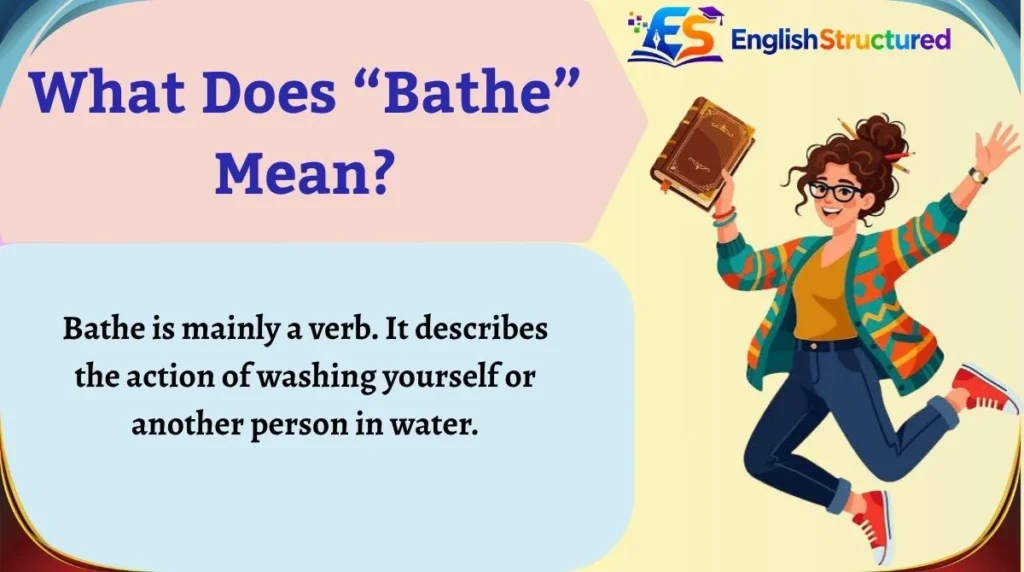
Bathe is mainly a verb. It describes the action of washing yourself or another person in water.
It can also mean washing or soaking part of the body in water.
For example:
- I need to bathe before bed.
- She bathed the baby.
- The nurse told him to bathe the wound.
- The children are bathing in the river.
- He bathed in warm water.
- She likes to bathe in the evening.
- We bathed the dog.
- The child was bathed before bedtime.
Because bathe is a verb, it can change according to tense.
Present Tense
- I bathe every evening.
- She bathes the baby.
- Bath or Bathe
Notice the -s in “bathes” with he, she, or it.
Past Tense
The past form is:
bathed
Examples:
- I bathed last night.
- She bathed the baby.
- We bathed in the lake.
- He bathed the dog.
-ing Form
The continuous form is:
bathing
Examples:
- Bath or Bathe
- They are bathing in the sea.
- I was bathing when you called.
Bathe Can Be Used With an Object
When you wash another person, animal, or body part, bathe can take an object.
For example:
- She bathed the baby.
- He bathed the dog.
- The nurse bathed the wound.
Here, the person doing the action is washing someone or something else.
This is different from:
- Bath or Bathe
Here, she is doing the action herself.
Bathe Can Also Mean Enjoying Water
The word bathe is not limited to taking a bath in a bathtub.
It can describe spending time in water, such as a lake, river, or sea.
For example:
- We bathed in the sea.
- They bathed in the river.
- The children were bathing in the lake.
This use can sound more formal or literary than everyday expressions such as swim or go swimming.
For ordinary conversation, many people would say:
“I went swimming in the lake.”
rather than:
“I bathed in the lake.”
Both can be correct, but they do not always sound equally natural in casual speech.
Common Confusion About Bathe
Bath or Bathe
It is not.
The two words are related, but their normal grammatical jobs are different:
- bath → usually a noun
- bathe → mainly a verb
A simple sentence pair makes this clear:
I had a bath.
I bathed before bed.
The first sentence names the activity as a noun. The second describes the action with a verb.
Difference Between Bath and Bathe
The main difference is grammar.
Bath or Bathe
| Word | Usual part of speech | Basic meaning | Example |
|---|---|---|---|
| bath | Noun | Washing or the container used for it | I had a bath. |
| bathe | Verb | To wash or spend time in water | I bathed before bed. |
| bathed | Past verb | Washed or spent time in water | She bathed the baby. |
| bathing | -ing verb form | Washing or spending time in water | He is bathing the child. |
Bath Talks About the Thing or Activity
When you say:
I had a bath.
You are using bath as a noun. The verb is had.
The structure is:
Bath or Bathe
Examples:
- I had a bath.
- She takes a bath every night.
- We are having a bath.
- He took a bath after exercising.
Bathe Talks About the Action
When you say:
I bathed before bed.
The word bathed tells us what action you performed.
The structure can be:
subject + bathe
or:
subject + bathe + object
Examples:
- I bathed before bed.
- She bathed the baby.
- They bathed in the sea.
Bath and Bathe Are Not Always Interchangeable
Consider these two sentences:
I had a bath.
I bathed.
They are similar in meaning, but their grammar is different.
You cannot simply replace one word with the other:
❌ I had a bathe.
This is not the normal standard expression.
Instead, say:
✅ I had a bath.
Or:
✅ I bathed.
The word a is another clue. When you use a bath, bath is functioning as a countable noun.
Grammar Rules You Must Remember
Rule #1: Use “bath” as a noun in “have a bath” and “take a bath”
When you want to describe the activity as a noun, use bath.
Examples:
- I have a bath every night.
- She took a bath after work.
- We had a bath before going out.
Do not normally say:
❌ I have a bathe.
Say:
✅ I have a bath.
Rule #2: Use “bathe” when you need an action verb
If you want a verb meaning “wash in water,” bathe can do the job.
Examples:
- Bath or Bathe
- She bathed the baby.
- He is bathing the dog.
- They bathed in the river.
Remember that verbs change form:
bathe → bathes → bathed → bathing
Rule #3: “Bathes” is for he, she, or it in the present tense
Because bathe is a verb, it follows normal present-tense rules.
Examples:
- I bathe at night.
- You bathe at night.
- She bathes at night.
- He bathes the baby.
- They bathe every morning.
A common spelling mistake is forgetting the e before adding s.
Correct:
Bath or Bathe
Not:
❌ baths
“Baths” can be a plural noun, but bathes is the third-person singular form of the verb bathe.
Rule #4: Use “bathed” for the simple past
The past form of bathe is bathed.
Examples:
- I bathed last night.
- She bathed the baby.
- We bathed in the sea.
- He bathed the dog.
Do not use “bath” as the past form of “bathe.”
❌ She bath the baby yesterday.
Correct:
Bath or Bathe
Common Mistakes Students Make
These mistakes are common because the two words have almost the same spelling and meaning.
Mistake 1: “I am going to bath.”
❌ I am going to bath.
For many learners, this sentence feels natural because they think bath is the action.
Better choices are:
✅ I am going to have a bath.
✅ I am going to take a bath.
✅ I am going to bathe.
The first two use bath as a noun. The third uses bathe as a verb.
Mistake 2: “I had a bathe.”
❌ I had a bathe.
The normal noun is bath, not “bathe.”
Correct:
Bath or Bathe
Think of the pattern:
have + a + bath
Mistake 3: “She bathes the baby yesterday.”
❌ She bathes the baby yesterday.
The word “yesterday” tells us that we need the past tense.
Correct:
✅ She bathed the baby yesterday.
Compare:
Every day: She bathes the baby.
Yesterday: She bathed the baby.
Mistake 4: Confusing “bath” and “bathtub”
In British English, bath can mean the container itself.
In American English, bathtub is often used for the container.
For example:
- Bath or Bathe
- American English: The bathtub is full.
This does not mean one version is wrong. English changes naturally between countries.
Mistake 5: Thinking “bathe” always sounds natural in casual English
“Bathe” is correct, but everyday speakers often choose simpler expressions.
For example:
I need to bathe.
is grammatically correct.
But many speakers may say:
I need to take a shower.
or:
I need to have a bath.
The best word depends on the situation, dialect, and type of washing being described.
Easy Trick to Remember the Difference
Here is a simple trick:
Bath = thing.
Bathe = action.
Think about these two sentences:
I had a bath.
I bathed.
In the first sentence, bath is the name of the activity.
In the second sentence, bathed tells us what the person did.
You can also remember the pattern:
Bath or Bathe
Bathe.
Never try to build the sentence “have a bathe” if you mean the normal bathing activity.
Another useful trick is to look for an article such as a.
If you see:
a + ______
and you mean the washing activity in a tub, bath is usually the right choice.
- a bath ✅
- a bathe ❌
If you need an action word after the subject, bathe may be the right choice.
- I bathe. ✅
- She bathes. ✅
- They bathed. ✅
This small grammar test can save you from many mistakes.
Daily Life Examples
Here are some natural examples you might hear or use in everyday English.
1. Talking About Your Routine
A: What do you usually do before bed?
B: I usually have a bath and read for a few minutes.
2. Talking About a Baby
A: Who will wash the baby tonight?
B: I will bathe the baby after dinner.
Here, bathe is used as an action verb because someone is washing another person.
3. Talking About Yesterday
A: Why did you go to bed so early?
Bath or Bathe
4. Talking About the Present
A: Where is Mom?
B: She is bathing the baby.
The -ing form shows an action happening now.
5. Talking About a Vacation
A: Did you swim at the beach?
B: Yes. We bathed in the sea for a while.
In casual speech, “went swimming” would often sound more natural.
6. Talking About the Bathtub
A: Can I use the bathroom?
B: Yes, but please clean the bath when you finish.
Here, bath refers to the tub in British English.
7. Talking About a Relaxing Evening
A: What helps you relax after a long day?
B: A warm bath always helps me relax.
8. Talking About a Past Routine
A: Did you bathe the dog yesterday?
B: Yes, I bathed him in the afternoon.
9. Asking About Someone’s Routine
A: Does your son have a bath every night?
B: Yes, he usually has one before bed.
10. Giving Simple Advice
A: I feel very tired today.
B: Have a warm bath and get some rest.
This sounds natural and friendly in everyday English.
Practice Section
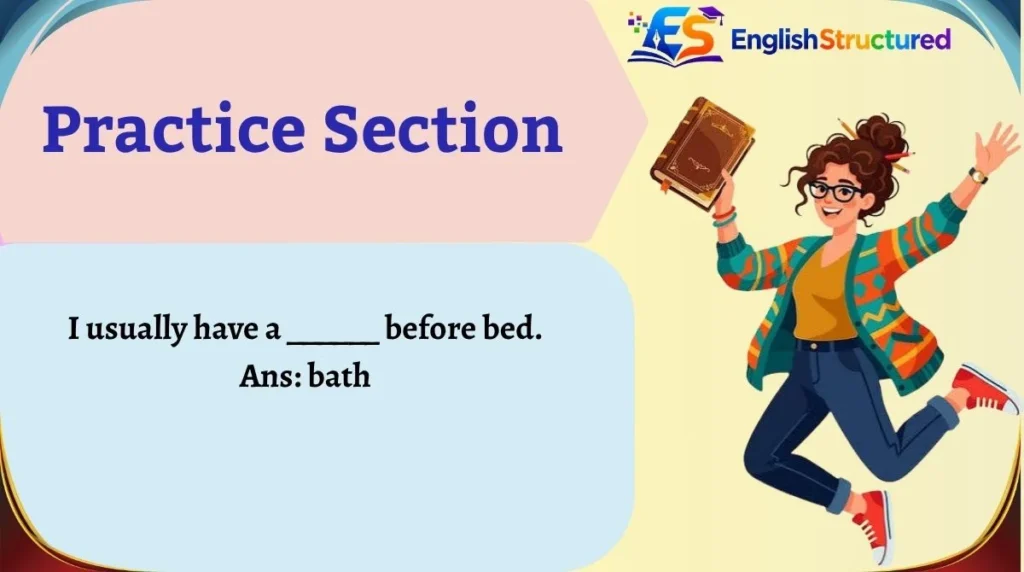
Choose bath or bathe to complete each sentence.
1. I usually have a ______ before bed.
2. She needs to ______ the baby.
3. We ______ in the lake yesterday.
4. He took a ______ after exercising.
5. They are ______ the dog right now.
Answers
1. bath
“I usually have a bath before bed.”
The word is a noun after “have a.”
2. bathe
Bath or Bathe
The word is an action verb after “needs to.”
3. bathed
“We bathed in the lake yesterday.”
The word “yesterday” calls for the past form.
4. bath
“He took a bath after exercising.”
“Take a bath” is a common expression.
5. bathing
“They are bathing the dog right now.”
The phrase “are bathing” describes an action happening now.
FAQs
What is the difference between bath and bathe?
Bath is usually a noun, while bathe is mainly a verb. You can have a bath, but you can also bathe. For example, “I had a bath” and “I bathed before bed” are both possible ways to describe washing.
Can we use “bathe” in questions?
Bath or Bathe
For example:
“Do you bathe every day?”
“Did you bathe the baby?”
“Are you bathing the dog?”
The form changes according to the tense and sentence structure.
Is “bath” a noun or a verb?
Bath is most commonly a noun. However, it can also be a verb in some varieties of English, especially British English. For example, “She bathed the baby” is widely understood, while “She bathed” describes washing herself.
Is “I had a bath” correct English?
Yes. “I had a bath” is completely correct. It is especially common in British English. American English also uses “take a bath” very often, although “have a bath” can be understood as well.
Is “I had a bathe” correct?
It is not the normal standard expression for everyday English. The usual phrase is “I had a bath.” If you want a verb, say “I bathed.” Remember: have a bath, but simply bathe.
Should I say “take a bath” or “have a bath”?
Both are correct. Take a bath is especially common in American English, while have a bath is especially common in British English. Your choice can depend on the variety of English you are learning.
Conclusion
Bath or Bathe
Bath is usually a noun. You can have a bath, take a bath, or talk about a bath as an activity or, in British English, the tub itself.
Bathe is mainly a verb. You can bathe yourself, bathe a baby, bathe a dog, or bathe in water. Its forms include bathes, bathed, and bathing.
The easiest rule is simple: bath is usually the thing or activity; bathe is the action.
So remember these useful patterns:
- have a bath
- take a bath
- Bath or Bathe
- bathed
- bathing
Once these patterns become familiar, the choice will feel much more natural. Try using them in short sentences about your own daily routine.
A few minutes of practice can make this small grammar difference easy to remember.