
Sensuous vs Sensual
They also come from the same idea: the senses. That is why even good English learners sometimes use the wrong word.
The two words can describe things that give us pleasure through sight, sound, smell, taste, or touch.
However, they do not always create the same feeling in the reader’s mind.
Sensuous usually focuses on the pleasure or beauty of the senses, while sensual often suggests physical pleasure and can sometimes have a sexual meaning.
For example, you might say, “The singer has a sensuous voice.” The sentence suggests that the voice is rich, beautiful, and pleasing to hear.
On the other hand, “The perfume has a sensual scent” may suggest a warm, attractive, or intimate feeling.
This small difference matters because choosing the wrong word can change the tone of your sentence.
A harmless description can even sound more romantic or sexual than you intended.
The good news is that the difference is easier to understand once you connect each word with its main idea.
By the end, you will know when to use sensuous and when to use sensual, with plenty of simple examples from everyday English.
What Does “Sensuous” Mean?

Sensuous is an adjective that describes something that gives pleasure to the senses.
Our five main senses are sight, hearing, smell, taste, and touch. If something feels especially beautiful, rich, pleasant, or enjoyable through these senses, sensuous can be a good choice.
Think about soft music, a beautiful painting, the smell of fresh flowers, or the taste of a delicious dessert. These things can create a strong sensory experience without having a sexual meaning.
Simple definition of sensuous
Sensuous means pleasing or enjoyable to the senses.
It often describes something that makes you notice how pleasant an experience feels, sounds, looks, smells, or tastes.
For example:
- Sensuous vs Sensual
- She listened to the sensuous sound of the violin.
- The artist used sensuous colors in the painting.
In each sentence, the focus is on sensory pleasure, beauty, or richness.
When should you use “sensuous”?
Use sensuous when you want to talk about an experience that is strongly connected to the senses.
It is especially useful when describing:
- music
- art
- colors
- food
- smells
- fabrics
- nature
- voices
- scenery
- physical sensations
- beautiful or rich experiences
The word is often used in creative writing, art criticism, literature, and descriptions.
Examples of “sensuous”
- Sensuous vs Sensual
- The chef created a sensuous dining experience.The food, smell, presentation, and atmosphere were all pleasing.
- I love the sensuous sound of rain against the window.The sound creates a pleasant sensory experience.
- The painting has a sensuous quality.The painting is visually rich and enjoyable.
- The soft silk had a sensuous feel against my skin.The focus is on the pleasant physical feeling of the fabric.
- The room was filled with the sensuous smell of roses.The smell was rich and enjoyable.
- The dancer moved with sensuous grace.Here, the movement is beautiful and strongly appealing to the senses.
- The writer uses sensuous language to describe the forest.The language helps readers imagine the sights, sounds, smells, and textures of the forest.
Is “sensuous” always romantic?
No.
This is one of the most important points to remember.
Sensuous does not automatically mean sexual. It can simply mean strongly pleasing to the senses.
For example:
Sensuous vs Sensual
There is nothing sexual about this sentence. The writer is simply describing a rich and enjoyable taste.
Similarly:
Sensuous vs Sensual
Again, the word describes visual beauty.
Grammar rule for “sensuous”
Sensuous is an adjective.
It usually comes before a noun:
a sensuous voice
a sensuous painting
a sensuous experience
sensuous music
It can also come after a linking verb:
The music was sensuous.
The fabric felt sensuous.
The noun form is sensuousness, although it is much less common in everyday English.
You may also see related words such as sense, sensory, and sensation, but they do not mean exactly the same thing.
What Does “Sensual” Mean?

Sensual is also an adjective related to the senses. However, it usually has a stronger connection with physical pleasure, bodily feelings, attraction, or intimacy.
The word does not always mean sexual. That is an important distinction. But in many situations, sensual can suggest sexuality or romantic attraction, especially when it describes a person, movement, touch, appearance, or behavior.
Simple definition of sensual
Sensual means relating to physical pleasure or the enjoyment of the senses, often with a feeling of physical or sexual attraction.
For example:
Sensuous vs Sensual
This may mean the fragrance was rich and attractive, but it can also suggest an intimate or romantic feeling.
When should you use “sensual”?
Use sensual when the physical or bodily side of an experience is important.
It can describe:
- physical pleasure
- touch
- attraction
- romantic feelings
- intimate experiences
- certain movements
- fragrances
- clothing
- appearance
- food or drink in a strongly physical way
The exact meaning depends on the context.
Examples of “sensual”
- Sensuous vs Sensual.The fragrance feels attractive, rich, or intimate.
- The dancer’s movements were slow and sensual.The movements suggested physical attraction or intimacy.
- The movie has a sensual atmosphere.The atmosphere feels romantic, intimate, or physically attractive.
- The fabric has a sensual softness.The softness creates a strong physical feeling.
- The advertisement used sensual images.The images were designed to create physical or romantic attraction.
- She chose a sensual fragrance for the evening.The perfume was intended to create an attractive or intimate mood.
- The novel contains several sensual scenes.The scenes focus on physical attraction or intimacy.
- The music created a sensual mood.Depending on the context, the music created a romantic or physically intimate feeling.
Is “sensual” always sexual?
No, but it can easily suggest sexuality.
This is where many learners need to be careful.
Suppose you say:
Sensuous vs Sensual
This sounds unusual, but the intended meaning could be that the blanket feels very pleasant.
Now compare:
The model wore a sensual dress.
This sentence is likely to suggest physical attraction. The reader may understand the dress as attractive in a sexual or intimate way.
So, although sensual is not a synonym for sexual, it often carries a stronger romantic or physical suggestion.
Grammar rule for “sensual”
Like sensuous, sensual is an adjective.
It can come before a noun:
Sensuous vs Sensual
a sensual fragrance
a sensual movement
It can also follow a linking verb:
The atmosphere was sensual.
The experience felt sensual.
The noun form is sensuality, which means the quality of being sensual.
For example:
The poem explores sensuality and physical attraction.
Difference Between Sensuous and Sensual
The easiest way to separate the two is to focus on the type of pleasure being described.
Sensuous usually points to pleasure through the senses in a broad, often artistic or beautiful way.
Sensual usually points more toward physical pleasure, bodily feeling, attraction, or intimacy.
Comparison table
| Sensuous | Sensual |
|---|---|
| Pleasing to the senses | Related to physical pleasure or attraction |
| Usually broad and sensory | Often more physical or intimate |
| Common in art and nature descriptions | Common in descriptions of attraction and intimacy |
| Does not normally suggest sex | Can suggest sexuality |
| Often sounds artistic or literary | Often sounds romantic or intimate |
| Can describe sounds, colors, tastes, and scenery | Can describe touch, appearance, fragrance, movement, and attraction |
Compare these sentences
Sensuous vs Sensual
This suggests that the painting is rich, beautiful, and pleasing to the senses.
Now:
Sensuous vs Sensual
This may suggest that the painting contains or creates feelings of physical attraction.
The difference is small, but the emotional tone changes.
Another useful comparison
The chef prepared a sensuous meal.
This suggests that the meal was delicious, fragrant, beautifully presented, and enjoyable through the senses.
The chef prepared a sensual meal.
This is possible, but it sounds more unusual. It may suggest that the meal created a strongly physical, romantic, or intimate experience.
Therefore, when talking about ordinary sensory enjoyment, sensuous is often the safer and clearer choice.
Sensuous and sensual can overlap
The words are not completely separate.
Both can describe experiences involving the senses. In fact, some dictionaries give overlapping definitions.
The important difference is connotation.
Connotation means the extra feeling or idea that a word can create beyond its basic dictionary meaning.
Sensuous tends to have a positive sensory or artistic connotation.
Sensuous vs Sensual
That is why the surrounding sentence matters so much.
Grammar Rules You Must Remember
Rule #1: Both words are adjectives
Both sensuous and sensual describe nouns.
You can say:
a sensuous voice
Sensuous vs Sensual
But the two sentences do not necessarily create the same impression.
The first may focus on the beauty and pleasing quality of the voice. The second may make the voice sound more intimate or attractive.
Rule #2: Use “sensuous” for broad sensory pleasure
When the main idea is beauty or pleasure experienced through the senses, sensuous is usually a strong choice.
Examples:
The garden had a sensuous beauty.
The singer’s sensuous voice filled the hall.
Sensuous vs Sensual
The focus is on how enjoyable the experience is.
Rule #3: Use “sensual” when physical attraction is important
When a sentence involves physical attraction, intimacy, or bodily pleasure, sensual is often more appropriate.
Examples:
Sensuous vs Sensual
The dance was slow and sensual.
The perfume gave the room a sensual atmosphere.
The word creates a stronger physical or intimate feeling.
Rule #4: Context decides the exact meaning
Do not assume that every use of sensual is sexual or every use of sensuous is completely non-romantic.
Context changes meaning.
For example:
Sensuous vs Sensual
Here, sensual refers to physical enjoyment through taste and other senses. There is no necessary sexual meaning.
Likewise:
Sensuous vs Sensual
This may describe beauty and sensory appeal, but depending on the context, it could also carry a romantic or physically attractive feeling.
So, always look at the whole sentence, not just the individual word.
Common Mistakes Students Make
Learners often confuse these words because they are almost identical in spelling and both relate to the senses.
Another problem is that dictionaries sometimes give definitions that overlap. This can make the difference seem unclear.
Mistake 1: Thinking “sensual” always means sexual
This is too strong.
Sensuous vs Sensual
That is not correct.
For example:
The sensual pleasure of tasting fresh fruit can be intense.
Here, sensual means physical pleasure through the senses.
However, because sensual can suggest sexuality, you should consider your audience and context.
Mistake 2: Thinking the words are always interchangeable
They are sometimes interchangeable, but not always.
Compare:
The artist created a sensuous landscape.
This sounds natural and suggests beauty that appeals to the senses.
Sensuous vs Sensual
This is grammatically possible, but it gives the landscape a more intimate or physically attractive feeling.
If you simply mean beautiful and sensory, sensuous is often clearer.
Mistake 3: Using “sensual” when you mean “sensory”
These three words are related but different.
Sensory means connected with the senses.
The book contains many sensory descriptions.
Sensuous vs Sensual
The writer uses sensuous descriptions of the garden.
Sensual often suggests physical pleasure or attraction.
The perfume has a sensual quality.
This three-way distinction is very useful for English learners.
Mistake 4: Thinking “sensuous” only describes people
It does not.
You can describe many things as sensuous:
sensuous music
Sensuous vs Sensual
sensuous food
sensuous language
Sensuous vs Sensual
sensuous scenery
The word is especially useful when describing something that feels rich, beautiful, or pleasurable.
Easy correction tip
Before choosing the word, ask yourself:
“Am I talking mainly about sensory beauty, or physical attraction?”
If the answer is sensory beauty, sensuous is often the better choice.
If the answer is physical attraction or intimacy, sensual is often better.
Easy Trick to Remember the Difference
Here is a simple memory trick.
Sensuous = Senses + beauty
Think:
Sensuous vs Sensual
If something is enjoyable because of the way it looks, sounds, smells, tastes, or feels, sensuous is often the right word.
Imagine a beautiful sunset.
You see bright colors. You feel the cool air. You hear birds. You smell flowers.
That whole experience can be called sensuous.
Sensual = Senses + physical attraction
For sensual, think about a stronger physical or intimate feeling.
Imagine a romantic perfume, an intimate atmosphere, or a slow, attractive dance.
Sensuous vs Sensual
A quick classroom trick
Remember these two short phrases:
Sensuous = pleasing to the senses.
Sensual = physical or intimate pleasure.
They are not perfect dictionary definitions, but they are excellent memory guides for everyday English.
Daily Life Examples
The following examples show how the two words work in natural situations.
1. Talking about music
A: How did you like the concert?
Sensuous vs Sensual
Here, sensuous suggests that the sound was rich, beautiful, and deeply pleasing.
2. Talking about perfume
A: What kind of perfume is that?
B: It has a warm and sensual scent.
Here, sensual suggests an attractive, intimate, or romantic fragrance.
3. Talking about food
A: How was the dessert?
B: Amazing. The chocolate had a sensuous richness.
The focus is on taste and the enjoyable sensory experience.
4. Talking about a painting
A: Why do you like this painting?
B: I love its sensuous colors.
The colors are visually rich and pleasing.
5. Talking about dancing
A: Did you see their performance?
B: Yes. Their movements were slow and sensual.
Sensuous vs Sensual
6. Talking about nature
A: How was your walk?
B: Wonderful. The forest had a sensuous beauty after the rain.
The sentence focuses on the sights, smells, sounds, and general beauty of nature.
7. Talking about clothing
A: Why did you choose this fabric?
B: I love its sensuous softness.
The focus is on the pleasant physical feeling of the fabric.
8. Talking about romance
A: How would you describe the scene?
B: It was quiet, romantic, and sensual.
Here, sensual clearly connects with intimacy and romantic attraction.
9. Talking about writing
A: Why is this author’s description so powerful?
B: The author uses sensuous language that makes you imagine every smell and sound.
The word focuses on the reader’s senses.
10. Talking about an advertisement
A: Why does the advertisement feel so different?
B: It uses sensual images to create an intimate mood.
The word suggests physical attraction and a romantic or intimate tone.
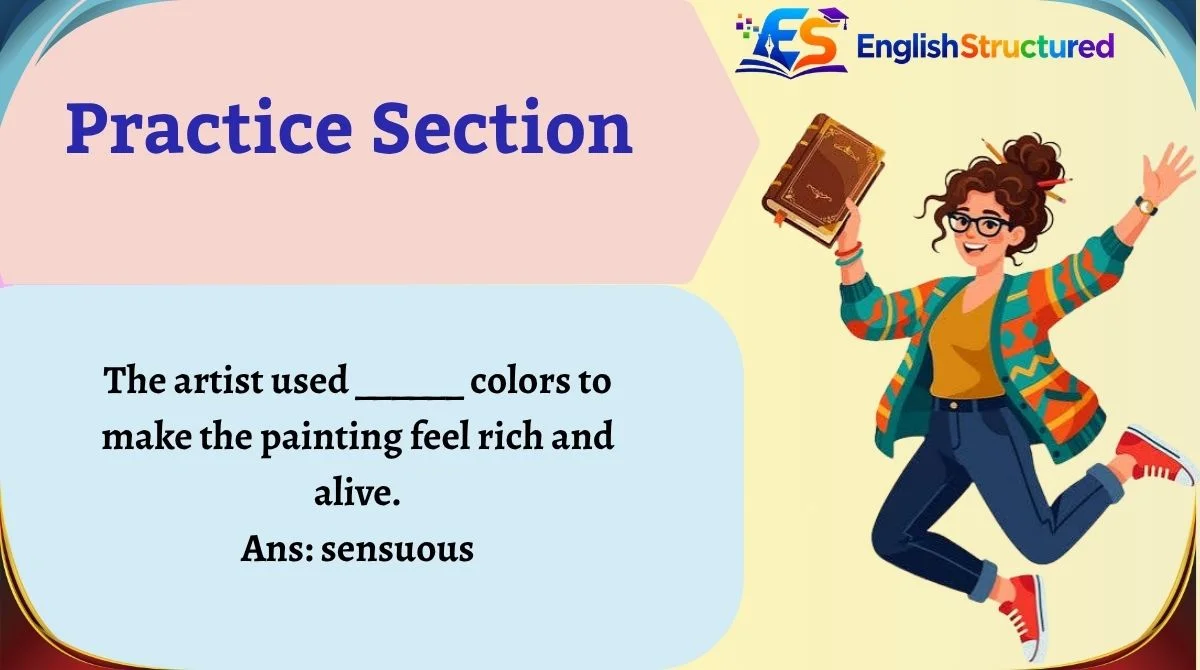
Practice Section
Sensuous vs Sensual
1.
The artist used ______ colors to make the painting feel rich and alive.
2.
The perfume had a warm and ______ fragrance.
3.
The restaurant offered a ______ dining experience with beautiful food, music, and smells.
4.
The couple shared a slow and ______ dance.
5.
The writer gave a ______ description of the forest, including its sounds, smells, and textures.
Answers
1. sensuous
The colors are pleasing to the eyes and create a rich visual experience.
2. sensual
The word suggests an attractive, intimate, or physically appealing fragrance.
3. sensuous
The sentence focuses on several senses and overall sensory pleasure.
4. sensual
The context suggests physical or romantic attraction.
5. sensuous
The writer is appealing to several senses through description.
One extra challenge
Consider this sentence:
Sensuous vs Sensual
Is it wrong?
No. It can be correct. It suggests that eating the cake created strong physical pleasure through taste, smell, texture, and perhaps other senses.
However:
The cake was a sensuous experience.
also sounds natural and puts more emphasis on the rich sensory enjoyment.
This shows why context matters.
FAQs
What is the difference between sensuous and sensual?
Sensuous usually describes something that is pleasing to the senses, such as beautiful music, food, colors, smells, or textures.
Sensual also relates to the senses but more often suggests physical pleasure, attraction, romance, or intimacy.
The two words can overlap, so context is important.
Is sensual the same as sexual?
Sensuous vs Sensual
It can describe physical pleasure through the senses, such as enjoying food, perfume, music, or touch. However, the word often carries a romantic or sexual suggestion, especially when describing people, movements, or intimate situations.
Is sensuous a positive word?
Yes, sensuous is generally positive.
It often describes something that is rich, beautiful, pleasant, or enjoyable to the senses. For example, sensuous music means music that gives a rich and pleasing sensory experience.
Can I use sensuous for food?
Yes. Sensuous can describe food when you want to emphasize its rich sensory qualities.
For example:
The dessert was a sensuous combination of chocolate, cream, and fresh berries.
The word focuses on the pleasure created by taste, smell, texture, and appearance.
Can I use sensual for music?
Yes, but be careful with the tone.
Sensual music can mean music that creates a physical, romantic, intimate, or attractive mood. If you simply mean that the music sounds beautiful and pleasing, sensuous music may be a clearer choice.
Which is better: sensuous beauty or sensual beauty?
Both are possible, but they suggest different things.
Sensuous beauty usually means beauty that strongly appeals to the senses.
Sensuous vs Sensual
If you are describing a landscape, painting, or piece of music, sensuous beauty is often the more natural choice.
Is sensuous a formal word?
Yes. Sensuous is somewhat literary or descriptive, although it is perfectly correct in normal English.
It is common in writing about art, music, food, nature, literature, and design. In very casual conversation, people may simply say beautiful, pleasant, rich, or amazing instead.
Is sensual a formal word?
Yes. Sensual is also a standard English adjective. It appears in everyday writing as well as literature, advertising, fashion, art, and discussions of relationships.
Because it can suggest intimacy or sexuality, choose it carefully when you want a completely neutral description.
What is the difference between sensory and sensuous?
Sensory simply means connected with the senses.
The book contains sensory details.
Sensuous vs Sensual
The book contains sensuous descriptions of the garden.
So, sensory is more neutral, while sensuous usually adds an idea of pleasure or beauty.
Can sensuous and sensual describe a person?
Yes, but the choice can change the meaning.
If you call someone’s voice, appearance, or movement sensuous, you may be describing its pleasing sensory quality.
If you call someone sensual, it can suggest that the person is physically attractive or has a strong connection with physical pleasure.
Sensuous vs Sensual
Conclusion
Sensuous vs Sensual
Both words are connected with the senses, yet they create different shades of meaning.
Use sensuous when you want to describe something that is rich, beautiful, or pleasing to the senses. Think of music, food, colors, nature, smells, textures, and art.
Use sensual when the idea of physical pleasure, attraction, romance, or intimacy is stronger. Remember that sensual does not automatically mean sexual, but it can easily suggest that meaning depending on the context.
The simplest memory trick is this:
Sensuous = pleasing to the senses.
Sensuous vs Sensual
When you are unsure, look at the feeling you want your sentence to create. If you are simply describing sensory beauty, sensuous is often the safer choice.
If physical attraction or intimacy is part of the meaning, sensual may be more suitable.
A little practice will make the difference feel natural.