English has many words that look almost the same but have completely different meanings.
Tough vs Though
They share several letters, so beginners often mix them up when reading or writing.
The confusion becomes even stronger because their pronunciations are very different.
Tough ends with a sound similar to the end of rough, while though ends with a long vowel sound.
They may look like close relatives on paper, but they do very different jobs in a sentence.
Tough is usually an adjective. It can describe something difficult, strong, hard to break, or a person who can deal with difficult situations. For example, you might say, “This exam is tough.”
Though, on the other hand, is commonly used to show contrast.
It can mean something similar to “although,” “even though,” or “however,” depending on the sentence. For example, “It was raining. We went outside, though.”
Knowing the difference matters because these words appear often in spoken English, school writing, conversations, books, and online messages.
Once you understand their meanings, grammar, pronunciation, and sentence patterns, the difference becomes much easier.
You will also learn a few simple tricks that can help you choose the right word quickly.
What Does “Tough” Mean?
Tough is mainly an adjective. It describes something that is difficult, strong, hard, or able to withstand pressure.
The exact meaning depends on the situation. When we talk about a task, exam, or problem, tough usually means difficult.
Tough vs Though
Here, tough means that the test was difficult.
When we talk about an object or material, tough can mean strong and not easily damaged.
Tough vs Though
When we describe a person as tough, the word can mean that the person is strong, brave, or able to handle difficult situations.
She is a tough person.
It does not always mean that someone is physically strong. A person can also be emotionally or mentally tough.
Tough as “Difficult”
This is one of the most common uses of tough.
You can use it to describe something that requires a lot of effort.
- Tough vs Though
- That was a tough question.
- Learning a new language can be tough.
- We had a tough day at work.
- The final exam was really tough.
- Finding a good job can be tough.
- Tough vs Though
- The team had a tough match.
Notice that tough comes before a noun when it acts as an adjective:
tough + noun
For example:
a tough exam
a tough decision
Tough vs Though
a tough game
You can also place tough after a linking verb:
The exam was tough.
Tough as “Strong”
Tough can also describe something that is strong and difficult to damage.
For example:
These shoes are tough.
This suggests that the shoes can handle a lot of use.
Other examples include:
- Tough vs Though
- The boots are tough enough for hiking.
- We need a tough material for this job.
- This plant is surprisingly tough.
- The old bag is still tough after many years.
Tough as “Strong in Character”
We can use tough for people too.
My mother is tough.
Depending on context, this could mean she is strong, firm, brave, or able to handle problems.
For example:
He had a difficult childhood, but he became tough.
Here, tough refers to his ability to deal with hardship.
A Common Confusion With Tough
Many learners see the letters -ough and expect the word to sound like other -ough words.
English spelling can be tricky here.
Tough does not rhyme with though. In fact, tough has the same ending sound found in words such as rough and enough.
That is one reason learners sometimes confuse the two.
Remember:
Tough vs Though
The exam was tough.
What Does “Though” Mean?
Though is a very different word. It is commonly used as a conjunction or adverb.
Its basic idea is contrast. It connects two ideas that are different, unexpected, or opposite in some way.
One common meaning is similar to “although”.
Though it was raining, we went outside.
This means that it was raining, but we still went outside.
You can also put though after the main clause:
We went outside, though it was raining.
In everyday English, though is also often used at the end of a sentence to mean something like “however” or “but.”
I don’t like the color. It’s comfortable, though.
The speaker does not like the color, but there is a positive point: the item is comfortable.
Though Meaning “Although”
At the beginning of a sentence, though can introduce a contrast.
The basic structure is:
Though + subject + verb, main clause
Examples:
- Tough vs Though
- Though he was tired, he finished the job.
- Though the road was busy, we arrived on time.
- Though she was nervous, she gave a great speech.
- Though the food was expensive, we enjoyed it.
- Though I was sick, I went to class.
- Tough vs Though
- Though the question was difficult, I answered it.
In these sentences, though introduces an idea that might make the second action seem surprising.
Though at the End of a Sentence
This is especially common in casual spoken English.
For example:
I don’t usually drink coffee. I like tea, though.
Here, though means something close to “however.”
More examples:
- Tough vs Though
- It’s a little expensive. I might buy it, though.
- He isn’t very tall. He’s strong, though.
- I was tired. I enjoyed the trip, though.
- The restaurant was small. The food was excellent, though.
- I don’t agree with everything she said. She made some good points, though.
This use is extremely common in everyday conversation.
Though vs Although
Though and although are often interchangeable when they introduce a contrasting clause.
Compare:
Tough vs Though
and:
Though it was cold, we went swimming.
Both sentences express the same basic idea.
Though is often a little more natural in casual conversation, while although can sound slightly more formal depending on the context.
A Common Confusion With Though
The biggest mistake is treating though as if it means difficult.
It does not.
The exam was though. ❌
This is incorrect if you mean that the exam was difficult.
You need:
Tough vs Though
Though is about contrast, not difficulty.
Difference Between Tough and Though
The easiest way to understand the difference is to focus on their jobs in a sentence.
| Word | Main meaning | Common grammar role | Example |
|---|---|---|---|
| Tough | Difficult, strong, hard to deal with | Adjective | The test was tough. |
| Though | Although, however, but | Conjunction/adverb | Though it was hard, I finished. |
The two words are not interchangeable.
1. Tough Describes Something
Tough normally tells us what something or someone is like.
Tough vs Though
The word tough describes the exam.
You can replace it with words such as:
- difficult
- hard
- challenging
- strong
For example:
It was a difficult exam.
The meaning is close to:
It was a tough exam.
2. Though Connects Contrasting Ideas
Though does not normally describe a noun.
Instead, it helps show a contrast.
Though the exam was difficult, I passed.
There are two ideas:
- The exam was difficult.
- I passed.
The second result may seem unexpected because of the first idea.
3. Different Sentence Structures
With tough, you often see:
subject + be + tough
Tough vs Though
or:
tough + noun
It was a tough job.
With though, common patterns include:
Though + clause, clause
Though the job was tough, I enjoyed it.
You can also use though at the end:
Main clause + though
Tough vs Though
4. Their Meanings Are Completely Different
Think of tough as a description.
Think of though as a contrast word.
Compare:
This is a tough problem.
Meaning: This problem is difficult.
Though this problem is difficult, I can solve it.
Meaning: The problem is difficult, but I can solve it.
The same situation can contain both words:
Tough vs Though
This sentence is a perfect example of how different their jobs are.
Grammar Rules You Must Remember
Rule #1: Use “Tough” to Describe Difficulty
When you want to say something is difficult, use tough.
This question is tough. ✅
This question is though. ❌
You can use tough before a noun too:
It was a tough question.
A useful replacement test is to ask:
Can I replace the word with “difficult”?
If yes, tough may be the correct choice.
Tough vs Though
It was a difficult day.
Both work.
Rule #2: Use “Though” to Show Contrast
Use though when you want to connect ideas that contrast.
Though I was tired, I kept working.
The sentence means:
I was tired, but I kept working.
The first fact does not stop the second action.
Rule #3: “Though” Can Come at the End
In informal English, though can appear at the end of a sentence.
I didn’t buy the jacket. It looked nice, though.
Here, though means something like “however.”
This is common in conversation and casual writing.
Rule #4: “Tough” Can Describe People, Things, and Situations
Tough is flexible.
You can describe:
People
Tough vs Though
Things
This fabric is tough.
Situations
It was a tough situation.
Tasks
Tough vs Though
Decisions
Tough vs Though
The central idea is usually difficulty, strength, or resistance.
Common Mistakes Students Make
These words are often confused because they look so similar. The spelling is the main trap.
Mistake 1: Using “Though” for “Difficult”
Incorrect:
The exam was though. ❌
Correct:
Tough vs Though
Why?
Because the speaker is describing the exam as difficult. Therefore, an adjective is needed.
Mistake 2: Using “Tough” for “Although”
Incorrect:
Tough I was tired, I went to work. ❌
Correct:
Though I was tired, I went to work. ✅
Tough vs Though
Mistake 3: Thinking They Sound the Same
They do not have the same pronunciation.
This is important when listening to English. A learner may hear one word and mentally connect it with the other because of the spelling.
Do not depend only on spelling. Learn the meaning and sound together.
Mistake 4: Forgetting the Difference Between “Though” and “Although”
Both can introduce contrast:
Though she was tired, she studied.
Tough vs Though
Both are correct.
But though has another very common use at the end of a sentence:
I was tired. I studied, though.
This ending use is common in casual English.
Mistake 5: Trying to Use “Tough” as a Linking Word
Incorrect:
Tough it was expensive, I bought it. ❌
Correct:
Though it was expensive, I bought it. ✅
The word needs to connect the two contrasting ideas.
Easy Correction Tip
When you are unsure, ask yourself one question:
Am I describing something, or am I showing contrast?
Tough vs Though
If you are showing a contrast between two ideas, choose though.
Easy Trick to Remember the Difference
Here is a simple classroom trick.
Think: Tough = Trouble
The word tough often describes a situation that causes trouble or requires effort.
Tough vs Though
a tough job
a tough decision
a tough day
So remember:
Tough → difficult
Now think:
Though = “But”
When you see though, try replacing it with but or although.
For example:
Though it was raining, we played outside.
You can understand the idea as:
It was raining, but we played outside.
Another example:
I don’t like the price. I like the product, though.
You can think:
I don’t like the price, but I like the product.
The replacement will not work perfectly in every sentence because grammar structures differ, but it is a very useful beginner’s trick.
A Quick Mental Test
If you can say “difficult”, think tough.
If you can say “but/however/although”, think though.
For example:
This homework is ___.
“Difficult” fits.
So:
Tough vs Though
Now:
___ the homework was difficult, I finished it.
“Although” fits.
So:
Though the homework was difficult, I finished it.
That small test can save you from many mistakes.
Daily Life Examples
These examples show how the two words work in normal conversations.
Example 1: Talking About School
A: How was your exam?
B: It was really tough, but I think I did well.
Here, tough means difficult.
Example 2: Talking About Weather
A: Did you go outside?
B: Yes. Though it was raining, I went for a walk.
Here, though introduces a contrast.
Example 3: Talking About Work
A: How was your first week at your new job?
B: It was tough, but I’m getting used to it.
The work was difficult.
Example 4: Talking About Food
A: Did you like the restaurant?
B: The service was slow. The food was great, though.
Here, though means something like “however.”
Example 5: Talking About a Decision
A: Are you going to move to another city?
B: It’s a tough decision. I need more time.
The decision is difficult to make.
Example 6: Talking About a Friend
A: How did Maria handle the problem?
B: Though she was nervous, she stayed calm.
The two ideas contrast.
Example 7: Talking About a Product
A: Is that phone good?
B: It’s a little expensive. It’s very fast, though.
The speaker mentions a negative point and then adds a positive one.
Example 8: Talking About Exercise
A: Was the workout difficult?
B: Yes, it was tough.
Here, tough simply means difficult.
Example 9: Talking About Travel
A: Was the journey comfortable?
B: The journey was tough because the road was bad.
Again, tough describes a difficult experience.
Example 10: Using Both Words
Tough vs Though
This is a useful sentence to remember because both words appear together.
Though introduces contrast, while tough describes the training.
Practice Section
Choose tough or though in each sentence.
1. The final exam was very ______.
2. ______ he was tired, he continued studying.
3. The job is ______, but I enjoy it.
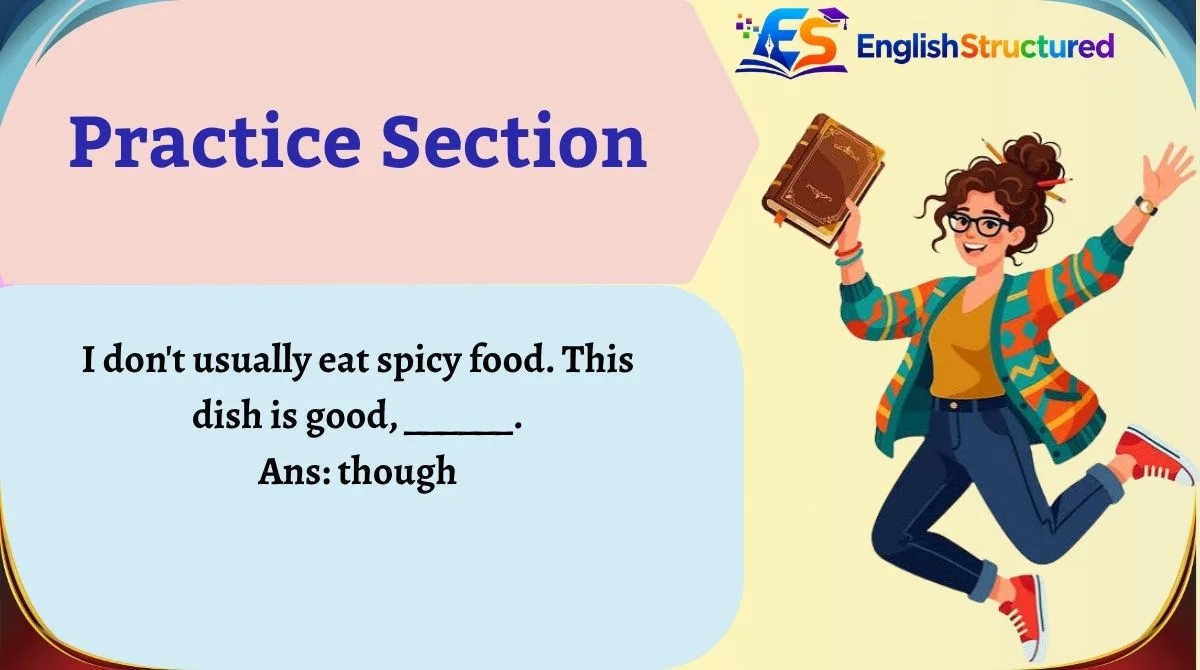
4. I don’t usually eat spicy food. This dish is good, ______.
5. ______ the weather was cold, we went to the park.
Answers
1. tough
The final exam was very tough.
The word describes the exam as difficult.
2. though
Though he was tired, he continued studying.
The word shows contrast.
3. tough
The job is tough, but I enjoy it.
The job is difficult.
4. though
I don’t usually eat spicy food. This dish is good, though.
The word adds a contrasting positive idea.
5. though
Though the weather was cold, we went to the park.
The cold weather contrasts with the decision to go to the park.
FAQs
What is the difference between tough and though?
Tough is mainly an adjective meaning difficult, strong, or hard to deal with.
Though is used to show contrast and can often mean “although” or “however.”
For example, “The test was tough” means the test was difficult, while “Though the test was tough, I passed” shows a contrast.
Is tough the same as difficult?
Yes, tough can mean difficult in many situations.
For example:
It was a tough exam.
This has nearly the same meaning as:
It was a difficult exam.
Tough is especially common in everyday spoken English.
Does though mean but?
Sometimes, yes. Though can express an idea similar to “but” or “however,” especially when it appears at the end of a sentence.
For example:
I didn’t like the movie. The music was good, though.
The final though introduces a contrasting idea.
Can though be used at the beginning of a sentence?
Yes. Though can begin a sentence when it introduces a contrasting clause.
For example:
Though I was tired, I finished my homework.
It can often be replaced by although without changing the basic meaning.
Is though formal or informal?
Though can be used in both formal and informal English.
However, using though at the end of a sentence is especially common in casual conversation.
For formal writing, although or however may sometimes be a better choice, depending on the sentence.
Why are tough and though pronounced differently?
English spelling does not always show pronunciation clearly. The letters ough can represent several different sounds in English.
That is why tough and though look similar but sound different. Learning each word as a complete vocabulary item is more helpful than trying to pronounce ough with one fixed rule.
Conclusion
Tough vs Though
Tough is mainly an adjective. It describes something difficult, strong, or hard to handle. You can talk about a tough exam, a tough job, a tough decision, or a tough person.
Though is used to show contrast. It can mean something similar to “although,” and it can also appear at the end of a sentence with a meaning close to “however” or “but.”
A simple trick is to remember:
Tough = difficult.
Though = contrast.
For example:
The test was tough.
But:
Though the test was tough, I passed.
Reading and using these words in your own sentences will make the difference feel natural. Don’t worry if you confuse them at first.
Their spelling is genuinely tricky, even for learners who already know a lot of English.