Evoke vs Invoke
Both words come from the same old idea of calling or bringing something forward. However, they are not used in the same way in modern English.
The word evoke is usually connected with memories, feelings, images, or ideas. Something can evoke a happy memory, a strong emotion, or an image in your mind.
For example, the smell of fresh bread may evoke memories of your childhood.
Invoke, on the other hand, often means to call on something for help, support, or authority.
You can invoke a law, invoke a rule, invoke a right, or invoke a higher power. It is also used in formal English and in technical language.
For example, a lawyer may invoke a legal rule to support an argument.
The difference may seem small at first, but there is a simple way to remember it.
Think of evoke as bringing something out of your memory or feelings, while invoke often means calling on something for help, support, or effect.
This guide explains both words with simple definitions, grammar rules, examples, common mistakes, and everyday sentences.
By the end, you should feel confident about choosing evoke or invoke in your own writing and speech.
What Does “Evoke” Mean?
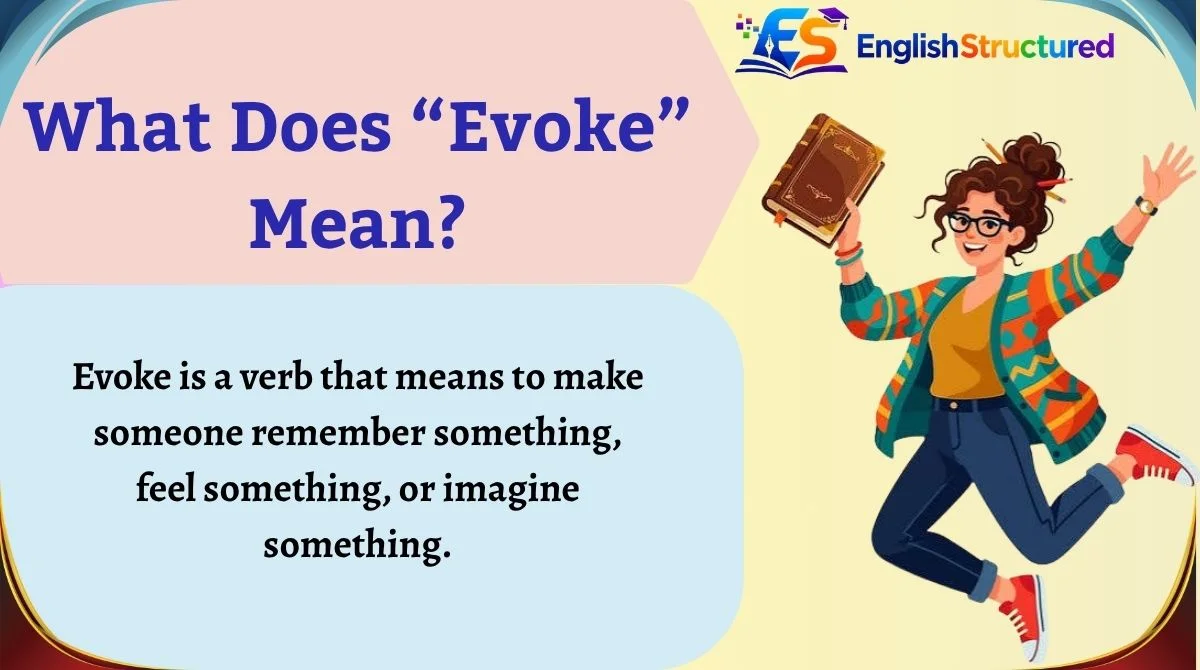
Evoke is a verb that means to make someone remember something, feel something, or imagine something.
When something evokes a memory or feeling, it causes that memory or feeling to come into your mind. A smell, song, photograph, place, story, or even a person can evoke something.
For example:
Evoke vs Invoke
The smell did not directly bring the grandmother into the room. Instead, it caused a memory of her to come into the speaker’s mind.
Cambridge Dictionary defines evoke as making someone remember something or feel an emotion.
When should you use “evoke”?
Use evoke when one thing causes another thing to appear in someone’s mind, memory, imagination, or emotions.
Common things that can be evoked include:
- memories
- feelings
- emotions
- images
- thoughts
- ideas
- memories of the past
- a sense of something
Here are some common patterns:
Evoke vs Invoke
The old photograph evoked a happy memory.
evoke + an emotion
Evoke vs Invoke
evoke + a feeling
The music evoked a feeling of peace.
evoke + an image
Evoke vs Invoke
The object after evoke is often the thing that comes into the person’s mind or feelings.
Grammar rule for “evoke”
Evoke is a transitive verb, which means it normally takes a direct object.
The basic structure is:
Subject + evoke + object
Examples:
Evoke vs Invoke
The movie evoked sadness.
Her words evoked a strong reaction.
You can also use evoke in different tenses:
Present:
This song evokes old memories.
Past:
Evoke vs Invoke
Present perfect:
The story has evoked many emotions.
Future:
The ceremony will evoke memories of the past.
8 examples with “evoke”
- The smell of rain evoked memories of my childhood.
- That old song evokes feelings of happiness.
- The painting evoked an image of a quiet village.
- Evoke vs Invoke
- The house evoked memories of her grandparents.
- The movie evoked a sense of sadness.
- The beautiful garden evoked feelings of peace.
- Evoke vs Invoke
A common confusion about “evoke”
Learners sometimes think evoke means simply to remember.
That is not quite right.
If you say:
I evoked my childhood.
the sentence sounds unusual because the person is presented as causing the memory to appear.
A more natural sentence is:
Evoke vs Invoke
The song causes the memory. The person experiences the memory.
So remember this point:
Evoke = cause a memory, feeling, image, or idea to come into someone’s mind.
What Does “Invoke” Mean?
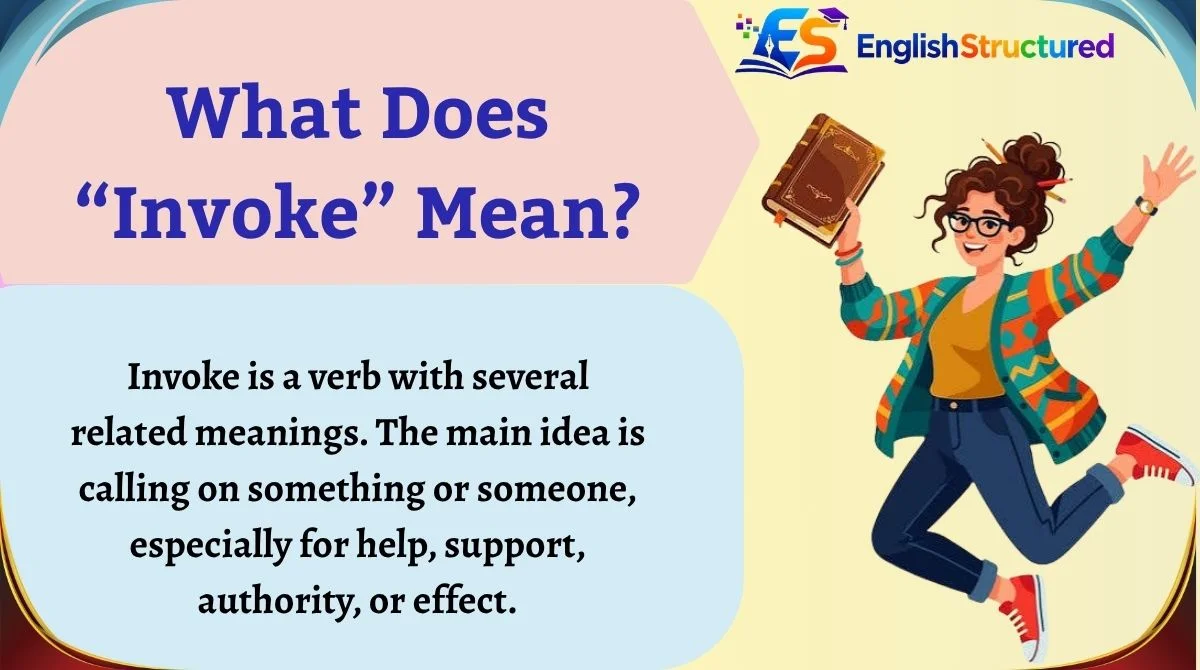
Invoke is a verb with several related meanings. The main idea is calling on something or someone, especially for help, support, authority, or effect.
It is often used in formal English.
For example:
Evoke vs Invoke
Here, the lawyer is not simply remembering the law. He is using the law as support or authority.
Cambridge Dictionary lists several uses of invoke, including using a law to achieve something, asking a higher power for help, and causing a feeling or memory. It also uses invoke in technical contexts, such as making a computer program start working.
When should you use “invoke”?
You can use invoke when someone:
- calls on a law
- uses a rule as support
- appeals to a right
- asks a higher power for help
- calls on a person or idea
- brings a formal principle into use
- starts a computer program or function in technical English
For example:
Evoke vs Invoke
The company is using a right as the basis for its action.
Another example:
Evoke vs Invoke
Here, invoke means to call upon God for help or protection.
Grammar rule for “invoke”
Like evoke, invoke is normally a transitive verb.
The common structure is:
Subject + invoke + object
Examples:
Evoke vs Invoke
He invoked his rights.
Evoke vs Invoke
The program invoked a function.
You can also use invoke in different tenses.
Present:
Evoke vs Invoke
Past:
The lawyer invoked the law during the case.
Present perfect:
The government has invoked emergency powers.
Future:
Evoke vs Invoke
8 examples with “invoke”
- The lawyer invoked the law to defend his client.
- The employee invoked her right to remain silent.
- The leader invoked tradition during the ceremony.
- The villagers invoked the name of God during the prayer.
- Evoke vs Invoke
- The judge allowed the defendant to invoke his legal rights.
- The program invoked a function to process the data.
- The speaker invoked history to explain the present situation.
A common confusion about “invoke”
Many learners think invoke simply means to mention.
Sometimes it can mean mentioning or referring to something, but there is usually a stronger idea of calling upon it for a purpose.
Compare:
She mentioned the law.
This simply means she talked about the law.
But:
Evoke vs Invoke
This suggests that she used or appealed to the law to support an action, claim, or decision.
That difference is important.
So remember:
Invoke = call on something for help, support, authority, or effect.
Difference Between Evoke and Invoke
The easiest way to separate these two words is to focus on what is being called.
Evoke usually brings something out of the mind or emotions.
Invoke usually calls on something for help, support, authority, or action.
| Word | Main meaning | Common objects | Typical use |
|---|---|---|---|
| Evoke | Cause something to come to mind or cause a feeling | memories, feelings, emotions, images, ideas | Emotional or mental response |
| Invoke | Call on or use something for support or effect | laws, rights, rules, powers, traditions, gods | Formal, legal, religious, or technical use |
| Evoke | Bring out a memory or feeling | “evoke memories” | Common in descriptions and personal experiences |
| Invoke | Appeal to something | “invoke the law” | Common in formal writing |
Usage difference
Look at these two sentences:
Evoke vs Invoke
The lawyer invoked the law to defend his client.
In the first sentence, the photograph causes memories to come into someone’s mind.
In the second sentence, the lawyer calls on the law as support or authority.
That is the central difference.
Grammar logic
Both words are verbs, and both normally take a direct object.
Evoke:
Evoke vs Invoke
Invoke:
The lawyer invoked the law.
The grammar is similar, but the meaning of the object is different.
With evoke, the object is often something mental or emotional.
evoke a memory
Evoke vs Invoke
evoke an image
evoke a feeling
With invoke, the object is often something that can be called upon or used.
invoke a law
invoke a rule
invoke a right
invoke a principle
invoke a tradition
invoke God’s name
Sentence structure difference
Both words can follow this pattern:
Subject + verb + object
But the purpose changes.
Evoke:
Evoke vs Invoke
Meaning: The song caused sadness.
Invoke:
Evoke vs Invoke
Meaning: The lawyer called on the law for support.
A useful question to ask yourself is:
Did something cause a memory or feeling?
If yes, evoke is probably the right choice.
Did someone call on a rule, law, right, power, person, or higher authority?
If yes, invoke is probably the right choice.
Meaning comparison
Consider these examples:
The smell of coffee evoked memories of college.
The smell brought memories into the person’s mind.
The lawyer invoked the Constitution.
The lawyer referred to it as a source of legal support or authority.
Now compare:
Evoke vs Invoke
The speech caused people to feel angry.
The leader invoked national unity.
The leader called upon the idea of national unity, usually to support a message or action.
This is why replacing one word with the other can change the meaning or make a sentence sound unnatural.
Grammar Rules You Must Remember
Rule #1: Use “evoke” for memories, feelings, and emotions
When something causes a memory or feeling to appear, evoke is usually the natural choice.
The old house evoked memories of my childhood.
Evoke vs Invoke
A useful pattern is:
evoke + memory/feeling/emotion/image
Rule #2: Use “invoke” for laws, rights, rules, and authority
When someone uses or appeals to a law, rule, right, or power, use invoke.
The lawyer invoked the law.
The worker invoked her right to speak with a representative.
Evoke vs Invoke
This is especially common in formal and legal English. Cambridge labels invoke as formal and gives examples involving laws and legal powers.
Rule #3: Use “invoke” when calling on a higher power
Invoke can also be used when someone calls upon a god or another higher power for help.
The priest invoked God’s blessing.
They invoked the gods for protection.
This meaning is more common in religious, historical, literary, or formal contexts.
Rule #4: Remember that “evoke” focuses on a response
With evoke, think about what appears in someone’s mind or emotions.
The music evoked happiness.
Evoke vs Invoke
The story evoked sympathy.
With invoke, think about what someone calls upon or uses.
She invoked the law.
He invoked his rights.
Evoke vs Invoke
One quick question can help:
“Did it bring a feeling or memory out?” → evoke.
“Did someone call on something for help or support?” → invoke.
Common Mistakes Students Make
The two words are easy to confuse because they look similar and both are related to the idea of “calling.” Their shared history makes the confusion understandable.
Both words ultimately come from Latin forms built around vocare, meaning “to call.” Evoke developed from Latin evocare, while invoke comes from Latin invocare.
Mistake 1: Using “invoke” for an ordinary memory
Wrong:
Evoke vs Invoke
This sentence may be understood, and modern English sometimes uses invoke with memories or feelings. However, when your meaning is simply that something caused a memory to come to mind, evoke is usually the clearer choice.
Better:
The song evoked memories of my school days.
Mistake 2: Using “evoke” for a law
Wrong:
The lawyer evoked the law to defend his client.
Correct:
The lawyer invoked the law to defend his client.
The lawyer is not causing a memory. He is calling on the law for support.
Mistake 3: Thinking “invoke” only has a religious meaning
Some students learn invoke through phrases about God or gods.
For example:
They invoked God’s help.
That is correct, but invoke has many other uses.
You can also:
invoke a law
invoke a right
invoke a rule
invoke a principle
invoke emergency powers
Mistake 4: Thinking the words are completely interchangeable
They are not.
Evoke and invoke can overlap in some contexts, especially when something is being brought to mind or referred to. But their most common uses are different.
When talking about a memory or emotion, evoke is usually the natural choice.
When talking about a law, right, rule, authority, or formal appeal, invoke is usually the better choice.
Easy correction tip
When you are unsure, look at the noun after the verb.
If you see:
memory → evoke
emotion → evoke
feeling → evoke
image → evoke
But if you see:
law → invoke
right → invoke
rule → invoke
power → invoke
authority → invoke
This is not an absolute rule for every sentence, but it is an excellent guide for learners.
Easy Trick to Remember the Difference
Here is a simple memory trick:
Evoke = E for Emotion
Think:
Evoke → Emotion
You can also connect it with memories and mental images.
The song evoked happy memories.
The movie evoked sadness.
The feeling or memory comes out.
Invoke = I for “I call on”
Think:
Invoke → I call on something.
For example:
I invoke the law.
I invoke my right.
I invoke God’s help.
The speaker is calling on something for support, help, or authority.
There is also an interesting clue in the history of the words. Evoke comes from a Latin form connected with calling out, while invoke comes from a Latin form connected with calling upon.
So you can make this little classroom rule:
EVOKE = bring a feeling or memory out.
INVOKE = call on something for help or support.
If you remember just that, you will get many sentences right.
Daily Life Examples
Here are some simple examples showing how native speakers may use these words.
1. Talking about music
“This song always evokes memories of my college days.”
The song makes the speaker remember the past.
2. Talking about food
“The smell of fresh bread evoked memories of my grandmother’s kitchen.”
The smell brings back a memory.
3. Talking about a movie
“That movie evoked a lot of emotion.”
The movie caused an emotional response.
4. Talking about a lawyer
“The lawyer invoked the law during the hearing.”
The lawyer used the law as support.
5. Talking about someone’s rights
“She invoked her right to remain silent.”
She formally used a legal right.
6. Talking about a family tradition
“During the wedding, my father invoked an old family tradition.”
He called on or referred to that tradition as part of the ceremony.
7. Talking about an old photograph
“Looking at this picture evokes so many memories.”
The picture brings back memories.
8. Talking about an emergency
“The government invoked emergency powers.”
The government officially used those powers.
9. Talking about a smell
“The smell of the ocean evokes memories of our vacation.”
The smell brings the vacation back to mind.
10. Talking about a religious ceremony
“The ceremony began with a prayer that invoked God’s blessing.”
The prayer called upon God for a blessing.
Notice how naturally the two words separate. Memories and feelings are commonly evoked. Laws, rights, powers, and higher authorities are commonly invoked.
Practice: Choose the Correct Word

Choose evoke or invoke in each sentence.
1. The old photograph ______ memories of my childhood.
A. evoked
B. invoked
2. The lawyer ______ his client’s legal rights.
A. evoked
B. invoked
3. That beautiful song ______ feelings of peace.
A. evoked
B. invoked
4. The company ______ a safety rule to explain its decision.
A. evoked
B. invoked
5. The smell of flowers ______ memories of my grandmother.
A. evoked
B. invoked
Answers
1. A — evoked
The photograph brings memories into the person’s mind.
2. B — invoked
The lawyer calls on a legal right for support.
3. A — evoked
The song causes a feeling of peace.
4. B — invoked
The company uses a rule as support for its decision.
5. A — evoked
The smell causes memories to come back.
FAQs
What is the difference between evoke and invoke?
Evoke usually means to cause a memory, feeling, emotion, image, or idea to come into someone’s mind. Invoke usually means to call on or use something for help, support, authority, or effect. For example, a song can evoke memories, while a lawyer can invoke a law.
Can “invoke” be used for feelings and memories?
Yes. Invoke can sometimes be used for feelings, memories, or ideas, especially in formal writing. However, evoke is often the more natural choice when you mean that something causes a feeling or memory to appear. For everyday learner English, “The song evoked memories” is a useful pattern to remember.
Can we use “evoke” with a law?
Usually, invoke is the better word when you mean using or appealing to a law. For example, “The lawyer invoked the law” means the lawyer used the law to support an argument or action. Evoke is mainly associated with memories, emotions, images, and mental responses.
Is “invoke” formal or informal?
Invoke is generally formal. It is common in legal, academic, religious, business, and technical writing. For example, people may invoke a law, legal right, principle, or emergency power. In casual conversation, simpler words such as “use,” “call on,” or “refer to” may sound more natural.
Is “evoke” only used for memories?
No. Evoke can be used for memories, feelings, emotions, images, ideas, and other mental responses. You can say that a song evokes memories, a speech evokes anger, or a painting evokes an image of a peaceful place.
What is an easy way to remember evoke and invoke?
Remember “Evoke = emotion.” It often brings a memory or feeling to mind. For invoke, think “I call on.” You invoke a law, right, rule, power, tradition, or higher authority. This simple contrast can help you choose the right word quickly.
Conclusion
Evoke vs Invoke
Use evoke when something brings a memory, feeling, emotion, image, or idea into someone’s mind.
A song can evoke memories. A photograph can evoke sadness. A smell can evoke childhood memories.
Use invoke when someone calls on something for help, support, authority, or effect. A lawyer can invoke a law.
A person can invoke a legal right. A government can invoke emergency powers. A religious ceremony can invoke a higher power.
The easiest trick is to remember:
Evoke = emotion or memory.
Invoke = call on something.
You may still see some overlap between the two words, especially in formal writing. That is normal. Focus on the main idea rather than trying to memorize every possible use.
The best way to make the difference natural is to practice with short sentences.
After you see and use these words several times, choosing between evoke and invoke will become much easier.