Different vs Differently
Both words are connected to the idea of not being the same, but they do not work in the same way in a sentence.
The main reason for the confusion is simple: different is an adjective, while differently is an adverb. This small grammar difference changes where each word can be used.
For example, we can say, “My answer is different,” but we cannot normally say, “My answer is differently.”
On the other hand, we can say, “She answered differently,” because the adverb tells us how she answered.
You may hear both words every day in conversations, classrooms, offices, and online messages.
Native speakers use them when they compare people, things, ideas, actions, opinions, and ways of doing something.
Knowing the difference will help you make your English clearer and more natural.
It can also help you avoid a very common grammar mistake: using an adjective where an adverb is needed.
By the end of this guide, you will know what different means, what differently means, how their grammar works, and how to choose the right word quickly when you speak or write.
What Does “Different” Mean?
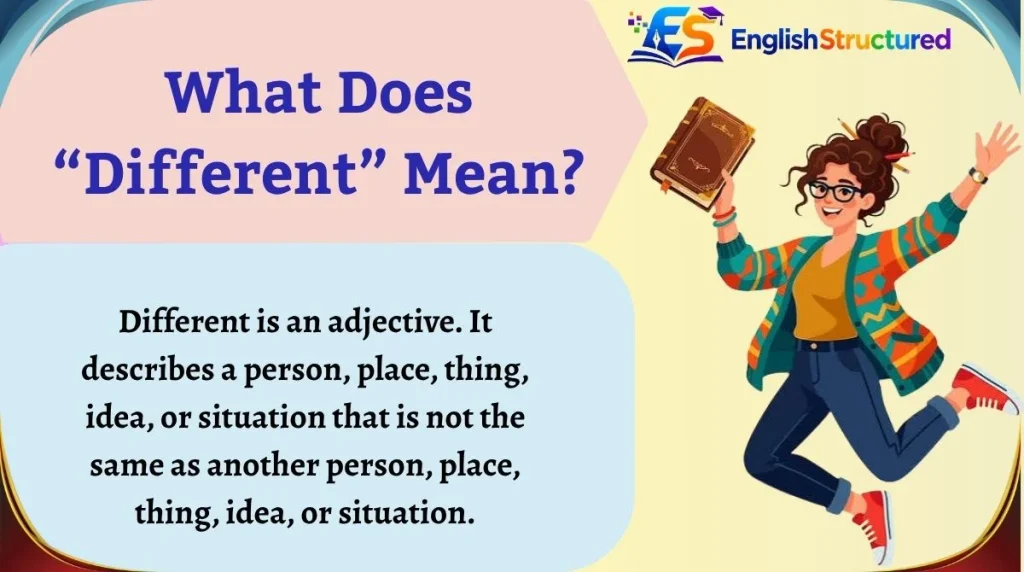
Different is an adjective. It describes a person, place, thing, idea, or situation that is not the same as another person, place, thing, idea, or situation.
In simple words, different = not the same.
We usually use different when we are talking about a noun. It gives information about that noun.
For example:
- Different vs Differently
- We have different opinions.
- She chose a different dress.
- These two answers are different.
- I want to try a different restaurant.
Notice how different describes a noun or tells us about the subject.
When Do We Use “Different”?
We often use different when comparing two or more things.
The common structure is:
Different vs Differently
Examples:
- We need a different plan.
- He bought a different phone.
- Different vs Differently
- She wants a different job.
We can also use it after a linking verb such as be, seem, look, feel, or become.
Examples:
- You look different today.
- This feels different.
- Different vs Differently
- Things are different now.
A very common structure is:
different from + noun/pronoun
Examples:
- My school is different from yours.
- Different vs Differently
- Her opinion is different from mine.
In everyday English, you may also hear different than, especially in American English. However, different from is a safe and widely accepted choice for learners.
8 Example Sentences With “Different”
- My new teacher is different from my old teacher.
- We have different plans for the weekend.
- This coffee tastes different today.
- She bought a different pair of shoes.
- Your answer is different from mine.
- Different vs Differently
- This house looks different at night.
- I want to try something different.
A Common Confusion With “Different”
A common mistake is putting different after an action verb when the speaker wants to describe how an action happens.
For example:
❌ She sings different.
If you mean that her singing style is not the same as before or someone else’s, the more standard form is:
Different vs Differently
But there is an important point. In some informal speech, especially in certain American varieties of English, people may use different in ways that are traditionally considered nonstandard. For formal writing and careful English, it is better to use differently when you are describing an action.
So remember:
Different describes a person or thing.
What Does “Differently” Mean?
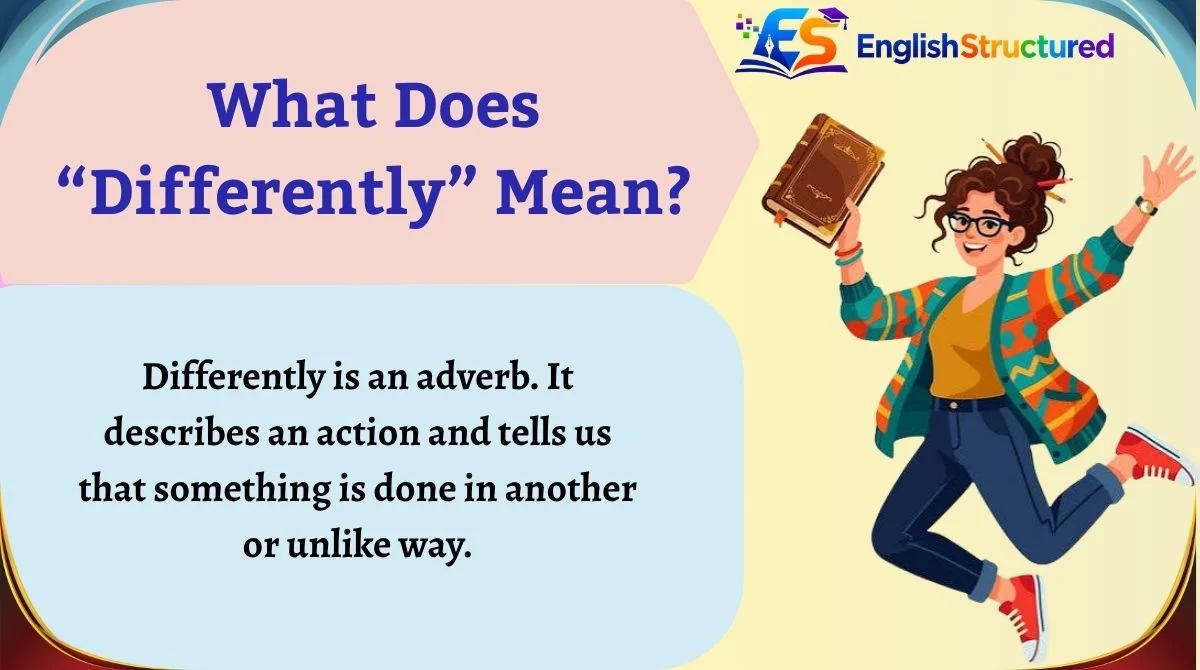
Differently is an adverb. It describes an action and tells us that something is done in another or unlike way.
In simple words:
differently = in a different way
This is the key idea to remember.
For example:
- Different vs Differently
- He works differently.
- They solved the problem differently.
- I would do it differently.
In each sentence, differently explains how an action happens.
When Do We Use “Differently”?
Use differently when you want to describe a verb or action.
Common pattern:
verb + differently
Examples:
- Different vs Differently
- think differently
- behave differently
- work differently
- Different vs Differently
- look at something differently
- do something differently
- answer differently
Consider this sentence:
Tom works differently.
The word differently tells us how Tom works.
Now compare it with:
Different vs Differently
Here, different describes the noun job.
That one change makes the grammar clear.
8 Example Sentences With “Differently”
- She thinks differently from her classmates.
- I would handle the situation differently.
- Different vs Differently
- People react differently to stress.
- He answered the question differently this time.
- Different vs Differently
- You may see the problem differently after some practice.
- She dresses differently now.
“Differently” and Comparisons
Differently is often used when two people do something in different ways.
For example:
- Sarah studies differently from Emma.
- Children learn differently from adults.
- My parents think differently about money.
The word does not tell us exactly what the different way is. It simply tells us that the way is not the same.
If we want to give more information, we can explain the difference:
Sarah studies differently from Emma. Sarah studies in the morning, while Emma studies at night.
A Common Confusion With “Differently”
Learners sometimes use different because it sounds more familiar.
For example:
❌ He drives different.
For standard English, use:
Different vs Differently
Why? Because drives is a verb, and we need an adverb to explain how he drives.
Difference Between Different and Differently
The biggest difference is their part of speech.
Different is an adjective.
Differently is an adverb.
That means they perform different jobs in a sentence.
| Word | Part of Speech | Basic Meaning | What It Describes | Example |
|---|---|---|---|---|
| different | Adjective | not the same | noun or subject | They have different ideas. |
| differently | Adverb | in a different way | verb/action | They think differently. |
1. Different Describes a Noun
Look at this sentence:
Different vs Differently
The word different describes shirt.
The shirt is not the same as another shirt.
Another example:
We chose different answers.
Here, different describes answers.
2. Differently Describes an Action
Now look at:
We answered differently.
The word differently describes the action answered.
It means we did not answer in the same way.
This is the easiest grammar test:
Different vs Differently
Are you describing an action? Use differently.
3. Compare These Pairs
They have different ideas.
Here, different describes ideas.
They think differently.
Here, differently describes think.
Another pair:
He has a different way of studying.
Different vs Differently
Both sentences talk about a different style of studying, but the grammar is different.
4. Sentence Structure
A common structure with different is:
different + noun
Example:
She chose a different answer.
Another common structure is:
subject + linking verb + different
Example:
Different vs Differently
For differently, a common structure is:
subject + verb + differently
Example:
Different vs Differently
This simple sentence structure can help you choose the right word.
5. Meaning Comparison
Both words contain the same basic idea: not the same.
But their meanings are slightly different in use.
Different = not the same thing.
Different vs Differently
Compare:
We have different methods.
The methods are not the same.
We work differently.
The way we work is not the same.
Grammar Rules You Must Remember
Rule #1: Use “Different” Before a Noun
When different comes before a noun, it describes that noun.
Examples:
- a different idea
- a different color
- Different vs Differently
- a different person
- different methods
Sentence:
I need a different answer.
Here, different describes answer.
Rule #2: Use “Differently” to Describe an Action
When you want to say that someone does something in another way, use differently.
Examples:
- She speaks differently.
- He thinks differently.
- Different vs Differently
- We learn differently.
Sentence:
My sister studies differently from me.
The word differently tells us about the action studies.
Rule #3: “Different From” Is a Common Comparison Structure
When you compare two things, different from is a very useful structure.
Examples:
- This book is different from that book.
- My opinion is different from yours.
- His car is different from mine.
- The new system is different from the old one.
For learners, different from is a good standard form to remember.
Rule #4: “Differently” Can Follow Many Action Verbs
You can use differently after verbs when the meaning is “in another way.”
Examples:
- think differently
- speak differently
- Different vs Differently
- behave differently
- work differently
- respond differently
- react differently
- understand differently
For example:
People react differently to the same situation.
The people are doing the action of reacting in different ways.
Common Mistakes Students Make
Many learners make mistakes with these words because they focus on their similar spelling instead of their grammar.
The ending -ly is an important clue. Many adverbs end in -ly, and differently is one of them.
Mistake 1: Using “Different” After an Action Verb
❌ She speaks different.
✅ She speaks differently.
Why?
Speaks is an action, so differently describes how she speaks.
Mistake 2: Using “Differently” Before a Noun
❌ He bought a differently car.
✅ He bought a different car.
Why?
Car is a noun, and we need an adjective to describe it.
Mistake 3: Saying “They Have Differently Ideas”
❌ They have differently ideas.
✅ They have different ideas.
The word ideas is a noun. Therefore, different is needed.
Mistake 4: Saying “We Think Different”
❌ We think different.
✅ We think differently.
In careful standard English, differently is the better choice because it describes the verb think.
You may hear “think different” in advertising or informal expressions. One famous slogan uses this form as a deliberate style choice. That does not mean learners should use it as the normal grammar pattern.
Easy Correction Tip
Whenever you are unsure, ask yourself:
“Am I talking about a thing, or am I talking about a way of doing something?”
Different vs Differently
If it is a way of doing something, choose differently.
Easy Trick to Remember the Difference
Here is a simple classroom trick:
Different = thing
Differently = action
Think about these two sentences:
I have a different car.
I drive differently.
In the first sentence, different describes a thing: car.
In the second sentence, differently describes an action: drive.
You can also remember the phrase:
Different = not the same.
Differently = not in the same way.
Imagine two students taking the same test.
Student A uses a blue pen.
Student B uses a black pen.
They used different pens.
But imagine Student A writes slowly and Student B writes quickly.
They write differently.
That is the whole idea.
Another useful trick is to look for the noun or verb near the word.
If you see:
different + noun
the grammar is probably correct.
If you see:
verb + differently
the grammar is probably correct.
For example:
different shoes
different answers
different plans
but:
walk differently
answer differently
behave differently
Once you notice this pattern, choosing between the two words becomes much easier.
Daily Life Examples
Here are some natural examples you might hear in everyday English.
Example 1: Talking About Clothes
A: Why are you wearing a different jacket today?
B: My old one is dirty.
Here, different describes the noun jacket.
Example 2: Talking About Work
A: How does your new computer work?
B: It works differently from my old one.
Here, differently describes the action works.
Example 3: Talking About Opinions
A: Do you agree with Mike?
B: Not really. We have different opinions.
Different describes opinions.
Example 4: Talking About Learning
Teacher: Why did you solve the problem differently?
Student: I used another method.
Differently describes the action solve.
Example 5: Talking About Food
A: This pizza tastes different.
B: Yes. They changed the recipe.
Here, different comes after the linking verb tastes and describes the subject.
Example 6: Talking About People
A: Your brother seems different today.
B: Yes, he seems much happier.
Here, different describes the person through the linking verb seems.
Example 7: Talking About Driving
A: Does your father drive differently in the rain?
B: Yes. He drives more slowly.
Here, differently describes the action drives.
Example 8: Talking About Plans
A: What are you doing this weekend?
B: I have different plans this time.
Different describes plans.
Example 9: Talking About Behavior
A: Why is Sam behaving differently?
B: I think he is nervous.
Differently tells us about the action behaving.
Example 10: Talking About Answers
Teacher: You both got the same result, but you used different methods.
Student: Yes. We solved the problem differently.
This example shows both words together.
Different methods = the methods are not the same.
Solved differently = the students used different ways to solve the problem.
Practice Section
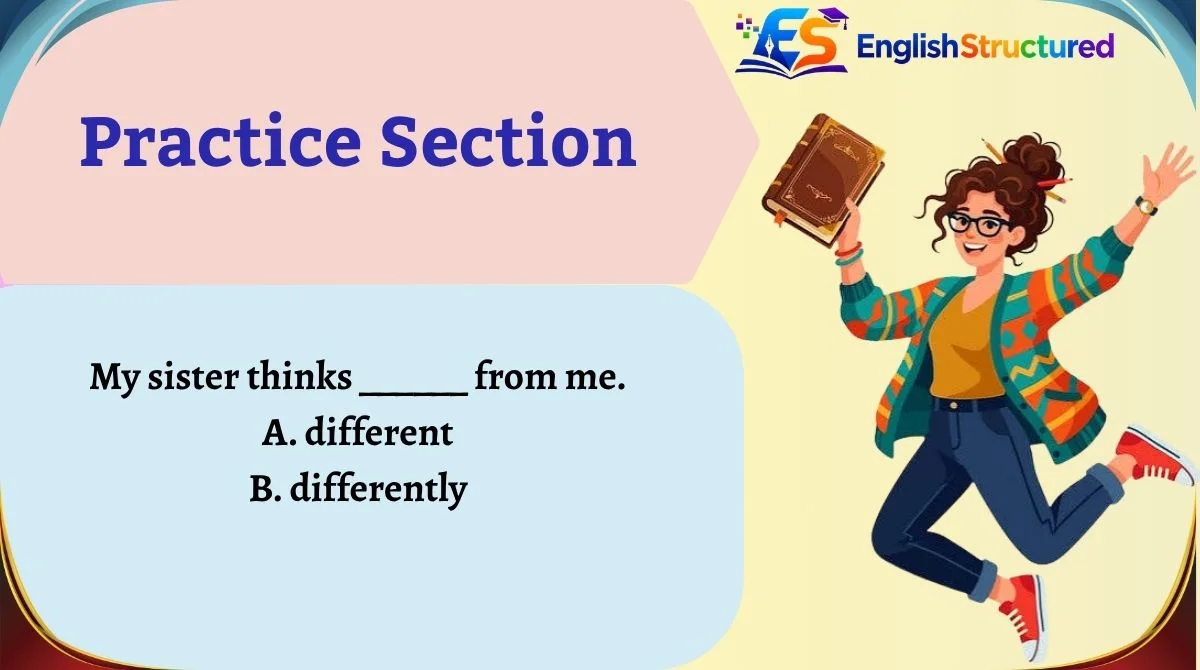
Choose different or differently in each sentence.
1. My sister thinks ______ from me.
A. different
B. differently
2. We need a ______ plan.
A. different
B. differently
3. They answered the question ______.
A. different
B. differently
4. These two shirts are ______.
A. different
B. differently
5. People learn ______.
A. different
B. differently
Answers
1. Differently — “thinks differently” describes the way she thinks.
2. Different — “different” describes the noun “plan.”
3. Differently — it describes the action “answered.”
4. Different — it describes the shirts.
5. Differently — it describes the action “learn.”
A good way to practice is to make your own pairs:
different + noun
and
Different vs Differently
For example:
different books
read differently
This will help the pattern become automatic.
FAQs
What is the difference between different and differently?
Different is an adjective, so it usually describes a noun or subject. Differently is an adverb, so it usually describes an action or verb.
For example, “We have different ideas” and “We think differently.”
Can we use “different” in a sentence with a verb?
Yes, when the verb is a linking verb such as be, seem, look, feel, or become.
For example, “You look different today” is correct. Here, different describes the subject “you,” rather than describing how you look.
Can we use “differently” in questions?
Yes. Differently can be used in questions when you are asking about a different way of doing something.
For example: “Why did you do it differently?” or “Do you think differently now?”
Is “different” formal or informal?
Different is a normal word used in both formal and informal English. It is common in everyday conversation, school writing, business writing, and academic English.
The important point is to use it in the correct grammatical position.
Is “differently” an adjective or an adverb?
Differently is an adverb. It usually tells us how an action happens.
For example, in “She answered differently,” the word differently describes the verb answered.
Is “different from” correct English?
Yes. Different from is a standard and widely accepted comparison structure.
For example, “This phone is different from my old phone.” Learners can safely use different from when comparing two things.
Conclusion
Different vs Differently
Different is an adjective. It usually describes a noun or tells us that something is not the same. We can say different ideas, a different book, or “My answer is different.”
Differently is an adverb. It usually describes an action and means in a different way. We can say “They think differently” or “She answered differently.”
The easiest memory trick is:
Different = thing.
Differently = action.
When you are writing or speaking, look at what you are describing. If you are describing a noun, different is usually the right choice.
If you are explaining how an action happens, choose differently.
Do not worry if you still mix them up sometimes. Make a few simple sentences every day, and the difference will soon feel natural.
Good grammar comes from understanding the pattern and using it often.