Choose vs Chose
They come from the same verb, but they are used at different times.
This can be confusing because the spelling changes by only one letter.
You may say, “I choose this one,” and then wonder whether you should say, “I chose this one” when talking about yesterday. The answer depends on when the action happened.
The good news is that the rule is simple once you understand it.
Choose is the present form. We use it when someone is choosing now, chooses regularly, or is talking about a future choice.
Chose is the past form. We use it when the choice happened in the past.
These two words appear often in everyday English. You use them when talking about food, clothes, schools, jobs, friends, travel plans, movies, and many other things.
By the end of this guide, you will know exactly when to use choose and when to use chose.
You will also learn common mistakes, sentence patterns, a simple memory trick, and real-life examples that make the difference easier to remember.
What Does “Choose” Mean?
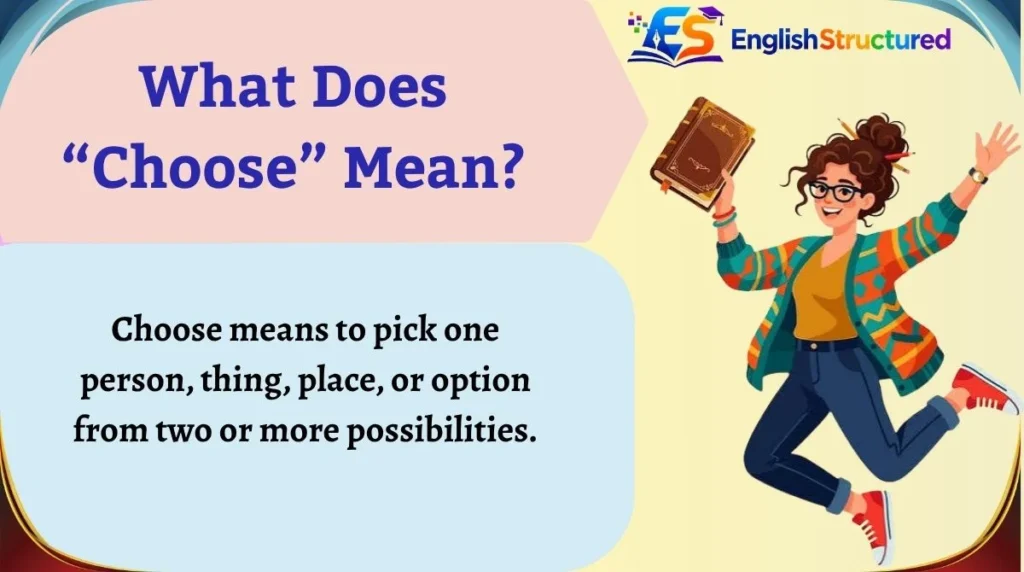
Choose means to pick one person, thing, place, or option from two or more possibilities.
It is the present form of the verb. The word is pronounced like “chooz.”
For example:
I choose the blue shirt.
This means I pick the blue shirt. The choice is happening now, or the sentence is talking about a current decision.
Choose vs Chose
I always choose tea instead of coffee.
Here, the person is talking about a habit, not one choice that happened yesterday.
When Do We Use “Choose”?
Choose vs Chose
It can describe:
- A choice happening now
- A regular choice or habit
- A general fact
- A decision that someone is being asked to make
- A choice connected to the future
Consider this sentence:
You can choose any seat you like.
The person is being asked to make a choice now.
Another example is:
I usually choose simple clothes.
This describes a regular habit.
We can also use choose when talking about a future decision:
I will choose a college next month.
Notice that will is followed by the base form choose, not chose.
Grammar Rule for “Choose”
The basic forms are:
Present: choose
Past: chose
Past participle: chosen
-ing form: choosing
Choose vs Chose
After helping verbs such as will, can, should, may, and must, we normally use the base form.
For example:
I will choose later.
You can choose one.
Choose vs Chose
We do not say:
Choose vs Chose
The correct sentence is:
I will choose later. ✅
Examples of “Choose”
- I choose the chocolate cake.
- Please choose one answer.
- We usually choose the cheaper option.
- You can choose any color you want.
- I will choose my seat after lunch.
- She always chooses healthy food.
- Why did you choose this dress?
The last example is especially useful. Even though the question is about a choice, did already shows the past. Therefore, we use choose, not chose.
Why did you choose this dress? ✅
Not:
Choose vs Chose
This is one of the most common mistakes learners make.
Common Confusion About “Choose”
Many learners think choose always means the choice is happening right now.
That is not always true.
After did, we use choose because did carries the past tense:
What did you choose?
The choice happened in the past, but the correct verb after did is still the base form.
Another common mistake is using chose after will:
Choose vs Chose
Correct:
Choose vs Chose
A simple rule helps:
After will, can, should, must, may, or did → use choose.
What Does “Chose” Mean?
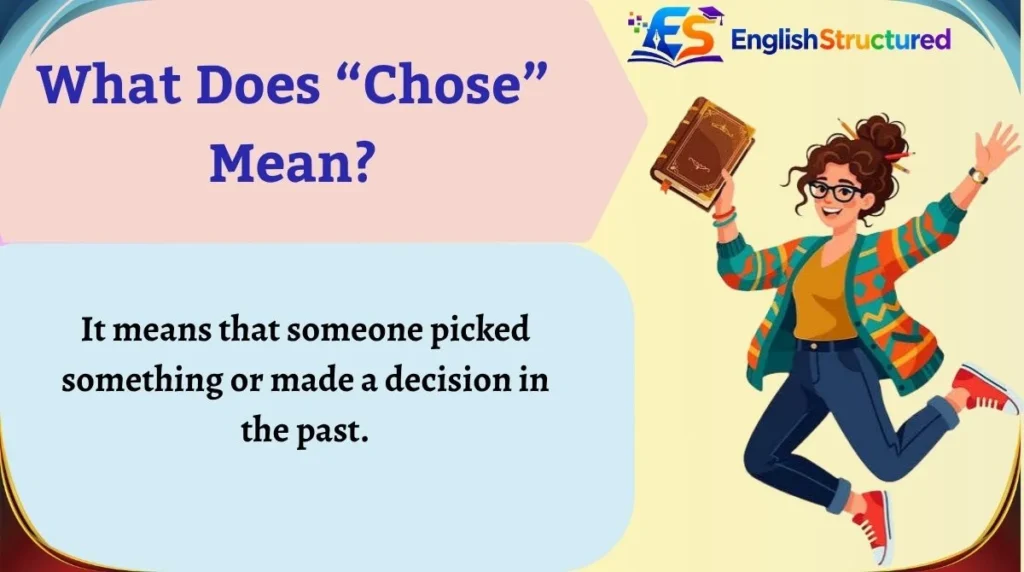
Chose is the past tense of choose.
It means that someone picked something or made a decision in the past.
Choose vs Chose
For example:
Choose vs Chose
The choice is finished. It happened yesterday.
Compare:
Choose vs Chose
This can describe a current choice.
I chose the blue shirt.
This describes a past choice.
That small change in spelling changes the time of the action.
When Do We Use “Chose”?
Choose vs Chose
Words that often appear with chose include:
- yesterday
- last night
- last week
- last year
- earlier
- before
- when I was younger
- a few days ago
- in 2025
- at that time
For example:
Choose vs Chose
The word yesterday clearly tells us that the choice happened in the past.
We can also use chose without a specific time word if the context already makes the past clear.
She chose the red one.
If the conversation is about something that happened earlier, chose is correct.
Grammar Rule for “Chose”
Choose vs Chose
We use it when the choice itself happened in the past.
The basic pattern is:
Subject + chose + object
For example:
I chose the black shoes.
He chose a different answer.
Choose vs Chose
However, remember one important rule: do not use chose after did.
For example:
Did you choose the blue one? ✅
Not:
Choose vs Chose
Why?
Because did is already the past-tense helping verb. The main verb returns to its base form.
Examples of “Chose”
- I chose the blue car last week.
- She chose a different dress.
- We chose the Italian restaurant.
- He chose to stay at home.
- Choose vs Chose
- My parents chose this house many years ago.
- I chose English because I enjoy learning languages.
In the last example, the decision happened in the past, even though the reason may still be true today.
Common Confusion About “Chose”
Choose vs Chose
These are not interchangeable.
I chose this book. ✅
I have chosen this book. ✅
But:
I have chose this book. ❌
After have, has, or had, we normally use the past participle chosen.
So remember the three main forms:
Choose vs Chose
Think of them as three steps:
- choose = present
- chose = past
- Choose vs Chose
Difference Between Choose and Chose
The main difference is time.
Choose is used for the present or as the base form after helping verbs.
Chose is used for a completed choice in the past.
| Word | Verb form | Main use | Example |
|---|---|---|---|
| choose | Present/base form | Present choices, habits, after helping verbs | I choose tea. |
| chose | Simple past | A choice made in the past | I chose tea yesterday. |
The difference becomes clearer when you compare similar sentences.
Choose vs Chose
This talks about a current choice.
Choose vs Chose
This talks about a past choice.
Present Choice vs Past Choice
Imagine you are standing in a clothing store.
You look at two shirts and say:
Choose vs Chose
You are making the decision now.
Now imagine you are telling your friend about the shopping trip from yesterday:
I chose the black one.
Choose vs Chose
The meaning is closely connected, but the time is different.
Sentence Structure
With choose, you can use several structures.
Choose vs Chose
I choose the blue one.
Choose + to + verb
She chose to leave.
Choose vs Chose
You can choose between tea and coffee.
Choose vs Chose
You can choose from five colors.
The same structures can work with chose when the decision happened in the past.
Choose vs Chose
We chose between two hotels.
Choose vs Chose
The key is not the sentence structure. The key is when the choice happened.
Questions With Choose and Chose
Questions often cause confusion.
If there is did, use choose:
What did you choose?
Which one did she choose?
Why did they choose that option?
Do not use chose after did.
What did you chose? ❌
The word did already marks the past.
But without did, chose can be correct:
Which one did you choose? ✅
Which one was chosen? ✅
She chose the red one. ✅
Grammar Rules You Must Remember
Rule #1: Use “Choose” for the Present
When someone is making a choice now, use choose.
I choose the chicken sandwich.
We choose our seats now.
It can also describe a regular habit:
I always choose water with my lunch.
Here, choose is not about one particular past event. It describes what the person normally does.
Rule #2: Use “Chose” for the Simple Past
When the choice happened in the past, use chose.
I chose this school last year.
She chose the red dress yesterday.
Words such as yesterday, last week, and two days ago often make the past time obvious.
Rule #3: After “Did,” Use “Choose”
This rule is extremely important.
Did you choose this one? ✅
Did you chose this one? ❌
The reason is simple. Did already shows past tense.
The same rule applies to other verbs:
Did you go? ✅
Not:
Did you went? ❌
Likewise:
Did you choose? ✅
Not:
Did you chose? ❌
Rule #4: After “Have,” “Has,” or “Had,” Use “Chosen”
This is where a third form appears.
I have chosen a new laptop.
She has chosen her dress.
They had chosen a different route.
The correct forms are:
choose → chose → chosen
Do not say:
I have chose. ❌
Say:
I have chosen. ✅
This difference is important because chose is simple past, while chosen is the past participle.
Common Mistakes Students Make
These mistakes are common because the three forms of the verb look and sound similar.
Mistake 1: Using “Chose” After “Did”
Incorrect:
Did you chose the blue one?
Correct:
Did you choose the blue one?
The word did already makes the question past tense.
Quick tip: When you see did, think base verb.
Mistake 2: Using “Chose” After “Will”
Incorrect:
I will chose later.
Correct:
I will choose later.
After will, always use the base form.
Choose vs Chose
Not:
will chose
Mistake 3: Using “Choose” for a Finished Past Action
Incorrect:
Yesterday, I choose the red dress.
Correct:
Yesterday, I chose the red dress.
The word yesterday tells you that the action happened in the past.
Mistake 4: Confusing “Chose” With “Chosen”
Incorrect:
I have chose a new phone.
Correct:
I have chosen a new phone.
Remember:
chose = simple past
chosen = past participle
Mistake 5: Thinking “Choose” Always Means “Now”
Sometimes choose appears in a future sentence.
Choose vs Chose
The word will changes the time of the sentence. We still use choose because it follows a modal verb.
This is why it is better to remember the grammar pattern, not just memorize “choose = now.”
Easy Trick to Remember the Difference
Here is a simple memory trick:
Choose = use today
Chose = already closed
The word chose has an o sound that can remind you of something that is already over.
For example:
Yesterday, I chose pizza.
The decision is finished.
For a current decision:
Choose vs Chose
You are making the choice now.
Another useful trick is to remember the three forms as a small family:
CHOOSE → CHOSE → CHOSEN
Think:
Today → Yesterday → Have
I choose today.
I chose yesterday.
I have chosen already.
This pattern is much easier to remember than trying to memorize random sentences.
There is also a pronunciation trick.
Choose sounds like “z.”
Chose sounds like “z” with a different vowel sound.
So when you hear the word, listen to the vowel carefully. But when writing, focus more on the grammar and time of the sentence.
Daily Life Examples
The easiest way to learn these words is to see them in normal conversations.
1. At a Restaurant
Waiter: Which meal would you like?
Sam: I’ll choose the chicken.
Here, choose follows will, so we use the base form.
2. Talking About Yesterday
Ali: What did you order yesterday?
Tom: I chose the chicken sandwich.
The question uses did + choose. The answer uses chose because it is a simple past statement.
3. Choosing Clothes
I usually choose comfortable shoes.
This describes a habit.
4. Talking About a Past Purchase
I chose these shoes because they were on sale.
The purchase and choice happened in the past.
5. Making a Decision
You can choose any seat.
The choice is available now.
6. Talking About School
She chose science as her favorite subject.
The choice happened in the past.
7. Talking About the Future
I will choose my university next month.
Even though the choice is about the future, will requires the base verb choose.
8. Asking About a Past Choice
Why did you choose this restaurant?
The correct form is choose because it follows did.
9. Talking About a Habit
My brother always chooses the window seat.
Notice that chooses has an -s because the subject is my brother.
I choose the window seat.
But:
He chooses the window seat.
10. Talking About a Completed Decision
We chose to stay home because it was raining.
The decision happened in the past, so chose is correct.
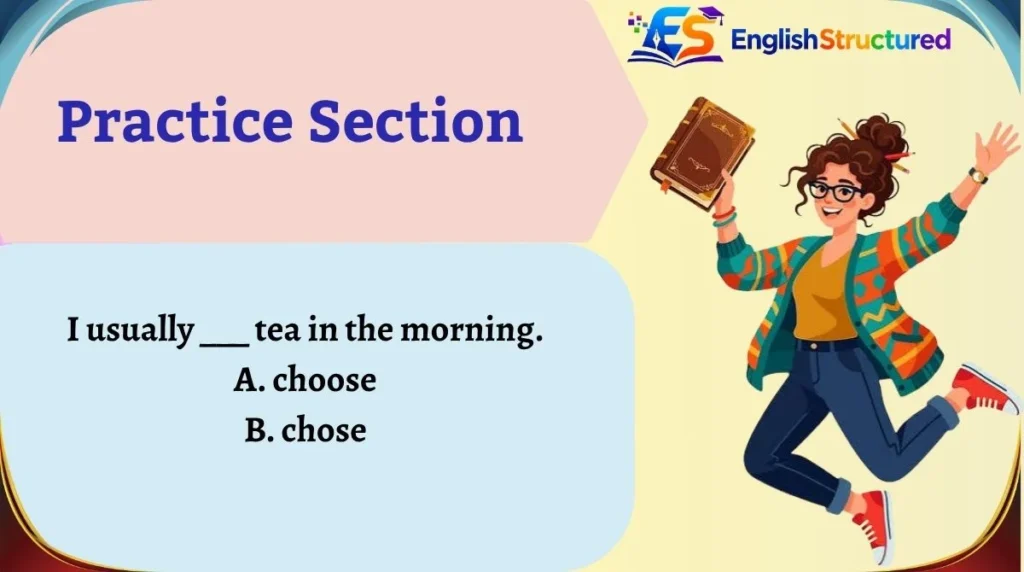
Practice Section
Choose vs Chose
1. I usually ___ tea in the morning.
A. choose
B. chose
2. We ___ the blue hotel last summer.
A. choose
B. chose
3. What did you ___ for dinner?
A. choose
B. chose
4. I will ___ a new phone next month.
A. choose
B. chose
5. She ___ the red dress yesterday.
A. choose
B. chose
Answers
1. Choose — “usually” shows a habit.
2. Chose — “last summer” shows the past.
3. Choose — did requires the base form.
4. Choose — will requires the base form.
5. Chose — “yesterday” shows a completed past action.
Try making your own sentences with both words. For example:
I choose pizza when I am hungry.
I chose pizza yesterday.
Creating your own examples is one of the fastest ways to make the difference feel natural.
FAQs
What is the difference between choose and chose?
Choose is the present or base form of the verb. Chose is the simple past form.
You can say, “I choose the blue one,” for a current choice. For a past choice, say, “I chose the blue one yesterday.”
Can we use “choose” in questions?
Choose vs Chose
For example:
Which one did you choose?
Notice that we use choose, not chose, because it comes after did.
You can also ask:
Which one should I choose?
Here, choose follows should.
Is “chose” the past tense of “choose”?
Yes. Chose is the simple past tense of choose.
For example:
I choose the red one every time.
I chose the red one yesterday.
The third form is chosen, which is used with helping verbs such as have, has, and had.
Can I say “I have chose”?
No. The correct sentence is:
I have chosen. ✅
The three forms are choose, chose, chosen.
Chose is the simple past form, while chosen is the past participle.
Which is correct: “Did you choose” or “Did you chose”?
The correct form is:
Did you choose?
Never use chose directly after did.
The word did already carries the past tense, so the main verb stays in its base form.
Which is correct: “I will choose” or “I will chose”?
The correct form is:
I will choose.
After will, use the base form of the verb.
This is the same pattern as:
I will go.
I will eat.
I will decide.
So:
I will choose. ✅
Can “choose” talk about the future?
Yes. Choose can appear in future sentences when it follows a future or modal structure.
For example:
I will choose tomorrow.
You can choose later.
The word choose itself does not always mean that the action is happening right now. The surrounding grammar tells you the time.
Conclusion
Choose vs Chose
Use choose as the present or base form. It can describe a current choice, a habit, or a choice that follows words such as will, can, should, or did.
Use chose when you are talking about a completed choice in the simple past.
The most important pattern to remember is:
choose → present/base form
chose → simple past
chosen → past participle
Pay special attention to questions. Say “Did you choose?”, not “Did you chose?” Also remember that will choose is correct, while “will chose” is not.
Do not worry if you mix these forms up at first. Many English learners do. Practice with short sentences about your own life.
Talk about what you choose today and what you chose yesterday. After a little practice, the correct form will start to feel natural.